
Anthony Licciardello | July 4, 2026
Montclair, NJ
Moving to Montclair · Essex County, NJ
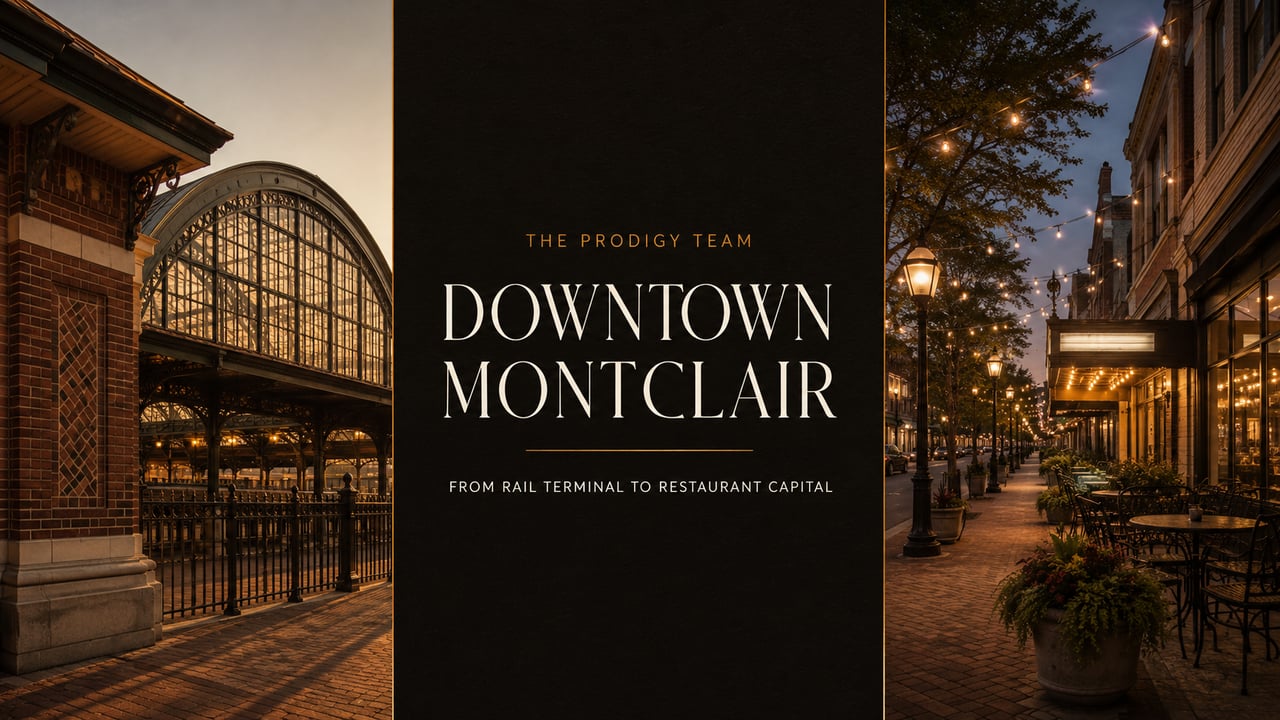
Downtown Montclair didn't become one of New Jersey's most vibrant town centers by accident. Its story runs from a grand 1913 rail terminal through decades of decline and reinvention to today's walkable, restaurant-rich district — and it's still being written, with a major redevelopment freshly approved. Understanding how the downtown got here helps a buyer read where it's going. This is the arc of Montclair Center, and what it means for living here now.
See the downtown today — Watch on YouTube →
This is part of our complete guide to moving to Montclair. For the scene today, see things to do in Montclair and the downtown condo guide.
1868
Montclair splits from Bloomfield, driven by the railroad.
1913
The grand Lackawanna Terminal opens downtown.
2000s–2020s
Two decades of redevelopment reshape the center.
Today
A dining and arts destination for the region.
Montclair began as a quiet settlement once known as Cranetown at the foot of the First Watchung Mountain. Its modern identity was forged by the railroad: the desire for a direct rail line to Manhattan drove Montclair to formally split from Bloomfield in 1868. From the start, the town's fortunes were tied to the train — the same feature that anchors its appeal to New York commuters today. Downtown grew up around the tracks, and the grandest expression of that came in the early twentieth century.
In 1913, Montclair opened the Lackawanna Terminal, a grand station with four platforms and six tracks serving the Delaware, Lackawanna and Western Railroad. It was added to the National Register of Historic Places in 1973. But rail service moved to the Bay Street station in 1981, and the beautiful terminal was converted into an enclosed shopping mall and supermarket — Lackawanna Plaza — with shops tucked beneath the old glass-roofed train sheds. For decades it anchored the southeast side of downtown, until its supermarket closed in 2015, leaving the neighborhood without a grocery store and the historic building searching for a new purpose. Its long limbo became one of the town's defining civic questions.
Did You Know
The Lackawanna Terminal was designed by architect William Hull Botsford — who died in the sinking of the Titanic in 1912, the year before his Montclair station opened.
Over the last twenty years, downtown Montclair transformed through a wave of redevelopment. Mixed-use projects like Valley & Bloom, completed around 2011, and the boutique MC Hotel, which opened in 2019, brought new density, ground-floor retail, and modern residences to the Bloomfield Avenue corridor. The concierge-serviced Siena added upscale downtown living, while the restored Wellmont Theater anchored a revived arts district around Seymour Street. The building spree wasn't without controversy — a historic-preservation review flagged some new projects as over-scaled for their surroundings, feeding an ongoing town debate about how much and how tall Montclair should build. That tension between growth and character still shapes every new proposal.
Then came the surge. In the years after 2020, an influx of New York outer-borough residents supercharged Montclair's appeal, and the downtown answered with new restaurants, galleries, music, and film. Pedestrian-friendly Church Street became a dining destination, and the town leaned fully into its identity as, by its own reckoning, the Restaurant Capital of New Jersey. What had been a solid suburban center became a genuine draw — the kind of downtown people visit for the weekend, and increasingly move to for good.
A downtown built by the railroad, and reborn by the people the railroad brings.
The next chapter centers on the old terminal itself. In March 2026, Montclair approved a redevelopment plan for the Lackawanna site that would finally return a supermarket to the neighborhood alongside roughly 300 new apartments — a portion of them affordable — office space, and a parking structure, supported by a long-term tax agreement. It's the biggest downtown project in a generation, and it captures the town's balancing act: honoring a landmark and filling a food gap while managing density and traffic. For anyone buying near the center, this is the change to watch — and confirm the current status, since large projects evolve.
“
From the Broker
Buyers ask if downtown is done growing. It never is — and knowing what's coming next to a block is part of knowing what a home there is worth.
Want to buy near the action?
We know which downtown blocks are changing and what's coming next — context that matters when you buy near Montclair Center. The Prodigy Team moves New York and Staten Island families into New Jersey for a living. We work both sides of the water.
Anthony Licciardello, Broker, The Prodigy Team · 718-873-7345
Montclair formally separated from Bloomfield in 1868, a move driven largely by the desire for a direct rail line to Manhattan. The railroad shaped the town's growth and still defines its commuter appeal today.
It's the site of Montclair's historic 1913 Lackawanna rail terminal, later converted into a shopping mall and supermarket. After the supermarket closed in 2015, the site sat in limbo; in March 2026 the town approved a redevelopment plan bringing back a grocery store along with new apartments and office space.
Two decades of redevelopment plus a post-2020 influx of New York residents turned Montclair Center into a walkable dining and arts destination, often called the Restaurant Capital of New Jersey, with a direct train to Manhattan.
Yes. The most significant current project is the Lackawanna redevelopment approved in March 2026, which includes roughly 300 apartments, a supermarket, and office space. Large projects evolve, so confirm the current status when it matters to a purchase.
The Prodigy Team · Montclair, NJ
Explore the Complete Montclair Series
Start Here · Relocation
🗺️
Moving to Montclair: The New York Buyer's Guide
The full relocation picture — commute, cost, schools, and lifestyle in one place.
🏘️
The Neighborhoods of Montclair
A buyer's map to every part of town, from Upper Montclair to the South End.
🚆
Midtown Direct, the Hoboken option, and all six stations, station by station.
🎓
Montclair Schools & the Magnet System
How school choice works — and an honest look at the 2026 budget question.
🎨
Art, film, music, and the Restaurant Capital of New Jersey.
The Market & Your Money
📈
Real sale prices vs. misleading assessments, plus the over-ask premium.
🏆
Record medians, the $3M+ surge, and the Estate-area trophy homes.
🧾
Property Taxes: What You'll Actually Pay
The rate, the average bill, relief programs, and how to estimate your real number.
Living & Selling
🏙️
Downtown and transit-oriented living, fees, and the due diligence that matters.
🏛️
The Evolution of Downtown Montclair
From the 1913 rail terminal to today's dining-and-arts destination.
🔑
The seller's closing roadmap — the fire certificate, permits, and transfer fees.
Prodigy Real Estate is an innovative real estate company offering high-end video production, home valuation services, purchasing, and home sales. Serving New York and New Jersey.