
Anthony Licciardello | September 12, 2026
Cranford, NJ
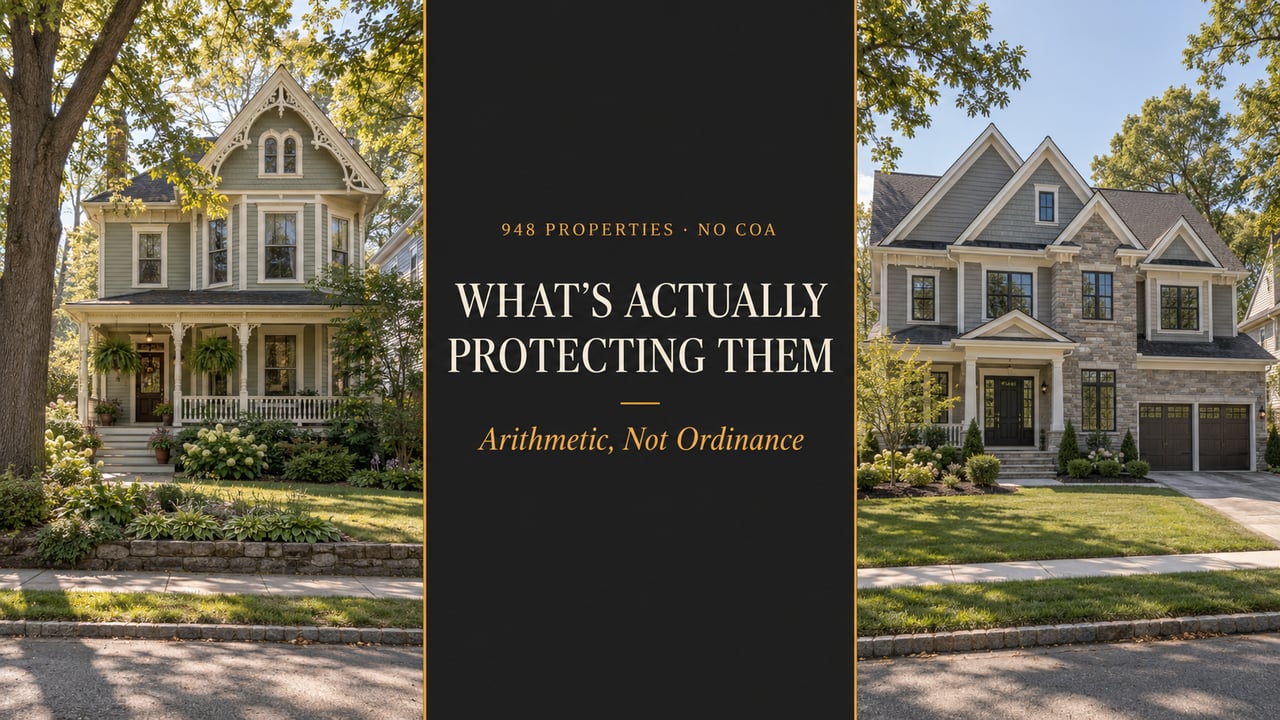
Cranford has a 948-property historic district on the National Register and, so far as we can determine, no requirement that an owner get approval before changing the outside of their house. It also has builders buying older homes at four to five hundred thousand and selling their replacements at over a million. Both things are true. What follows from them is not what most people assume.
A National Register listing is an honour, not a restriction. It imposes nothing on what a private owner does to their own building with their own money, and Cranford's Historic Preservation Advisory Board documents and advises rather than approves. Meanwhile builders acquire older capes and modest colonials at $400,000–$550,000 and sell 3,000–4,000 square foot replacements at $1.05M–$1.3M. So what actually preserves Cranford's older housing is not the ordinance — it is the arithmetic: constrained lots, a floodplain across much of the township, and the fact that the acquisition target is modest houses rather than the district's significant ones. That protection is real. It is also contingent.
None of this is a criticism of the Township. Advisory-only preservation is a legitimate and common municipal choice, and it gives owners a freedom that regulated districts do not. Our review of the Code was not exhaustive and we are not lawyers. Confirm your specific parcel's designation status and any applicable review requirement with the Township of Cranford in writing.
The North Cranford Historic District covers roughly 948 properties, about 80% of them contributing. A National Register listing is a federal and state honour; on its own it imposes no restriction on what a private owner does to their own building with private money.
Cranford's Historic Preservation Advisory Board, created in 1993, states its mission as documentation, education and advice. Under the Code it surveys and inventories, and prepares designation lists that are referred to the Planning Board and the governing body — it proposes; others decide. We found no Certificate of Appropriateness requirement over an owner's exterior work. Compare Cranbury Township, which operates a Commission with an actual certificate requirement and a 45-day decision clock. Cranford's structure is different by design. Full detail in our historic district guide.
Our own market analysis documents it plainly: builders target older capes and modest colonials in the $400,000–$550,000 acquisition range and replace them with 3,000–4,000 square foot homes priced from $1.05M to $1.3M. One recently completed home closed at approximately $1.22M. Select turnkey new builds have cleared $1.2M.
At the other end, the $600,000–$750,000 renovation tier moves quickly with multiple offers, frequently 6–12% over list. Our analysis calls it a two-speed market with a widening gap — the full picture is in our Cranford market analysis.
Put those side by side and the obvious inference is alarming — and largely wrong. A district with no binding review, in a market where replacement pays, sounds like a district about to disappear. That is not what has happened, and the reason is worth understanding, because it tells you what is actually holding the town's character in place.
Four things do the work that an ordinance would do elsewhere. None of them is a rule, and that is the point.
A $400,000–$550,000 acquisition range does not reach a well-kept Victorian or a sizeable Colonial Revival in the district — those trade far above it. The economics point at the plainest houses in the plainest condition, which are disproportionately outside the district's contributing core.
The replacement product is 3,000 to 4,000 square feet. Cranford is 4.87 square miles with a street pattern laid out from the 1890s. Bulk, setback and coverage limits do more preservation work in a town of older lots than any design review — a builder who cannot build the big house does not buy the small one.
Cranford's zoning designates a Floodplain Overlay District along the Rahway River, and projects near the river must clear elevation requirements, drainage analysis and flood insurance implications. Our market analysis notes the practical effect: builders cannot simply find underutilised land and build. The river that runs through the historic district's heart is also its most effective constraint.
The Downtown Core Overlay District permits multifamily and mixed-use development but carries a 20% affordable housing set-aside. Our analysis describes that provision as a practical brake — developers must model compliance before ground breaks, which is part of why the downtown evolves slowly and deliberately.
Every one of those four protections is a function of price and geometry rather than of policy. A binding design review does not care what the market does. Arithmetic does. If the spread between an acquisition price and a finished-product price widens far enough, houses that were uneconomic to replace become economic to replace — and our own analysis says the gap between the tiers is already widening.
That is not a prediction and we are not making one. Lot geometry and the floodplain are durable constraints that will hold regardless. But a buyer choosing Cranford for its architectural character should understand what is doing the preserving, because the answer is not the thing most people assume it is.
And there is a fifth factor that no map captures: the owners themselves. A township with a 158-property plaque programme, an active historical society, Certificates of Eligibility filed with the State Historic Preservation Office for the Canoe Club, the Sperry Observatory and others, and a Historic Preservation Element in its Master Plan is a town whose residents demonstrably care. In a place with advisory-only review, owner preference is not a soft factor — it is the mechanism.
You may have two very different buyers — and they value your house for opposite reasons.
A builder is pricing your lot and what can be built on it. A period-house buyer is pricing the house itself, and in this market that tier is clearing 6–12% over list. Those are different offers from different pools, and running only one of them leaves money on the table. We market to both, comp within product type rather than against a town median that blends $349,900 two-bedrooms with $1,487,500 new construction, and tell you honestly which pool your house actually belongs to. Backed by the New York metro buyer pool we bring to every listing.
It protects the honour, not the streetscape. Your neighbour can, so far as we can determine, alter or replace their house without design approval — and so can you. If the character of the block is what you are buying, buy the block, not the designation: walk it, look at lot sizes, note how many houses are already renovated versus original, and ask what has traded on that street in the last three years. The pattern of what has happened is a better forecast than a listing on a register.
This is the more common misconception and the better news. Buyers routinely rule out district properties assuming a committee will vet their window replacement. Based on our review, that approval requirement does not exist here — you have more freedom than most buyers believe. Ordinary construction permits still apply, and if you take a state or federal grant or tax credit, conditions come with the money. Confirm your parcel with the Township in writing, then renovate.
The market is telling you something specific: the $600,000–$750,000 renovation tier clears quickly, often 6–12% over list. Renovated period houses are not the discount product in Cranford — they are among the fastest-moving inventory in the township. Sympathetic renovation is rewarded here rather than penalised, which is a genuinely favourable position to be in.
Get the other number before you answer. A builder's offer is a lot valuation. In a market where renovated period houses clear over list and new construction reaches $1.05M–$1.3M, the question is whether the builder's price reflects what they will make or what your house is worth to someone who wants to live in it. Those can be very different, and you are entitled to test both. Take the builder's offer seriously — and take it to market first.
Cranford is not without instruments — it has chosen how to use the ones it has. The Code contains a designation process under which the Advisory Board prepares lists that go to the Planning Board and governing body. The Township adopted a Historic Preservation Element in its Master Plan in 2022, recommending continued use of the existing framework. Certificates of Eligibility have been filed with the State Historic Preservation Office for properties including the Canoe Club, the Sperry Observatory and the First Baptist Church, following earlier filings for the Masonic Building, the Cranford Hotel and Sunny Acres.
Those are the actions of a township that is paying attention. They are also, on our reading, actions of documentation and eligibility rather than of binding review. A municipality that wanted certificate-of-appropriateness authority could adopt it; Cranbury has. Whether Cranford should is a question for its residents and its governing body, and we take no position on it.
We are not saying Cranford's historic housing is at risk. The constraints in Chapter II are real, the owner base is demonstrably invested, and the district has persisted through a decade in which replacement has been profitable.
We are not saying the Township should adopt binding review. Advisory-only preservation is a legitimate choice with real benefits to owners — chiefly the freedom to renovate your own house without a committee, which is exactly what many buyers here want.
We are saying one thing only: know which mechanism is protecting the street you are buying on. If you believe it is the historic district, and it is in fact lot geometry and a price spread, then you are relying on something that can move rather than something that cannot. That is worth knowing before you spend a million dollars, in either direction.
Two things to watch if this matters to you. Whether the designation process in the Code gets used to create binding review for any specific area — that would change the analysis entirely. And whether the acquisition range moves: our market analysis puts builder acquisitions at $400,000–$550,000 today. If that number climbs materially, the set of houses in play climbs with it. The township overview is in our Cranford guide, and the sections in our neighbourhoods guide.
Before you buy on a Cranford street for its character, pull the last three years of sales on that block and look at what happened to each house. Not the prices — the outcomes. Were the older houses renovated and resold, or acquired and replaced? One street can go either way from another two blocks over, because the deciding factors are lot width, setback and what the floodplain map says — none of which is visible from a listing photograph. Three years of block-level history tells you more about what your street will look like in a decade than any designation, plaque or district boundary. And it takes an afternoon.
"Two facts nobody puts together. Cranford's got a nine-hundred-forty-eight-property historic district with no certificate of appropriateness — the Board advises, it doesn't approve. And builders are buying at four-fifty and selling the replacement at one-two. So what's actually keeping those old houses standing? Lot sizes, the floodplain, and the fact that four-fifty doesn't buy a Victorian. That's arithmetic, not an ordinance. And I want to be careful here — I'm not saying the town's doing it wrong. No certificate requirement means you can renovate your own house without a committee, and a lot of my buyers want exactly that. I'm saying know which one is protecting your street. If you think it's the designation and it's really the geometry, you're leaning on something that can move."
— Anthony Licciardello, Broker, The Prodigy Team

Reading what a municipal ordinance actually does — as opposed to what people assume it does — is native ground for me: I'm Anthony Licciardello, Broker of The Prodigy Team, a former Director of Community Affairs in the Bloomberg Administration who spent years inside municipal government, now dual-licensed in New York and New Jersey and a leading broker for cross-border New York–New Jersey transactions.
Anthony Licciardello · Broker, The Prodigy Team · 718-873-7345
We pull the block history before you offer — and market to both buyer pools before you sell.
Does Cranford's historic district restrict what I can do to my house?
Based on our review, no — and this is the most common misconception about the district. A National Register listing is a federal and state honour that, on its own, imposes no restriction on what a private owner does to their own building with private money. Cranford's Historic Preservation Advisory Board, created in 1993, documents, educates and advises; it prepares designation lists referred to the Planning Board and governing body. We found no Certificate of Appropriateness requirement. Ordinary construction permits still apply, and grant or tax-credit conditions attach to the money. Confirm your specific parcel with the Township in writing.
Are older Cranford homes being torn down?
Replacement is an active part of this market. Our analysis documents builders acquiring older capes and modest colonials at $400,000–$550,000 and selling 3,000–4,000 square foot replacements at $1.05M–$1.3M, describing a two-speed market with a widening gap. But the acquisition range does not reach the district's significant houses, and lot geometry, the Floodplain Overlay District and downtown's 20% affordable set-aside all constrain what can be built where. Separately, the $600,000–$750,000 renovation tier clears quickly, often 6–12% over list.
What actually protects Cranford's older housing stock?
On our reading, arithmetic and geometry rather than the district designation. Four constraints do the work: the $400,000–$550,000 acquisition range does not reach the district's significant houses; lot width, setback and coverage limits in a township platted from the 1890s make a 3,000–4,000 square foot replacement impossible on many parcels; the Floodplain Overlay District takes land out of play along the Rahway River; and downtown's 20% affordable set-aside slows redevelopment. A fifth factor is owner preference, which in an advisory-review township is the mechanism rather than a soft factor.
A builder offered to buy my older Cranford home. Should I take it?
Get the other number first. A builder's offer values your lot and what can be built on it. A period-house buyer values the house — and in this market that tier moves quickly, frequently 6–12% over list. Those are two different buyer pools with two different valuation methods, and testing only one leaves money undiscovered. Take the builder's offer seriously, and take it to market first.
The North Cranford Historic District — 948 Properties
Cranford Market — Home Prices, Development & Market Data
Moving to Cranford — The Town That Gave Away Two Towns
Cranford Neighborhoods — What Each Section Was Built As
The Venice of New Jersey — Canoe Club, Theatre, Crane-Phillips House
Selling a Home in Cranford — What the Township's FAQ Doesn't Make Clear
Cranford Homes for Sale — Browse Current Listings
Details as of publication, from the sources noted. Historic district and preservation framework: the North Cranford Historic District comprises approximately 948 properties with roughly 80% contributing; Cranford's Historic Preservation Advisory Board was created in 1993 and states its mission as documentation, education and advice to the Township, surveying and inventorying resources and preparing designation lists that are referred to the Planning Board and to the governing body; the Township adopted a Historic Preservation Element in its Master Plan in 2022 recommending continued use of the existing framework; Certificates of Eligibility have been submitted to the New Jersey State Historic Preservation Office for properties including the Canoe Club, the Sperry Observatory and the First Baptist Church, following earlier filings for the Masonic Building, the Cranford Hotel and Sunny Acres; a plaque programme covers approximately 158 properties. Our review of the Township Code located no Certificate of Appropriateness requirement over an owner's exterior work. That is a negative finding from a review that did not extend to every chapter, every amendment, or administrative practice outside the codified ordinances, and it is expressly not a legal determination. Cranbury Township is cited as a contrasting New Jersey municipality operating a preservation commission with a certificate requirement and a 45-day decision period. Full sourcing appears in our North Cranford Historic District guide. Market and development figures are drawn from our own Cranford market analysis and its cited sources: builders targeting older capes and modest colonials in the $400,000–$550,000 acquisition range and replacing them with 3,000–4,000 square foot homes priced from $1.05M to $1.3M, with one recently completed home closing at approximately $1.22M and select turnkey new builds clearing $1.2M; a $600,000–$750,000 renovation tier absorbing strong demand with properties frequently closing 6–12% over list; a described two-speed market with a widening gap between tiers; Cranford's Downtown Core Overlay District permitting multifamily residential and mixed-use development subject to a 20% affordable housing set-aside described as acting as a practical brake on commercial redevelopment; and a Floodplain Overlay District tied to the Rahway River corridor requiring elevation compliance, drainage analysis and flood insurance consideration, with the practical effect that builders cannot simply find underutilised land and build. Township area of 4.87 square miles per the U.S. Census Bureau. This article takes no position on whether the Township of Cranford should adopt binding historic review, makes no prediction about future teardown activity or municipal policy, and does not criticise any municipal decision. Advisory-only historic preservation is a legitimate and widely adopted municipal approach with real benefits to property owners. Nothing here is legal, planning, tax or investment advice, and no statement here applies to any specific property. Designation status, applicable review requirements, permit obligations, zoning constraints and flood determinations must be confirmed for any individual parcel with the Township of Cranford and your own professionals before you rely on them.
Prodigy Real Estate is an innovative real estate company offering high-end video production, home valuation services, purchasing, and home sales. Serving New York and New Jersey.