
Anthony Licciardello | May 5, 2026
Cranford, NJ
Most American towns of Cranford's vintage have a train station they have stopped paying attention to. The platform is there, the trains still run, the commuters still stand on it — but the downtown has migrated toward the highway interchange or the strip-mall edge of town. The station has become a piece of infrastructure rather than the heart of the place.
Cranford did the opposite. Starting in the late 1990s, the township made a deliberate, documented decision to recommit to its train station as the organizing center of the community. The 1997 Danth Inc. report identified what was holding the downtown back. The 2000 Smart Growth grant from the New Jersey Department of Community Affairs funded a comprehensive Downtown Vision Plan that 88 percent of Cranford residents supported.1 The 2003 Transit Village designation from the New Jersey Department of Transportation locked the commitment in formally. Cranford became the first Raritan Valley Line town to earn the designation, and remains the closest Transit Village to New York City on the entire Raritan Valley Line.2
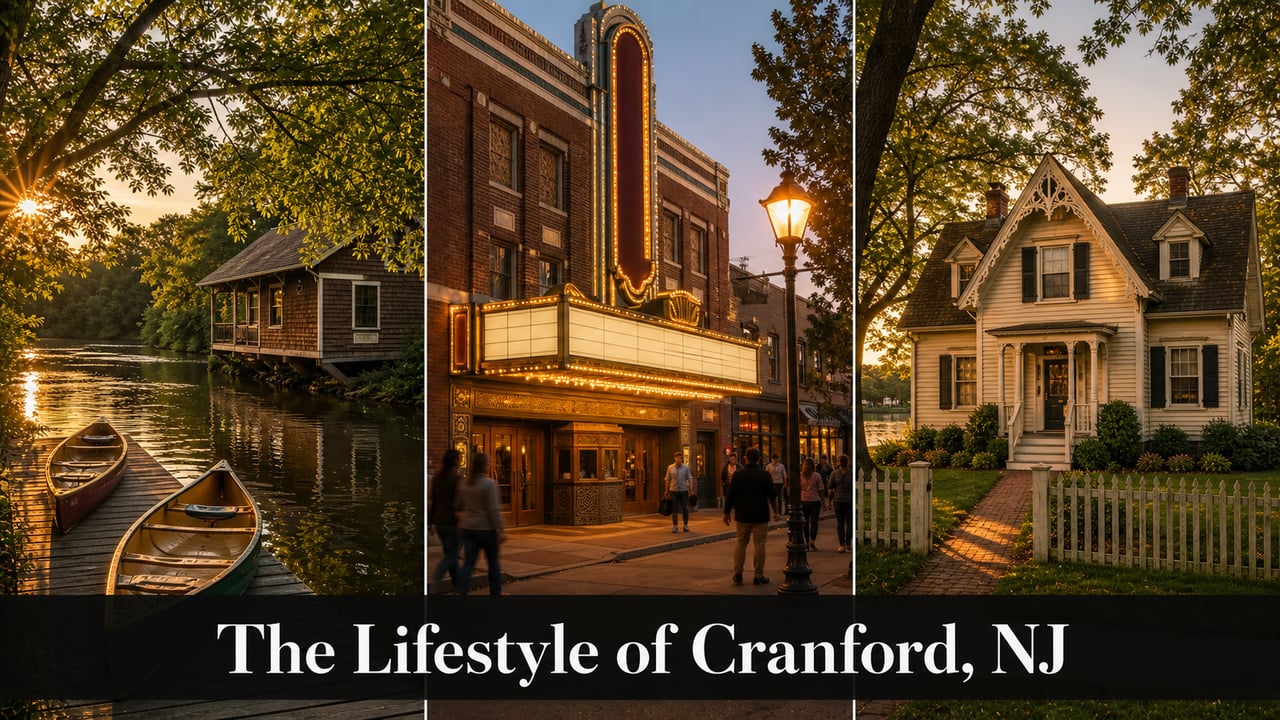
What that decision produced is the Cranford that exists today: a downtown where the coffee shops, restaurants, boutiques, and outdoor cafe seating radiate out from the station like spokes on a wheel; a Saturday farmers market a five-minute walk from the train; a 1908 canoe livery on the Rahway River two blocks from the platform; a 1926 movie palace still showing films a few minutes' walk in the other direction; and a 1840 Victorian cottage on the riverbank that the White House named an "American Treasure" in 1999. The pieces have always been there. What changed is that the town decided to put the train station at the center of all of it.
This is the lifestyle piece for Cranford. Not the market data, which Prodigy's Cranford market deep-dive covers in full, and not the carrying-cost math, which appears in the 2026 property tax breakdown. This is about the daily and weekly rituals that make Cranford one of the most distinctive small towns in New Jersey to actually live in.
The Rahway River runs through downtown Cranford from north to south, and approximately two miles of that river are paddle-able in canoes and kayaks rented from the Cranford Canoe Club at the corner of Springfield Avenue and Orange Avenue. The club is one of the oldest in the United States, formalized in 1907 by a group that originally met as the "Shanty Gang" in Alfred Clark's red Lobster Shanty livery at Normandie Place and Riverside Drive in the late 19th century.3 The current building was constructed in 1908 as the Ulhigh Canoe Club, then absorbed into the broader Cranford Canoe Club operation. After private ownership through the 20th century, the township purchased the facility in 1990. It now operates as a seasonal livery and is, per the Mr. Local History Project's documentation, New Jersey's oldest canoe livery operation.
The town earned its nickname — the Venice of New Jersey — from the centrality of the river to its identity. There was once a Fourth of July canoe regatta tradition documented in the original WPA-era state guide, and the river-as-organizing-feature shows up in the names of nearly all the major parks: Hanson Park, Sperry Park, Crane's Park, Droescher's Mill Park, Nomahegan Park, Lenape Park — all of them strung along the Rahway River Parkway, the seven-mile linear park designed in the 1920s by the Olmsted Brothers, the same firm responsible for the Watchung Reservation in northern Union County.4
For Cranford residents, the canoe club is a summer ritual. Tuesday evenings have a weekly free-ice-cream-with-rental special. There is a soft-serve concession stand on the property. Kids learn to paddle on the same stretch of river their parents and grandparents learned on. The club is cash or check only. There are families on their fourth and fifth generation of paddling that same two miles of river.
A canoe club that has been operating since 1907 is not a feature in a marketing brochure. It is a generational anchor. Towns with these kinds of anchors are not towns you discover through a Zillow search. They are towns people grow up in, leave, and find their way back to.
The Crane-Phillips House at 124 North Union Avenue is the rarest piece of architectural and civic heritage in all of Union County. Built around 1840 by Josiah Crane Sr. as a honeymoon cottage for his son Josiah Crane Jr., the Victorian cottage was designed in the architectural style of Andrew Jackson Downing — widely regarded as the first American architect.5 It sits on the bank of the Rahway River, a few blocks from where the river crossing of "Crane's Ford" gave the township its name in the early 18th century.
The Cranes were the first European settlers to come to the area in 1715. They built mills on the river and established a farm on the west side of the Rahway. The cottage was sold to Henry and Cecelia Phillips in 1867. Henry Phillips was an American Civil War veteran of the 7th New York Militia and one of the first inventors of the modern kitchen hood. His brother, Charles Henry Phillips, was the inventor of Phillips' Milk of Magnesia. The house is now operated as a living museum by the Cranford Historical Society, founded in 1927 and headquartered at Hanson House, 38 Springfield Avenue.
The Crane-Phillips House is on the National and State Registers of Historic Places. In 1999, it was named an "American Treasure" by the White House Millennium Council and the National Trust for Historic Preservation. It is one of only 27 such designations in the entire state of New Jersey, and it is the only "American Treasure" in Union County. For a 4.8-square-mile township to hold the county's sole designation is a structural authority anchor that almost no comparable Union County suburb can claim — particularly meaningful in 2026, the year of America's Semiquincentennial commemoration.
Inside the Crane-Phillips House, the museum displays Native American artifacts, American Revolutionary War and Civil War objects, 19th-century farm implements, a Victorian parlor, and a Victorian girl's bedroom set in 1870. The Cranford Historical Society maintains rotating exhibits drawn from its antique clothing collection. The museum runs an active programming calendar, including a "Cranford and the Revolution" presentation timed to the 2026 anniversary year.
On November 29, 1926, the Cranford Theatre opened on the site of Cranford's old Township Building, with 1,300 seats, a stage, and an $18,000 Wurlitzer pipe organ.6 The first film shown was the silent feature Padlocked, starring actor Noah Beery Sr. The theater opened as the "New Branford Theatre," but a naming dispute — documented at length in the Cranford Chronicle at the time — led to the "B" on the electric marquee being replaced with a "C," and the theater has been the Cranford Theatre ever since.
The 1920s were the great era of the American movie palace — the same era that produced Westfield's Rialto, Cranford's Cranford Theatre, and a thousand other ornate single-screen-with-balcony venues across the country. Most are gone. The Rialto in Westfield closed in 2019 and is in the process of being restored as the Rialto Center for Creativity. The Cranford Theatre never closed. It still shows films a short walk from the train station, anchoring the eastern end of the downtown commercial district. Going to the movies in Cranford means walking, in many cases, from your house to the theater. That is increasingly unusual in modern American suburbia.
For broader context on the parallel story in Westfield, Prodigy's nostalgia of Westfield piece covers the Rialto's century-long arc and the Westfield Arts Collective's $5 million restoration plan. The two theaters — Cranford's still operating, Westfield's being saved — together tell most of the story of how Union County held onto the parts of itself that other parts of America let slip.
The Riverside Inn was built in 1900 along the bank of the Rahway River. Affectionately known to Cranford residents as "The Dive," the building started life as a flower shop and converted, during the Prohibition era of the 1920s, into a speakeasy. Evidence of that earlier life remains visible on the basement walls today — painted images of bottles and barkeeps, painted on by the Prohibition-era patrons who used the basement to drink in defiance of the law.7
The Riverside Inn has weathered the Rahway's history of major flooding — the river has flooded over twelve recorded times since 1938, including Hurricane Floyd in 1999, Hurricane Irene in 2011, and Hurricane Ida in 2021. The inn is still standing. Cranford residents still drink there. The basement still has the speakeasy paintings. For a town with a flood history that Prodigy's flood zone buyer's guide covers in primary-source detail, the Riverside Inn functions as the township's most enduring symbol that the river is part of the place's character rather than something to be defeated.
The Transit Village designation defines the area around the station as a half-mile radius. Within that half-mile in Cranford is essentially the entire functional downtown: restaurants, coffee shops, boutiques, the farmers market, the library, the Community Center, two of the three TOD residential developments built in the last twenty years, and the platform itself. A summary view of what fits inside that walking radius:
| Anchor | What It Is | Walk From Station |
|---|---|---|
| Cranford Crossing | 2006 mixed-use, 50 condos + 22,000 sf retail | 1 block |
| Riverfront at Cranford Station | 2013 mixed-use, 127 rentals + 20,000 sf retail | 2 minutes |
| Cranford Theatre | 1926 movie palace, still operating | 5 minutes |
| Cranford Canoe Club | 1908 livery on the Rahway, NJ's oldest | 8 minutes |
| Crane-Phillips House Museum | ~1840 Victorian, "American Treasure" | 10 minutes |
| Cranford Community Center | Walnut Avenue, classes, sports, library | 10 minutes |
| Cranford Public Library | Walnut Avenue, adjacent to Community Center | 10 minutes |
Sources: Township of Cranford; New Jersey Future; NJ Transit Village Initiative documentation; Cranford Historical Society; Mr. Local History Project. Walking distances are approximate and reflect typical pedestrian travel time in fair weather.
The retail and dining mix inside the Special Improvement District has evolved significantly since the early 2000s. Apparel and gift shops, ethnic restaurants, ice cream parlors, coffee programs, and small specialty retailers have come and gone, with the overall density of independent businesses growing rather than shrinking. The 2003 Transit Village designation produced a $200,000 grant funding the Vision Plan study, which in turn funded ongoing pedestrian, parking, and traffic improvements that continue to shape the downtown today. The downtown is not a museum — it is a working commercial district that happens to have been built around a 19th-century street grid.
The Rahway River Parkway was designed in the 1920s by the Olmsted Brothers landscape architecture firm — the sons of Frederick Law Olmsted, the same firm associated with Central Park, Prospect Park, and the original Boston Emerald Necklace. The Cranford section follows the meandering Rahway River for approximately seven miles southbound through Lenape Park, Nomahegan Park, Hampton Park, MacConnell Park, Hanson Park, Sperry Park, Crane's Park, Droescher's Mill Park, and Mohawk Park.8
The Cranford Riverwalk and Heritage Corridor portion begins where Orange Avenue meets Springfield Avenue at the Cranford Canoe Club and follows the river south to the Williams-Droescher Mill, an early-18th-century mill site. Heritage Plaza at the southwest corner of South Avenue and Centennial preserves century-old stone walls and iconic stone columns winding through woodland to the mill. The corridor's Olmsted-era design language — meandering paths, naturalistic planting, the river as the central organizing feature — has aged into one of the more genuinely beautiful linear parks in northern New Jersey.
Nomahegan Park at the northern end of the corridor is the largest of the parks, with the river broadening into a wider park space. The name Nomahegan is a variation of "Noluns Mohegans" — the New Jersey indigenous people referenced in the 1758 treaty. Translated, it means "women Mohegans" or "she-wolves," applied in scorn by the Iroquois during the conflicts of the early 18th century. The park sits at the Cranford-Kenilworth border and includes walking trails, picnic areas, and a small lake.
There are very few towns in New Jersey where you can walk out your front door, take a five-minute walk to a 1908 canoe livery, paddle two miles down a river designed by Olmsted Brothers, and end up at a 1920s-era stone bridge near an 18th-century mill. Cranford is one of them.
Cranford's calendar is anchored by a smaller number of large recurring events than Westfield's, but the events themselves carry deep generational weight. The Cranford Historical Society organizes a Fall Festival each September with music, games, vendors, and museum tours at the Crane-Phillips House and Hanson House. The Society also coordinates the Tour of Notable Gardens and Historic Homes — a self-guided walking tour through some of the township's finest gardens and 19th-century houses, scheduled to spotlight Revolutionary-era heritage in 2026 for the Semiquincentennial year.
The Cranford Canoe Club operates seasonally, typically late spring through early fall, with weekly specials and a soft-serve concession. The Cranford Theatre runs continuous programming year-round. The Saturday farmers market operates a few minutes from the train station during the warmer months. The Community Center on Walnut Avenue runs a continuous calendar of classes, sports leagues, and speaker series. The Cranford Public Library, adjacent to the Community Center, hosts cultural programming throughout the year.
For the broader Union County context, Prodigy's four seasons of Westfield piece covers a fuller monthly calendar in the neighboring township, and the nostalgia of Westfield piece covers the parallel Westfield heritage register. For the comparative analysis of Clark, Cranford, and Westfield as the three tiers of the Union County market, the Clark trade-off analysis walks through the pricing math.
A meaningful share of Prodigy's Cranford buyer conversations in 2026 involve relocations from Hoboken, Jersey City, Brooklyn, and Manhattan. Per Kathleen Miller Prunty's documented observation as director of Cranford's Office of Business and Economic Development, "We are seeing lots of young people moving here from places like Hoboken because of access to transportation, a pedestrian-oriented town center and excellent schools." That migration pattern has been documented for over a decade and continues today.
What those buyers are actually purchasing is not a house. It is a lifestyle pattern: walk to the train, walk to dinner, walk to the canoe club on a Saturday morning, walk the kids to the library on a Tuesday afternoon, walk to the Saturday farmers market, walk to the movie theater on a Friday night. That set of small daily and weekly walks is what Cranford genuinely delivers. The Hoboken-to-Cranford migration is not buyers giving up walkable urbanism for a yard. It is buyers trading one walkable lifestyle for another walkable lifestyle, with a yard added.
For the purchase mechanics — pricing, broker selection, offer construction, the 2026 buying-side discipline — the framework appears in Prodigy's 2026 buyer's guide and applies with equal force in Cranford. The current Cranford market data sits in the Cranford market trends post. The carrying-cost math appears in the 2026 property tax breakdown. The flood-zone diligence framework, which is essential reading for any Cranford buyer evaluating a river-adjacent property, sits in Prodigy's flood zone buyer's guide. And the live inventory and current market data are on Prodigy's Cranford neighborhood page.
1. 1997 Danth Inc. report; 2000 Smart Growth grant; Downtown Vision Plan 88% resident support: New Jersey Future, "Cranford Crossing" smart growth award documentation; NJ Transit-Friendly Planning Newsletter (njtod.org).
2. 2003 Transit Village designation; closest Transit Village to NYC on the Raritan Valley Line: NJ Department of Transportation Transit Village Initiative; New Jersey Transit-Friendly Planning Newsletter exploration of Raritan Valley Line Transit Villages (Cranford 2003, Plainfield 2014, Dunellen 2013, Bound Brook 2003, Somerville 2010, High Bridge 2025).
3. Cranford Canoe Club origins (Shanty Gang, ~1904–1906; Skeeter Club; formalized as Cranford Canoe Club 1907; current 1908 structure originally Ulhigh Canoe Club; township purchase 1990; NJ's oldest canoe livery operation): Mr. Local History Project (mrlocalhistory.org/cranford-history); Cranford Canoe Club official site.
4. Rahway River Parkway design by Olmsted Brothers in 1920s; ~7-mile linear corridor through Lenape, Nomahegan, Hampton, MacConnell, Hanson, Sperry, Crane's, Droescher's Mill, and Mohawk Parks: Wikipedia, Cranford NJ; Township of Cranford parks documentation.
5. Crane-Phillips House (~1840 by Josiah Crane Sr., Andrew Jackson Downing-style Victorian, 124 N. Union Avenue, sold to Phillips family 1867, Henry Phillips Civil War 7th NY Militia, brother Charles Henry Phillips invented Phillips' Milk of Magnesia, museum operated by Cranford Historical Society founded 1927, "American Treasure" designation 1999 by White House Millennium Council and National Trust for Historic Preservation, only "American Treasure" in Union County, one of 27 in NJ): Wikipedia, Crane-Phillips House; Cranford Historical Society (cranfordhistoricalsociety.org); Explore Union County (exploreunioncounty.com).
6. Cranford Theatre opening November 29, 1926; 1,300 seats, $18,000 Wurlitzer pipe organ, first film Padlocked with Noah Beery Sr.; "New Branford Theatre" naming dispute and "B"-to-"C" sign change: Mr. Local History Project (mrlocalhistory.org/cranford-history).
7. Riverside Inn ("The Dive") built 1900, originally a flower shop, Prohibition-era basement speakeasy with surviving wall paintings: Mr. Local History Project.
8. Cranford Crossing 2006 (Westminster Communities, 50 condos, 22,000 sf retail, 310-space parking garage); Riverfront at Cranford Station 2013 (S. Hekemian Group, 127 luxury rentals, 20,000 sf retail, 20,000 sf office); Woodmont Station at Cranford 2015 (163 homes including affordable housing); ~1,300 weekday Cranford Station boardings; ridership +32% over prior decade: NJ Transit-Friendly Planning Newsletter (njtod.org); New Jersey Future smart growth documentation.
Event schedules, hours, programming, and rental availability for venues including the Cranford Canoe Club, Cranford Theatre, Crane-Phillips House Museum, and Cranford Historical Society are subject to change. Buyers should verify current operating status directly with venues before relying on this information for planning purposes.

Prodigy Real Estate is an innovative real estate company offering high-end video production, home valuation services, purchasing, and home sales. Serving New York and New Jersey.