
Anthony Licciardello | May 11, 2026
Clark, NJ
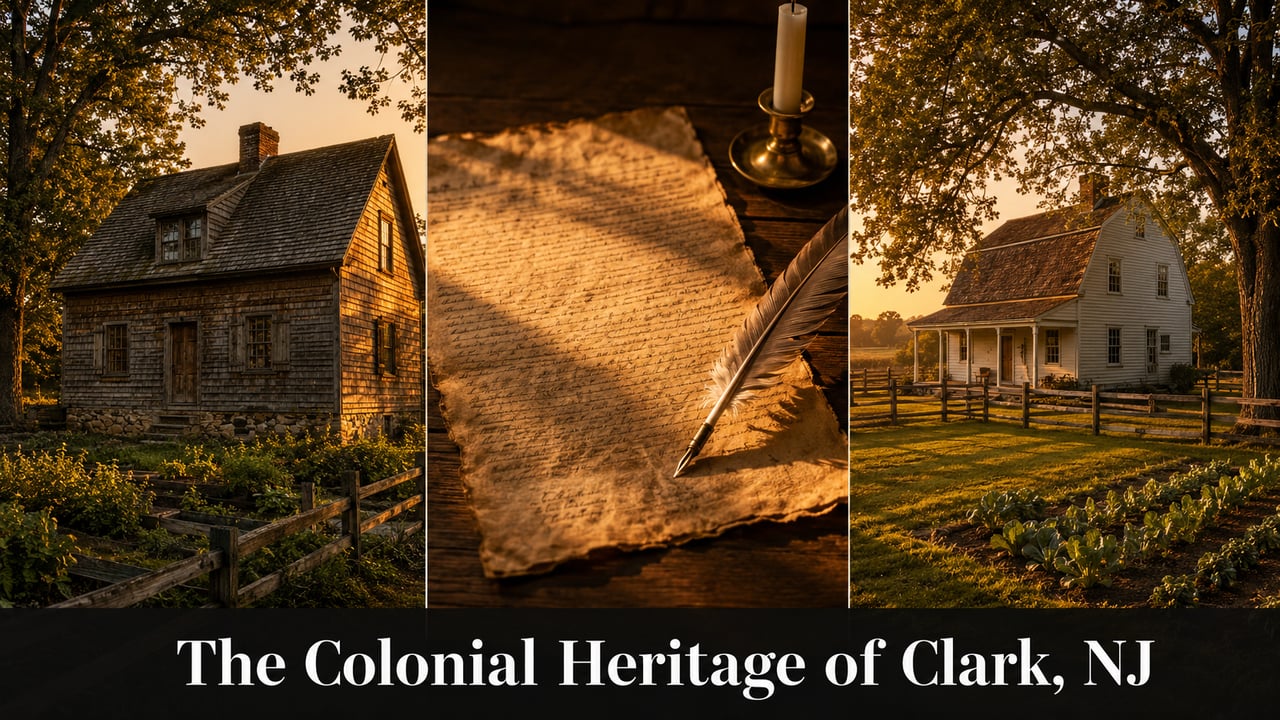
Most New Jersey suburbs are named after geographical features or English place names. A river, a hill, a Massachusetts town. Clark, New Jersey is not. Clark Township is named after Abraham Clark — a sickly, self-taught surveyor and lawyer from Elizabethtown who was elected to the Continental Congress in 1776, signed the Declaration of Independence, watched two of his sons get captured by the British and imprisoned on the most notorious prison ship of the Revolutionary War, refused the British offer to free them in exchange for renouncing the Declaration, and lived the rest of his life as a politician who opposed every form of privilege he could find.1 When the township was incorporated, his name was the name they chose. That decision was deliberate.
Most New Jersey suburbs also do not have surviving 17th-century houses. Clark Township has two of them — the Robinson Plantation House at 593 Madison Hill Road, built around 1690 by a Scottish-born physician, and the Squire Hartshorne House, a second 17th-century structure also still standing.2 Neither is a museum-piece reconstruction. The Robinson Plantation House is the original 1690 building, with its rubble stone foundation, its post-medieval English-and-Dutch construction methods, and the original hearth where Dr. William Robinson practiced "Physick" — the colonial era's name for medicine using plants and herbs — for the few colonists who could afford a doctor at all. The house is on the National Register of Historic Places as the "Seventeenth Century Clark House." It is one of only a few surviving examples of late-17th-century domestic architecture anywhere in the United States.
2026 is America's Semiquincentennial — the 250th anniversary of the Declaration of Independence. Most New Jersey suburbs will mark the year with a parade and a few civic ceremonies. Clark has something more substantial to bring to the moment: a working museum in a 1690 building, a documented Revolutionary War battlefield connection, and a township named after a Founding Father whose name appears in the founding document of the country. This piece is the heritage piece for Clark. It walks through what's actually there, what each piece means, and what the township is worth a visit for in the 250th anniversary year and the years that follow.
For the comparative real estate analysis of Clark versus its neighbors, Prodigy's Clark trade-off post covers the pricing math. This piece is about something different — the cultural and historical bedrock that distinguishes Clark from suburbs of comparable price tier across the rest of the metro New York area.
Dr. William Robinson was a Scottish immigrant who arrived in colonial New Jersey in the late 17th century at a time when professional medicine in the American colonies barely existed. There were perhaps a dozen formally trained physicians in all of New Jersey. Robinson was one of them. He acquired land within the Elizabethtown Tract — one of the original New Jersey land grants established in the 1660s — and built a frame house around 1690 to serve simultaneously as his home, his medical practice, and the family seat for the Robinsons who would occupy the property until 1973.3
The house itself is the rare thing. Most American houses do not survive 335 years. The ones that do tend to be elite estates, ceremonial public buildings, or buildings preserved as monuments. The Robinson Plantation House is none of those. It is a working physician's frame house, built using the post-medieval English and Dutch carpentry techniques that Scottish, English, and Dutch settlers brought with them to the colonies. The rubble stone foundation is original. The summer beam — a heavy supporting timber that runs across the central first-floor ceiling — is original and well-preserved. The fireplace foundation is large enough to suggest the kitchen, the medicine practice, and the family hearth all converged at the same fire.
In 1973, the last descendant of Dr. Robinson left the property, and the Township of Clark stepped in to acquire the building rather than allow demolition. The house was added to the National Register of Historic Places in 1974 under the name "Seventeenth Century Clark House." The Clark Historical Society led restoration efforts in the early 1980s, stabilizing the structure and adapting it for use as a working museum. Today, the property operates as the Dr. William Robinson Plantation Museum, open the third Sunday of each month from March through June and September through December.4 The hearth is restored. There is an herb garden interpreting Dr. Robinson's medical practice. The summer beam is still where it was in 1690.
A 335-year-old house that survived because a Scottish family kept it for nine generations and a township stepped in when the ninth generation could not is not a curiosity. It is a structural fact about a place. Clark is a township that has been continuously occupied by people who chose to stay since before the United States existed.
The Squire Hartshorne House is the second surviving 17th-century structure in Clark Township. Like the Robinson Plantation House, it dates to the late 1600s, predating the founding of the United States by nearly a century. The Hartshorne family was among the early Quaker and English settlers in central New Jersey, and the house represents the same post-medieval English construction tradition that produced the Robinson Plantation House — the same era, the same general carpentry methods, the same architectural language.5
For a township covering 4.45 square miles to retain two surviving 17th-century houses is genuinely unusual. By comparison, the entire State of New Jersey contains fewer than two dozen documented 17th-century surviving structures across all 6,800 square miles of the state, and most of them sit in concentrated clusters along the Delaware River and in Salem County rather than in the metropolitan New York corridor. Clark's two structures, in close proximity to each other, mark the township as one of the most concentrated pockets of surviving pre-Revolutionary architecture in northern New Jersey.
For visitors and residents alike, the existence of two contemporaneous 17th-century houses in the same small township provides a rare comparative window into early colonial domestic architecture. The houses share construction methods but diverge in detail. Standing in one and then the other gives a visitor a sense of the variation that existed within a single carpentry tradition — a sense that no single preserved house can quite deliver on its own.
The Homestead Farm at Oak Ridge is the third anchor of Clark's colonial heritage and the link to the Revolutionary War. The main farmhouse was built around 1750 in the area then known as Ash Swamp. In late June 1777, the area saw active military movement as British and American forces maneuvered through what would become known as the Battle of Short Hills.6 The skirmishes that preceded the main engagement crossed through the Ash Swamp area — close enough that the Homestead Farm sits within the documented battlefield context.
The Battle of Short Hills was the result of British General William Howe's attempt in June 1777 to draw General George Washington's Continental Army into a major engagement on terrain favorable to the British. Howe moved his forces out of New Brunswick toward Westfield with the goal of provoking Washington off his strategic high ground at the Watchung Mountains. Washington declined the engagement at full strength but committed Lord Stirling's forces to a delaying action. The fighting was concentrated around what is today Scotch Plains and Edison, with the surrounding Ash Swamp area — including modern-day Clark — serving as the broader operational zone through which troops moved, foraged, and skirmished.
The Homestead Farm survives as a tangible link to that moment. The 1750 main building stood through the Revolutionary War and continued in use for generations after. For the 2026 Semiquincentennial year, the farmstead's connection to the Battle of Short Hills positions Clark as one of the few Union County townships with a documented Revolutionary War battlefield context — alongside Springfield (Battle of Springfield, June 1780), Connecticut Farms (Battle of Connecticut Farms, June 1780), and the Watchung Reservation operational area documented in Prodigy's Scotch Plains historic districts piece.
Abraham Clark was born on February 15, 1726, in Elizabethtown, New Jersey — the only child of farmer Thomas Clark and Hannah Winans, both descended from the founding Elizabethtown families that arrived in 1664.7 He was, by every account, a sickly child unable to do heavy farm work. His father noticed his mathematical abilities and, despite the family's modest means, hired a tutor to teach him surveying. From surveying he taught himself law — he was never formally admitted to the bar — and built a practice offering free legal advice to neighbors who could not afford a lawyer. He became known as "the Poor Man's Counselor."
In 1748, Clark married Sarah Hatfield, with whom he eventually had ten children. He served as clerk of the New Jersey colonial Legislature from 1752 to 1766 and as High Sheriff of Essex County. As tensions with Britain intensified through the 1760s and early 1770s, Clark was among the first New Jersey patriots to argue openly for independence. When New Jersey's original conservative delegates to the Continental Congress refused to support independence, the state convention replaced them with a new slate including Clark, Richard Stockton, John Witherspoon, Francis Hopkinson, and John Hart. They arrived in Philadelphia on June 28, 1776, and voted for the Declaration of Independence in early July.
Clark signed the Declaration. The personal cost came later. Two of his sons, Thomas and Aaron, served as officers in the Continental Army — both First Lieutenants who rose to Captain. Both were captured by the British. Both were imprisoned aboard the HMS Jersey, the most notorious British prison ship of the Revolutionary War, anchored in New York Harbor. Conditions on the Jersey were so brutal that more American soldiers and sailors died on board than were killed in battle during the entire Revolutionary War. Aaron Clark, by some accounts, was confined to a dungeon and fed through a keyhole because his father was a signer of the Declaration. The British made Abraham Clark an offer: renounce the Declaration of Independence, and his sons would be released. Clark refused.8
In a letter to his friend Elias Dayton on the day of the vote in July 1776, Clark wrote: "Our Congress Resolved to Declare the United Colonies Free and Independent States... It is gone so far that we must now be a free independent State, or a Conquered Country... This seems now to be a trying season, but that indulgent Father who hath hitherto Preserved us will I trust appear for our help, and prevent our being Crushed; If otherwise, his Will be done." His private words on the day of the signing were even more direct: "We can die here but once."
Clark continued to serve in the Continental Congress through 1778, then in the New Jersey Legislative Council, then in the Continental Congress again from 1780 to 1783 and from 1786 to 1788, then in the U.S. House of Representatives in the Second and Third Congresses from 1791 until his death. He was elected to the Constitutional Convention of 1787 but was too ill to attend. He died on September 15, 1794, at the age of 68. He never owned an estate. He never accepted a fortune for his service. He was, in every sense, the Founding Father most explicitly aligned with ordinary New Jersey people — and the township that bears his name was deliberately chosen to honor that alignment.
A township named after a man who refused to trade his sons' lives for his political principles is not just a place. It is a piece of civic memory. The fact that a buyer in 2026 can drive past Garden State Parkway Exit 135, see the sign that reads "Clark/Westfield," and not know what that name means is a failure of contemporary New Jersey storytelling. The story is genuinely there.
A summary view of the four primary heritage anchors that distinguish Clark's colonial-era footprint:
| Anchor | Era | Significance |
|---|---|---|
| Robinson Plantation House | ~1690 | 17th-century surviving frame house, museum, National Register |
| Squire Hartshorne House | 17th century | Second surviving 1690s structure in the same 4.45-square-mile township |
| Homestead Farm at Oak Ridge | ~1750 | Battle of Short Hills (June 1777) battlefield context |
| Abraham Clark Legacy | 1726–1794 | Township namesake, Declaration of Independence signer |
Sources: National Register of Historic Places (Robinson Plantation House, 1974); Clark Historical Society; Dr. William Robinson Plantation Museum (drrobinsonmuseum.org); Britannica, U.S. National Park Service, Constitution Center, Crossroads of the American Revolution. Visiting hours and access for the Robinson Plantation Museum are limited to designated open-house dates; verify current schedule before visiting.
2026 marks 250 years since the signing of the Declaration of Independence. For the entire calendar year, American towns with documented founding-era heritage are receiving meaningful attention from researchers, historians, school groups, and visitors looking for places where the story of the founding still lives in physical form. Clark is one of those places. The Robinson Plantation Museum is open on its third-Sunday schedule. The Squire Hartshorne House remains a documented site. The Homestead Farm at Oak Ridge connects to the Battle of Short Hills' broader operational footprint. The Abraham Clark namesake of the township carries the most personal Founding Father story in New Jersey.
For Clark residents and prospective buyers, the heritage layer is part of what the township actually is. A move into Clark is a move into a 4.45-square-mile township that has been continuously occupied since the 1690s, that survived the Revolutionary War, that is named after a man who chose his country over his family's safety. That is not a marketing claim. It is a documented civic fact. For buyers who weight these things — the buyers who are drawn to Westfield's 2004 Great American Main Street designation, to Cranford's Crane-Phillips "American Treasure" status, to Scotch Plains' two historic districts — Clark belongs in the same conversation. The pricing math, covered in Prodigy's Clark trade-off post, sets Clark's price tier well below those neighbors. The heritage layer, when fully understood, complicates the value calculation in Clark's favor.
For visitors planning a 2026 Semiquincentennial route through Union County, Clark is a worthwhile addition to the standard itinerary. The Robinson Plantation Museum, the Squire Hartshorne House perimeter, the Homestead Farm context, and a stop at the Garden State Parkway Exit 135 sign — with its quiet civic acknowledgment of Abraham Clark — combine into a substantive half-day experience. The neighboring townships extend the route: Westfield's heritage register, Cranford's Crane-Phillips House, Scotch Plains' Frazee House and historic districts, and the Watchung Reservation operational footprint together cover Union County's Revolutionary-era story at greater depth than most visitors realize.
1. Clark Township named after Abraham Clark, signer of the Declaration of Independence: Township of Clark official documentation; Constituting America (constitutingamerica.org); Garden State Parkway Exit 135 signage.
2. Robinson Plantation House and Squire Hartshorne House as Clark's two surviving 17th-century structures: Wikipedia (Robinson Plantation House); Clark Historical Society documentation.
3. Robinson Plantation House construction (~1690 by Dr. William Robinson, Scottish-born physician); rubble stone foundation; summer beam; post-medieval English/Dutch construction; "Physick" medical practice; descendant occupancy until 1973: Clio (theclio.com/entry/21862); Dr. William Robinson Plantation Museum (drrobinsonmuseum.org); Wikipedia (Robinson Plantation House).
4. National Register of Historic Places listing 1974 as "Seventeenth Century Clark House"; Clark Historical Society 1980s restoration; museum hours (third Sunday March-June and September-December): WhichMuseum (whichmuseum.com); New Jersey DCA Historic Trust (nj.gov/dca/njht).
5. Squire Hartshorne House as 17th-century surviving structure in Clark: Wikipedia (Robinson Plantation House) cross-reference; Clark Historical Society documentation.
6. Homestead Farm at Oak Ridge (main building ~1750), Ash Swamp area, Battle of Short Hills (June 1777) connection: Kiddle/Wikipedia (Homestead Farm at Oak Ridge); Crossroads of the American Revolution.
7. Abraham Clark biographical detail (born February 15, 1726, Elizabethtown; died September 15, 1794; Sarah Hatfield wife 1748/1749; ten children; surveyor and self-taught lawyer; "Poor Man's Counselor"; Continental Congress 1776; signed Declaration of Independence; later New Jersey Legislative Council, Annapolis Convention 1786, U.S. House of Representatives 1791-1794): Britannica (britannica.com/biography/Abraham-Clark); Constitution Center (constitutioncenter.org/signers/abraham-clark); U.S. National Park Service signers biography (nps.gov/parkhistory/online_books/declaration); Crossroads of the American Revolution (revolutionarynj.org); Descendants of the Signers of the Declaration of Independence (dsdi1776.com).
8. Sons Thomas and Aaron Clark captured by British and imprisoned on HMS Jersey prison ship; British offer to release them in exchange for renouncing Declaration; Clark's refusal; "We can die here but once" quote; July 1776 letter to Elias Dayton: Britannica; Constitution Center; Constituting America; Brian D. Colwell biographical analysis (briandcolwell.com).
Visiting hours, programming, and access for the Dr. William Robinson Plantation Museum are limited and subject to change. Verify current schedule with the Clark Historical Society or via drrobinsonmuseum.org before planning a visit. The Squire Hartshorne House and Homestead Farm at Oak Ridge are not currently operating as public museums and may be on private property; visitors should respect property boundaries and verify access protocols before approaching.

Prodigy Real Estate is an innovative real estate company offering high-end video production, home valuation services, purchasing, and home sales. Serving New York and New Jersey.