
Anthony Licciardello | August 30, 2026
New Jersey Shore
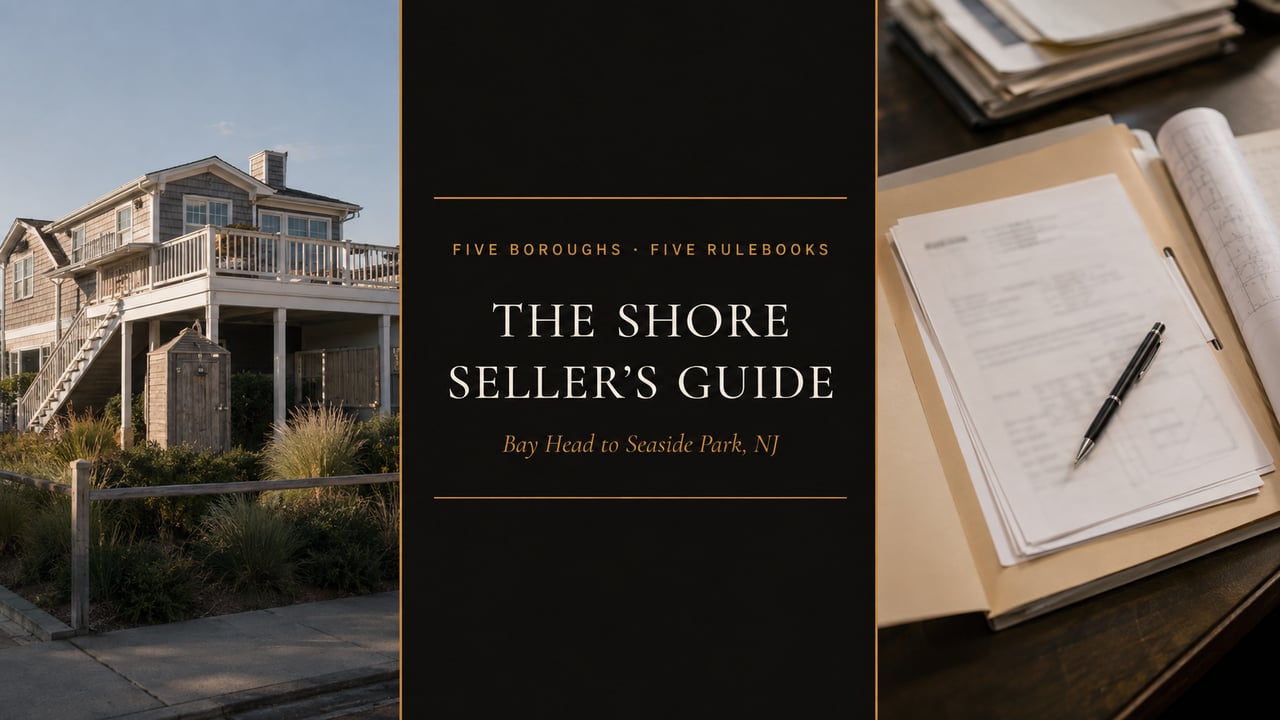
Three of the five barrier island boroughs will not issue a certificate of occupancy until your property is verified against the Borough's zoning, its property maintenance laws, its site plans, its building permits — and its Tax Assessor records. On an island that rebuilt itself after 2012, often in a hurry, that is a materially different exposure than a smoke alarm check.
The barrier island boroughs are not Toms River. Where the township repealed its resale certificate in 2024 and now requires only a smoke certificate, Lavallette, Bay Head and Seaside Heights each maintain their own certificate of occupancy ordinances — and Lavallette's and Seaside Heights' condition issuance on zoning, property maintenance, site plans, building permits and Tax Assessor records. Seaside Heights runs it in two stages: a smoke certificate to sell, a separate CO to occupy. Bay Head charges $100 per unit and prohibits tenancies under seven days borough-wide. If any work on your house was done without a permit, this is where it surfaces — and the buyer is already at the table.
Nearly every house in this footage was built or rebuilt after 2012. That decade of construction is exactly what an ordinance checking permits against Assessor records is looking at.
This is the barrier island companion to our Toms River seller's guide. Municipal requirements change and differ sharply between adjoining boroughs on the same road. Nothing here is legal advice. Confirm current requirements with the municipality having jurisdiction over your specific property and with your attorney before relying on anything in this article.
Lavallette and Seaside Heights use nearly identical language, and it goes well beyond fire safety. Both condition the certificate of occupancy on the property complying with "all applicable zoning and property maintenance laws of this Borough, site plans, building permits and Tax Assessor records."
Read what that last item means in practice. The Tax Assessor's record describes what the municipality believes exists on your parcel — bedroom count, bathroom count, finished square footage, decks, additions. If the house as it stands does not match that record, the borough has an ordinance-level reason not to issue. And building permits sit right next to it in the same sentence.
This peninsula rebuilt itself after 2012. In Mantoloking alone, all 521 homes were damaged or destroyed. Across the island, a decade of repairs, elevations, additions, decks, outdoor showers, finished lower levels and reconfigured layouts followed — much of it properly permitted, some of it not, and a great deal of it done under time pressure by owners desperate to get back in.
An ordinance that checks permits and assessor records against the house as it stands is, functionally, an audit of that decade. If you bought after the rebuild, the work may not even be yours — and you will still be the one resolving it, with a buyer waiting.
Seaside Heights adds a structural wrinkle worth understanding. Its Chapter 55 separates two things most people treat as one: no residential property may be sold until the owner obtains a certificate verifying smoke detector compliance — and no such property may be occupied until a certificate of occupancy issues verifying the broader zoning, permit and assessor compliance. Two certificates, two thresholds. A seller can theoretically clear the sale and leave the buyer unable to move in, which is a conversation nobody wants to have at the closing table.
A resale certificate of occupancy at $100 per dwelling unit, with a $15 reinspection fee. And the provision that catches investors: the borough prohibits tenancies of less than seven days, with short-term certificates of occupancy issued annually. If your listing markets weekend rental income, that is a problem to resolve before you advertise it, not after. Market context in our Bay Head guide.
We confirmed that Mantoloking appears on the Ocean County Fire Marshal's resale and rental inspection list, meaning the county performs the alarm inspection rather than the borough. We did not locate a separate borough certificate of occupancy ordinance, and we are not going to infer one from silence. Given how tightly this borough regulates land use — fifteen zoning districts, as our zoning guide documents — call the Borough directly before you list.
No residential property may be sold and title transferred until the owner obtains a transfer certificate of occupancy, demonstrating compliance with current smoke and carbon monoxide requirements and with the Borough's zoning and property maintenance laws, site plans, building permits and Tax Assessor records. $100 per dwelling unit. This is the strictest resale regime we found on the island and the one most likely to surface unpermitted work.
A smoke detector compliance certificate from the Code Enforcement Officer is required before sale; a separate certificate of occupancy verifying zoning, property maintenance, site plans, building permits and Tax Assessor records is required before occupancy. In a borough with an active redevelopment programme and a large condominium and multi-family stock, both matter — and rental operators should read the borough's rental provisions alongside them.
The borough's published construction fee schedule lists a certificate of continued occupancy at $150, against $75 for a standard certificate of occupancy and $30 for a temporary one. The highest certificate fee on the island. Note also that Seaside Park and Lavallette operate a shared Construction Department — one office serving two boroughs — so confirm which borough's requirements apply to your parcel. Market context in our Seaside Park guide.
And the two Toms River sections of the island are governed by the township, not by a borough. Ortley Beach and Chadwick Beach fall under Toms River Township, which repealed its resale certificate of occupancy in January 2024 and now requires only the smoke certificate — a materially lighter process than any borough on this list. And Normandy Beach spans the Brick–Toms River line, so which regime applies there depends on the specific parcel.
That is the whole point of this article in one sentence: on twenty miles of barrier island, a seller's obligations range from a single $75 smoke certificate to a $150 certificate of continued occupancy conditioned on an audit of every permit ever pulled — and the line between them is invisible from the road.
First, the fire extinguisher requirement is gone. Effective February 3, 2025, New Jersey repealed the portable fire extinguisher requirement for one- and two-family dwellings as a condition of the compliance certificate, under an amendment to the Uniform Fire Safety Act (P.L. 2025 c.19). Some municipalities began enforcing from February 15. A great many published forms, checklists and certificate names still list it — including borough notices issued well after the repeal. If you have an extinguisher, leave it in place; several fire departments ask that you do. But do not buy one because an outdated form told you to.
Second, and newer: something went in as the extinguisher came out. Neighbouring Brick now issues a Certificate of Smoke Alarm, Carbon Monoxide Alarm and Secondary Power Source Identification, requiring a label installed within 18 inches of the main electrical panel and electrical meter warning of the dangers associated with secondary power sources — permanently installed generators, solar panels and battery storage systems.
That requirement lands squarely on this island. Whole-house generators are near-standard on waterfront and post-Sandy construction here, as our luxury new construction guide documents, and solar is increasingly common. Confirm with your own enforcing agency whether the labelling requirement applies to you — it is a five-minute fix in advance and a failed inspection on the day.
Battery-operated detectors with ten-year sealed batteries, on every level. This is the tier most people picture when they think about resale alarms — and it is only one of three.
Hardwired, interconnected detectors with battery backup. Battery units are not an acceptable substitute here — if a hardwired alarm has failed, it must be replaced with a hardwired one.
All of the above, plus a detector inside every bedroom. Newer houses carry the strictest requirement, which surprises sellers who assume a modern home passes automatically.
Check your year of construction before you buy a single alarm. Walking into a 1985 house with a bag of ten-year sealed battery units is a wasted afternoon and a failed inspection — and the reinspection puts you back in the scheduling queue at exactly the wrong moment. Carbon monoxide alarms belong within ten feet of every bedroom door regardless of vintage.
Third, the alarm specifications themselves are stricter than most sellers assume. Ten-year sealed battery single-station smoke alarms are required under the state code. Alarms over ten years old must be replaced. Where a home was built or retrofitted with hardwired interconnected alarms, those must be replaced with hardwired units — battery alarms are not an acceptable substitute, and wireless battery-powered interconnected alarms are not accepted either. Detectors that are part of a home security system do not satisfy the code and must be augmented with standalone alarms. Carbon monoxide alarms belong within ten feet of all sleeping areas, and battery or plug-in CO units are commonly held to a five-year age limit.
Since March 20, 2024, every seller of real property in New Jersey must disclose flood risk on the Property Condition Disclosure Statement — before the purchaser becomes obligated under contract. The Flood Risk Notification Law (P.L. 2023 c.93) requires you to state whether the property sits in FEMA's Special Flood Hazard Area or Moderate Flood Hazard Area, and to disclose actual knowledge of flood risks and any history of flooding. New Jersey became the thirtieth state to require it.
The penalty is not a fine — it is the deal. Failure to comply releases the purchaser from their obligations under the contract until the seller complies, and the law supplements the Consumer Fraud Act. This is the requirement with the sharpest consequences on this list, and unlike the certificates it is a statewide obligation that no borough can repeal.
The NJDEP Flood Risk Notification Tool is searchable by address and exists precisely to help you answer these questions accurately. And if you rent the property: landlords must provide a separate Flood Risk Notice on any new or renewed lease — for residential leases it must be a separate rider in no less than 12-point type, individually signed or acknowledged by the tenant.
New Jersey's former 1% buyer-paid "mansion tax" is gone. For contracts fully executed on or after July 10, 2025, it is replaced by a Graduated Percent Fee paid by the seller, on residential sales over $1 million:
1% — over $1,000,000 to $2,000,000
2% — over $2,000,000 to $2,500,000
2.5% — over $2,500,000 to $3,000,000
3% — over $3,000,000 to $3,500,000
3.5% — over $3,500,000
Two features make this far more punishing than it looks. First, the rate applies to the entire consideration once triggered — not to the amount above the threshold. Second, it is separate from and in addition to the standard Realty Transfer Fee, which the seller also pays.
Which creates a pricing cliff with real teeth. A sale at $2,000,000 costs the seller $20,000. A sale at $2,000,001 costs $40,000. One dollar more, twenty thousand dollars worse. The same cliff sits at $2.5M, $3M and $3.5M. Exemptions exist and are claimed on Form RTF-1EE — discuss the arithmetic with your attorney before you set an asking price, not after you accept an offer.
On this island the fee is not a footnote — it is often the largest single line on the seller's settlement statement. Bay Head's trailing-twelve-month median sale of roughly $1,997,500 sits about $2,500 below the 2% cliff. Mantoloking's waterfront listing median of $9.5 million would carry a 3.5% fee — over $330,000. Chadwick Beach's recent sales cluster within $33,000 of one another at roughly $1.55 million, comfortably inside the 1% band; Normandy Beach's record runs to $2.5 million, straddling two brackets. Where your asking price sits relative to $2,000,000 is a pricing decision worth twenty thousand dollars, and almost nobody is running it.
This one is federal, it applies to most pre-1978 housing anywhere in the country, and it is not a municipal step you can skip. Under the Lead-Based Paint Disclosure Rule — Section 1018 of Title X — before a buyer signs a contract the seller and the agent must disclose known lead-based paint and hazards, provide any available records and reports, give the buyer the EPA's Protect Your Family From Lead In Your Home pamphlet, and allow a 10-day period to conduct a lead inspection or risk assessment (the parties may agree in writing to change that window).
The rule does not apply to housing built after 1977, to zero-bedroom units, to housing certified lead-free by a certified inspector, or to foreclosure sales. Sellers, landlords and agents are all responsible for compliance, and penalties for missing or false disclosure are severe.
And do not confuse it with New Jersey's lead-safe certification law. P.L. 2021 c.182 requires periodic lead-based paint inspections and Lead-Safe Certificates for pre-1978 rental dwellings — inspections at tenant turnover or every three years, certificates valid two years. Per the state Realtors' association, that law does not apply to home sales. If you rent the property, both obligations are live; if you are simply selling, the federal disclosure is the one that binds you.
And one operational point that simplifies life here: the Ocean County Fire Marshal performs resale and rental inspections for a long list of municipalities including Mantoloking, Lavallette, Seaside Heights, Seaside Park, Ocean Gate, Pine Beach, South Toms River, Point Pleasant Beach and Toms River Township. One county office, many towns — but the county handles the alarm inspection, not the borough's own certificate of occupancy, and confusing the two is how sellers end up with one certificate and a missing second one.
If an ordinance checks your building permits against your Tax Assessor record, that check should happen before you list — not with a buyer waiting.
Most sellers here are second-home owners who cannot easily attend a weekday morning inspection at an empty house — and a permit issue discovered in attorney review costs a season on an island where the selling window is short. We run the permit and assessor comparison before the sign goes up, confirm which borough's regime applies to your parcel, and cover the appointment. Backed by the New York metro buyer pool we bring to every listing.
We pull the property's permit history and the Tax Assessor's description and compare both against the house as it actually stands — bedroom and bath count, finished square footage, decks, additions, lower-level conversions. Where an ordinance names those records, this is the step that decides whether your closing is clean. If something is missing, there is time to resolve it while the house is still being photographed.
From the tax record, not the mailing address. On this island that matters more than anywhere — Normandy Beach spans two townships, Chadwick Beach carries a Lavallette ZIP inside Toms River, and Seaside Park and Lavallette share a construction office.
Every floor including the basement, stairwells and hallways, within ten feet of each sleeping area. Manufacture dates checked and the standard matched to the year of construction — anything over ten years replaced, hardwired replaced with hardwired, security-system detectors augmented with standalone units, CO alarms verified. Plus the secondary power source label if you have a generator or solar.
Both certificates where two are required, tracked against their validity windows so a delayed closing does not outrun them — and against a summer inspection calendar that is materially busier than a winter one on this island.
Most sellers here are second-home owners — Seaside Park runs roughly two-thirds seasonally vacant, and Bay Head and Mantoloking are heavily second-home. A weekday morning inspection at an empty house is precisely the thing your broker should absorb, not hand back to an owner who lives ninety miles away.
For waterfront sellers, four more items belong in the same pre-listing file — not municipal requirements, but a buyer's attorney will ask and having them ready is negotiating position: the elevation certificate, bulkhead and dock documentation including which approvals are granted rather than merely applied for, New Jersey tidelands status, and on older properties an oil tank sweep. Our waterfront guide sets out the full list.
And if rental income is part of your listing's story, verify it before you advertise it. Bay Head prohibits tenancies under seven days. Seaside Heights terminates short-term rental licences on sale or transfer. A rental history is not a conveyed right anywhere on this island, and a projection that cannot survive the borough's rules is a projection that unravels in attorney review.
Ask your municipality for your property's permit history the week you decide to sell — and read it against the house you are standing in. It is a public record, it costs nothing, and on this island it is the single highest-value thing a seller can do. You are looking for work that exists in the house but not in the file: a deck, an outdoor shower, a finished lower level, a bathroom that used to be a closet. Found in week one, an unpermitted improvement is a resolvable administrative task. Found in week six by a borough that will not issue a certificate of occupancy without it, it is a closing delay, a price renegotiation, or both — with a buyer who now doubts everything else you told them.
"Toms River repealed its resale CO and everybody on the island assumed that was the end of it. It wasn't — the boroughs never repealed theirs. Lavallette and Seaside Heights both tie their certificate to zoning, property maintenance, site plans, building permits and Tax Assessor records. Read that last part again. On an island where every house got rebuilt after Sandy, that's an audit of a whole decade of work, and half of it wasn't done by the person selling. The tip I give everybody: pull your permit history the week you decide to sell. It's free, it takes a day, and it turns a closing disaster into a Tuesday afternoon."
— Anthony Licciardello, Broker, The Prodigy Team
Municipal process — reading an ordinance properly, knowing which office has jurisdiction, and keeping it off a seller's plate — is native ground for me: I'm Anthony Licciardello, Broker of The Prodigy Team, a former Director of Community Affairs in the Bloomberg Administration who spent years inside municipal government, now dual-licensed in New York and New Jersey and a leading broker for cross-border New York–New Jersey transactions.
For owners who live in New York and sell on this island, the inspection logistics described here are exactly what we absorb rather than hand back to you.
Anthony Licciardello · Broker, The Prodigy Team · 718-873-7345
We run the permit and assessor comparison before you list — and we cover the inspection so an empty house never delays your closing.
Do barrier island boroughs require a certificate of occupancy to sell?
Several do, unlike Toms River Township which repealed its resale certificate in January 2024. Lavallette (Chapter 17) requires a transfer certificate of occupancy at $100 per dwelling unit. Bay Head (Chapter 101) requires a resale certificate at $100 per unit with a $15 reinspection fee. Seaside Heights (Chapter 55) requires a smoke certificate before sale and a separate certificate of occupancy before occupancy. Seaside Park lists a certificate of continued occupancy at $150 in its fee schedule. Confirm current requirements directly with the borough having jurisdiction over your specific property.
Can unpermitted work stop a sale on the barrier island?
It can delay one. Lavallette and Seaside Heights both condition the certificate of occupancy on compliance with the Borough's zoning and property maintenance laws, site plans, building permits and Tax Assessor records. Where the house as it stands does not match those records, the borough has an ordinance-level basis not to issue. On an island where most housing was rebuilt or repaired after 2012, that is a real exposure. Pull your property's permit history the week you decide to sell — it is a public record and costs nothing.
Can I market short-term rental income when selling in Bay Head?
Not for stays under a week. Bay Head prohibits tenancies of less than seven days, with short-term certificates of occupancy issued annually. Separately, in Seaside Heights the short-term rental licence terminates upon sale or transfer, so a buyer begins the licensing process anew. A seller's rental history is marketing, not a conveyed right — verify what a specific borough permits before advertising income projections, and confirm current rules directly with the borough.
Do I have to disclose flood risk when selling in New Jersey?
Yes — since March 20, 2024. Under the Flood Risk Notification Law (P.L. 2023 c.93), every seller must disclose on the Property Condition Disclosure Statement, before the purchaser becomes obligated under contract, whether the property is in FEMA's Special or Moderate Flood Hazard Area and any actual knowledge of flood risks or flooding history. Failure releases the purchaser from their obligations under the contract until the seller complies, and the law supplements the Consumer Fraud Act. The NJDEP Flood Risk Notification Tool is searchable by address. Landlords must separately provide a Flood Risk Notice on new and renewed leases.
Who pays New Jersey's mansion tax now?
The seller. For contracts fully executed on or after July 10, 2025, the former 1% buyer-paid mansion tax was replaced by a Graduated Percent Fee paid by the seller on residential sales over $1 million: 1% to $2M, 2% to $2.5M, 2.5% to $3M, 3% to $3.5M, and 3.5% above. The rate applies to the entire sale price once triggered, not just the amount above the threshold — so a $2,000,000 sale costs $20,000 and a $2,000,001 sale costs $40,000. It is separate from and in addition to the standard Realty Transfer Fee, which the seller also pays. Exemptions are claimed on Form RTF-1EE.
Do I still need a fire extinguisher for the inspection?
No. Effective February 3, 2025, New Jersey repealed the portable fire extinguisher requirement for one- and two-family dwellings as a condition of the compliance certificate, under an amendment to the Uniform Fire Safety Act (P.L. 2025 c.19). Some municipalities began enforcing from February 15. Many published forms and certificate names still reference it — if you have an extinguisher, several fire departments ask that you leave it in place, but you need not buy one. Separately, some jurisdictions now require a secondary power source label within 18 inches of the main electrical panel and meter where a generator, solar array or battery storage is installed.
The Toms River Seller's Guide — What to Clear Before Closing
The Barnegat Peninsula — Seven Communities, Twenty Miles
Toms River Waterfront — The Bayfront & Lagoon Guide
Toms River Flood Zones — The Township-Wide Owner's Guide
Bay Head — The Town That Built Its Seawall in 1882
Toms River Homes for Sale — Browse Current Listings
Requirements as described at the time of writing, from the sources noted. Lavallette: Borough Code Chapter 17, Certificates of Occupancy, providing that no residential property shall be sold and title transferred until the owner obtains a transfer certificate of occupancy demonstrating that the property complies as to current smoke and carbon monoxide detector requirements and all applicable zoning and property maintenance laws of the Borough, site plans, building permits and Tax Assessor records, with a fee of $100 per dwelling unit, per eCode360. Bay Head: Borough Code Chapter 101, Certificates of Occupancy, with a resale certificate of occupancy fee of $100 per dwelling unit and a reinspection fee of $15; the Borough's rental provisions prohibit tenancies of less than seven days and provide for short-term certificates of occupancy issued annually, per eCode360. Seaside Heights: Borough Code Chapter 55, Certificates of Occupancy, as amended by Ord. Nos. 97-13, 2000-18, 06-17 and 08-22, providing that no residential property may be sold until the owner obtains a certificate from the Code Enforcement Officer verifying compliance with current applicable smoke detector requirements, and that no such property may be occupied until issuance of a certificate of occupancy verifying compliance with all applicable zoning and property maintenance laws of the Borough, site plans, building permits and Tax Assessor records, per eCode360. Seaside Park: the Borough's published construction code fee schedule lists a certificate of continued occupancy at $150, a certificate of occupancy at $75 and a temporary certificate of occupancy at $30, per eCode360; Seaside Park and Lavallette are noted as operating a shared Construction Department. Mantoloking: we confirmed only that the Borough appears on the Ocean County Fire Marshal's resale and rental home inspection list. We did not locate a separate borough certificate of occupancy ordinance, and no inference should be drawn from that absence — confirm the Borough's current position directly. The Ocean County Fire Marshal performs resale and rental inspections for municipalities including Mantoloking, Lavallette, Seaside Heights, Seaside Park, Ocean Gate, Pine Beach, Point Pleasant Beach, South Toms River and Toms River Township, per the County Fire Marshal's published municipality list. Toms River Township states that it no longer requires a Municipal Certificate of Continued Use and Occupancy for the sale of a home, that ordinance having been repealed in January 2024, while a Residential Smoke Inspection with the Bureau of Fire Prevention remains required. Fire extinguisher repeal: effective February 3, 2025, portable fire extinguishers are no longer required for a resale inspection due to an amendment of the Uniform Fire Safety Act (P.L. 2025 c.19), with several municipalities commencing enforcement February 15, 2025 citing N.J.S.A. 52:27D-198.1; many published municipal forms and certificate names still reference the extinguisher. Secondary power source labelling: the Brick Township Fire Department publishes requirements for a Certificate of Smoke Alarm, Carbon Monoxide Alarm and Secondary Power Source Identification, including a label installed within 18 inches of the main electrical panel and electrical meter warning of dangers associated with secondary power sources including permanently installed internal combustion generators, solar panels and battery storage systems; applicability varies by enforcing agency and should be confirmed locally. Alarm specifications per N.J.A.C. 5:70-4.19 and published municipal resale requirements: ten-year sealed battery-powered single station smoke alarms required effective January 1, 2019; alarms over ten years old to be replaced; hardwired/interconnected systems to be maintained as approved and replaced with hardwired units rather than battery alarms; wireless battery-powered interconnected alarms not accepted as a substitute; detectors forming part of a home security system not meeting code and requiring augmentation with standalone alarms; carbon monoxide alarms located within ten feet of all sleeping areas; and battery-only and plug-in carbon monoxide alarms commonly held to a five-year age limit. Municipal requirements change and differ sharply between adjoining boroughs. Fees, forms, validity periods and procedures are subject to change without notice. Nothing in this article is legal advice, a determination regarding any property, or a substitute for confirming current requirements with the municipality having jurisdiction over your specific property and with your own attorney.
Prodigy Real Estate is an innovative real estate company offering high-end video production, home valuation services, purchasing, and home sales. Serving New York and New Jersey.