
Anthony Licciardello | April 27, 2026
Freehold, NJ
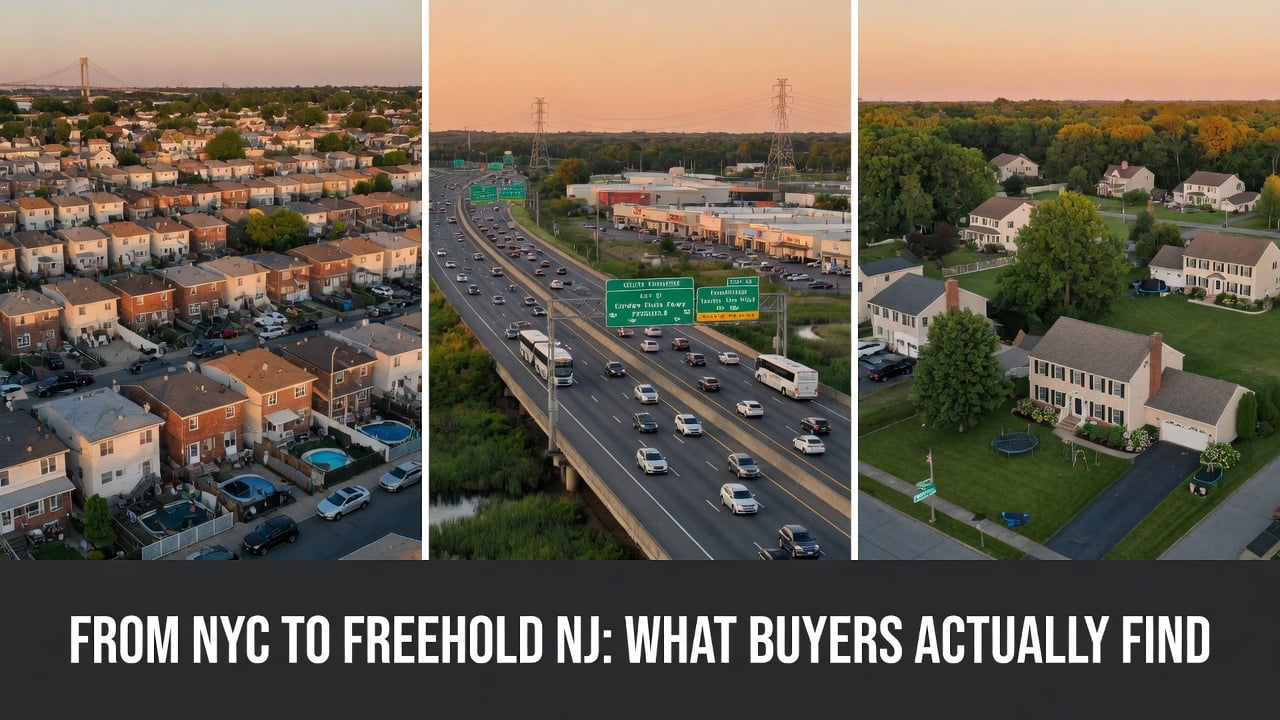
RELOCATOR GUIDE
Every week, buyers from Brooklyn, Queens, and Staten Island open a real estate app, set their budget, extend their search radius past the inner-ring New Jersey suburbs, and watch Freehold appear. The combination of price, space, and Monmouth County location puts it in front of buyers who were not specifically looking for it — and enough of them keep looking to make it one of the most active relocation destinations in Central New Jersey for NYC-area households in 2026.
This post is for the buyer who has seen Freehold in the search results and wants to understand what is actually there before driving down. It covers the price comparison against NYC and Staten Island, the honest commute math, the rental-to-ownership calculation that makes the move financially logical, and what buyers consistently find surprising when they arrive. For the full market data on what is happening with prices and absorption, see the Freehold NJ market report for 2026. For the neighborhood breakdown, see the Freehold neighborhood value guide. This post is the relocator-specific version of that story.
■ THE PRICE COMPARISON
The price comparison between Freehold and the NYC metro is where the conversation usually starts — and where most buyers realize the move is worth taking seriously. Freehold's blended median sale price in early 2026 was $489,000.* Staten Island's median in the same period was running in the $650,000 to $700,000 range depending on neighborhood and property type.* Brooklyn's median for detached or semi-detached housing in outer neighborhoods was north of $800,000 for anything with a private yard. Queens ranged widely but comparable outer-borough detached product was generally priced above $700,000.
The absolute dollar gap is real, but the more relevant comparison is what each budget physically delivers. That is where Freehold's advantage becomes concrete rather than abstract.
| Budget | Staten Island | Freehold Borough | Freehold Township |
|---|---|---|---|
| $450,000 | Small attached home, limited South Shore; condo or co-op elsewhere | 3-bed colonial or cape, some renovation likely | Townhome or entry-level attached |
| $600,000 | Modest detached home, competitive market, small lot | Renovated 3-bed colonial, good condition | 4-bed colonial, ½-acre lot, 2-car garage |
| $750,000 | Updated detached home, Todt Hill / Emerson Hill tier | Premium Borough block, fully renovated | 4–5 bed colonial, ¾-acre, updated systems |
| $1,000,000 | Todt Hill luxury tier, custom home on larger lot | Top-tier Borough asset, rare | Polo Club / luxury estate tier, 4,000+ sq ft |
* Approximate ranges based on closed-sale data, Q1 2026. Individual property values vary by specific address and condition.
The pattern is consistent across every budget tier: Freehold Township, in particular, delivers more physical space — indoor square footage, outdoor lot area, garage capacity — per dollar than comparable Staten Island product at the same price point. The buyer who spends $600,000 on Staten Island is getting a modest detached home on a tight lot in a competitive market. The buyer who spends $600,000 in Freehold Township is getting a four-bedroom colonial on a half-acre lot with a two-car garage. That is not a marginal difference. It is a fundamental change in how the household lives day to day.
■ THE COMMUTE
Freehold has no NJ Transit rail station. That is the first and most important thing NYC buyers need to understand before they fall in love with a property here. Every other commute conversation flows from that fact.
NJ Transit bus routes serve the Route 9 corridor in and around Freehold, with service to the Port Authority Bus Terminal in Midtown Manhattan. Door-to-desk times for Midtown-bound commuters from central Freehold typically run 90 minutes to two hours each way depending on traffic, bus schedule, and final destination within Manhattan. Buyers targeting Lower Manhattan or the Financial District can shave some time by driving to a ferry or to a closer NJ Transit connection point, but there is no version of the Freehold-to-NYC commute that produces a 45-minute door-to-desk experience.
COMMUTE OPTIONS FROM FREEHOLD — REALISTIC TIMES
NJ Transit Bus → PABT Midtown
90–120 min
Door-to-desk. Varies by traffic and schedule.
Drive → Staten Island Ferry → Manhattan
90–120 min
Goethals → SI Expressway → Ferry. Variable.
Drive → Turnpike → Holland Tunnel
60–90 min
Off-peak. Peak hour adds 30–45 min at tunnel.
The honest version of the Freehold commute conversation looks like this: for a household where one person commutes to Manhattan and the other works locally or remotely, the math is very workable two or three days a week. For a household where both adults commute to Manhattan five days a week, Freehold is a significant daily time investment that needs to be stress-tested on an actual Tuesday morning before the contract is signed, not hypothetically modeled on a Sunday afternoon.
The buyers who are landing in Freehold from NYC in 2026 are overwhelmingly hybrid workers — professionals who go to the office two or three days a week and work from home the rest. For that profile, 90 minutes each way two or three times a week is a manageable trade for 500 additional square feet, a backyard, a garage, and a school district they chose deliberately. The calculus is different from what it was in 2019, and Freehold's buyer pool has expanded accordingly.
COMMUTER NOTE
Before you sign a contract in Freehold, make the commute on a weekday morning during the hours you would actually be traveling. The bus schedule, the traffic on Route 9, and the Port Authority Bus Terminal at 8:45am are all real variables that look different on paper than they do in practice. Budget the commute at its worst case, not its best case, and decide from there.
■ THE RENT-TO-OWN MATH
Many NYC and Staten Island buyers who end up in Freehold are not making a pure ownership decision when they first arrive. They are making a rental decision — leasing a Freehold property first to validate the commute, the community, and the school district before committing equity. That staging pattern is healthy and the Freehold rental market supports it: average monthly rent of $2,693 in early 2026, with three-bedroom detached colonials typically achieving $2,200 to $2,800 per month.*
The rent-to-own transition math in Freehold is straightforward to model. A household renting a three-bedroom colonial at $2,500 per month is paying $30,000 per year in housing costs with no equity accumulation and no tax benefit. A household that purchases a comparable property at $520,000 with a conventional mortgage at current rates of approximately 6.1% — putting 20% down — is carrying a monthly mortgage principal and interest of roughly $2,500 to $2,600, plus taxes and insurance. The all-in monthly ownership cost is higher than the rental cost in year one. The difference is that the ownership payment is building equity in a market where the ratable base expanded nearly 60% in seven years.
The specific numbers vary by property, down payment, and rate — and all of this should be modeled with a lender and an accountant before any decision is made. But the directional truth is that the gap between renting and owning in Freehold is narrower than in most NYC-adjacent markets, and the equity and appreciation case on the ownership side is supported by real, documented market dynamics rather than speculative assumptions.
■ THE STATEN ISLAND BUYER SPECIFICALLY
Staten Island buyers occupy a specific position in the Freehold buyer pipeline that is worth addressing directly. The Island and Freehold share more cultural and geographic DNA than most people who haven't lived in both places realize. The commute to Manhattan from Staten Island — via the Expressway, the Goethals, and the ferry or the Verrazano — is already a significant daily undertaking for most Island residents. The transition to a Freehold commute via bus or car does not represent as dramatic a lifestyle change as it might for a buyer arriving from Midtown or the Upper West Side.
The social infrastructure also transfers more cleanly than buyers expect. Staten Island's Italian-American community, its food culture, and its suburban homeowner orientation are all echoed in Freehold's demographic profile and community character. Buyers who have spent their entire lives surrounded by a specific kind of outer-borough suburban culture find Freehold familiar in a way that more architecturally distinct or demographically different NJ markets are not. That cultural continuity lowers the psychological friction of the move and shortens the time it takes to feel at home.
The price dynamic is also specific to the Staten Island buyer. As documented in our Staten Island market report for Q1 2026, Island prices have been rising steadily — the median in early 2026 is running above $650,000 in many neighborhoods. The Staten Island seller who has built equity over the past several years is arriving in Freehold with a meaningful down payment and a competitive offer capacity. They are not the marginal buyer in this market. They are frequently the cash-heavy, fast-moving buyer who wins the bidding competition that the first-time buyer from the city loses.
■ WHAT BUYERS FIND WHEN THEY ARRIVE
Buyers who make the drive to Freehold for the first time consistently report three surprises — things they were not expecting based on the market data and the listing photos alone.
The downtown is real. NYC buyers arrive conditioned to expect a car-dependent suburb with no pedestrian infrastructure and a strip mall serving as the town center. Freehold Borough's Broad Street restaurant and retail corridor surprises people. It is not the West Village. But it is a functioning downtown with independently owned restaurants, a farmers market, street-level retail, and enough evening activity to sustain a social life without driving to a regional mall. For the buyer who was resigned to losing all walkable community life as the price of a New Jersey move, the Borough's downtown is a genuine discovery. Our Red Bank restaurant guide gives a sense of what the broader Monmouth County dining scene looks like — Freehold's Borough downtown fits into that regional context.
The price spread is wider than expected. Buyers searching Freehold often expect a relatively uniform price range given the single zip code. What they find is a market that runs from sub-$400,000 condominiums in the Borough core to $1.2 million custom estates on Militia Hill Road in the Township — a spread that reflects two separate municipalities with fundamentally different housing stocks. Navigating that spread requires understanding the Borough vs. Township distinction before you start touring, not after. The Borough vs. Township buyer's guide is the fastest way to get oriented.
The market moves faster than they expected. NYC buyers are not unaccustomed to competitive markets. But the Freehold market's 16 to 22 days to pending and its 1.000 median sale-to-list ratio surprises buyers who assumed a suburban NJ town 45 miles from the city would be a slower-paced search. It is not. Correctly priced, well-maintained properties in Freehold enter contract within two to three weeks of listing, and 45.2% of transactions close above asking price. Buyers who arrive in Freehold planning to take several months to decide and make a few lowball offers will lose several properties before adjusting their approach.
■ THE LIFESTYLE CASE
The financial case for leaving is well-documented — more space, lower price, equity accumulation. What is less often articulated is the lifestyle case, which for many buyers is ultimately the deciding factor.
Fifteen miles to the Jersey Shore is a number that registers differently once you have lived with it. Asbury Park, Spring Lake, and Belmar are all within 20 to 25 minutes of most Freehold addresses under normal traffic conditions. For a household with children, having the Shore as a practical weekend destination rather than a multi-hour undertaking changes how summer actually feels. The Monmouth County park system, the Freehold Raceway Mall's expanding experiential amenity, and the network of farm-to-table restaurants in the broader Central Jersey area give the area a quality-of-life infrastructure that is genuinely competitive with what most outer-borough NYC neighborhoods offer — without the density and the noise that comes with it.
The school district question is the final piece. Freehold Borough and Freehold Township feed into separate school systems — Borough students attend Freehold Borough High School while Township students enter the Freehold Regional High School District. Both systems have their advocates, and the right choice depends on the specific priorities of the family evaluating them. The point is that both represent a meaningful upgrade in the breadth of school options relative to what many NYC buyers are leaving behind — and school quality is consistently one of the top two reasons Prodigy clients from the city cite when asked why Monmouth County specifically.
For buyers who are still in the early stages of figuring out where in New Jersey they want to be — weighing Freehold against other Monmouth County markets or against towns in Union or Middlesex County — the county-by-county breakdown of where NYC buyers are relocating is a useful starting point. The full Prodigy neighborhood map across NJ and Staten Island is at prodigyre.com/communities.
If you are coming from New York and want a direct conversation about whether Freehold fits your specific situation — budget, commute schedule, school priorities, and timeline — call Anthony Licciardello at (718) 873-7345. The initial conversation is worth having before you are scheduling showings, not the morning of your first tour.
* Freehold median sale price and days on market per closed-sale data, Q1 2026. Staten Island median price per closed-sale data, Q1 2026. Rent figures per listing-side rental market trackers, early 2026. National average rent per home value index data, early 2026. Commute times are estimates based on typical conditions — actual times vary significantly by departure time, traffic, and specific origin and destination addresses. Mortgage payment estimate is illustrative only and does not account for taxes, insurance, HOA, or other ownership costs. All figures subject to change. This post does not constitute financial, legal, or investment advice.
FAQ
Q
Is Freehold NJ a good place to move from NYC?
For the right buyer profile, yes. Freehold delivers more interior square footage, more land, and lower acquisition prices than comparable NYC or Staten Island properties. The Borough's walkable downtown and Monmouth County's Shore proximity add genuine lifestyle value. The trade-off is commute — Freehold has no rail station, and NYC-bound commuters are looking at 90 minutes to two hours each way via bus or car. For hybrid workers commuting two or three days per week the math works well. For five-day commuters it requires honest evaluation before committing.
Q
How long is the commute from Freehold NJ to NYC?
There is no direct NJ Transit rail service from Freehold. NJ Transit bus routes serve the Route 9 corridor with service to the Port Authority Bus Terminal. Door-to-desk times for Midtown commuters typically run 90 minutes to two hours depending on traffic and schedule. Driving to the Turnpike and connecting to the Holland Tunnel runs 60 to 90 minutes off-peak with significant variation at peak hours. Make the commute on a real weekday morning before signing a contract — not on a Sunday afternoon.
Q
How do Freehold NJ home prices compare to Staten Island?
Freehold's blended median of $489,000 sits below Staten Island's early 2026 median of roughly $650,000 to $700,000 — but the more relevant comparison is what each budget physically delivers. At $600,000 in Freehold Township, a buyer typically gets a four-bedroom colonial on a half-acre lot with a two-car garage. At $600,000 on Staten Island, the same budget produces a more modest detached home on a tighter lot. The space-per-dollar advantage favors Freehold meaningfully at most price points.
Q
What do NYC buyers find surprising about Freehold NJ?
Three things come up consistently. First, the Borough's downtown — buyers expecting a car-dependent suburb find a functioning restaurant and retail corridor on Broad Street that delivers genuine walkable community life. Second, the price spread — the gap between sub-$400,000 Borough condos and $1.2 million Township estates within the same zip code surprises buyers who assumed a uniform market. Third, the market speed — 16 to 22 days to pending and 45.2% of transactions closing above asking price is not what most buyers expect from a market 45 miles from the city. Properties go fast here. Arriving with a clear decision framework is not optional.
Prodigy Real Estate is an innovative real estate company offering high-end video production, home valuation services, purchasing, and home sales. Serving New York and New Jersey.