
Anthony Licciardello | August 1, 2026
Westfield, NJ
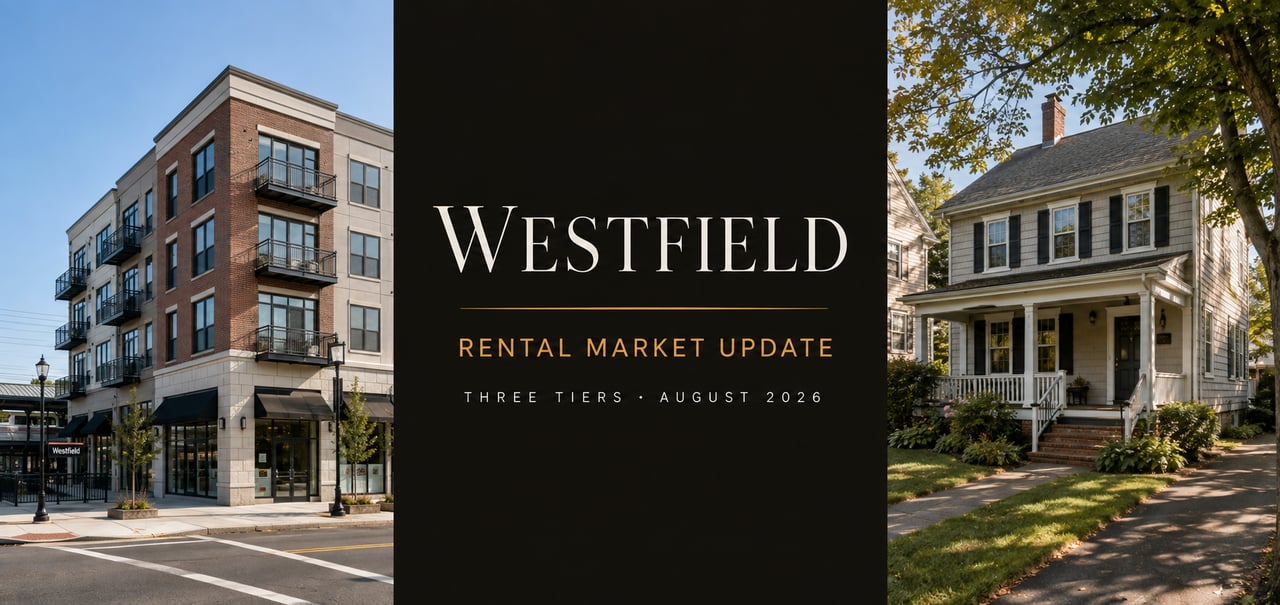
One tracker says Westfield rents rose 23.7% this year. Another says they fell 0.6%. Both are describing the same town in the same period, and the gap between them is not an error — it is the arrival of six new buildings that a legal obligation required Westfield to zone for. Almost nobody's rent went up 23.7%.
Westfield has three rental markets wearing one name: older garden and privately-owned apartments, a new luxury tier delivered over the past few years, and single-family houses. Blend them and you get a citywide median near $3,159 that describes none of them. The +23.7% year-over-year figure now circulating is property-mix distortion, not rent inflation — it is the statistical shadow of roughly 380 units across five affordable-housing overlay sites entering the sample. The mix-controlled evidence says otherwise: the same houses relisting a year later are flat, and one property asked $5,000, cut to $4,600, and came back at $4,700. Meanwhile the luxury tier carries a premium that widens as units get larger — 39%, then 65%, then 68% — which puts a luxury three-bedroom apartment at roughly $6,250 against a three-bedroom house at $3,945. That top end looks exposed. The middle of the luxury tier does not: normalise the house comps for tenant-paid water, sewer, trash, lawn and snow and the two-bedroom premium falls to single digits. The honest caveat is that all of this is asking rents. Nobody publishes Westfield's absorption, and absorption is what would settle it.
A landlord pricing a Westfield rental today is choosing between published figures that disagree by twenty-four percentage points on direction. This update explains why, names the buildings in each tier, and tests the one question worth testing — whether the luxury end is as solid as its asking rents suggest. Every figure below is an asking rent from active listings rather than a signed lease, and I flag where the evidence runs thin rather than papering over it.
The citywide median is a blend of three markets that have nothing to do with each other. Pricing off it — in either direction — costs you a month of vacancy or several hundred a month for the whole term. Call Anthony directly: 718-873-7345 →
The conventional apartment tier is the most legible part of this market. Central Park advertises one-bedrooms around $2,000 and two-bedrooms from $2,400. Duncan Hill asks roughly $2,255 for a one-bedroom, $2,640–$2,905 for two, and up to $3,385 for three. Hamilton House sits near $2,490 and $2,795-plus. That produces a defensible baseline of about $2,200–$2,450 for a conventional one-bedroom and $2,700–$3,050 for a conventional two-bedroom, assuming sound condition and parking but no amenity package.
The luxury tier is a genuinely separate product. Westfield Crossing spans $3,000–$5,500. Parkside at Westfield asks from roughly $3,665 for one bedroom, $4,395-plus for two, and around $6,395 for three. The Parker sits near $3,050 for a large one-bedroom, The Andrew at $3,150-plus and $5,000-plus, and The Franklin currently shows a two-bedroom near $5,200. Those rents buy elevators, newer construction, fitness facilities, covered parking, lounges and a short walk to the station — and a renovated private apartment should never be priced against them.
And single-family houses are a third market with its own logic. The clearest current three-bedroom asks are 113 Florence Avenue at $3,900, 628 Central Avenue at $3,850, 742 Central Avenue at $3,990 and 299 Springfield Avenue at $4,700 — a mean of $4,110 and a median of $3,945. Four-bedroom examples run 518 Downer Street at $4,250, 1425 Boynton Avenue at $4,500 and a Hort Street property near $5,900.
One number needs quarantining. A 4,550-square-foot 2016-built five-bedroom was offered at $12,200 a month. That is a bespoke result, not a comparable, and any average that includes it is broken. Where the luxury tier came from matters too — several of these buildings sit on Westfield's affordable-housing overlay sites, which we cover in our overlay-zone explainer.
Two trackers, same town, same period, opposite conclusions. One reports a median of $3,159, up 23.7% year over year. Another reports a townwide average of $3,530, down 0.6%. That is a spread of 24.3 percentage points on the direction of travel, and a landlord quoting either one in isolation is quoting a coin flip.
The pattern inside the disagreement gives the game away. On one-bedrooms the two sources are 1.7% apart — effectively identical. On two-bedrooms they are 24.9% apart, on three-bedrooms 13.3%, and on four-bedrooms 27.6%. Agreement collapses as unit size rises, because the large-unit sample is thin and mixes luxury apartments with single-family houses. The one-bedroom market is legible; everything above it is a sampling problem.
And the 23.7% has a specific, non-mysterious cause. Westfield zoned five affordable-housing overlay sites for roughly 380 units, and the buildings that resulted — 333 Central Avenue among them, with nine low- and moderate-income units inside the structure, and The Parker on the former car wash site at 339 West Broad — entered the rental sample over a compressed period at $3,000-plus rents. A median rises when expensive new inventory joins the pool even if not one existing tenant's rent changed. That is composition, not inflation, and it is the signature of a compliance programme rather than a hot market.
The only mix-controlled evidence available says flat. Track the same properties across two years and the distortion disappears. 1425 Boynton Avenue was marketed around $4,400–$4,500 in 2025 and asks $4,500 in 2026. 299 Springfield Avenue opened at $5,000 in 2025, was cut to $4,600, and returned in 2026 at $4,700 — a property that told you its own clearing price by failing at the first number. Conventional single-family rents in Westfield are flat to mid-single-digit, and no honest reading of these two histories produces 23.7%.
Bedroom medians as reported by two commercial rental data platforms for periods through mid-2026. Neither is certified data and the platforms use different methodologies, samples and property-type definitions. The two agree almost exactly on one-bedrooms and diverge progressively as unit size rises — a sampling artifact rather than a market signal. Verify against active listings before setting a rent.
The luxury premium widens as units get larger, which is the wrong direction. Against the conventional tier, luxury one-bedrooms carry roughly a 39% premium, two-bedrooms 65%, and three-bedrooms 68%. That matters because the larger the unit, the more directly it competes with renting an entire house — and in Westfield, houses are inexpensive relative to apartments.
Run that comparison and the top of the tier looks exposed. A luxury three-bedroom apartment sits around $6,250. A three-bedroom single-family house asks a median $3,945. That is a 58% premium for the same bedroom count, no yard and no garage. Even loading the house with $300–$450 a month of tenant-paid water, sewer, trash, lawn and snow, the premium only falls to about 42–47%. That is a great deal of money to ask for an elevator.
A second signal points the same way, and it is easy to miss. 333 Central Avenue is a new building — one of the overlay sites — yet it asks about $2,408 for a one-bedroom, which is 3.3% below Hamilton House's older, conventional $2,490. New product pricing beneath old product is either aggressive lease-up or genuine absorption difficulty. It is not what a landlord with a queue does.
There is also a structural constraint specific to this line. The Raritan Valley Line is the only NJ Transit line physically connected to Penn Station New York whose passengers must transfer at Newark for most trains. Off-peak one-seat service exists; peak generally does not. A renter paying $5,200 a month has alternatives in Hoboken and Jersey City on PATH, or in the Midtown Direct towns — and that transfer weighs far more heavily on the $5,200 renter than the $2,400 one. Worth watching: NJ Transit has committed to shoulder-peak one-seat-ride service once sufficient new cars are delivered, with full all-day service dependent on the Hudson Tunnel, Penn Station expansion and the Hunter Flyover.
Now the honest counter-case, because the weakness is narrower than it first appears. Normalise the house comps for those tenant-paid services and the luxury two-bedroom premium falls from 20% to roughly 8–12% over a three-bedroom house — defensible pricing for full services, no maintenance and a lock-and-leave building. The three-bedroom luxury conclusion rests on essentially one unit. And supply pressure just eased: One Westfield Place's 205 units are paused following the Saks Chapter 11 filing, with 138 of them age-restricted in any case — covered in our briefing on the pause.
House median from four active three-bedroom single-family asking rents. Luxury midpoints are the centre of defensible pricing bands drawn from active asking rents at six buildings; the three-bedroom luxury figure rests on approximately one unit and should be treated as indicative only. The $300 service load is an illustrative adjustment for tenant-paid water, sewer, trash, lawn maintenance and snow removal where a lease imposes them — it is not a surveyed figure. All amounts are asking rents, not signed leases.
Everything above is an asking rent. Structural weakness is a claim about absorption, and absorption is measured by things no public tracker publishes for this town: days on market, concession packages, occupancy rates and signed-lease rents against asking. A single month of free rent or a waived amenity fee at one of the newer buildings would answer the question outright — a landlord with a queue does not give away rent. Until that evidence exists, the responsible position is the one stated here: the top of the luxury tier looks exposed, the middle looks defensible, and the newest product is pricing like it wants to fill quickly.
Price against the tier, never the town. A conventional one-bedroom belongs at $2,200–$2,450, a conventional two-bedroom at $2,700–$3,050. A luxury one-bedroom sits at $3,050–$3,400 and a luxury two-bedroom at $4,300–$5,200. A three-bedroom house in average updated condition belongs at $4,000–$4,350 — dated or single-bath, $3,700–$3,950; strongly renovated with two baths, garage and a usable yard, $4,500–$4,800. Ordinary four-bedroom houses cluster at $4,500–$5,000.
The features that actually move rent are walkability to downtown and the station, in-unit laundry, central air, updated kitchens and baths, two or more full bathrooms in family-sized rentals, garage or reliable off-street parking, finished lower-level space, a usable fenced yard, and pet permission. Presentation carries more weight than bedroom count on its own.
Normalise your comps for expenses before you trust them. Some single-family listings hand the tenant water, sewer, trash, lawn maintenance and snow removal on top of utilities. A house asking $4,700 on those terms can cost a tenant several hundred a month more than an apartment with services included — and tenants do that arithmetic even when landlords don't.
And remember what Westfield does and doesn't regulate. There is no rent control ordinance here — you may set any initial rent and propose any increase at term end. What you are bound by instead is a $500,000 liability insurance minimum, an annual certificate registration carrying a $500–$5,000 penalty, and landlord registration that goes to the Town or the State depending on unit count. Our guide to what actually governs a Westfield landlord sets all of it out.
Studio about $2,100 · one bedroom $2,200–$2,450 · two bedroom $2,700–$3,050 · three bedroom apartment or townhome $3,500–$3,950.
One bedroom $3,050–$3,400 · two bedroom $4,300–$5,200 · three bedroom $6,000–$6,500, on very thin evidence and the part of the market most worth testing before you commit to a number.
Dated or single bath $3,700–$3,950 · average updated $4,000–$4,350 · strong renovation, two baths, garage and yard $4,500–$4,800.
Ordinary stock $4,500–$5,000. Above $5,500 generally requires stronger renovation, more bathrooms, a garage, a particularly desirable location or flexible terms.
The five-bedroom range runs from roughly $5,750 to a $12,200 outlier. There is no band here — each is priced on its own merits, and no average including that top figure is usable.
Bands reflect active asking rents as at August 2026, not signed leases. A realistic signed lease may fall modestly below asking depending on condition, timing and concessions. Verify against current comparable listings before pricing.
Before you set a number, ring two of the luxury buildings and ask what they're offering on a twelve-month lease starting next month. You are not shopping — you are looking for the word concession. A month free, a waived amenity fee, waived parking, or a "current special" tells you the top of this market is competing on price rather than filling at ask, and that repositions every band beneath it. It takes ten minutes, it is free, and it is better information than any published median for this town.
"A landlord showed me the 23.7% figure and asked what it meant for his two-family on the north side. Nothing. It means six new buildings opened. His tenants' rents didn't move and neither did his comps. That's the whole trick of a townwide median in a small market — it tells you what changed about the inventory, not what changed about the rent. The number I'd actually watch is whether the new buildings start giving away a month. That's the one that moves everybody's price."
— Anthony Licciardello, Broker, The Prodigy Team
Pricing a Westfield rental means knowing which of three markets your property is actually in, and reading a townwide median for what it is. I'm Anthony Licciardello, Broker of The Prodigy Team, dual-licensed in New York and New Jersey, a member of the Staten Island Growth Management Task Force, and a former Director of Community Affairs in the Bloomberg Administration.
Our Above the Streets cinematic drone series extends that reach — aerial storytelling that markets entire towns rather than single listings.
Anthony Licciardello · Broker, The Prodigy Team · 718-873-7345
Send the address, bedrooms, baths, square footage, condition, parking and target lease date. We'll price it against genuinely comparable active listings in the right tier — not a townwide median blending six luxury buildings with a garden apartment.
Did Westfield, NJ rents really rise 23.7%?
Almost certainly not for existing tenants. The figure reflects property-mix distortion: roughly 380 units across five affordable-housing overlay sites entered the rental sample over a compressed period at $3,000-plus rents, which lifts a townwide median even if no existing rent changed. A second tracker reports the same market down 0.6% over the same period. The mix-controlled evidence — the same houses relisting a year later — shows flat to mid-single-digit movement.
What is the average rent in Westfield, NJ?
Published figures range from about $3,159 to $3,530 depending on the source, but neither describes a real property because Westfield has three separate rental markets. More useful working numbers: a conventional one-bedroom at $2,200–$2,450, a conventional two-bedroom at $2,700–$3,050, a luxury one-bedroom at $3,050–$3,400, a luxury two-bedroom at $4,300–$5,200, and a three-bedroom single-family house at roughly $4,000–$4,350 in average updated condition.
Is Westfield's luxury rental market weakening?
The evidence points to exposure at the top of the tier rather than a general decline. The luxury premium widens with unit size — roughly 39% on one-bedrooms, 65% on two, 68% on three — which puts a luxury three-bedroom apartment near $6,250 against a three-bedroom house at a median $3,945. One new overlay building also asks about 3.3% below older conventional stock for a one-bedroom. Against that, the two-bedroom premium narrows to single digits once house comps are normalised for tenant-paid services, and 205 further units at One Westfield Place are paused. Confirming weakness would require absorption data — days on market, concessions and signed-lease rents — which no public source publishes for this town.
How much does it cost to rent a house in Westfield, NJ?
Current three-bedroom asking rents run roughly $3,850 to $4,700, with a median near $3,945 and a mean near $4,110. Four-bedroom examples run about $4,250 to $5,900, with ordinary stock clustering at $4,500–$5,000. Check whether the lease hands the tenant water, sewer, trash, lawn maintenance and snow removal — those obligations can add several hundred dollars a month to the real cost.
Can a Westfield landlord raise rent to match the new buildings?
Westfield has no rent control ordinance, so there is no local percentage cap on an increase at the end of a term. But the new luxury buildings are not comparables for an older private apartment — their rents include a premium for elevators, newer construction, fitness facilities, covered parking and amenity services. Pricing conventional stock against luxury asking rents typically produces a vacancy rather than an increase, and New Jersey's Anti-Eviction Act separately makes an unconscionable increase unenforceable.
Westfield Has No Rent Control — What Actually Governs a Landlord Here
Selling a Westfield Multifamily — The Certificate You Need First
Westfield's Short-Term Rental Rules — 60 Days, Four Guests, and the Pool You Cannot Rent
Westfield's Affordable Housing Overlay Zones — 380 Units, 5 Sites
One Westfield Place, Paused — What the Saks Bankruptcy Means
Westfield Homes for Sale
Market date August 1, 2026. All rent figures in this update are asking rents from active listings, not signed leases, and a realistic signed lease may fall modestly below asking depending on condition, timing and concessions. Citywide medians of approximately $3,159 with bedroom medians near $2,420 (one bedroom), $2,930 (two bedroom), $3,690 (three bedroom) and $4,200 (four or more bedrooms), together with the reported 23.7% year-over-year change, per one commercial rental data platform; a townwide average of approximately $3,530 down 0.6% year over year with bedroom medians near $1,900, $2,460, $3,660, $4,180 and $5,360, per a second platform. Neither is certified data; the platforms use different methodologies, samples and property-type definitions, and Westfield's rental inventory is small enough that townwide figures are highly sensitive to a few large or new properties. Building-level asking rents for Central Park, Duncan Hill, Hamilton House, 333 Central, Westfield Crossing, Parkside at Westfield, The Parker, The Franklin and The Andrew, and single-family asking rents for 113 Florence Avenue, 628 Central Avenue, 742 Central Avenue, 299 Springfield Avenue, 518 Downer Street, 1425 Boynton Avenue and the Hort Street and Harding Street properties, are compiled from public listing platforms and should be verified against the New Jersey MLS. Repeat-listing histories for 1425 Boynton Avenue and 299 Springfield Avenue are drawn from prior-year listing records. Luxury premium calculations compare midpoints of defensible asking bands and are arithmetic on those bands, not a hedonic analysis; the three-bedroom luxury figure rests on approximately one observed unit. The $300–$450 monthly service adjustment applied to single-family comparisons is illustrative for leases imposing tenant-paid water, sewer, trash, lawn maintenance and snow removal, and is not a surveyed figure. Affordable-housing overlay figures of approximately 380 units across five sites, including nine low- and moderate-income units at 333 Central Avenue and development at 339 West Broad Street and 753 Grandview Avenue, and One Westfield Place figures of 205 residential units including 33 affordable and 138 age-restricted, per Town of Westfield materials and public reporting; One Westfield Place is subject to the Chapter 11 filing of Saks Global, parent of the project entities. Raritan Valley Line service characterisation per NJ Transit schedules and public advocacy materials: the line is the only NJ Transit line connected by track to Penn Station New York whose passengers must transfer at Newark Penn for most trains, with some weekday off-peak one-seat service; expanded shoulder-peak one-seat service has been publicly committed subject to equipment delivery, and full all-day service depends on the Hudson Tunnel Project, Penn Station expansion and the Hunter Flyover — confirm current schedules with NJ Transit. No conclusion in this update about absorption, vacancy or concessions is supported by primary data, because none is published for this market. Market conditions change continuously. This is general market commentary, not an appraisal, a rental valuation of any specific property, or legal advice.
Prodigy Real Estate is an innovative real estate company offering high-end video production, home valuation services, purchasing, and home sales. Serving New York and New Jersey.