
Anthony Licciardello | August 30, 2026
Westfield, NJ
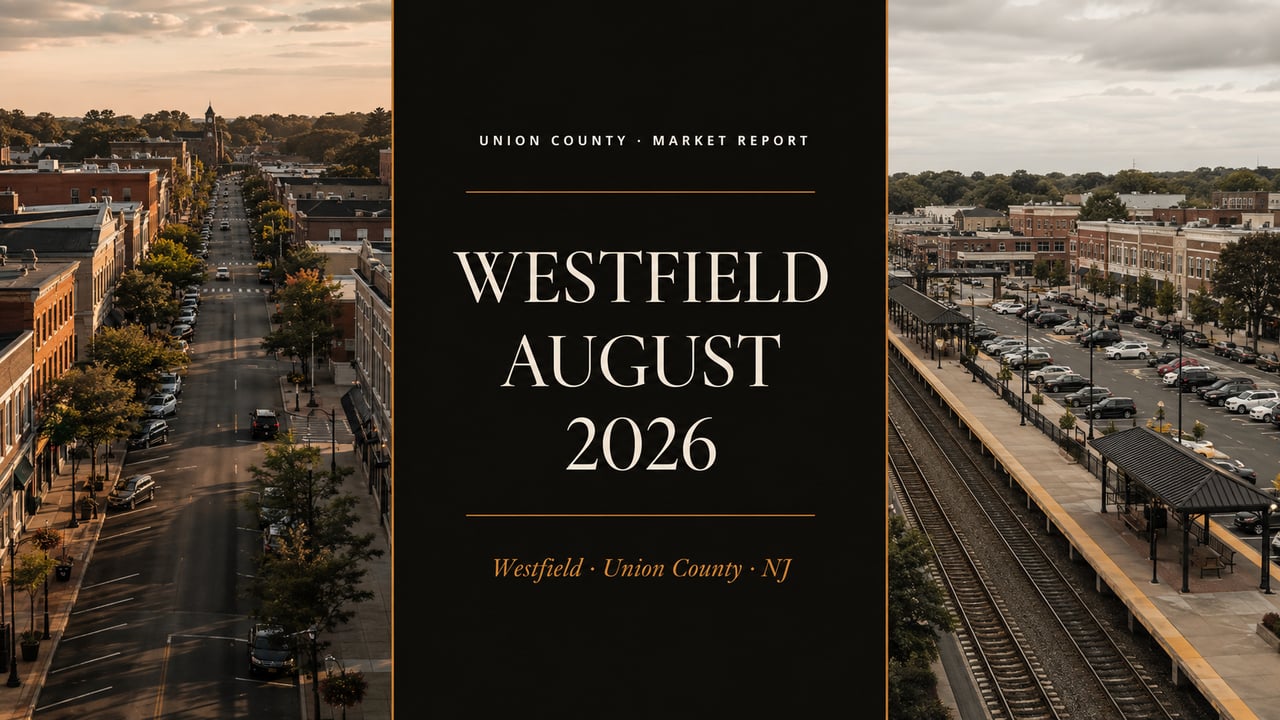
Union County · Market Report · August 30, 2026
Two commercial buildings on the town's prime corridors changed hands inside twelve days. One Westfield Place did not move. And the residential numbers everyone is quoting deserve a closer look than they usually get.
$11.2M Two downtown Westfield trades, 12 days | Paused One Westfield Place status | ~$1.4M Westfield median sale, 2026 | June 26 Developer's parent exited Chapter 11 |
There is a tension running through Westfield right now that most market commentary misses entirely. The town's largest redevelopment — fourteen acres around the shuttered Lord & Taylor and the train station lots — has been frozen for most of 2026 while its developer's parent worked through bankruptcy court in Texas. And in the same period, private capital has been buying stabilized buildings on Westfield's best corridors at prices that assume the downtown is going to be fine.
Both things are true at once. That is the August story, and it is more interesting than either half on its own.
Stabilized retail and mixed-use in a high-income commuter downtown is a supply-constrained asset class, and Westfield's core is about as constrained as Union County gets. Two transactions in August put a number on that.
Property | Price | Reported detail |
|---|---|---|
219–225 E. Broad St. | $5,900,000 | ~$454/sq ft · lifestyle retail tenancy · implies roughly 13,000 sq ft |
251 North Ave. W. | $5,260,000 | ~$295/sq ft · bank and healthcare credit tenancy · implies roughly 17,800 sq ft |
The spread between them is the useful part. A buyer paid roughly fifty percent more per square foot on East Broad Street than on North Avenue West in the same twelve-day window. That is the difference between a high-footfall retail address on the main shopping street and a larger, more efficient building on a transit-adjacent secondary corridor with longer-duration credit tenancy. Two different assets, two different underwriting cases, both clearing.
For a residential seller, the relevance is indirect but real: capital that underwrites Westfield's downtown at $454 a foot is not betting on the town center losing its draw. The walkable core is the asset that carries residential pricing here, and it just got repriced upward by people with money at risk.
"People ask me whether the stalled project downtown is a warning sign. I'd point them at these two closings instead. When investors buy the buildings around a paused development at full price, they're telling you they think the town works without it."
Here is the sequence, because the headlines have been conflating two different things.
Saks Global — parent of Saks Fifth Avenue, Neiman Marcus and Bergdorf Goodman — filed for Chapter 11 in January 2026 in the U.S. Bankruptcy Court for the Southern District of Texas, carrying debt from its 2024 acquisition of Neiman Marcus. That mattered to Westfield because SW Westfield, formerly Streetworks, and the eight LLCs formed for One Westfield Place are Saks subsidiaries, and they were included in the filing.
The court confirmed a reorganization plan in early June, and on June 26 the company emerged from Chapter 11 renamed Exemplar Luxury Group — roughly 75% less debt, $500 million in exit financing, and a store count cut by about two-thirds.
None of that is a groundbreaking announcement. The redevelopment remains on hold. Westfield's mayor has said there is no substantive update while the process resolves, and has signalled that the pause may become an opportunity to revisit the plan's scale, design and mix of uses against changed market conditions. The town says it still owns all the municipal parking lots in the plan, has not been financially exposed, and that property taxes on the site have been kept current; it retained bankruptcy counsel and is pursuing a cure claim of roughly $153,000, a figure a resident bankruptcy attorney has publicly characterised as a pending objection rather than settled money.
One item deserves more attention than it has received: during the bankruptcy the company moved to reject leases on closed Lord & Taylor stores, including Westfield's. Anyone modelling a timeline for this site should be tracking that, not the parent company's rebrand. Our full briefing on the pause, the town's financial position and what it means near the station is here.
Westfield from above — the East Broad Street commercial corridor and the station district as they stand today, shot in house by our FAA-licensed drone operation. This is the downtown that carries Westfield's value with or without the redevelopment.
Westfield is a small market. Roughly nine to fifteen single-family sales close in a slow month, and that sample size does something specific to the statistics: it makes the median trustworthy and the growth rate almost meaningless.
So rather than publish a single figure per indicator, here is each one as a band, with what actually supports it.
Indicator | Band | Grade |
|---|---|---|
Median sale price | $1.40M – $1.45M | CORROBORATED |
Sale-to-list ratio | 103% – 107% | CORROBORATED |
Median days on market | 16 – 26 days | INDICATIVE |
Year-over-year price change | Not publishable | INSUFFICIENT |
This is worth explaining, because you will see confident year-over-year figures for Westfield everywhere.
Across the major public sources this year, Westfield's reported annual price change has ranged from slightly negative to above sixty percent, depending on whether the source is measuring median sale price, average sale price, or a modelled home-value index — and depending on which month it caught. In a town where a single estate closing can move the median by six figures, all of those can be arithmetically correct and none of them describes the market.
A number that swings that wide is not an insight. Publishing one implies a precision the data cannot carry, and any seller who prices off it is pricing off noise. The median level is solid; the growth rate is not, and we will say so until the sample supports otherwise.
Inventory. Active single-family listings in the entire town have been running in the mid-thirties. In a 6.7-square-mile municipality of roughly 30,900 people with a one-seat ride to Manhattan, that is the whole explanation for the sale-to-list ratio. Every well-prepared listing is an event, and it is the scarcity — not the growth rate — that gives sellers their leverage. Current inventory is on our Westfield homes for sale page.
Five closings at or above $2 million inside a single month is unusual for a town this size, and it is the clearest read available on the top of the Westfield market.
26 Manchester Drive · Aug. 17 | $2,999,053 |
714 E. Broad Street · Aug. 20 | $2,900,000 |
125 Tudor Oval · Aug. 3 | $2,275,000 |
206 Munsee Way · Aug. 7 | $2,231,000 |
1091 Minisink Way · Aug. 5 | $2,000,000 |
Note the price at 26 Manchester Drive. A closing that lands on an odd figure like $2,999,053 rather than a round number is the signature of an escalation clause — a buyer who agreed to beat any competing offer by a set increment, up to a ceiling. It is direct evidence of a contested bidding round, and it tells you more about competition at the top of this market than any ratio does.
Aggressive bidding in Westfield is not confined to the estate tier, and the mid-market results are arguably the more useful signal because there are more of them.
Put 199 Lincoln next to 957 Willow Grove and you have the entire pricing argument in two lines. One seller priced at the ceiling and got the ceiling. The other priced below it and let the market find the number. Both strategies worked; they produced very different outcomes.
"A twenty-one percent overbid isn't luck and it isn't a hot market doing it on its own. Somebody priced that house to start a conversation instead of ending one. That's a strategy decision, and it's the conversation I want to have with a Westfield seller before we ever pick a number."
The gap between a full-price sale and a twenty-one percent overbid is not luck — it is a pricing decision made weeks before the listing goes live. Getting that decision right requires knowing which four or five Westfield properties genuinely compete with yours, not a blended town median or an automated estimate.
We prepare a broker valuation on your specific address — the real comparable set, the condition and lot adjustments, the strategic price band, and an honest read on where your house sits in the current inventory. No obligation, and no automated valuation dressed up as analysis.
Core indicators in this report are published as bands with confidence grades rather than point estimates, per Prodigy Vortex methodology. Median sale price and sale-to-list ratio clear the corroboration gate against multiple independent sources. Days on market is graded INDICATIVE — public sources disagree materially, partly because some measure active listings and others measure closed sales.
Year-over-year price change is graded INSUFFICIENT and is not published. Source dispersion exceeds the tolerance at which any single figure would be meaningful.
Individual commercial and residential transactions above are reported figures pending confirmation against Monmouth and Union County records and the MLS. Confirm any specific closing before using it as a comparable to support a listing price or an offer.
With the developer's parent formally out of Chapter 11, Westfield said it intends to evaluate its options. Any move to revisit scale, design or use mix would be the most consequential land-use decision in town, and it would come through the council in public.
The lease-rejection question is the real gating item on the site's future, and it has drawn far less coverage than the rebrand. Watch the docket, not the press releases.
Two trades in twelve days is a signal; a third in the fourth quarter makes it a trend. A downtown Westfield retail trade above $500 a foot would reset the corridor's underwriting.
Active listings in the mid-thirties are what produce the sale-to-list ratio. If September and October bring the usual post-Labor Day supply and that count climbs meaningfully, the over-ask premium compresses first — before prices do.
Westfield's value has never depended on One Westfield Place. The downtown, the schools, the one-seat train and a chronic shortage of listings were here before the plan and will be here whatever happens to it — and the August commercial trades say investors agree. If you are buying near the station, price the house on the downtown that exists today and treat the redevelopment as unpriced optionality. If you are selling, the leverage is real, but it comes from scarcity, not from a growth rate anyone can actually verify.
No. The developer's parent emerged from Chapter 11 on June 26 as Exemplar Luxury Group, but that is a corporate milestone, not a construction one. The project remains paused, no groundbreaking date has been set, and Westfield has signalled it may revisit the plan's scale and design before anything proceeds.
Roughly $1.40 to $1.45 million, which is well supported across independent sources. Be sceptical of anyone quoting a precise year-over-year growth rate alongside it — in a market this small those figures diverge wildly depending on method and month.
Often, but not always, and the premium varies enormously by how the property was priced. August produced a full-price closing at $1,695,000, a 9% overbid at $899,250, and a reported 21% overbid at $1,305,000. Budget for competition on anything well presented, and have your financing and inspection position settled before you tour.
Not in any fundamental way. The drivers of Westfield pricing are unchanged, and an idle housing project arguably tightens supply further. The nuance is hyper-local near the station: the pause removes the near-term construction disruption and the longer-term amenity upside at the same time. The vacant department store shell also remains exactly that.
The Prodigy Team tracks Westfield the way most brokerages track their own listings — council agendas, court dockets, county records and the closed tape, month over month. That reporting runs on the same digital infrastructure that feeds our New York buyer pipeline into Union County: a hyperlocal content engine, in-house 4K cinematic drone production, and a NY/NJ/FL relocation community most brokerages cannot match.
You can see the town from the air on Above the Streets, our cinematic drone series covering the downtown corridor and the station district discussed in this report.
Corporate and development reporting: U.S. Bankruptcy Court for the Southern District of Texas, Saks Global Chapter 11 (filed January 2026, plan confirmed June 2026, emergence June 26, 2026 as Exemplar Luxury Group); Associated Press, Bloomberg, WWD and Retail Dive coverage of the emergence; CoStar News reporting on SW Westfield and the eight project LLCs; Town of Westfield One Westfield Place project record and public statements at Town Council. Residential and commercial figures: Monmouth and Union County property records and MLS-derived brokerage and consumer property portals. Indicator bands and grades follow Prodigy Vortex methodology; see the disclosure above.
Prodigy Real Estate is an innovative real estate company offering high-end video production, home valuation services, purchasing, and home sales. Serving New York and New Jersey.