
Anthony Licciardello | May 10, 2026
Staten Island
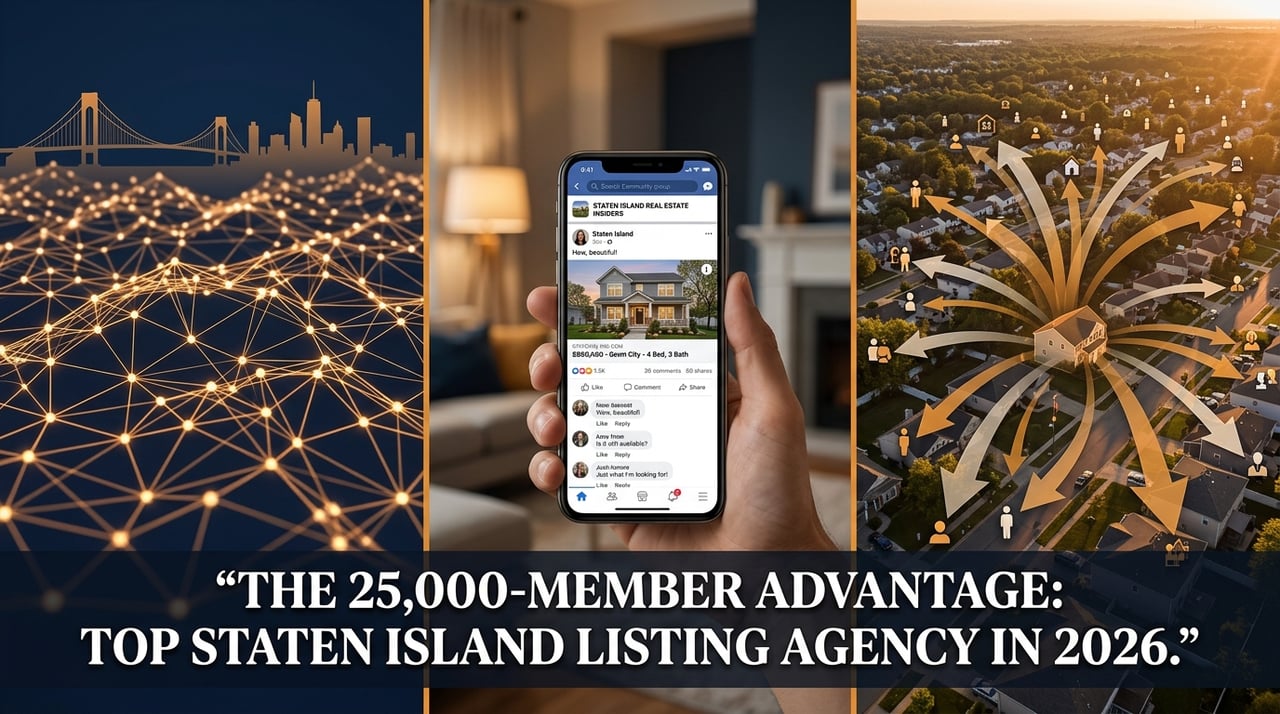

The single asset that most clearly separates the top Staten Island real estate agency from every other brokerage in the borough is one that can't be bought, can't be replicated quickly, and can't be claimed without proof: a real, qualified buyer audience built over years of consistent content and engagement.
Most Staten Island brokerages, when they talk about distribution, mean syndication. They mean their listing will go on Zillow, Redfin, Realtor.com, the MLS, and a few smaller portals — the same channels every other listing in the borough goes on, reaching the same passive audience of portal browsers. That's not distribution. That's table stakes. Real distribution is owning a direct line to the buyers who are already mid-research on Staten Island, already qualified, already pre-educated on the neighborhoods, and already trusting the source delivering the listing. That kind of audience takes years to build, costs nothing to reach, and produces conversion rates that paid advertising simply cannot match.
This is Layer 4 of our 2026 Staten Island listing playbook: the structural advantage of a 25,000-member relocation community, why pre-intent buyer audiences outperform paid ad spend at every measurable level, and what it actually takes for a top Staten Island listing agency to build distribution most competitors will never have.
106 Overlook Avenue, Dongan Hills Colony — the kind of cinematic listing content distributed directly into the 25,000-member relocation community on day one of launch.
Listing syndication — getting a home onto Zillow, Redfin, Realtor.com, and the major portals — used to be the meaningful part of distribution. Twenty years ago, even ten years ago, the brokerage that had better portal placement reached more buyers. That advantage is gone. Syndication is now universal, automatic, and undifferentiated. Every Staten Island listing ends up on every major portal, regardless of the agent or brokerage behind it. That isn't distribution any more than putting a sign in the yard is distribution. It's the floor.
The actual distribution question in 2026 is not where a listing appears, but who sees it and when. A listing that appears on Zillow but doesn't surface in front of the qualified buyers actively researching the neighborhood is invisible during the most consequential phase of the buyer's decision. A listing that goes directly to a 25,000-member relocation community on launch day reaches a pre-qualified, pre-educated audience the same hour. The difference between those two scenarios is not marginal. It's the difference between competing for a buyer's attention in a sea of 200 other listings and arriving in a buyer's feed as the most relevant home in their active research.
The top Staten Island listing agency understands this distinction structurally. The rest of the market is still treating MLS syndication as the marketing plan.
A 25,000-member audience is meaningless if the members are bots, disengaged followers, or geographic mismatches. The relevant question is not size — it's composition. The Prodigy NY/NJ/FL relocation community is built around the specific buyer segments most active in the Staten Island and New Jersey shore markets, and the audience composition reflects that targeting. Three core member groups make up the majority of the community:
NYC residents researching a move to Staten Island or New Jersey. The largest segment. Manhattan and Brooklyn buyers researching Staten Island neighborhoods, family-formation-stage couples planning a move outside the city, professionals weighing hybrid-work-driven relocations. These members are mid-research, not casually browsing — most are 30 to 90 days out from a real decision when they join, and they stay engaged because the content addresses what they're actually trying to figure out.
Florida and out-of-state inbound households. Families returning to the metro after Florida tax experiments, remote workers reconsidering their relocations, retirees coming back to be closer to grandchildren, military and corporate transferees moving into the NYC region. These buyers research from a distance, often have firm timelines tied to school enrollment or job start dates, and need exactly the kind of neighborhood-level, lifestyle-rich content the community provides.
Local Staten Island and New Jersey residents in active market mode. Move-up buyers researching their next home, multi-generational households planning the next purchase, investors tracking specific neighborhoods. This segment is smaller but converts fastest because they're already in-market, often with financing in place.
The result is an audience where the average member is materially more qualified than the average buyer reached through any paid channel. They've self-selected into the community because the content is relevant to a real decision they're making. They've already invested time engaging. By the time a new listing launches into that community, the audience reading it isn't being introduced to Staten Island for the first time — they've already done the introduction themselves over weeks or months.
The most common alternative to a real community audience is paid advertising — Facebook ads, Instagram ads, Google ads, retargeting campaigns. These channels work in the sense that they put a listing in front of eyeballs. They don't work in the sense that the eyeballs they put it in front of are mostly cold, mostly unqualified, and mostly disengaged. The conversion math reflects that.
Three structural reasons a community audience outperforms paid ad spend:
The combination of these three structural gaps means a single Prodigy listing launch into the relocation community typically generates more qualified buyer engagement in the first 48 hours than a paid ad campaign would generate over a full week of spend. That's not a marketing claim — it's the predictable mathematical result of distributing into a pre-intent audience versus a cold one. The community is the asset. Paid ads are a fallback for brokerages that don't have one.
A 25,000-member community is not a marketing asset that can be turned on. It's an asset that has to be earned, one piece of content at a time, over years.
The structural advantage of a 25,000-member relocation community is not the size. The size is downstream of the actual moat, which is time and consistency. A real audience of this scale takes seven-plus years of consistent content publishing, community management, and audience-building to construct. There is no shortcut. Buying followers produces fake numbers. Paying for ad-driven group growth produces low-quality, transient members who churn out within weeks. Hiring a social media agency to run a relocation community for a brokerage produces administrative output, not audience trust.
A competing Staten Island brokerage that decided today to build a 25,000-member relocation community as a competitive response would, optimistically, be at this scale in 2033. By that point, the brokerage that started seven years earlier has 50,000 members, deeper trust, more content history, more conversion data, and stronger algorithmic positioning across every distribution channel. The gap doesn't close — it widens.
This is what makes the community layer of the digital media stack different from every other layer. Production quality can be improved with budget. YouTube channels can be grown faster than communities because YouTube's discovery algorithm rewards content quality more than time. SEO authority can be accelerated with strategic content investment. But community audiences are durably accumulative — they exist because of relationship history that can't be compressed. The top Staten Island listing agency has this asset because Prodigy started building it years before anyone else in the borough understood it would matter.
A new Prodigy listing launching into the relocation community follows a specific, repeatable distribution sequence on day one. Each step compounds the next:
Hour 0. The cinematic listing video is published to the Prodigy YouTube channel and shared into the relocation community. The community sees it the same hour. Members already researching Todt Hill or Tottenville get the listing as part of content they were already going to consume.
Hours 1–6. Initial engagement layer — views, comments, saves, direct messages from members asking specific questions about the home, the neighborhood, or the timeline. This is the highest-quality buyer engagement that exists in real estate marketing because it comes from members who have already self-identified as serious.
Hours 6–24. The video begins surfacing in YouTube's algorithmic recommendations to non-community members researching similar Staten Island content. The community engagement signal accelerates the algorithm's confidence in the content, which extends reach beyond the community itself.
Days 2–4. The first wave of qualified tour requests arrives. Because community members have already pre-researched the neighborhood, the conversion from "watched the video" to "wants to see the home in person" is dramatically faster than from any cold-source channel.
By the time most competing Staten Island listings have generated their first portal click, a Prodigy listing has already delivered to 25,000 qualified buyers, accumulated dozens of high-intent engagement signals, surfaced into algorithmic recommendation systems beyond the community, and generated a first wave of qualified tour requests. The first 96 hours of distribution are not comparable. They're operating on different infrastructure entirely.
Community size is one of the easiest claims for a brokerage to inflate, and one of the hardest for a seller to verify without knowing what to look for. A brokerage can join a few unrelated Facebook groups and claim "community access." A brokerage can run a stagnant page with a few hundred followers and call it a community. A brokerage can buy followers and present them on a slide. None of these reach the standard of an actual functioning audience asset.
The specific questions a seller should ask any Staten Island brokerage claiming a community distribution layer:
A brokerage that answers all five questions with specifics, screenshots, and on-screen verification has a real community. A brokerage that hesitates, deflects, or pivots to general marketing language doesn't. The Prodigy relocation community can be verified through any of these five questions in real time. The seller doesn't have to take the claim on faith — every part of the answer is observable.
Of every layer in the digital media stack, the community distribution layer is the one that most clearly separates the top Staten Island listing agency from every other brokerage in the borough. Production capability can be matched with investment. YouTube channels can be built with consistency over a few years. SEO authority can be accelerated with strategic content. But a 25,000-member relocation community of pre-qualified, pre-educated buyers takes the entire arc of a brokerage's history to construct, and once built, becomes a permanent structural advantage every listing benefits from.
For Staten Island sellers in 2026, the community distribution question is structural and unambiguous. A listing agent at a brokerage with a real community delivers that listing into 25,000+ qualified buyers on day one. A listing agent at a brokerage without one delivers the same listing into MLS syndication and hopes the right buyer happens to find it. The two outcomes are not in the same category — and the price-and-speed difference between them is the most direct measurement of why this layer matters.
The full five-layer Prodigy digital media stack integrates the community with cinematic production, YouTube discovery, and SEO authority into a single distribution system that no competing Staten Island brokerage operates. Each layer makes the next one stronger. Together, they produce closing outcomes — the $4.4M Nicolosi Drive, the Forked River price-per-square-foot record, and a continuing record of asking-or-above closings — that the rest of the market can't replicate without the same infrastructure.
To learn how the Prodigy relocation community distribution will be applied to your specific listing, or to verify any of the community claims in this piece in real time, contact Anthony Licciardello directly.
The single most defensible advantage of the top Staten Island listing agency in 2026 is direct distribution into a 25,000-member relocation community of pre-qualified buyers. Listings launch the same day to an audience already researching Staten Island and New Jersey neighborhoods, generating qualified engagement that paid advertising cannot match at any budget. Competing brokerages relying on MLS syndication alone reach a fundamentally different — and smaller — buyer pool.
A relocation community outperforms paid ads structurally on three dimensions: pre-qualification (members joined because they care about the topic, ad audiences are reached because an algorithm guessed), trust transfer (members already trust the source from prior content consumption, ad audiences start every interaction at zero trust), and cost-per-qualified-view (community distribution is free per impression, paid ads run into five-figure budgets to reach equivalent audiences). Engagement and conversion rates run 10 to 30 times higher in community distribution than in cold paid campaigns.
Building a real, functioning relocation community of 25,000 pre-qualified members takes seven or more years of consistent content publishing, community engagement, and audience-building. There is no shortcut that produces real audience trust at this scale. Bought followers, paid group growth, and outsourced social media management produce administrative output but not durable community trust. The community layer is the one part of the digital media stack that cannot be accelerated with budget alone.
To verify a Staten Island brokerage's community is real, ask for the exact member count and active history, check the most recent post for live engagement matching the audience size, request the geographic and demographic composition, ask for the specific day-one distribution process for new listings, and review engagement metrics on the brokerage's last three listing launches. Real communities answer all five with specifics and screenshots in real time. Inflated or claimed-only communities cannot.
Prodigy Real Estate is an innovative real estate company offering high-end video production, home valuation services, purchasing, and home sales. Serving New York and New Jersey.