Anthony Licciardello | April 12, 2026
Real Estate
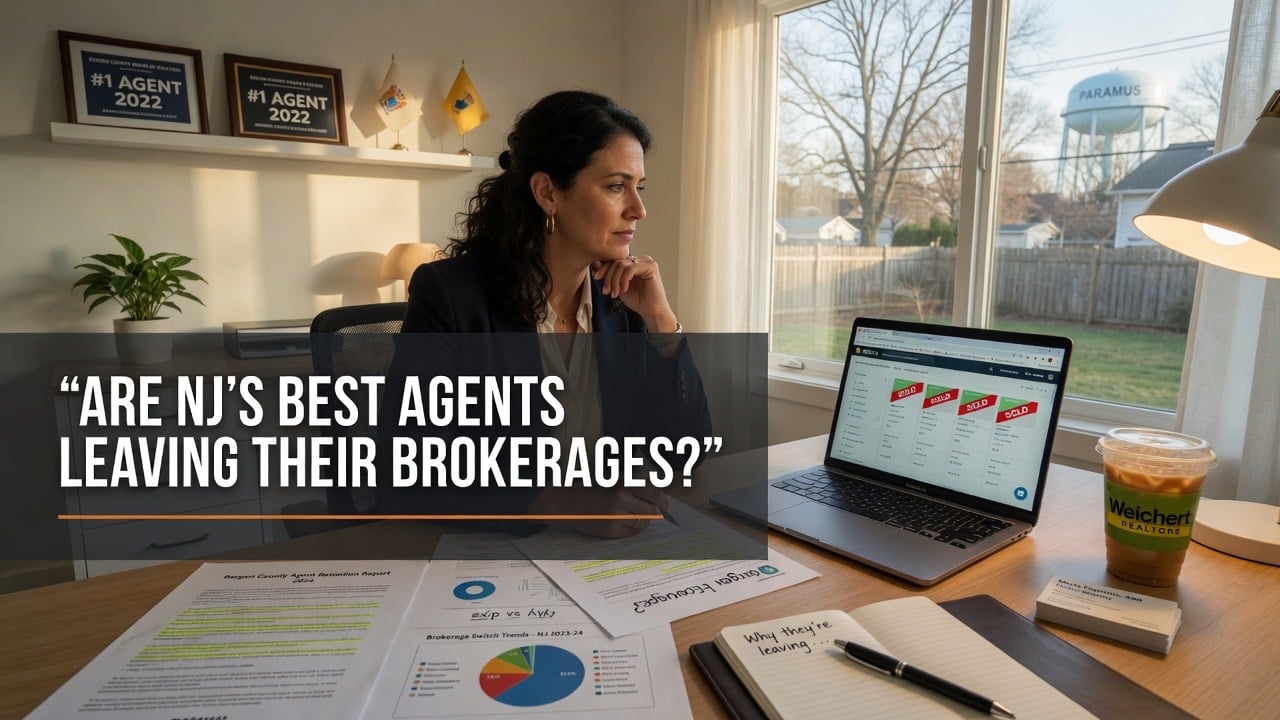
The best real estate agents in New Jersey aren't disappearing from the industry. They're disappearing from the rosters of the companies that were supposed to support them. If you've been watching colleagues go quiet — fewer open houses, fewer posts, fewer answered calls — you're not imagining a trend. You're watching a structural problem finally surface in a market that no longer has room to hide it.
This isn't a piece about the market being hard. You know the market is hard. Rates have compressed buyer pools. Inventory is still tight in most NJ suburbs. Sellers who locked in at 3% aren't listing. Commission structures are under legal and cultural pressure for the first time in a generation. All of that is real. But agents who are struggling right now aren't struggling because the market is hard. They're struggling because the infrastructure around them was never built for a market that demands this much.
There's a difference between a difficult market and a broken system. One of them you can outlast. The other one you leave.
By the Numbers
87%
of new agents leave real estate within five years — NAR
1.6M+
licensed agents in the U.S. competing for a shrinking transaction pool
<12
transactions per year for the median active agent nationally
The National Association of Realtors has tracked this pattern for decades: roughly 87% of new agents leave the profession within their first five years. That number gets cited a lot, usually as a cautionary warning to rookies. What it rarely gets used as is what it actually is — an indictment of how most brokerages onboard, support, and retain the people who join them.
A 87% failure rate in any other industry would trigger a structural review. In real estate, it gets reframed as natural selection. The logic goes: this business is hard, and not everyone is cut out for it. That framing benefits brokerages that collect fees, desk charges, and E&O splits regardless of whether their agents close anything. It does not benefit agents.
It's also worth noting that this attrition isn't evenly distributed. Agents who enter a market with genuine mentorship, a defined territory, and actual lead infrastructure — not just a desk and a Zoom training calendar — perform and persist at meaningfully higher rates. The problem isn't agent quality. It's brokerage architecture.
The pitch from a large national or regional franchise goes something like this: come for the brand recognition, stay for the training, grow with the network. It's compelling. It's also largely a set of inputs with no guaranteed outputs. A brand name on the sign does not make your phone ring. A training library does not teach you how to own a neighborhood. A network of thousands of agents in unrelated markets does not give you a buyer for the listing on Elm Street.
What most big-box environments actually deliver is generic infrastructure — CRM systems that weren't designed for your market, marketing templates that look identical to every other agent in the system, and "support" that arrives in the form of a weekly sales meeting where the top producers talk and everyone else listens.
The model works well for the brokerage. It collects splits and fees at volume regardless of agent performance. It works well for the top 5% of producers who already had the skills and client base before they walked in. For everyone in the middle — the working agent who is genuinely trying to build something — it's an expensive education in what support is supposed to look like but rarely does.
Here's what doesn't get discussed enough: when every agent at your brokerage uses the same logo, the same color palette, the same listing presentation template, and the same boilerplate social posts — you are not building a personal brand. You're building brand equity for someone else's company. The moment you leave, you take nothing with you that the market recognizes as distinctly yours.
In a market where buyers and sellers make decisions based on trust and local expertise, generic is not a style choice. It's a liability.
Buyers and sellers in New Jersey — whether they're moving from Brooklyn, relocating from the Midwest, or trading up within the same county — are not choosing agents based on franchise flags. They're choosing based on evidence. Who knows this town? Who has content that shows up when I search for it? Who's been showing up consistently in the places I'm actually looking?
That evidence lives in blog posts, YouTube videos, neighborhood market reports, and Facebook community groups — the kinds of hyperlocal digital touchpoints that build credibility before any phone call is made. A buyer who has watched three videos about Red Bank real estate before they ever contact an agent has already made a trust decision. The question is whether that decision points to you or someone else.
This is not theoretical. Search volume for town-specific real estate terms — "Red Bank NJ homes for sale," "moving to Westfield NJ," "best neighborhoods in Monmouth County" — is driven almost entirely by organic content, not paid placements. The agents who show up in those results are the ones who have been publishing consistently and specifically. That's a skill set. And it requires an environment that treats it as one.
Related Reading
See how hyperlocal content is reshaping one NJ market: Red Bank is being rebuilt from the ground up — and it's all by design
The teams that are actually holding onto good agents right now share a few common traits. They're small enough to operate with intention. They're built around a specific market, not a general geography. And they're running content operations that most traditional brokerages wouldn't recognize as a business function — because they've never had to.
Prodigy Real Estate is one example of how this looks in practice. A Monmouth and Union County independent brokerage also active in Staten Island, Prodigy operates a YouTube channel that has crossed 3,100 subscribers with strong organic search positioning in Red Bank and surrounding markets. Their content isn't promotional in the traditional sense — it's local. Neighborhood history. Development timelines. Market data explained plainly. A 25,000-member Facebook relocation community that functions as a live buyer pipeline, not just a social presence.
The agents inside that kind of ecosystem aren't cold-calling. They're not buying leads. They're building the kind of local authority that compounds — where every published piece of content adds to a body of work that keeps generating trust, and by extension, business. That's a fundamentally different value proposition than a shared logo and a training library.
Consider an agent — call her Maria — who came into real estate after fifteen years in pharmaceutical sales. She was organized, driven, and genuinely good with people. She joined a large regional franchise because the name felt safe and the onboarding looked thorough. Within eighteen months she had completed every training module, attended every sales meeting, and closed nine transactions.
Nine closings in eighteen months isn't failure. But Maria's split, her desk fees, and her marketing spend left her with less net income than she'd projected, and no clearer sense of how to build consistent pipeline. She had been taught scripts, not strategy. She had been given templates, not territory. And she had been surrounded by agents who were either out-producing her by a factor of ten or quietly interviewing at other firms.
What changed for her wasn't a different mindset — she already had that. It was moving into an environment where she was handed a defined farm area, introduced to a content workflow she could actually sustain, and given access to a local audience that already trusted the brand she was joining. Within her first year in that structure, she doubled her transaction count. Not because the market got better. Because the infrastructure finally matched her effort.
Maria is composite — but the pattern is not. This story plays out across New Jersey every year. The market doesn't break agents. The mismatch between an agent's potential and their brokerage's capacity does.
The Infrastructure Gap
73%
of agents say their brokerage provides insufficient lead generation support — Inman survey
2–4×
higher retention among agents with defined farm areas vs. open territories
68%
of buyers begin their home search online before contacting any agent — NAR
If you're having this conversation with yourself — whether you're two years in or twelve — there are a few concrete questions worth asking before you make any move.
Does this brokerage have a defined local presence, or just a wide footprint? There's a meaningful difference between a firm that covers all of NJ and one that has built genuine market authority in specific towns. The latter will teach you something the former cannot.
What does their content operation look like? If the answer is "we have a social media coordinator who posts listings," that's not a content operation. Look for brokerages with YouTube presence, neighborhood-specific blog infrastructure, and active community engagement. That's where leads actually come from in 2026.
Will you own something when you're done? Agents who build personal brand equity inside a content ecosystem — their own videos, their own bylined market reports, their own geo farm — leave every year with more than they came with. Agents who spend years under a generic franchise logo leave with a license and a list of closed transactions that strangers can't verify.
Is there actual mentorship, or just access? Access to a training library is not mentorship. Sitting down with someone who has farmed 3,000 homes in a single NJ zip code, built an audience that follows their market commentary, and can show you the actual mechanics of how a lead converts — that's mentorship. One of those things is common. The other is rare. Know which one you're being offered.
None of this is a knock on any single firm. It's a framework for an honest evaluation. The brokerage that was right for the market five years ago may not be right for the market you're working in today. That's not betrayal. It's strategy.
For a closer look at what a content-driven local market presence actually produces, see what the Red Bank market data currently shows — and how that kind of market-specific publishing creates the visibility most agents are still trying to buy.
Q
What should I look for in a new real estate brokerage?
Look beyond the split and the brand name. Evaluate the brokerage's actual local market presence — do they have search-visible content, a defined geographic focus, and agents who are genuinely building their own reputation rather than borrowing someone else's? A smaller, market-specific team with real digital infrastructure will generally serve a working agent better than a large franchise with generic support systems.
Q
Is it too late to build a personal brand as a real estate agent?
No — and in many NJ markets, the opportunity is wider than it's been in years because most agents still aren't doing it. YouTube, neighborhood-specific blogging, and community group management are genuinely underutilized by the vast majority of working agents. The agents who start building a content presence now will be the ones with compounding search authority in 18 to 24 months. The window is open. It just requires consistency.
Q
What does a tech-forward real estate team actually mean in practice?
It means the team treats digital presence as a business function, not an afterthought. In practice, that looks like a brokerage with its own SEO-optimized content publishing operation, a YouTube channel built around local market authority, active community management across social platforms, and CRM tools that are actually trained on NJ-specific buyer behavior. The word "tech-forward" gets used loosely — the real test is whether those tools are generating actual inbound interest or just checking a box on a recruitment slide deck.
Q
Should I stay at my current brokerage if the market is slow?
A slow market is actually the clearest moment to evaluate your environment honestly. When the transaction volume is high, it's easy to credit the brokerage for results that were really driven by demand. When the market pulls back and your pipeline dries up, you learn quickly whether your current situation is building anything durable — or just giving you a place to sit while you wait for rates to drop. If the answer is the latter, the timing is better than you think for making a move.
Prodigy Real Estate is an innovative real estate company offering high-end video production, home valuation services, purchasing, and home sales. Serving New York and New Jersey.