
Anthony Licciardello | May 15, 2026
Real Estate Career
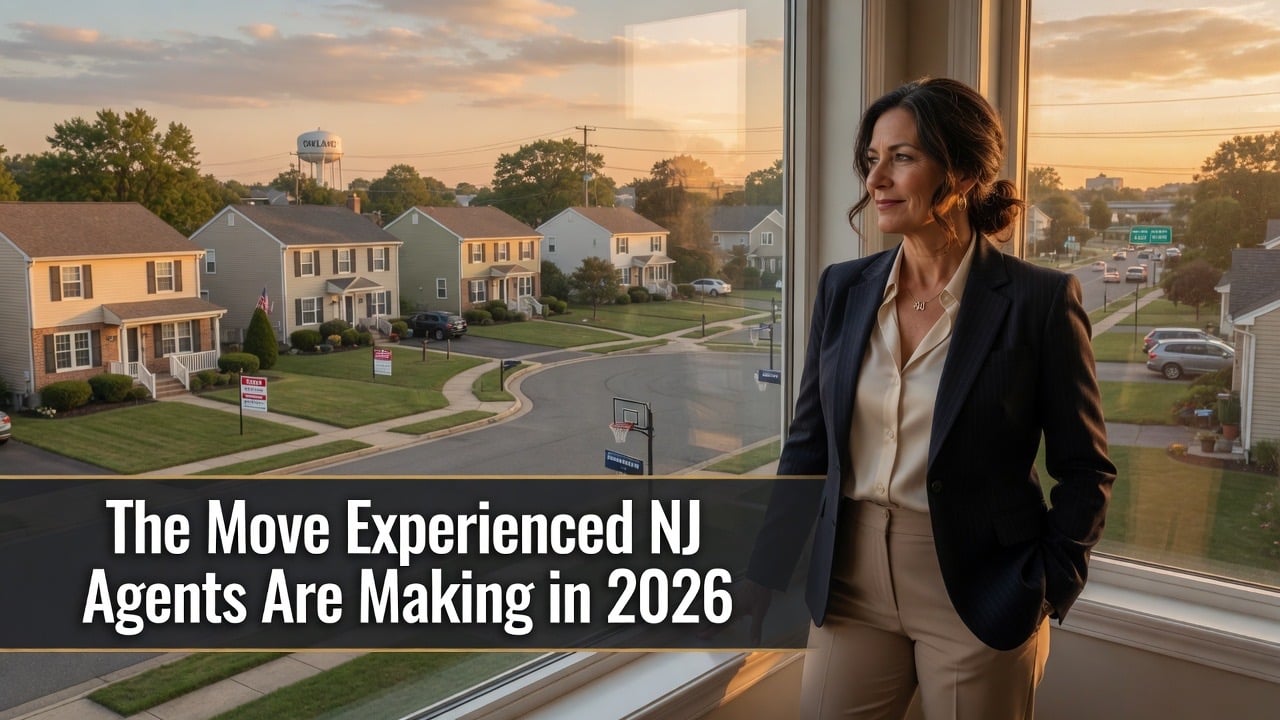
Nobody broadcasts that they're looking. That's not how this works. You're still showing up to the sales meeting. You're still closing deals under the same logo you've carried for years. But quietly — at night, between appointments, after a closing where you did the math on what you actually netted — you're running a parallel evaluation. What would it look like somewhere else? Is the grass greener, or just different dirt?
That's not disloyalty. That's strategy. And the fact that you're doing it quietly says more about your professionalism than it does about any dissatisfaction. The agents who never ask that question are the ones who stop growing — not because the market passed them by, but because they confused comfort with momentum.
This post is for the agent who has built something real — a production record, a client base, a reputation in their market — and is starting to wonder whether their current environment is still the right place to protect and grow it. Not because something is broken. Because something could be better.
The Mid-Career Landscape in 2026
72%
of agents who switch brokerages report higher satisfaction within 12 months — Inman
82%
of clients follow their agent to a new brokerage when the relationship is strong — NAR
5–7 yrs
average tenure before a top-producing agent first seriously evaluates a brokerage move
The conversation about switching brokerages almost always starts with splits. That's the wrong place to start. Splits are visible and easy to compare — but they're rarely where the real cost lives for an experienced producer. The deeper cost is subtler, and it accumulates slowly enough that most agents don't notice it until they sit down and actually run the numbers.
Think about the marketing infrastructure that was never built around your production. The listing presentations you've refined over years that still carry someone else's brand at the top. The client data that lives in a CRM your brokerage owns, not you. The Google reviews that mention your name but attach to a company page you have no control over. The social media content your brokerage posts about your closings — content that builds their brand authority, not yours.
None of that is malicious. It's just how most brokerage relationships are structured — in the brokerage's favor. The agent generates the relationships, the closings, the local credibility. The brokerage captures the brand equity. After five or ten years, a top producer often has a strong market reputation that is almost entirely invisible on the internet because it lives under someone else's logo.
Before any conversation about a move makes sense, there's a set of questions worth sitting with honestly. Not as a checklist for leaving — as a framework for understanding what your current situation is actually worth and what you'd be trading it for.
Who owns the leads your brokerage generates? If the brokerage feeds you leads through a CRM or referral system, find out what happens to those contacts the day you leave. In most franchise environments, the answer is that they stay with the brokerage. That matters more for some producers than others — but it's worth knowing.
What does your digital footprint actually look like? Search your own name in Google. Search your primary market plus "real estate agent." What shows up? Is it you — your content, your profile, your expertise — or is it a page on your brokerage's website that you have no control over? That gap is the difference between a portable reputation and one that belongs to someone else.
Is your brokerage growing your market authority or diluting it? Some environments sharpen an agent's local identity. Others pool it into a generic brand that means nothing specific to buyers in your farm area. If a client who closes with you in Red Bank can't easily find you through a Google search six months later, your brokerage's digital infrastructure is working against your long-term business — not for it.
What would you take with you if you left tomorrow? Your sphere. Your reputation. Your license. Your hustle. Everything else — the CRM, the marketing templates, the brand recognition, the referral pipeline from the corporate website — stays behind. Most agents have more than they think and less than they've built for someone else.
Is there a ceiling here? Not a commission ceiling — a growth ceiling. Is there a path inside your current brokerage that would give you better tools, a more defined market position, and an infrastructure that compounds your effort over time? If the honest answer is no, that's not a reason to panic. It's a reason to have a conversation.
Related Reading
On why the top agents in New Jersey are reconsidering their environments — not out of desperation, but out of strategy: Top NJ real estate agents aren't leaving the business — they're leaving their brokerages.
The fear that holds most experienced agents in place is not about splits or brand names. It's about clients. The working assumption — one that most brokerages are happy to reinforce — is that a brokerage move is a gamble with your relationships. That clients will be confused, that some will drift, that the disruption will cost you more than whatever you were hoping to gain.
The data doesn't support that fear. Research consistently shows that the overwhelming majority of clients follow their agent, not their agent's employer. Buyers and sellers choose people, not logos. The agent who has been their trusted advisor for a decade doesn't lose that relationship by moving to a different brokerage — they take it with them, the same way any professional takes their client relationships when they change firms.
What a well-executed transition actually looks like is straightforward. You communicate the move proactively, personally, and before it becomes public. A short handwritten note or a direct phone call to your top clients — not an email blast, not a Facebook post — that frames the move as a decision you made to serve them better. Most clients don't care which brokerage you're affiliated with. They care that you're still their agent. Lead with that, and the transition is a non-event for most of your book.
A slower market is genuinely lower friction for a transition than a hot one. When transaction volume is compressed, you have fewer pending deals to manage through the paperwork of a brokerage transfer and more time to make deliberate, relationship-centered outreach to your sphere. The agents who say "I'll wait until the market picks up to make a move" often find that when the market does pick up, they're too busy to execute the transition thoughtfully — and then they wait again.
There's no perfect time. But a slow market and a considered decision is a better combination than a hot market and a reactive one.
The Client Retention Reality
82%
of clients follow their agent to a new brokerage when personally contacted — NAR
<30
days is the typical license transfer timeline in New Jersey for an experienced agent
91%
of buyers say they would use the same agent again — what matters is the relationship, not the flag
The pitch for an experienced agent is completely different from the pitch for a new one. A new agent needs training and structure. A veteran producer doesn't need to be taught real estate. What they need is leverage — an environment that takes what they've already built and multiplies it, rather than absorbing it into a generic pool.
Prodigy Real Estate operates as an independent brokerage across Monmouth and Union counties in New Jersey and Staten Island, NY. The infrastructure here isn't built around recruiting volume. It's built around market authority — a YouTube channel with over 3,100 subscribers and organic search positioning in Red Bank and surrounding markets, a 25,000-member Facebook relocation community that functions as a live buyer pipeline, and a geo-farm operation in Red Bank covering roughly 3,000 homes with consistent multi-touch cadences. An experienced producer who steps into that environment isn't starting from zero on digital presence or community recognition. They're adding their production and their client relationships to a platform that's already running.
That's the leverage question worth asking about any environment you're evaluating. Not just what does this brokerage offer — but what does it already have built that your effort can plug into and immediately compound?
Experienced agents often underestimate how much opportunity exists in adjacent markets they haven't fully worked. For producers in the New York metro area, the cross-market dynamic between Staten Island, Monmouth County, and Union County NJ is one of the most active relocation corridors on the East Coast right now. NYC outmigration continues to feed all three markets simultaneously — and the agents positioned closest to that buyer pipeline, with the deepest local content presence, are capturing disproportionate share.
Staten Island's luxury tier is performing at levels that would surprise most agents who haven't been watching closely — a record $8.5M sale in Todt Hill in early 2026 and a luxury segment showing 3–5% annual appreciation potential despite broader market softness. Monmouth County's Shore markets are operating under new elevation and regulatory frameworks that are reshaping value dynamics in ways that demand hyperlocal expertise, not generic market commentary. Union County continues to absorb Brooklyn and Manhattan buyers who want commuter access without the NJ Shore price premium.
None of those markets are saturated with content-forward, digitally positioned agents. That's not a small thing. It's the entire opening.
Related Reading
The full picture on where NYC buyers are going right now — and why Union and Monmouth counties are absorbing the largest share: Where NYC buyers are moving in New Jersey: a county-by-county breakdown.
The objection most experienced agents land on is timing. The market is uncertain. Rates are elevated. Inventory is thin. This isn't the moment to disrupt something that's working. All of that is understandable — and most of it is a way of not having the conversation rather than a genuine evaluation of the circumstances.
The market has been uncertain for three years. Rates have been elevated since mid-2022. If the right conditions for making a deliberate career move were going to arrive on a clean schedule, they would have shown up by now. What actually happens is that agents wait for clarity that doesn't come and find themselves having the same internal conversation two years later — from a position of two additional years of compounding in the wrong direction.
The question isn't whether the timing is perfect. The question is whether the conversation is worth having. For an experienced producer who has genuinely built something and wants to protect and grow it — the answer is almost always yes.
The conversation is the low-stakes part. All it costs is an hour.
A Confidential Conversation
Anthony Licciardello leads Prodigy Real Estate — an independent brokerage with active operations across Staten Island, Monmouth County, and Union County NJ. If you're an experienced producer who has spent years building under someone else's flag and is starting to ask whether the infrastructure around you is still worth what it costs, Anthony is available for a direct, pressure-free conversation about what a different environment looks like in practice.
This isn't a recruitment pitch. It's a peer-level conversation about fit, market opportunity, and what kind of platform actually serves a producer at your level. Everything discussed is completely confidential — no announcements, no obligations, no pressure.
Call or text Anthony directly:
Serving experienced agents exploring opportunities in Staten Island, Monmouth County, and Union County NJ. All conversations are confidential.
Q
Is it worth switching real estate brokerages after 10+ years in the business?
That depends entirely on what you're evaluating and why. If your current environment is genuinely supporting your production, growing your local authority, and building something portable that you own — there's a strong argument for staying. If the honest answer is that you've outgrown the infrastructure and you're doing more for the brokerage's brand than it's doing for yours, then the question isn't whether to move, it's how to do it well. Tenure is not a reason to stay. It's just a reason to move carefully.
Q
How do I move my clients to a new brokerage without losing them?
The research is consistent on this: clients follow agents, not logos. The agents who lose clients in a transition are typically the ones who let the news spread on its own — through social media, through the office rumor mill, before they've had a personal conversation. Proactive, personal outreach to your top relationships before the move becomes public is the single most important thing you can do. A direct call or handwritten note that leads with your commitment to continuing to serve them — not an explanation of your career decision — keeps retention high in almost every case.
Q
What should an experienced real estate agent look for in a new brokerage?
Beyond the split conversation, look for three things: ownership, leverage, and specificity. Ownership — do you control your leads, your content, your digital profiles? Leverage — does the brokerage have infrastructure already running that multiplies your effort rather than starting from zero? Specificity — is this a brokerage with genuine local market authority in your area, or a wide-footprint operation that treats your market the same as every other zip code in the state? A smaller, market-specific team with real digital infrastructure will outperform a large franchise on all three for most mid-career producers.
Q
What's the difference between joining an independent brokerage vs. a franchise in NJ?
Franchise brokerages offer brand recognition, standardized systems, and a national referral network. The tradeoff is that you're building under someone else's brand, operating within someone else's systems, and paying for overhead that benefits the parent company's market position as much as your own. Independent brokerages that have built genuine local authority — through content, community, and market-specific positioning — often give experienced producers more control, better economics, and a cleaner path to building something they actually own. The right choice depends on what you're trying to build and who you want to be known as in your market.
Prodigy Real Estate is an innovative real estate company offering high-end video production, home valuation services, purchasing, and home sales. Serving New York and New Jersey.