
Anthony Licciardello | August 12, 2026
Toms River, NJ
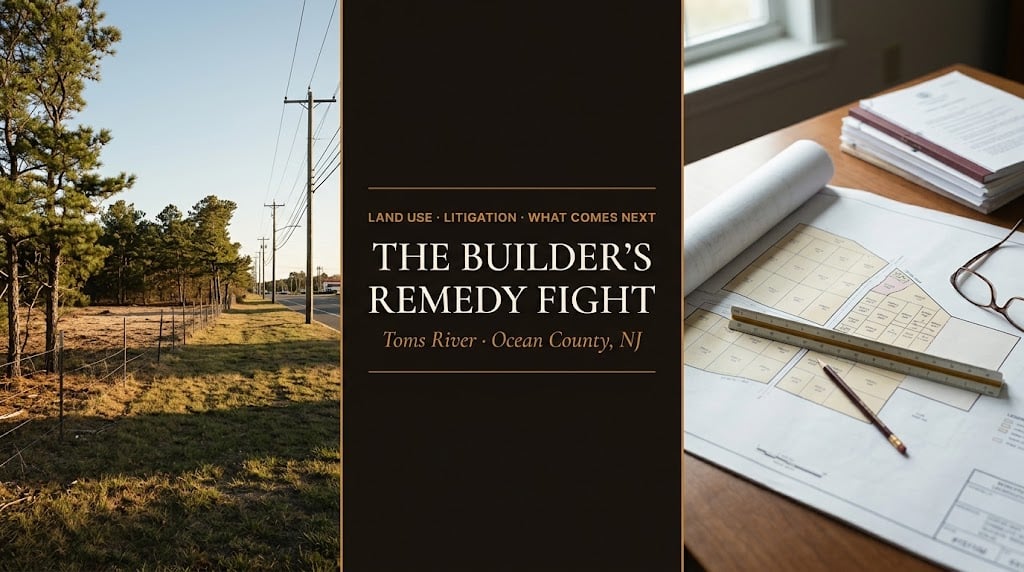
A township-owned parking lot on the river, conveyed to a developer for one dollar. Twin towers approved, then shrunk, then killed. A federal grant turned down. Three redevelopment plans repealed in a single night — and a judge who, fourteen months later, threw that repeal out in a thirty-one-page opinion. Toms River's downtown waterfront has been the most contested ground in Ocean County for a quarter century, and as of 2026 the fight is not over. Here is the whole arc, and what it means if you own, buy, or invest anywhere near the river.
The story runs in four acts. The ambition: a business improvement district established in late 2002 and a decades-long effort to turn a riverfront of parking lots and aging motels into a walkable downtown with apartments, a two-level boardwalk, and a waterfront amphitheater. The rise: by 2019 the township had designated a redeveloper for two municipally owned lots on Irons and Water streets and won a $5.66 million federal grant to rebuild the road loop connecting the Parkway to the waterfront; by December 2021 the planning board had approved 285 apartments in twin towers reaching 112 feet, with 16,000 square feet of retail, roughly $4 million in public improvements, and a $68 million price tag. The reversal: a 2023 election fought on density, a default declaration in May 2024, termination of the redevelopment agreement that August — with the motel site once conveyed for a dollar reverting to the township and the federal grant turned down — and, that December, a 4–2 council vote repealing three redevelopment plans at once. The reckoning: on February 25, 2026, Superior Court Judge Sean D. Gertner issued a thirty-one-page opinion invalidating that repeal ordinance and entering judgment for the developer on multiple counts, a ruling the developer called a complete and decisive victory and the mayor answered by promising to repeal the plans again, properly. A separate suit over the waterfront project itself remains pending — and all of it now runs alongside the township's affordable-housing case. What that means for property is the last chapter.
This is the downtown spoke of our Toms River township guide, and it pairs directly with our builder's-remedy explainer — the two cases are now entangled. Everything below summarizes public records, court rulings, and local reporting as of publication; approvals and litigation change quickly, and nothing here is legal advice.
Toms River's downtown sits where the river opens toward the bay — a county seat with a courthouse, a walkable grid, and, for decades, a waterfront given over to surface parking and aging motels. The modern effort to change that began when the governing body established a business improvement district in late 2002, and it has advanced, as one account put it, in fits and starts ever since. The planning apparatus built up steadily: the Hooper-Caudina Redevelopment Plan adopted February 26, 2019 and amended in 2020 to add a subarea, with a designated redeveloper engaged in 2021; a Downtown Core Redevelopment Plan; a Robbins Parkway Redevelopment Plan; and a Waterfront Redevelopment Plan. Four instruments, governing the future of dozens of downtown parcels — a detail that matters enormously in Chapter III, when three of them are repealed in a single night.
Momentum arrived in 2019. In June the council designated Capodagli Property Co. as redeveloper for two township-owned parking lots on Irons and Water streets, with preliminary concepts of roughly 160 apartments on the Irons lot and more than 400 units plus retail and a restaurant on the Water Street lot. In parallel the township secured a $5.66 million federal BUILD grant to reconstruct Herflicker Boulevard and Water Street as one-way complete streets — a loop connecting the Garden State Parkway to the waterfront, with the infrastructure the whole vision depended on.
In October 2021, the council approved Meridia Toms River — the developer's multifamily arm — as developer of the West Water and Irons street property. That December the planning board reviewed and approved the site plan: 285 apartments in two towers reaching 112 feet on a three-acre parcel bounded by Water and Irons streets and Herflicker Boulevard, parking occupying the two lower stories with eight residential floors above, a two-level riverfront boardwalk, 16,000 square feet of retail including a restaurant and coffee shop, and a pool and green space between the buildings. The developer's counsel put the cost at $68 million including nearly $4 million in public improvements — the boardwalk and a small waterfront amphitheater — with a CAFRA permit application already filed and an estimated 18-to-24-month build once permits landed. A tax abatement had been approved that August. The towers were later revised down from ten stories to six, an amended agreement the council approved 5–2. On paper, downtown was finally happening.
Then the politics turned. Daniel Rodrick, who had opposed the towers as a councilman, won the mayoralty in 2023 on a platform against dense development, unseating the incumbent who had championed the waterfront complex. In May 2024 the administration declared the developer in default, citing missed contractual deadlines on financing and permits. That August, the mayor announced termination of the redevelopment agreement — the former motel site, previously conveyed to the developer for one dollar, would revert to township ownership within 60 days — and simultaneously turned down the $5.66 million federal grant, on the reasoning that the road work had been designed to serve the project. Bulkhead reinforcement along the river was already underway at the site; the county planning board had granted a conditional approval that June.
The decisive move came on December 18, 2024, when the council voted 4–2 to repeal three redevelopment plans at once — the Downtown Core, Robbins Parkway, and Waterfront plans. This is the step most coverage understates: terminating one agreement affects one project, but repealing the plans changes what is legally possible on every parcel those plans govern. For downtown property owners, that vote reset the development rulebook overnight. The developer sued within weeks.
Own downtown or near the river? Your parcel's value moves with plans that have now been repealed, restored, and challenged.
Get a valuation that reads the actual regulatory picture on your block — which plan governs it today, what density it permits, and what the pending litigation could change — backed by the New York metro buyer and investor pool we bring to every listing.
On February 25, 2026, Superior Court Judge Sean D. Gertner issued a thirty-one-page opinion entering judgment for Meridia Toms River 40 Urban Renewal LLC on multiple counts and concluding the repeal ordinance must be invalidated. The developer had argued the repeal violated both the Municipal Land Use Law and the Local Redevelopment and Housing Law; the court's findings also addressed disqualifying conflicts of interest involving a former assistant township attorney and a former councilman. The developer called the result a complete and decisive victory. The mayor's response was immediate and specific: the township would begin the process of repealing the plan again, following the judge's guidance on how to do it lawfully, stating that residents do not want a downtown of 150-foot buildings.
Note carefully what that ruling did not do: it did not resolve the separate, still-pending lawsuit over the waterfront project itself at West Water and Irons streets, in which the developer alleges the township interfered with its redevelopment agreement. And it did not happen in isolation — the same judge is presiding over the township's affordable-housing case, where the same developer is an active participant, downtown sites have been floated as the logical location for required units, and a critical September 1 deadline looms. Downtown redevelopment and the housing obligation are now effectively one negotiation with two case numbers.
What it means for property. Downtown owners: your parcel's permitted use and density have changed on paper more than once in two years, and could again — establish which plan governs your lot today before you price, refinance, or improve it. Buyers near the river: the walkable-downtown thesis is genuinely alive (the boardwalk, amphitheater, and complete-streets loop all remain on the drawing board in some form), but the timeline is a political and legal variable, not a construction schedule — buy the neighborhood you'd want if nothing gets built, and treat delivery as upside. Investors: this is a market where the regulatory framework itself is the asset being fought over, which means unusual risk and unusual opportunity in the same parcels. The township-wide context is in our complete Toms River guide.
Track the plans, not the project. Everyone downtown watches whether the towers get built — but the towers affect three acres, while the Downtown Core, Robbins Parkway, and Waterfront redevelopment plans govern dozens of parcels, setting permitted uses, heights, and densities across the whole district. Those plans have now been adopted, repealed, and judicially restored within about two years. Before you transact on any downtown property, get a written answer to one question: which redevelopment plan controls this lot as of today, and what does it permit? The answer changes the value materially, it is knowable from public records, and in our experience most parties on the other side of the table have not asked.
"I've watched waterfront redevelopment fights from both sides of the table — inside city government, and now as the broker whose clients have to price the outcome. Here's what I tell people about downtown Toms River: the disagreement is real and both sides have honest arguments, but the land doesn't care who wins. A county seat with a walkable grid on a river three-quarters of a mile from the Parkway has fundamentals that outlast any council term. My clients aren't betting on the towers. They're buying a location that works either way and treating the plans as an option they didn't pay for."
— Anthony Licciardello, Broker, The Prodigy Team
Redevelopment politics and their effect on property value are native ground for me: I'm Anthony Licciardello, Broker of The Prodigy Team — a former Director of Community Affairs in the Bloomberg Administration who watched waterfront redevelopment from inside government, now dual-licensed in New York and New Jersey and a leading broker for cross-border New York–New Jersey transactions, bringing the New York market to New Jersey sellers.
Our Above the Streets cinematic drone series films this waterfront from the air — the vantage that shows what downtown actually is — with audience performance exceeding industry benchmarks for real estate media.
Anthony Licciardello · Broker, The Prodigy Team · 718-873-7345
We establish which plan governs your lot, what it permits today, and how the pending cases could change it.
Is the downtown Toms River waterfront apartment project still happening?
Not as originally approved. The township terminated the redevelopment agreement in August 2024 after declaring the developer in default, and the motel site reverted to township ownership. Litigation followed: in February 2026 a judge invalidated the township's ordinance repealing three redevelopment plans, and a separate suit over the West Water and Irons street project remains pending. The outcome is unresolved — verify current status before relying on it.
What did the February 2026 court ruling actually decide?
In a thirty-one-page opinion issued February 25, 2026, Judge Sean D. Gertner entered judgment for Meridia Toms River 40 Urban Renewal on multiple counts and held that the township's ordinance repealing the Downtown Core, Robbins Parkway, and Waterfront redevelopment plans must be invalidated, with findings including disqualifying conflicts of interest. It did not resolve the separate lawsuit over the waterfront project itself, and the mayor stated the township would pursue a lawful repeal again.
Why did Toms River turn down $5.66 million in federal funding?
The BUILD grant funded reconstruction of Herflicker Boulevard and Water Street as a one-way complete-streets loop connecting the Parkway to the waterfront. When the administration terminated the redevelopment agreement in August 2024, the mayor said the road improvements had been designed only to serve that project and canceled the grant. A subsequent county planning board condition required the developer to address traffic impacts given the grant's termination.
How does this affect my downtown Toms River property?
Redevelopment plans set permitted uses, heights, and densities across many parcels, and Toms River's downtown plans have been adopted, repealed, and judicially restored within roughly two years. Before pricing, refinancing, or improving a downtown property, confirm in writing which plan governs your lot today and what it permits — the answer materially affects value and is available from public records.
Toms River Property Taxes — What You Actually Pay
Toms River Home Prices — The Forensic Market Report
Moving to Toms River — The Complete Township Guide
The Builder's Remedy Fight — What It Means for Owners
Ten Towns, Five Markets — The Ocean County Breakdown
Moving to Ortley Beach — The Township's Oceanfront Section
Browse Current Barrier-Island Listings
Details as of publication, August 11, 2026, summarizing township records, public court proceedings, and reporting by Patch, Shorebeat, Jersey Shore Online, Asbury Park Press, and other outlets: establishment of a downtown business improvement district in late 2002; the Hooper-Caudina Redevelopment Plan adopted February 26, 2019 and amended May 26, 2020 to add Block 608, Lot 19.01 as Subarea B, with a designated redeveloper engaged in 2021; a June 25, 2019 council resolution designating Capodagli Property Co. as redeveloper for two township-owned parking lots on Irons and Water streets, with preliminary concepts of approximately 160 units on the Irons lot and more than 400 units plus retail on the Water Street lot; a $5,660,000 U.S. Department of Transportation BUILD grant to reconstruct Herflicker Boulevard and Water Street as one-way complete streets; October 2021 council approval of Meridia Toms River as developer of the West Water Street and Irons Street property; December 2021 planning board approval of a site plan for 285 apartments in two towers reaching approximately 112 feet on a roughly three-acre parcel bounded by Water and Irons streets and Herflicker Boulevard, with parking on two lower stories and eight residential floors above, a two-level riverfront boardwalk, approximately 16,000 square feet of retail including a restaurant and coffee shop, a pool and green space between buildings, approximately 50.2% building coverage against a 50% maximum, setback and step-back variance requests, an estimated $68 million project cost including nearly $4 million in public improvements such as a riverfront boardwalk and small waterfront amphitheater, a CAFRA permit application, and an estimated 18-to-24-month construction period; a tax abatement approved by the council in August of that year; a subsequent revision reducing the towers from ten stories to six, approved by the council 5–2; the 2023 election of Mayor Daniel Rodrick on a platform opposing dense development; a May 2024 default declaration; the August 2024 termination of the redevelopment agreement, with the former motel property (reported variously as the former Red Carpet Inn and Red Roof Inn site), previously conveyed for $1, to revert to township ownership within 60 days, and cancellation of the BUILD grant, alongside bulkhead reinforcement work begun in late July 2024 and a June 19 conditional approval from the Ocean County Planning Board requiring traffic-impact measures in light of the grant's termination; a December 18, 2024 council vote of 4–2 repealing the Downtown Core, Robbins Parkway, and Waterfront redevelopment plans; and a February 25, 2026 thirty-one-page opinion by Superior Court Judge Sean D. Gertner entering judgment for Meridia Toms River 40 Urban Renewal LLC on multiple counts, concluding the repeal ordinance must be invalidated, and including findings of disqualifying conflicts of interest involving a former assistant township attorney and a former councilman — a ruling that did not resolve the separate, still-pending lawsuit concerning the downtown waterfront project at West Water and Irons streets, and after which the mayor stated the township would pursue repeal again consistent with the court's guidance. Approvals, agreements, ordinances, plan status, and litigation are subject to change and may have changed since publication. This article describes public records and litigation and is general information only — not legal, planning, tax, or investment advice, and no outcome is predicted or promised. Verify all current details with Toms River Township, the Superior Court, and your own professionals before acting.
Prodigy Real Estate is an innovative real estate company offering high-end video production, home valuation services, purchasing, and home sales. Serving New York and New Jersey.