
Anthony Licciardello | April 11, 2026
St. George
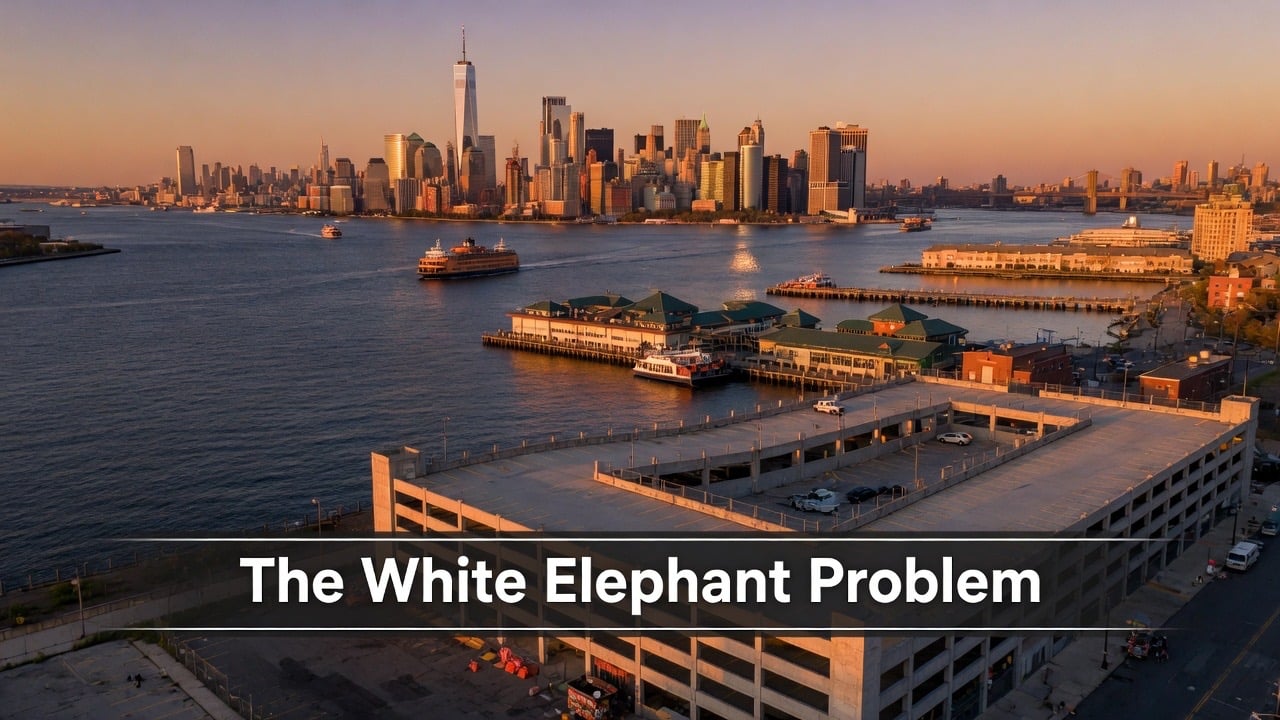
Staten Island real estate has a paradox problem. The North Shore of the borough — St. George in particular — sits on what is arguably the most dramatic waterfront real estate position in the entire New York metropolitan area. The panoramic view of lower Manhattan, the Statue of Liberty, and the upper harbor from the St. George esplanade is not a matter of opinion. It is genuinely world-class. And yet, for well over a century, that view has not translated into the kind of sustained property demand, organic neighborhood growth, or cultural momentum that has reshaped comparable post-industrial waterfronts in Brooklyn and New Jersey.
While DUMBO median sale prices have pushed past $1.9 million and Jersey City's median crossed $800,000 in early 2026, the Staten Island North Shore real estate market remains structurally challenged — underpinned by one of the longest-running, most expensive, and most instructive records of failed mega-development in New York City history. Understanding why requires going back further than the rusted shell of the New York Wheel. It requires going back to the elephants.
This is the story of the "white elephant" — a possession costly to maintain and nearly impossible to offload — and why St. George has spent 140 years collecting them.
Part I — 1880s
The blueprint for every failed St. George development was drawn in the 1880s by a Canadian entrepreneur named Erastus Wiman. Wiman saw the North Shore not as a residential community but as a spectacle platform. He consolidated the island's ferry franchises, waterfront piers, and rail lines into a monopoly, struck a deal with developer George Law to name the new terminal "St. George," and then faced the investor's fundamental problem: routine commuter traffic wasn't going to cover the debt.
So he bought a baseball team. In 1886, Wiman purchased the New York Metropolitans franchise for $25,000, relocated it to St. George, and bundled game tickets with free round-trip ferry rides. When baseball alone failed to move the needle, he partnered with theatrical promoter Imre Kiralfy to produce "The Fall of Babylon" — a 1887 open-air production staged on a 450-by-250-foot platform built directly into the stadium's outfield. The show required five train cars of sets, 170 arc lights, over 1,000 performers, and a live menagerie that included camels, rhinoceroses, and literal elephants. The American Association was forced to issue a specific ground rule: any ball landing on the Babylonian stage in right field was an automatic single.
Crowds of up to 20,000 came nightly. The following summer, Wiman and Kiralfy escalated to "Nero, or the Destruction of Rome" — 2,000 performers, chariot races, gladiator contests, and a staged burning of Rome as the grand finale. Attendance was extraordinary. Returns were not. The operating costs of maintaining live elephants, thousands of actors, and nightly pyrotechnics consumed every dollar the ferry tolls produced. The Metropolitans folded after the 1887 season. Wiman eventually embezzled from his own firm to stay solvent, was convicted of forgery, and died penniless in 1904.
"The operating costs of live elephants and 2,000 performers outstripped every dollar the ferry tolls generated. The lesson was written in 1887. Staten Island would spend the next century ignoring it."
The St. George Pattern, Est. 1887
Wiman's legacy established the template: believe that geographic isolation can be overcome by importing massive, capital-intensive spectacle rather than cultivating sustainable community. It is a template that would be reprinted, with minor variations, for the next 140 years.
Part II — 1900s–2000s
Following Wiman's bankruptcy, Staten Island entered a long period defined by municipal neglect and infrastructural decisions that compounded its isolation. Robert Moses's aggressively car-centric policies dismantled most of the borough's ferry network by mid-century, leaving the Whitehall-to-St. George crossing as the sole surviving municipal route. When the Verrazzano-Narrows Bridge opened in 1964 and triggered rapid population growth, Moses explicitly excluded rail from its design — permanently severing the borough from the New York City subway system and guaranteeing that any future developer would be fighting a transit deficit no attraction could overcome.
The speculative failures that followed were remarkably consistent in their structure. Ambitious announcement. Community excitement. Financial overextension. Collapse.
Late 1990s
New York Fast Ferry — Bankrupt in 12 Months
A high-speed Midtown ferry charged $5 per ride and drew just 400 daily passengers before going bankrupt by end of 1997. NY Waterway took over and killed the route by July 1998. A post-Sandy fast ferry subsidized to $2 a ride still saw ridership collapse within eight weeks.
2006
82,000-Seat NASCAR Track — Scrapped Before a Single Lap
Plans for a 671-acre racing facility near the Goethals Bridge were scrapped when the West Shore could not accommodate race-weekend traffic. Post-Sandy environmental analysis confirmed the site's wetlands were critical storm surge buffers that couldn't be touched.
2006–2011
Waterfront Commons — $90M Land, $0 In Revenue
Developer Lieb Puretz purchased land in Richmond Valley for $90 million, billed as NYC's first major outlet mall. He defaulted by 2009 and filed for bankruptcy in 2011. The collapse dragged down Kars4Kids, which reported $5 million in direct losses tied to the project.
Part III — 2010s
The Bloomberg administration's 2011 "North Shore 2030" plan launched a coordinated revitalization campaign anchored entirely in tourism, luxury retail, and monumental attractions. What followed was the most expensive iteration of the white elephant model in the borough's history — three simultaneous failures that collectively consumed hundreds of millions in public and private capital.
Conceived in 2008 by developer Meir Laufer after riding the London Eye, the New York Wheel was envisioned as the tallest observation wheel in the world — 600 to 630 feet above the harbor, 1,440 passengers per ride, 4 million annual visitors projected. Initially budgeted at $200 million, costs ballooned to over $1 billion as engineering complexities compounded. To close the financing gap, developer Rich Marin leveraged the federal EB-5 visa program, raising between $150 million and $206 million from more than 400 foreign investors at a 2.7% interest rate — investors who were, in effect, purchasing U.S. permanent residency.
In 2017, Dutch engineering firm Mammoet-Starneth walked off the job over a pay dispute, leaving the developers paying $700,000 a month simply to store $68 million worth of manufactured wheel components. The developers asked Mayor de Blasio for a municipal bailout via tax-free city bonds. He declined. By January 2019, the custom capsules and massive steel legs were sold for scrap metal. The sole completed remnant: a 950-space parking garage that services virtually nothing.
Designed by SHoP Architects and backed by Goldman Sachs, the 350,000-square-foot Empire Outlets opened in May 2019 as New York City's first outlet mall. Its business model depended entirely on the Wheel's projected foot traffic. When the Wheel died, the thesis collapsed with it. Fewer than half of the 100 planned storefronts were ever occupied. COVID-19 eliminated the international tourist base. By 2023, the complex went to foreclosure and was sold at auction.
In 2001, the city opened a $71 million publicly funded stadium for the Staten Island Yankees, a minor league affiliate of the New York Yankees. In 2020, MLB contracted its minor league system from 160 to 120 teams. The Yankees pulled their affiliation. The franchise folded. The city was left with a pristine, publicly funded waterfront stadium with no primary tenant — the pattern, once again, exact.
Part IV — 2022–2026
No single transaction captures the structural ceiling of the North Shore luxury market more precisely than what happened to Pete Davidson's condo at 90 Bay Street Landing.
In 2022, Davidson — Staten Island's most famous living export — purchased a unit at The Accolade, a nine-story converted warehouse in a 24-hour guard-gated, 13-acre waterfront community in St. George, for $1.3 million. The building offers the full luxury package: doorman, fitness center, outdoor tennis courts, children's playroom, golf simulator, and unobstructed views of the skyline and the Verrazzano-Narrows Bridge. Monthly HOA fees exceed $1,130. Davidson heavily customized the unit — two bedrooms converted into a loft-style one-bedroom with bold red accents and a custom fish tank.
When he decided to relocate to Brooklyn and listed the property, the market responded with indifference. The unit sat. Buyer interest was tepid. Davidson ultimately sold in early 2026 for $850,000.
The Accolade — Transaction Snapshot
"Davidson chose the cultural vibrancy and walkability of Brooklyn over the isolated, gated luxury of St. George. His $450,000 loss is not a celebrity story — it is a market signal."
North Shore Luxury Market, 2026
The coda is almost too perfect: in the same year Davidson bought the condo, he and fellow Staten Island native Colin Jost purchased a decommissioned Staten Island Ferry at a city auction for $280,000, with vague plans to convert it into an entertainment venue. A massive, aging municipal vessel with no clear purpose, acquired by the borough's most famous sons. Erastus Wiman would have recognized the impulse entirely.
Part V — The Competition
All three waterfronts — St. George, DUMBO, and Jersey City's Gold Coast — offer stunning, world-class views of the Manhattan skyline. The divergence in their real estate outcomes comes down to transit friction, organic community formation, and tax calculus. None of these factors favor Staten Island.
DUMBO's transformation was not engineered by a top-down municipal mandate. Artists moved into abandoned post-Navy Yard warehouses in the late 1970s seeking cheap studio space. Developer David Walentas and Two Trees Management recognized the inherent value of the industrial brick stock, cobblestone streets, and proximity to lower Manhattan, and spent years securing a pivotal 1997 rezoning that allowed residential conversions — negotiating public schools and below-market units into controversial projects to secure community approval. The result was a neighborhood that grew from within. By 2015, DUMBO was Brooklyn's most expensive neighborhood. No observation wheel required.
Jersey City doesn't lead with culture. It leads with math. The PATH train delivers residents directly into Manhattan's Financial District and Midtown in 15 to 30 minutes, one seat, no transfers. A comparable one-bedroom apartment runs roughly $2,800 per month against Manhattan's $4,000-plus average. The median home price crossed $800,000 in early 2026 — still offering more square footage per dollar than DUMBO. And critically, New Jersey residents are entirely exempt from New York City municipal income tax. For a high-income professional, that exemption alone generates net savings that dwarf the property tax premium New Jersey carries. The Prodigy team's Jersey City Q1 2026 market report breaks down the Gold Coast numbers in full.
| Metric | St. George, SI | DUMBO, Brooklyn | Jersey City, NJ |
|---|---|---|---|
| Primary Transit | Ferry & Express Bus | NYC Subway (F, A, C) | PATH Train |
| Avg. Commute to Manhattan | 45–75 min | 15–30 min | 15–30 min |
| Last-Mile Friction | High — multiple transfers | Low — direct access | Low — direct access |
| Effective Property Tax Rate | 0.85%–0.92% | 0.68% | 2.2%+ (NYC income tax exempt) |
| Car Ownership Required? | Almost always | Rarely | Rarely |
| 2026 Median Home Price | ~$695,000 | $1.9M+ | ~$800,000 |
Sources: WalkScore; NYC Finance Department; closed-sale and listing data, Q1 2026.
The transit math is the conversation-ender. A St. George commute requires a car or bus to the terminal, a wait for a ferry running every 15 to 30 minutes, a 25-minute crossing, and a subway transfer at Whitehall before the actual commute begins. That daily multimodal friction is real, cumulative, and priced directly into what buyers will pay. When buyers with $700,000 also factor in the near-certain cost of car ownership — insurance, fuel, parking — the apparent price discount relative to Brooklyn shrinks considerably. The view is free. The commute is not.
Part VI — 2026
After more than a century of pursuing white elephants, the civic strategy for St. George is finally changing at a fundamental level — not in tone, but in structure.
In September 2023, Mayor Eric Adams and the NYCEDC unveiled the Staten Island North Shore Action Plan. Bolstered through late 2025 by a community visioning process led by Borough President Vito Fossella, Council Member Kamillah Hanks, and more than 1,000 local participants, the city formally abandoned the tourism-first model. The $400 million investment framework calls for up to 2,500 new homes at mixed income levels, 20-plus acres of continuous public waterfront, and a projected $3.8 billion in long-term economic impact over 30 years. The empty Wheel site and struggling Empire Outlets footprint are targeted for residential conversion — not another attraction.
The shift is already producing tangible results. Lighthouse Point, a $200 million adaptive reuse of the historic former U.S. Lighthouse Service Depot at St. George, finally opened its 115-unit residential building in late 2025 after nearly a decade of contractor bankruptcies, pandemic delays, and stop-work orders. Twenty percent of units are priced below market rate, and the building includes co-working spaces designed to incubate local startups — the exact community-building infrastructure DUMBO built organically in the 1990s.
A new NYC Ferry route connecting St. George directly to Brooklyn and Wall Street has been finalized. A mass timber residential complex in neighboring Stapleton is in developer selection. The two-acre Tompkinsville Esplanade is complete. These are not attractions. They are infrastructure — and that distinction is everything. The Prodigy team tracks North Shore inventory and pricing on an ongoing basis — the Staten Island Q1 2026 market report covers current conditions across the borough in full.
Q 01
Why is Staten Island real estate cheaper than Brooklyn if the views are just as good?
The price gap reflects transit and liquidity, not the view. A buyer spending $700,000 in DUMBO gets direct subway access to Manhattan in 15 to 30 minutes. The same buyer in St. George gets a multimodal commute of 45 to 75 minutes involving a ferry, a wait, and a subway transfer. That daily friction compounds over years and is priced into the market. Property tax rates on Staten Island (0.85%–0.92% effective) also run higher than Brooklyn's 0.68%, and car ownership — which Brooklyn residents can largely avoid — is a near-certain added expense for most North Shore residents.
Q 02
What happened to the New York Wheel?
The New York Wheel was a proposed 600-foot observation wheel announced in 2012 with Bloomberg administration backing. Its budget grew from $200 million to over $1 billion as engineering delays compounded. The Dutch contractor walked off the job in 2017 over a pay dispute, leaving developers paying $700,000 per month to store $68 million in manufactured parts. After Mayor de Blasio refused a public bond bailout in 2018, the project died. The wheel components were auctioned for scrap in January 2019. The only completed structure is a 950-space parking garage that still stands largely unused.
Q 03
Is St. George, Staten Island a good place to buy real estate in 2026?
It depends on commute tolerance and investment timeline. For buyers who work locally, remotely, or in lower Manhattan, St. George offers genuine value — waterfront access, architectural character, and significantly lower price-per-square-foot than Brooklyn. The $400 million North Shore Action Plan, Lighthouse Point's opening, and a new NYC Ferry route to Brooklyn and Wall Street are the most substantive infrastructure commitments the neighborhood has seen in decades. That said, the market has limited liquidity — Pete Davidson's 35% loss on his North Shore condo in 2026 is a useful data point. Plan a longer holding period and buy for lifestyle reasons, not as a pure appreciation play.
Q 04
How does the Staten Island commute compare to commuting from Jersey City?
Jersey City residents take a direct PATH train into Manhattan's Financial District or Midtown in 15 to 30 minutes — one seat, no transfers. A St. George commute involves getting to the terminal by car or bus, waiting for a ferry that runs every 15 to 30 minutes, a 25-minute crossing, and a subway transfer at Whitehall Street — 45 to 75 minutes total under normal conditions. That structural commute gap is the primary reason Jersey City's median home price has risen faster than Staten Island's despite New Jersey's higher property tax burden.
Prodigy Real Estate is an innovative real estate company offering high-end video production, home valuation services, purchasing, and home sales. Serving New York and New Jersey.