
Anthony Licciardello | May 24, 2026
Summit, NJ
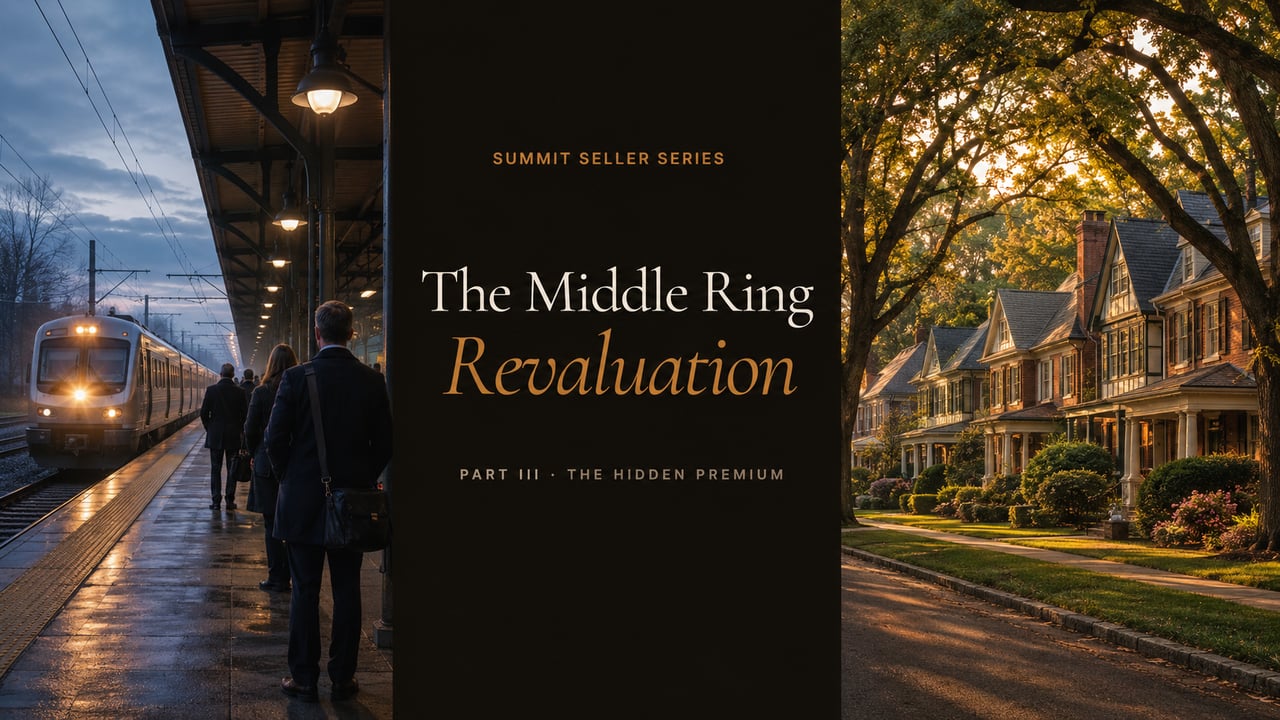
The Middle Ring Was Quietly Revalued in 2016. Most Sellers Still Price as if It Wasn’t.
A $120,000 municipal contract did what a $5 million parking garage was supposed to do — and in the process repriced every home in Summit’s 0.5-to-2.0-mile commuter band. Nine years later, automated valuation models still haven’t learned to see it.

Before 2016, a Summit home in the 0.5-to-2.0-mile band carried a structural discount: the train was there but the parking was not. The Lyft-and-Uber subsidy at 40 Railroad Avenue dissolved that discount almost overnight, and most of the homes in this band have spent the last nine years quietly worth more than their AVMs say. The Middle Ring is where the largest hidden seller premium in Summit currently lives — and the one most consistently missed.
The Middle Ring is the part of Summit that the textbook commuter-suburb pricing model assumes is just a smooth continuation of the walkable downtown radius. From roughly half a mile out to roughly two miles out, the math is supposed to be simple — a little further from the train, a little less expensive, a little more reliance on a car. For most of New Jersey’s rail suburbs, the math does work that way. For Summit, between roughly 2010 and the end of 2016, it absolutely did not.
What the model could not see, and what nearly every automated valuation tool still cannot see today, is that being half a mile to two miles from Summit Station in 2014 was not a smooth interpolation of being half a block away. It was a structurally different commuting experience — one that depended on whether you could secure a permit, whether you could find an open space before the lots saturated around nine in the morning, and whether your morning had room for the uncertainty of either. The result was an infrastructure friction discount: a measurable, persistent gap between what a Middle Ring home should have been worth under a clean distance-decay model and what it actually traded for in practice.
In the fourth quarter of 2016, Summit’s municipal government did something unprecedented in American suburban transit policy. Rather than spending an estimated five million dollars on additional concrete parking infrastructure, it signed a partnership with Uber — later transitioned to Lyft — that gave residents a subsidized ride to and from the station at a fare engineered to exactly match the cost of parking. The program was framed at the time as a clever solution to a local infrastructure problem. What it actually did, over the following years, was reset the access economics for every single residential parcel in the Wyoming, Brayton, and broader Middle Ring sections of the city. This post is about what that reset meant, why automated models have failed to catch up, and how sellers in the band should price their homes today.
To understand what changed in late 2016, it helps to be precise about what the Middle Ring commuting experience was before then. The City of Summit operated, then as now, approximately 2,800 commuter parking spaces distributed across surface lots and structures around the train station. The standard residential parking permit cost ten dollars annually. A daily fee of four dollars activated at four in the morning and ran until six in the evening. With a valid permit, residents could theoretically park at the Broad Street Garage, the Elm Street lot, the Sampson Lot, or the Railroad Avenue lot. Theoretically.
In practice, by approximately 8:30 AM on a typical weekday, the permit lots were saturated. A commuter pulling into Broad Street at 8:45 to catch the 9:01 express to Penn Station would, with some regularity, find every authorized space taken and would then have to contact the Parking Services Agency for special permission to park elsewhere — a process that introduced enough daily uncertainty into the morning commute that many residents shifted their schedules earlier, parked illegally and accepted the citation as a cost of doing business, or quietly stopped using the train altogether and drove into Manhattan or to a different regional station.
The economic literature has a specific name for the phenomenon. When a binding physical constraint blocks access to a transit asset, it introduces what urban economists call an access wedge — a measurable gap between the marginal value the transit asset should be generating and the actual realized utility residents experience. A 2017 study of office property sales in Los Angeles County found that binding parking constraints function as an implicit tax on density and distance, sharpening the negative slope of the bid-rent curve for any property located outside the immediate pedestrian radius. The same dynamic, applied to residential parcels in Summit’s Middle Ring, produced a structural discount that affected every single home in the band, whether the seller realized it or not.
A home one and a half miles from Summit Station in 2014 was not just worth a little less than a comparable home half a mile away. It was worth less than a clean linear extrapolation would have predicted — less, because the commuter purchasing it could not reliably use the asset the higher price would have been compensating for. The slope of the value gradient in the Middle Ring was, in that period, artificially steepened by a failure of localized infrastructure. The capitalized value of the Midtown Direct line was, parcel by parcel, suppressed for a wide swath of Summit’s residential geography.
Before 2016, Middle Ring sellers were absorbing a discount they had nothing to do with. The train was there. The parking wasn’t. The market knew the difference.
Faced with the chronic saturation of its parking infrastructure, Summit’s municipal government in 2016 had two paths available. The conventional path was capital infrastructure: convert an existing surface lot into a multi-level garage, or acquire new land near the station. The cost estimate, based on a comparable project in Millburn that produced 362 additional spots for roughly eight million dollars, ran to approximately five million dollars for the kind of capacity expansion Summit needed.
The city chose the other path. In a pilot program launched in 2016, Summit partnered with Uber — later transitioning to Lyft based on commuter feedback — to provide subsidized rideshare service to and from the train station during weekday commute hours. The original program structure was simple and deliberately designed to be economically neutral for the commuter: a resident with a prepaid parking permit rode free, and a resident without one paid two dollars per ride, exactly half of the four-dollar daily parking fee at the time. The city subsidized the difference between that two-dollar fare and the actual market cost of the ride. The program ran out of an annual budget that, by 2023, the Common Council had formalized at approximately $120,000, entirely offset by non-resident parking revenue at the Broad Street Garage, which generated $450,000 in 2019 and $250,000 in 2022.
The economic mathematics of this substitution are extraordinary, and deserve to be stated plainly. The city replaced what would have been a five-million-dollar capital expenditure with a one-hundred-twenty-thousand-dollar annual operating expenditure — roughly two and a half percent of the capital cost — and produced what is, for the commuter, a functionally equivalent or arguably superior result. The Lyft pickup at the intersection of Railroad Avenue and Maple Street, accessed by entering "40 Railroad Avenue" as the destination, became the new last-mile infrastructure for Middle Ring commuters. The parking constraint did not disappear — the lots are still saturated by mid-morning — but the dependency on parking did.
The program has evolved since launch. By 2023, the resident fare had been raised to four dollars to align with the daily parking fee, and the city implemented a total trip cap limiting the maximum subsidy to eight dollars per ride. Lyft introduced a "Price Lock" subscription feature for regular commuters, shielding them from peak-hour surge pricing for a small monthly fee. The Pinellas Suncoast Transit Authority in Florida and other transit agencies around the country have launched similar partnerships. None of them, so far as the public record reveals, were designed quite the way Summit’s was — as a direct, intentional substitute for a specific municipal capital project. The Middle Ring of Summit, New Jersey is one of the only residential markets in the United States where a municipal operational subsidy has been deliberately engineered to function as 1:1 replacement infrastructure for parking. That distinction matters for pricing.
When the rideshare program launched, the Middle Ring did not simply gain a small commuting convenience. It gained a structurally permanent solution to the binding constraint that had been suppressing its property values for years. From the perspective of a household evaluating whether to buy a home one and a half miles from the train station, the access calculus shifted overnight from can I reliably park in the morning to can I reliably get a Lyft to the platform. The answer to the second question, unlike the answer to the first, was yes.
In spatial-economic terms, the program flattened the bid-rent curve within the Middle Ring. The infrastructure friction discount that had been steepening the value slope between half a mile and two miles from the station was removed. Homes in the band became, in a meaningful sense, closer to the train — not in physical distance but in generalized daily commuting cost, which is the variable that actually capitalizes into residential property value. A 1.5-mile home in Summit in 2017 was, by every measure that matters to a buyer, more accessible to the Midtown Direct line than a 1.5-mile home in 2014. The market understood this. The market started paying for it. Within the band, the value gradient flattened toward something resembling what the textbook model had always predicted it should look like.
The technical empirical test for this kind of policy-driven revaluation is a difference-in-differences analysis: compare the price trajectory of Middle Ring homes in Summit to the price trajectory of a control group of homes in a comparable nearby town with no rideshare program, before and after late 2016. The Watchung-flanking municipalities of Chatham Borough and Chatham Township, which share access to the same Midtown Direct rail line but rely entirely on traditional waitlisted permit parking with no municipal rideshare subsidy, function as a natural control. Outer Ring homes within Summit itself function as a secondary control. The empirical question is whether Summit’s Middle Ring homes appreciated faster than both controls in the years immediately after the program launched.
The literature on these kinds of capitalization effects is consistent. Where a binding infrastructure constraint is removed by policy, the resulting market revaluation typically begins within twelve to eighteen months of the intervention and continues over a three-to-five-year window as buyers and sellers progressively recognize the new equilibrium. The Summit-Lyft program launched at the end of 2016, which means the revaluation window for Middle Ring homes ran from roughly 2017 through 2021. By 2022, the new equilibrium was, for sophisticated buyers and informed sellers, the baseline. For everyone else — including, critically, automated valuation models — the pre-2016 friction discount remained baked into the comp set.
The Middle Ring did not appreciate because the Summit market got hotter. It appreciated because the parking constraint that had been suppressing it for years got dissolved by a one-hundred-twenty-thousand-dollar contract. That is the revaluation. And it is still working its way through the comp sets.
Automated valuation models — Zillow’s Zestimate, Redfin’s estimate, the proprietary models running inside every major lender’s appraisal review software — share a common architecture. They select a set of recent comparable sales based on proximity, square footage, lot size, age, and a handful of structural attributes, then weight those comps against the subject property and produce a point estimate of value. The architecture is sound. The architecture also has a specific, structural blindspot when a policy event creates a step-function change in value within a defined geographic band.
The blindspot operates as follows. When the rideshare program launched at the end of 2016, the Middle Ring of Summit began the slow process of repricing upward. But the AVMs were, simultaneously, drawing comps from the immediately preceding years — comps that reflected the pre-rideshare friction discount. As 2017 unfolded into 2018 and 2019, each Middle Ring sale was being priced partially by current market conditions and partially by stale comps that had been transacted under the old constraint. The lag is not a bug. It is the inherent latency of any comp-based model when the underlying market regime has shifted.
In normal markets this lag is invisible because the underlying regime does not change discretely. In Summit’s Middle Ring it changed at a specific date for a specific policy reason, and the lag has been visible ever since. Sellers in the band who relied on Zillow estimates in 2018 received estimates pulled significantly from 2014-2016 comps. Sellers who relied on the same estimates in 2022 received estimates pulled significantly from 2018-2020 comps, which had themselves been partially built on stale older comps. The compounding effect is a persistent, systematic under-estimation of true market value within the band.
The Pedestrian Zone does not suffer this distortion to the same degree because the access dynamics within walking distance of the station did not change. The Outer Ring does not suffer it to the same degree because those parcels are priced primarily on topographical and architectural variables rather than transit-access ones, as detailed in the second post in this series. The distortion is specific to the Middle Ring — specific to the band where access economics did change discretely, and specific to the comp pool that has been slowest to catch up.
Models reach backward into recent sales, and those sales were themselves priced partly by older sales transacted under the pre-2016 constraint. The friction discount stays embedded in the comp set for years after the constraint itself is gone.
There is no input field in any major AVM for "municipality has subsidized rideshare program." The structural change that revalued the band is invisible to the model by design — it sits one layer above what the architecture can ingest.
When AVMs draw comps from outside the Middle Ring — pulling in Pedestrian Zone or Outer Ring sales to round out the comp set — they unwittingly pull from pricing regimes governed by entirely different variables. The result is a blended estimate that fits neither ring.
A Middle Ring buyer in Summit today is a different household than a Middle Ring buyer was in 2014. Then, the buyer was making peace with a structural inconvenience — they wanted the schools, the town character, the proximity to the Midtown Direct line, and they were prepared to deal with the parking situation as the price of admission. The discount reflected the inconvenience. The home was priced for the buyer who would tolerate it.
The buyer today is making a different calculation. The 1.5-mile distance from the station is no longer the access constraint it once was. The household’s actual daily commute calculus runs something like this: walk to the door, call a Lyft, ride to 40 Railroad Avenue at the subsidized fare, catch the train. Total elapsed time is comparable to driving and parking, total cost is comparable to the daily parking fee, and the daily uncertainty associated with finding a space is eliminated. The buyer is now buying the train at face value, not at a discount.
What this means for the listing strategy is significant. A Middle Ring home in 2026 should not be priced as if it carries a structural commuting penalty. It should not be marketed in the language of "convenient to the train" or "easy drive to the station" — those phrases were the seller’s defensive posture during the friction discount era, and they continue to anchor buyer expectations toward the older, lower pricing regime. The accurate framing is that the property carries full Midtown Direct access via a structurally permanent municipal subsidy program — access that is no less reliable, and arguably more reliable, than what the Pedestrian Zone enjoys.
Beyond the access story, Middle Ring buyers are also paying for what the band itself offers structurally: larger lots than the Pedestrian Zone, more square footage per dollar than downtown Summit, and access to the same school district, town services, and quality-of-life amenities. The household at this price point is often a growing family or a move-up buyer who needs the additional space and would not fit comfortably in the smaller-lot Pedestrian Zone footprint. The Middle Ring is, in market terms, where a family can buy a full-sized Summit home without giving up the Midtown Direct line. That is a strong story. It is also, in current pricing, an underpriced one.
The Middle Ring is where a family can buy a full-sized Summit home without giving up the train. That is a different story than "convenient to transit" — and it deserves a different list price.
Pricing a Middle Ring home correctly in 2026 means refusing to take the AVM estimate as a baseline and instead building the list price from a clean understanding of the post-2016 access regime. The scorecard below summarizes how to approach the exercise.
| Pricing Input | What to Trust | What to Discount |
|---|---|---|
| Comp Selection | Sales from 2022 onward, within the Middle Ring only, on streets with comparable Lyft pickup proximity | Sales prior to 2020; Pedestrian Zone or Outer Ring sales pulled in to "round out" the set |
| AVM Estimates | As a floor — the AVM is usually approximately the lower bound of defensible value | As a ceiling — the AVM systematically underprices this band |
| Access Narrative | Direct, structural Midtown Direct access via subsidized municipal program | Apologetic language like "convenient to" or "short drive from" — these anchor down |
| Comparable Towns | Other Midtown Direct towns with full pedestrian station radius; Summit’s downtown comp baseline | Chatham’s park-and-ride sections, which still operate under traditional waitlisted-parking economics |
The single most consequential operational rule in this framework is also the simplest: when the AVM and the post-2020 comp set disagree, trust the comp set. The AVM is structurally biased downward in the Middle Ring because of the lag dynamic described in Chapter IV. A seller who anchors to the Zestimate is anchoring to a regime that has, in this specific geographic band, been obsolete for nearly a decade.
The second operational rule: tell the access story directly in the listing. The Lyft program at 40 Railroad Avenue is not common knowledge among out-of-area buyers, including the relocation buyers from New York City and the western suburbs of New Jersey who make up a significant share of the Summit market. A listing that explains the program in two or three sentences in the property remarks — what it is, what it costs the resident, and the fact that it functions as municipal commuter infrastructure — converts an invisible amenity into a visible one. Buyers cannot pay for what they cannot see.
Part IV of this series turns to the Pedestrian Zone — the half-mile downtown radius where the access story is different, the buyer profile is different, and the listing strategy that captures full value follows a different logic. Sellers in the downtown Summit core, the Edgewood section, and the immediate station radius are the primary audience for that post.
Measure the walking route — not the driving route — from your front door to the Summit Station platform. If that walking distance falls between approximately 0.5 miles and 2.0 miles, you are in the Middle Ring. Properties closer than 0.5 miles fall in the Pedestrian Zone; properties beyond 2.0 miles fall in the Outer Ring. The framework was introduced in Part I of this series.
The program has been continuously funded since 2016, with the Summit Common Council unanimously approving its most recent extension in 2023 at an annual budget of approximately $120,000. The program is fully offset by non-resident parking revenue at the Broad Street Garage, which makes it structurally self-funding. While no municipal program is guaranteed indefinitely, the economic logic that drove the original decision — $120,000 in operating cost versus $5 million in capital expenditure to solve the same problem — is unlikely to reverse under any foreseeable budget environment.
Not by reflex — but yes, the Zestimate should be treated as approximately the floor of defensible value in the Middle Ring, not the ceiling. The correct list price is built from a clean, post-2020 comp set within the band, supported by an accurate narrative about the structural access regime. In many cases that price will sit meaningfully above the AVM estimate; in some cases it will not. The discipline is in the framework, not the assumption.
Almost, but not quite. Properties at the inner edge of the Middle Ring — close to 0.5 miles — benefit somewhat less because they were less affected by the original parking constraint to begin with. Properties at the outer edge — close to 2.0 miles — benefit somewhat more because they were the most penalized by the pre-2016 access uncertainty. The revaluation is strongest in the 1.0 to 1.8-mile sub-band, which is where the largest residual mispricing typically sits today.
Part IV covers the Pedestrian Zone — the half-mile downtown radius where transit access dominates pricing, structural features carry different weight, and the buyer profile diverges meaningfully from the Middle Ring and Outer Ring. Sellers in downtown Summit, the Edgewood section, and the immediate station radius are the primary audience.
A 30-minute pricing audit with The Prodigy Team covers your ring designation, a clean post-2020 comp set, an explicit access-regime narrative, and a list-price recommendation built on the framework above — not on the AVM that has not yet caught up to the post-2016 market.
Request Your AuditProdigy Real Estate is an innovative real estate company offering high-end video production, home valuation services, purchasing, and home sales. Serving New York and New Jersey.