
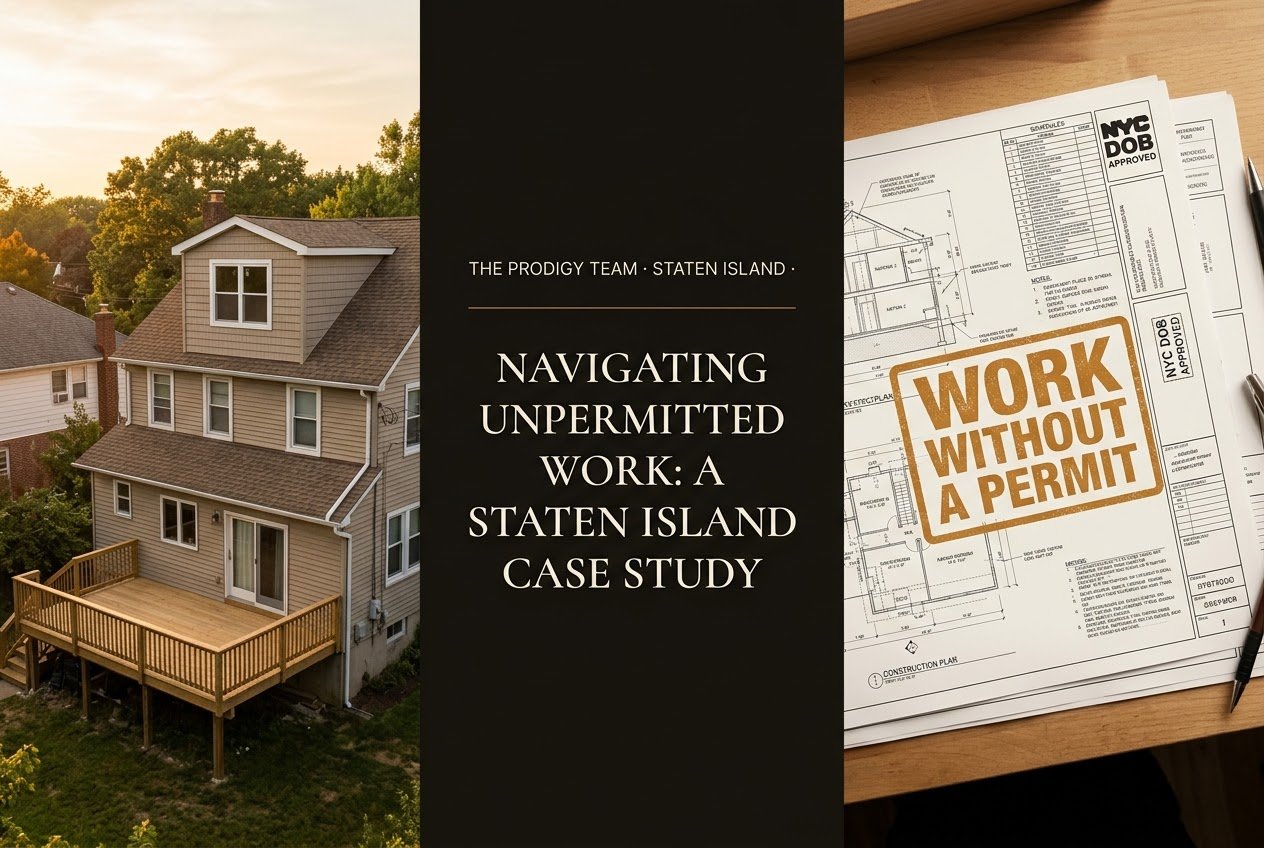
The deck nobody pulled a permit for — and what it does to your closing
On Staten Island’s one- and two-family housing stock, the most common survey surprise isn’t a boundary line. It’s a deck, dormer, rear extension, or finished attic that a previous owner added without a permit — work that does not appear on the Certificate of Occupancy and was never inspected by the Department of Buildings.
Left alone, it sits quietly for years. Then a buyer’s lender, title company, or surveyor compares what physically exists to the C of O on file, the mismatch surfaces, and suddenly you’re negotiating a credit or a delay under someone else’s clock.
The good news: the fix is almost always retroactive legalization, not a demolition crew. This guide explains how DOB sees unpermitted work, how it shows up in a sale, and how to clear it on your own timeline.
An “illegal” structure usually isn’t unsafe or even ugly — it’s simply undocumented. The City’s objection is procedural: work that changes the footprint, layout, use, or egress of a home is supposed to be filed, permitted, inspected, and reflected on the Certificate of Occupancy. When it isn’t, the record and the reality no longer match, and that gap is what a sale exposes.
What “unpermitted work” actually means
Decks, dormers, rear or side extensions, finished basements, and converted attics all change a home in ways DOB expects to be filed and permitted. When they aren’t, the home no longer matches its Certificate of Occupancy. DOB can issue a Work Without a Permit violation under Administrative Code §28-204.6, with fines that generally run from $2,500 to $10,000 — and converting a one-family home into two units without an amended C of O is a separate, costlier illegal-conversion violation.
Here is the part that catches sellers off guard: intent does not matter, and neither does who did the work. If the prior owner built the deck, the violation still attaches to the property — and to you, once you own it.
“Grandfathered” is one of the most expensive words in Staten Island real estate. An old structure is only legal if the record says so. Assume nothing is grandfathered until you’ve confirmed it in the building file.
How it surfaces in a sale
Unpermitted work rarely announces itself until money is on the table. It typically appears when a buyer’s surveyor or appraiser notes a structure that isn’t on the Certificate of Occupancy, when the title company’s municipal search turns up an open violation, or when a lender’s review compares the filed plans to what’s actually standing. Neighbor complaints to 311 are another frequent trigger, and the City increasingly cross-checks aerial and satellite imagery to flag new construction that was never filed.
“I’ve had deals where a beautiful, well-built deck nearly sank the closing — not because anything was wrong with it, but because it wasn’t on the C of O and the buyer’s lender wouldn’t move until it was resolved.”
The fix is legalization, not demolition
In most cases you don’t tear anything down. A licensed architect or professional engineer measures the as-built condition, files plans with DOB, obtains the permits that should have existed, schedules the required inspections, and closes the job out in the DOB system — ending in an amended Certificate of Occupancy or, for minor work, a Letter of Completion. Where the as-built doesn’t quite meet code or zoning, the design professional identifies what has to be modified to bring it into compliance.
The cost and timeline depend entirely on the scope and how clean the existing file is, so the first dollar you spend should be on a professional assessment, not a guess. Open permits and violations often travel with unpermitted work, so handle them together.
Your proactive game plan
Sixty to ninety days before listing, pull your Certificate of Occupancy and permit history from DOB’s Building Information System (BIS) and DOB NOW, then walk your home room by room against it. Anything that exists but isn’t reflected — the deck, the dormer, the extra bathroom — is a candidate for legalization.
Order your C of O and a permit-history printout this week, then have an architect or expediter scope the gap. Knowing the size of the problem early is what lets you fix it cheaply instead of conceding it at the negotiating table.
For the full pre-listing sequence across every issue, see the Staten Island clear-title playbook and the step-by-step self-audit.
Frequently asked questions
Can I sell my Staten Island home with an illegal deck or addition?
Often yes, but it complicates the deal. Buyers’ lenders and title companies flag unpermitted work, and they can push for a price credit, an escrow holdback, or a delayed closing until it’s resolved. Legalizing it before you list keeps you in control of the cost and the timeline.
Will I have to tear the structure down?
Rarely. The usual path is retroactive legalization — an architect or engineer files plans, obtains the permits, and closes the work out with DOB. Demolition is a last resort reserved for work that simply cannot be brought into compliance.
Will an unpermitted addition kill my buyer’s mortgage?
It can stall it. Lenders want the home to match its Certificate of Occupancy, and an open violation or major undocumented structure can hold up the loan until it’s cleared or addressed in the contract through an escrow or credit.
Who pays to legalize — me or the buyer?
Whoever has less leverage at the moment it’s discovered. If you find and fix it before listing, you control the spend. If the buyer’s title report finds it, you’re usually the one funding the credit or the cure under time pressure.

Anthony Licciardello, Broker, The Prodigy Team
Anthony is a licensed real estate broker in New York and New Jersey and has run The Prodigy Team across Staten Island and New Jersey for more than 20 years. A former Director of Community Affairs in the Bloomberg administration and a member of the Staten Island Growth Management Task Force, he has spent his career on the land-use, zoning, and title issues that decide whether a Staten Island sale actually closes. Questions about your own property? Call 718-873-7345 or visit his agent profile.
Got an addition that was never on the plans? Let’s sort it before you list.
We'll run a pre-listing title and building-file review so you head to market with a clean file and full leverage.
Why Sell With The Prodigy Team →Or call Anthony directly at 718-873-7345
This article provides general information for Staten Island homeowners and does not constitute legal, tax, or title advice. Laws, fees, and City programs change; verify current requirements with the relevant agency and consult a licensed attorney, tax professional, or title company about your specific property.