
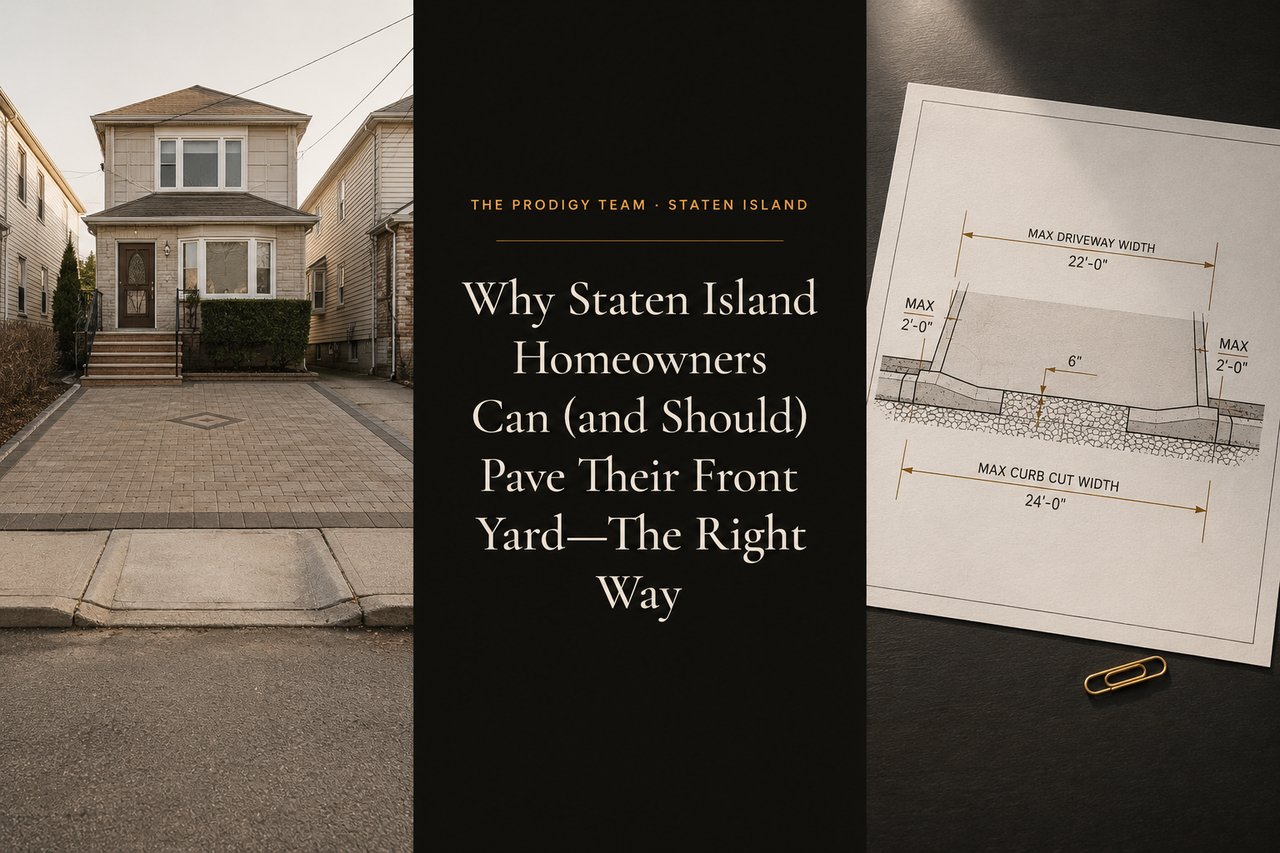
The driveway that was never permitted — and the parking spot the City says you can’t have
Curb cuts and front-yard parking are everywhere on Staten Island, and a surprising number were never legally permitted. A curb cut requires approval from both DOB and DOT, filed by a licensed engineer or architect — not a contractor with a jackhammer on a Saturday.
Paving a front yard into a parking pad runs into zoning rules that require a portion of the yard to stay open and planted, and the penalty for getting it wrong can be an order to restore the yard to its original condition.
This guide explains the curb-cut permit reality, the front-yard parking rules, and how an unpermitted driveway can become a problem exactly when you’re trying to sell.
Acurb cut looks like a small thing — a dip in the curb so a car can reach a driveway. Legally it’s anything but. It requires City approval, professional filing, and compliance with zoning rules about how wide it can be and how much of your front yard must remain unpaved. Skip those steps and you don’t just risk a fine; you risk being told to undo the work entirely.
The curb-cut permit reality
To create a legal curb cut you need a curb-cut permit from DOB plus a roadway/sidewalk permit from DOT, and the application has to be filed by a New York State licensed professional engineer or registered architect. There are strict limits on width — a single-car residential cut is generally about ten feet — and on placement relative to corners, hydrants, and neighboring cuts. A cut that’s too wide or in the wrong spot can be flagged even if a car has parked there for years.
The City increasingly uses aerial and satellite imagery to spot new driveways and curb cuts that were never filed. “Nobody will notice” is no longer a strategy — and the remedy for an illegal cut can be a restore-to-original-condition order, meaning you pay to remove what you paid to install.
Front-yard parking and open-space rules
Separate from the curb cut itself, zoning generally requires a portion of a residential front yard to remain unpaved and planted. Paving the whole yard into a parking pad can draw a violation for illegal front-yard parking, independent of whether the curb cut is legal. The specific requirement depends on your zoning district, which you can look up on the Department of City Planning’s ZoLa map.
Front-yard parking is a Staten Island staple and a Staten Island headache. Plenty of homes have a paved pad and a homemade curb cut that predate any thought of a permit — and that history doesn’t make them legal, it just makes them undiscovered.
How it hits a sale
An unpermitted curb cut or illegal front-yard parking can surface as an OATH/ECB violation in the title company’s search, or as a discrepancy a buyer’s surveyor notes. Like other violations, an unresolved one can complicate the closing and, if penalties go unpaid, migrate toward a lien. Buyers also simply care: the off-street parking they’re counting on may not be something they’re allowed to keep.
“Off-street parking is a real selling point on Staten Island — right up until the title search shows the curb cut was never legal. Then it flips from an asset to a liability in a single page of a report.”
Your proactive game plan
Before you list, confirm whether your curb cut was ever permitted — older approvals may only appear in BIS or be referenced on the Certificate of Occupancy — and check your zoning district’s open-space requirement on ZoLa. If the cut or the parking pad isn’t legal, talk to an engineer or architect about whether it can be permitted as-is or has to be modified, and weigh that against simply disclosing it.
Look up your property on ZoLa and check BIS for any curb-cut permit. Five minutes now tells you whether your driveway is an asset you can market or an issue you need to get ahead of.
Curb cuts sit right next to your sidewalk obligations, since both involve the public way in front of your home. Read them together, and see the clear-title playbook for the full picture.
Frequently asked questions
How do I find out if my curb cut is legal?
Check DOB’s records for a curb-cut permit and look at your Certificate of Occupancy, where older approvals are sometimes referenced. If you can’t find a permit, it may never have been legally created — an engineer or architect can confirm and advise on options.
Is paving my front yard for parking illegal in NYC?
Often, yes. Zoning generally requires part of a residential front yard to stay unpaved and planted, and paving it over for a parking pad can draw a violation regardless of the curb cut. The exact requirement depends on your zoning district, viewable on ZoLa.
What’s the penalty for an illegal curb cut?
Beyond fines, the City can issue an order to restore the area to its original condition — meaning you may have to remove the curb cut and driveway. That’s why it’s worth understanding the status before you market the home.
Will an illegal curb cut stop my sale?
It can complicate it. The violation may surface in the title search, can weigh on the closing, and if penalties go unpaid it can move toward a lien. Just as important, the off-street parking a buyer is counting on may not be legally theirs to keep.

Anthony Licciardello, Broker, The Prodigy Team
Anthony is a licensed real estate broker in New York and New Jersey and has run The Prodigy Team across Staten Island and New Jersey for more than 20 years. A former Director of Community Affairs in the Bloomberg administration and a member of the Staten Island Growth Management Task Force, he has spent his career on the land-use, zoning, and title issues that decide whether a Staten Island sale actually closes. Questions about your own property? Call 718-873-7345 or visit his agent profile.
Worried your driveway was never permitted? Let’s check before you list.
We'll run a pre-listing title and building-file review so you head to market with a clean file and full leverage.
Why Sell With The Prodigy Team →Or call Anthony directly at 718-873-7345
This article provides general information for Staten Island homeowners and does not constitute legal, tax, or title advice. Laws, fees, and City programs change; verify current requirements with the relevant agency and consult a licensed attorney, tax professional, or title company about your specific property.