
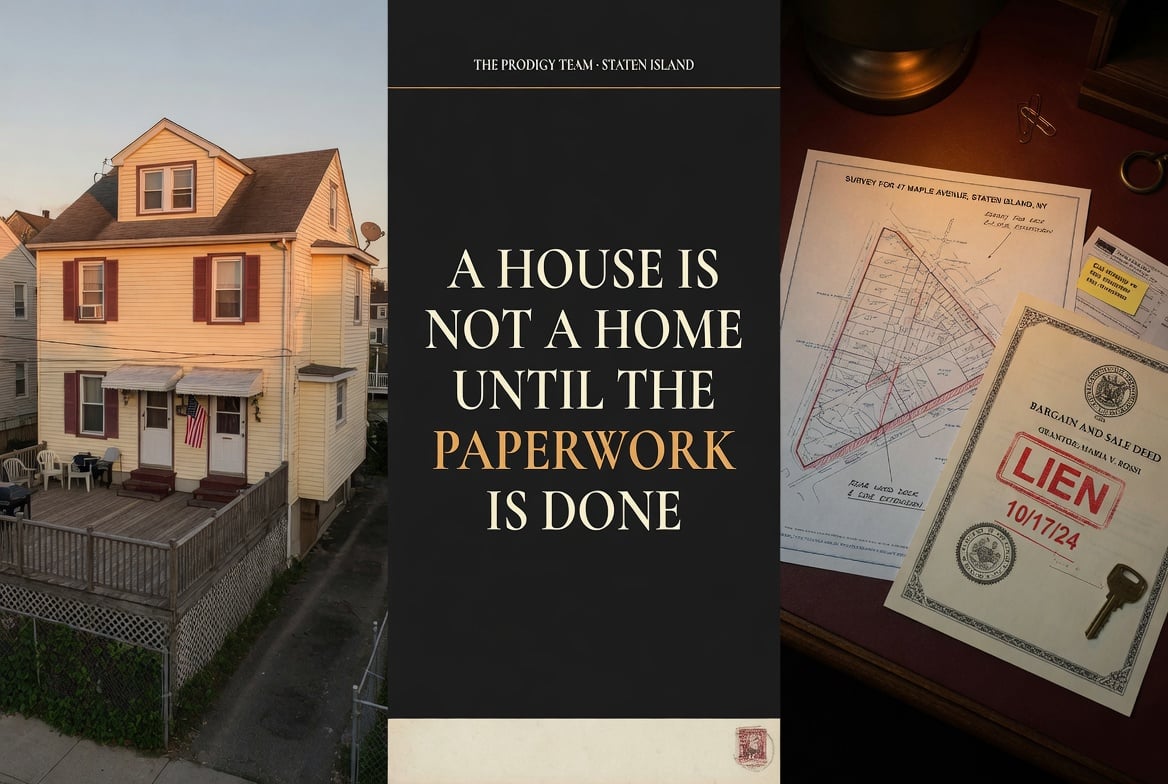
The two stacks of paper that quietly kill Staten Island closings
Most Staten Island deals do not fall apart over price. They fall apart in the last three weeks, when a title search or a fresh survey surfaces something the seller never knew was a problem: an open plumbing permit from 2011, a deck that was never legalized, a sidewalk lien, or a credit-card judgment docketed years ago. By then there is a buyer, a mortgage commitment with a clock on it, and very little room to maneuver.
There are really only two stacks of paper that cloud a sale. One is your survey and your building file — what physically exists on the lot versus what the City has on record. The other is your title — the liens and judgments recorded against the property and against you. This guide maps both, names the specific New York City rules behind each one, and shows you how to clear them before you list, while you still hold all the leverage.
One Staten Island wrinkle changes everything: Richmond County is not in ACRIS. The portal the rest of New York City uses to pull deeds and liens does not cover Staten Island. Your records live at the Richmond County Clerk. Advice that begins "just search ACRIS" is built for the other four boroughs — and it will miss your file.
The good news is that almost everything on these two lists is fixable, and most of it is far cheaper and faster to handle on your own timeline than under a buyer's. The expensive version is the one where a defect is discovered at the title report stage and you are negotiating a price cut, a credit, or an escrow holdback with a nervous buyer and an impatient lender. The cheap version is the one where you found it first. This is the master map; each section links to a deep-dive on the specific issue.
Survey problems vs. title problems — and why they are not the same
A survey problem is a mismatch between the physical property and the public record: a structure that was built without a permit, an addition that was never reflected on the Certificate of Occupancy, a fence or eave that crosses a boundary line, or a curb cut the City never approved. These surface on a current survey, in the Department of Buildings file, or in a title company's municipal search.
A title problem is a financial claim recorded against the property or its owner: a mechanic's lien from an unpaid contractor, a money judgment from a credit-card lawsuit, a federal tax lien, or a sidewalk lien the City placed after doing repairs you ignored. These surface in the title search itself.
The two overlap in one dangerous place: an unresolved violation can become a lien. Unpaid Environmental Control Board (ECB/OATH) penalties, for example, can be entered as judgments against the property. That is why a deck issue you think of as a "buildings problem" can quietly migrate onto your title.
"In 20 years I've watched more Staten Island deals stumble over a forgotten violation than over price. The buyer's title report doesn't care that you didn't do the work — it just shows the cloud."
Why Staten Island is its own animal
New York City's ACRIS system — the place agents and buyers are told to pull deeds, mortgages, and liens — covers Manhattan, Brooklyn, Queens, and the Bronx only. Staten Island documents are recorded with the Richmond County Clerk, not the City Register. Staten Island even appears as a selectable borough inside ACRIS, which fools people into thinking it is covered — it is not the live recording office for Richmond County.
The Office of the Richmond County Clerk sits at 130 Stuyvesant Place and is Staten Island's oldest government institution, founded in 1683. It is the official repository for deeds, mortgages, judgments, mechanic's liens, and tax liens on Staten Island property. When you sell here, your mortgage recording tax is even collected in person by the County Clerk rather than through the ACRIS workflow used elsewhere.
For the zoning side of the picture — what your lot is actually allowed to contain — the tool is the Department of City Planning's ZoLa map, and for the building file it is the DOB's Building Information System (BIS) plus DOB NOW. A clean Staten Island pre-listing check means working all three: Richmond County Clerk for recorded liens, BIS/DOB NOW for permits and violations, ZoLa for zoning.
Bookmark three tabs before you list: the Richmond County Clerk for recorded liens, DOB BIS / DOB NOW for permits and violations, and ZoLa for zoning. ACRIS is not on that list — it does not run Richmond County.
Survey & structure problems that hold up a sale
Illegal decks & unpermitted extensions
Decks, dormers, rear extensions, and finished attics built without a permit are the single most common Staten Island survey surprise. They will not match the Certificate of Occupancy, and DOB can issue a Work Without a Permit violation (Admin. Code §28-204.6, $2,500–$10,000) even when you did not do the work yourself. The fix is usually retroactive legalization, not demolition. Read the deep-dive on illegal decks and extensions →
Encroachments & boundary issues
A current survey can reveal a fence, driveway, garage, or roof overhang that crosses onto a neighbor's lot — or theirs onto yours. On Staten Island's older, irregular lots, shared driveways and decades-old fences are frequent offenders. Title companies flag these, and lenders want them resolved or insured over. Read the deep-dive on encroachments and survey red flags →
Open permits & DOB / ECB violations
An "open permit" is a permit that was pulled but never signed off — common with old electrical and plumbing work. It is not closed until DOB inspects and the record is updated in the system. Open permits and open violations routinely surface in title and lender review and stall a sign-off. Read the deep-dive on open permits and violations →
Temporary or missing Certificate of Occupancy
A Temporary C of O typically expires after about 90 days and must be renewed; an expired TCO, or an older home with no C of O at all, complicates financing, insurance, and closing. Pre-1938 homes may instead need a Letter of No Objection. Read the deep-dive on the C of O and TCO →
Illegal curb cuts & front-yard parking
A curb cut needs a DOB permit plus a DOT roadway/sidewalk permit, and a licensed engineer or architect to file it. Paving the front yard for parking violates zoning open-space rules across much of the city, and the remedy can be a "restore to original condition" order. The City now uses aerial imagery to flag unpermitted work. Read the deep-dive on curb cuts and front-yard parking →
With DOB violations, intent does not matter. You can inherit a Work Without a Permit violation for work a prior owner did — and the City increasingly flags unpermitted construction from aerial and satellite imagery. Assume nothing is "grandfathered" until the building record actually says so.
Liens & money claims that cloud your title
Mechanic's liens
An unpaid contractor, sub, or supplier can file a mechanic's lien under the NY Lien Law. On a single-family home the lien must be filed within four months of the last work and is valid for one year; unlike commercial liens, it can only be extended by court order, never by a simple re-filing. It can be discharged by payment, by bonding, or by depositing funds with the court. Read the deep-dive on mechanic's liens →
Money judgments & credit-card judgments
When a creditor wins a lawsuit — including a credit-card debt — and dockets the judgment with the Richmond County Clerk, it becomes a lien on real property you own in the county for ten years, renewable once (CPLR 5203). Many sellers do not learn one exists until the title search. It must be satisfied, released, or vacated to deliver clean title. Read the deep-dive on judgment liens →
IRS federal tax liens & NYS tax warrants
A filed Notice of Federal Tax Lien attaches to all of your real property in the county and lasts ten years plus thirty days from assessment, renewable. The IRS lien can even attach "silently" from the assessment date before it is publicly filed. New York State tax warrants behave similarly and, as of July 2025, are docketed through the NYS Department of State. Payoff and discharge take lead time — start early. Read the deep-dive on tax liens and warrants →
Sidewalk violations & sidewalk liens
Under Admin. Code §19-152 you are responsible for the sidewalk abutting your home. A Notice of Sidewalk Violation carries no fine and gives you 75 days to repair; ignore it and the City can repair and bill you, then place a lien if you do not pay. One Staten Island break: one-, two-, and three-family homes are not charged for damage caused solely by City street-tree roots, and qualifying older liens are being cancelled. Read the deep-dive on sidewalk violations and liens →
"A lien is almost always cheaper to clear on your clock than on a buyer's. Find it first and it's an errand. Find it on the title report and it's a negotiation you're already losing."
The proactive pre-listing audit
Every defect on this page is cheaper to clear before a buyer is attached. The window that matters is the 60–90 days before you list. Here is the order of operations.
If you only do one thing this week, order a title search through the Richmond County Clerk or a title company. It is inexpensive, it surfaces every recorded lien at once, and it tells you exactly how long your runway is.
1. Pull your own building file. Search BIS and DOB NOW by address for open permits, open violations, and the Certificate of Occupancy on record. Compare the C of O room-by-room against what physically exists.
2. Pull your own title. Order a search through the Richmond County Clerk or a title company — not ACRIS — for judgments, mechanic's liens, federal/state tax liens, and sidewalk liens.
3. Order a current survey. A fresh survey catches encroachments, unpermitted structures, and curb-cut issues before the buyer's does.
4. Triage and sequence. Legalizations and lien payoffs run on the longest clocks, so start those first; cosmetic items can wait.
At a glance: who clears what, and how long it takes
| Issue | Where it shows up | Who clears it | Typical lead time |
|---|---|---|---|
| Illegal deck / extension | DOB file vs. C of O; survey | Architect/expediter + DOB | Weeks to months |
| Encroachment | Current survey; title search | Surveyor + attorney/title | Varies widely |
| Open permit | BIS / DOB NOW | Expediter + DOB sign-off | Weeks to months |
| Expired / missing C of O | DOB; lender/title review | PE/RA + DOB | Months |
| Illegal curb cut | DOT/DOB; ECB violation | PE/RA + DOT/DOB | Weeks to months |
| Sidewalk violation / lien | DOT; County Clerk; DOF bill | Owner + DOT re-inspection | 75-day repair window |
| Mechanic's lien | Title search (County Clerk) | Attorney; payoff or bond | Days to weeks |
| Judgment lien | Title search (County Clerk) | Attorney; satisfy/vacate | Days to weeks |
| IRS / NYS tax lien | Title search; County Clerk | Tax pro/attorney + agency | Weeks to months |
Lead times are general planning estimates for Staten Island one- and two-family homes, not guarantees. Your situation may move faster or slower.
When to bring in the professionals
A good listing broker coordinates this team, but the specialists matter: a title company to run the Richmond County search and tell you exactly what must be cleared; a real estate attorney for liens, judgments, and tax matters; a licensed expediter, engineer, or architect for legalizations, open permits, and curb cuts; and a licensed surveyor for boundaries and encroachments. This article is general information for Staten Island homeowners and is not legal, tax, or title advice — confirm your specific situation with a licensed attorney, tax professional, or title company before acting.
Frequently asked questions
Can I sell my Staten Island home with an open permit or an illegal deck?
Often yes, but it complicates things. Buyers' lenders and title companies flag open permits and unpermitted structures, and they can force a price credit, an escrow holdback, or a delayed closing. Legalizing or closing the item before listing keeps you in control of cost and timing.
Why can't I just search ACRIS for liens on a Staten Island property?
Because ACRIS is the recording system for Manhattan, Brooklyn, Queens, and the Bronx only. Staten Island (Richmond County) records its deeds, mortgages, and liens with the Richmond County Clerk. To find liens on a Staten Island home you search the County Clerk's records or order a title search — not ACRIS.
How long does a money judgment stay attached to my property?
In New York, a docketed money judgment is a lien on real property for ten years and can be renewed for another ten (CPLR 5203). It has to be satisfied, released, or vacated before you can pass clean title, which is why a years-old credit-card judgment can resurface at closing.
Do I have to fix my sidewalk before I sell?
A Notice of Sidewalk Violation itself carries no fine and gives you 75 days to repair. If you do nothing, the City can repair it and bill you, and an unpaid bill can become a lien. One break for Staten Island homeowners: one-, two-, and three-family homes are not charged when the damage was caused solely by a City street tree.
How early should I start checking for these issues?
Sixty to ninety days before you list. Lien payoffs and legalizations run on the longest clocks, and starting early means you negotiate from strength instead of scrambling once a buyer's title report lands.

Anthony Licciardello, Broker, The Prodigy Team
Anthony is a licensed real estate broker in New York and New Jersey and has run The Prodigy Team across Staten Island and New Jersey for more than 20 years. A former Director of Community Affairs in the Bloomberg administration and a member of the Staten Island Growth Management Task Force, he has spent his career on the land-use, zoning, and title issues that decide whether a Staten Island sale actually closes. Questions about your own property? Call 718-873-7345 or visit his agent profile.
Let's clear the paperwork before it costs you the deal.
We'll run a pre-listing title and building-file review so you head to market with a clean file and full leverage.
Why Sell With The Prodigy Team →Or call Anthony directly at 718-873-7345
This article provides general information for Staten Island homeowners and does not constitute legal, tax, or title advice. Laws, fees, and City programs change; verify current requirements with the relevant agency and consult a licensed attorney, tax professional, or title company about your specific property.