
Anthony Licciardello | October 11, 2026
Linden, NJ
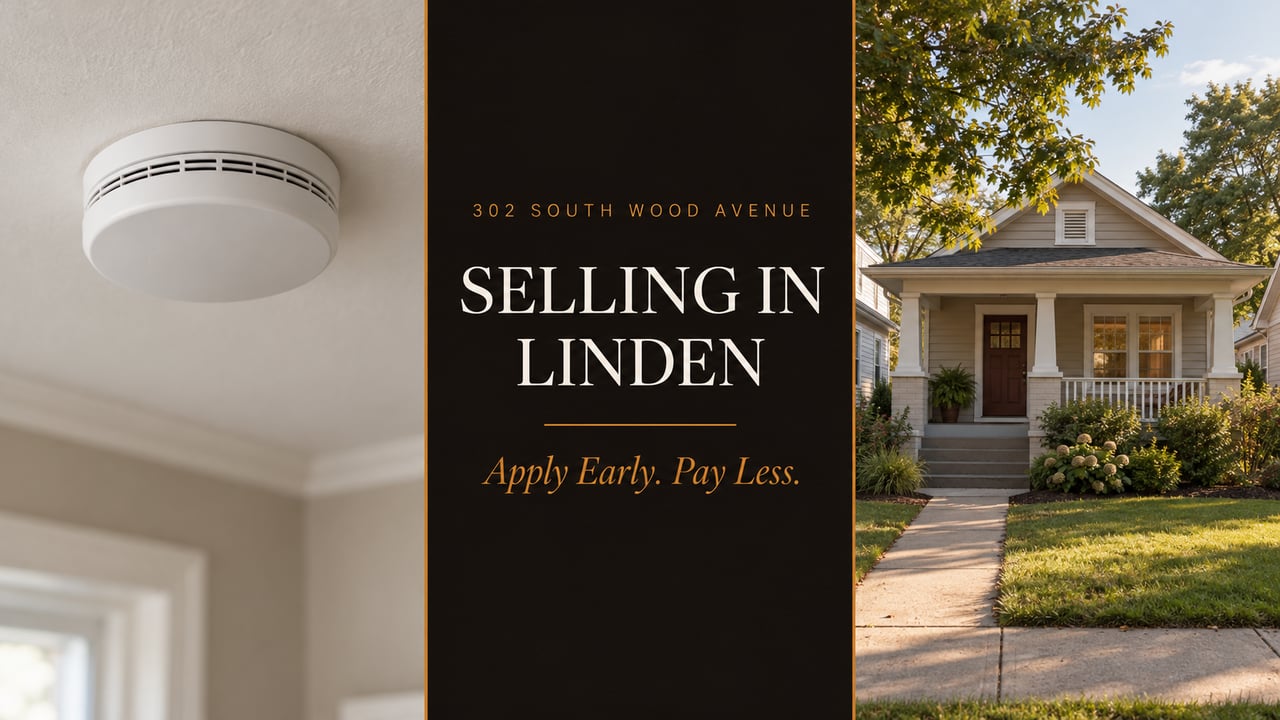
The certificate you cannot close without in New Jersey is priced by how much warning you give. Apply early and it costs one thing; apply the week before closing and it costs considerably more. And in Linden, the requirement that fails more homes than any other is a single line on the application: a smoke alarm with a removable battery fails inspection outright.
Every residential resale in New Jersey needs a Certificate of Smoke Detector and Carbon Monoxide Alarm Compliance, and in Linden it comes from the Fire Department's Fire Prevention Bureau at 302 South Wood Avenue. The application fee is set by how long before the expected change of occupancy you apply — so applying early is cheaper than applying late, which almost nobody plans for. Linden's own application is emphatic: smoke alarms must be 10-year sealed battery or hardwired. A removable-battery alarm fails. Separately, confirm with the City whether a resale certificate of occupancy applies to your sale — the published fee schedule carries a Certificate of Continued Occupancy at $500.
I am a broker, not an attorney, and municipal requirements, fees and forms change. Everything below should be confirmed directly with the City of Linden and your own New Jersey real estate attorney before you rely on it. Nothing here is legal advice.
Start with the distinction that confuses most sellers. The smoke and carbon monoxide certificate is required for every residential resale across New Jersey. A resale certificate of occupancy is different — only some municipalities require one. Two separate documents, two separate processes, and sellers routinely conflate them.
City of Linden Fire Department · Fire Prevention Bureau
302 South Wood Avenue, Linden, NJ 07036
Document: Certificate of Smoke Detector and Carbon Monoxide Alarm Compliance (CSDCMAC)
Authority: N.J.A.C. 5:70-2.3
A single approved inspection is required prior to final approval for occupancy whenever a home is sold
Linden's own application states it in capitals: smoke detectors MUST BE 10 YEAR SEALED BATTERY OR HARDWIRED. A smoke alarm with a removable battery fails inspection — and a failed inspection means a re-inspection, which means another fee and another delay against a closing date you have already agreed.
This is the cheapest problem in the entire transaction to solve and the most common one to discover late. Ten-year sealed alarms cost a few dollars each and take minutes to install. Walk your house this week, look at every alarm, and replace anything with a battery door. Do not wait for the inspector to tell you.
On every level of the residence — basement, first floor, second floor
Outside of sleeping areas, and at every finished level
Basement detectors in close proximity to the bottom of the basement stairwell
Carbon monoxide alarms in the vicinity of sleeping rooms, in buildings with fuel-burning appliances or attached garages
A portable fire extinguisher is part of the same compliance in New Jersey
The basement stairwell placement is the one people get wrong — an alarm in the middle of a finished basement ceiling is not the same as one at the bottom of the stairs, and the Linden application illustrates the required position with a diagram. Follow the form, not your assumption. The statewide picture, including what changed in 2025, is in our New Jersey seller certificate guide.
This is the mechanic most sellers never learn, and it is written into the Linden application in plain terms. The application fee for the certificate "shall be based upon the amount of time before the change of occupancy is expected." In other words, the state's fee structure under N.J.A.C. 5:70-2.3 charges you more for less notice.
To illustrate the structure rather than Linden's numbers: a neighbouring municipality publishes $45 for an inspection scheduled on a normal inspection day — defined as ten business days or more from the contact date — and $90 for a non-scheduled appointment at shorter notice. Double the cost, for the same inspection, because of timing alone.
Linden sets its own amounts and you must get them from the Fire Prevention Bureau — but the principle is statewide and the lesson is identical. Apply as soon as you have a contract, not as closing approaches. It costs less, and more importantly it leaves room for a re-inspection if something fails.
And understand what a failed inspection actually costs, because it is never just the re-inspection fee. If the inspector finds a violation, the seller must correct it and arrange a re-inspection before the municipality will issue the certificate. That is a second fee, a second appointment on the municipality's schedule, and contractor availability in between — against a closing date already in your contract.
Buyers will generally refuse to close without the certificate, and the seller is liable to a fine from the municipality for closing without one. It is not a formality you can paper over at the table.
There is one relief valve, and your attorney has to build it. In some cases buyer and seller agree that the buyer will take responsibility for correcting violations within a limited period after closing, signing an agreement given to the municipality so a temporary certificate can issue. That is a negotiated outcome, not an entitlement — and it is a conversation for your attorney, early, not a plan to rely on.
Fewer than half the homes in this city are what you're selling — and every citywide median your buyer reads includes the other 55%.
If you own a detached single-family house here, you are in a minority product type in your own city, and the medians circulating blend you with duplexes, converted homes and apartment complexes that do not compete with you. Add a market that went from 27 days to 45, and pricing correctly on day one stopped being optional. We comp detached against detached, price into the right neighbourhood band rather than the city average, handle the compliance calendar so nothing surfaces late, and bring the New York metro buyer pool that reaches Linden on the Northeast Corridor. Dual-licensed in New York and New Jersey.
New Jersey does not require a certificate of occupancy on the resale of an existing home at state level — but municipalities have the option of requiring one, and towns differ considerably in how stringent they are. Some require nothing beyond the smoke certificate; others run a full interior inspection against the building code.
Linden's municipal code, under the State Uniform Construction Code article, lists a Certificate of Continued Occupancy (All Subcodes, UCC) at $500, alongside certificate of occupancy fees for residential use groups R-3 and R-5 at 10% of the permit fee with a $150 minimum, and a temporary certificate of occupancy at $30.
Do not read that as "Linden charges $500 to sell a house." Those are construction-code fees, and a Certificate of Continued Occupancy is a specific UCC document that applies in specific circumstances — not automatically on every residential resale. What applies to your particular sale is a question for the City, and the answer may well be that only the smoke certificate is needed. Call and ask. Do not assume in either direction.
And ask one further question while you have them, because it is the one that catches people with older houses. If any work was done to your home without a permit, a municipal inspection is where that surfaces — and the cost of resolving it is not one number. Missing paperwork is one situation. Opening walls to correct electrical or plumbing is another. Structural is another again — and on top of the construction there are architect fees, re-inspections and carrying costs if the closing slips.
Nobody can price that until the building department has said what is required and contractors have quoted the corrections. Which is exactly why you check permits and approvals before you list, not after a buyer's inspector finds something. The same work costs less on your schedule than on theirs, because on theirs they hold the timing.
Only 45.17% of Linden's housing is single-family detached. A third is duplexes and converted homes that trade on rental income and financing terms, not kitchens and yards. A comp set that mixes them is describing a different market than the one your house is in. The full breakdown is in our Linden guide.
Reported bands run from the Linden Airport area at $385,000–$510,000 to the Wood Avenue corridor at $510,000–$640,000 — $255,000 apart, and heavily overlapping. Condition and street do as much work as area, and a prepared house in a cheaper band beats a tired one in an expensive band.
April 2026 recorded 117 sales against 90 a year earlier, but at 45 days against 27. A 27-day market forgives an aggressive asking price because scarcity does the work. A 45-day market does not — with more choice, the listing that sits is the listing that gets negotiated hardest.
OneWest delivered 334 apartments beside the station in 2026, with 13,000 square feet of new Wood Avenue retail, and the state is soliciting a second project on the commuter lot. Your closed comps sold into a downtown that existed before any of that. If you are within walking distance, that gap is an argument you have to make deliberately — see our downtown development analysis.
One more, specific to this corridor. Low-lying parts of the Arthur Kill shoreline carry documented flood exposure, and a buyer discovering flood history or an insurance cost late in the process is what derails transactions here. Get ahead of it: have the flood determination and a current insurance position ready before you list, so it is information you provide rather than something they find.
And remember the fee that changed sides. Since July 10, 2025, the fee formerly called the mansion tax is paid by the seller on a tiered schedule starting at 1% from $1 million, in addition to the ordinary Realty Transfer Fee. Most Linden sales sit below that threshold — but if yours does not, it is a real line in your net. Our cross-border guide sets out the full schedule. Confirm current rates with your attorney.
Walk your house tonight and look at every smoke alarm for a battery door. If it has one, it fails. Linden's application says it in capitals — 10-year sealed battery or hardwired — and this single requirement causes more failed inspections than everything else combined. Ten-year sealed alarms cost a few dollars and install in minutes. Then check the placement against the form: every level including the basement, outside sleeping areas, and the basement alarm close to the bottom of the stairwell rather than in the middle of the ceiling. Doing this before you apply converts a possible two-inspection, two-fee, closing-delaying problem into a twenty-minute job on a Saturday. And then apply for the certificate as soon as you have a contract — because the fee is set by how much notice you give, and the early tier is cheaper than the late one.
"Two things trip up Linden sellers and both are avoidable. First — the fee for your smoke certificate is based on how much notice you give. Apply when you get the contract, not two weeks out. Same inspection, cheaper, and you've got room for a re-inspection if something fails. Second, and this is the one — the application says it in capitals: ten-year sealed battery or hardwired. If your alarm's got a battery door, it fails. That's a few dollars a unit and twenty minutes on a Saturday, versus a second fee, a second appointment on the city's schedule, and a closing date you've already agreed to. Fire Prevention Bureau's at 302 South Wood. And while you've got them, ask whether anything beyond the smoke cert applies to your sale — don't assume either way."
— Anthony Licciardello, Broker, The Prodigy Team

Running a compliance calendar so nothing surfaces three days before closing is unglamorous and it is most of what a listing broker is actually for: I'm Anthony Licciardello, Broker of The Prodigy Team, dual-licensed in New York and New Jersey, a former Director of Community Affairs in the Bloomberg Administration, and a leading broker for cross-border New York–New Jersey transactions.
Anthony Licciardello · Broker, The Prodigy Team · 718-873-7345
We run the compliance calendar, comp detached against detached, and price into your band — not the city average.
What certificate do I need to sell a home in Linden, NJ?
A Certificate of Smoke Detector and Carbon Monoxide Alarm Compliance (CSDCMAC), required under N.J.A.C. 5:70-2.3 and issued by the City of Linden Fire Department's Fire Prevention Bureau at 302 South Wood Avenue. A single approved inspection is required prior to final approval for occupancy whenever a home is sold. This certificate is required for every residential resale across New Jersey — unlike a resale certificate of occupancy, which only some municipalities require. Confirm current forms, fees and whether anything further applies to your sale directly with the City.
How much does the Linden smoke certificate cost?
It depends on how much notice you give. Linden's application states the fee "shall be based upon the amount of time before the change of occupancy is expected" — the tiered structure under N.J.A.C. 5:70-2.3. Applying early costs less than applying late. To illustrate the principle, a neighbouring municipality publishes $45 for an inspection scheduled ten business days or more out, and $90 at shorter notice — double, for the same inspection. Linden sets its own amounts; get them from the Fire Prevention Bureau. Apply as soon as you have a contract, which also leaves room for a re-inspection.
What makes a home fail the Linden inspection?
Most often, the alarms themselves. Linden's application states in capitals that smoke detectors MUST BE 10 YEAR SEALED BATTERY OR HARDWIRED — an alarm with a removable battery fails. Placement also matters: detectors are required on every level including the basement, outside sleeping areas and at every finished level, with basement detectors in close proximity to the bottom of the stairwell. Carbon monoxide alarms are required near sleeping rooms where there are fuel-burning appliances or an attached garage, and a portable fire extinguisher forms part of the same compliance. A failure means correction plus a re-inspection, with another fee and another delay.
What happens if I close without the certificate?
Buyers will generally refuse to close without it, and the seller is liable to a municipal fine for closing without one. It is not a formality that can be papered over at the table. There is one relief valve and your attorney has to build it: in some cases buyer and seller agree the buyer will correct violations within a limited period after closing, signing an agreement given to the municipality so a temporary certificate can issue. That is a negotiated outcome, not an entitlement — raise it with your attorney early rather than relying on it.
What the Seller's Certificate Costs — County by County
New Jersey's Seller Certificate — What Changed in 2025
Moving to Linden — Fewer Than Half the Homes Are Houses
Linden Downtown — 334 Units in One Building
The Linden Commute — Two Lines, and the State Bought the Lot
The Arthur Kill Ladder — Three Markets, Eight Miles
Staten Island to New Jersey — The Three Questions and Two Rules
Details as of publication, from the sources noted, and subject to change. The author is a licensed real estate broker, not an attorney. Nothing in this article is legal advice. Municipal requirements, forms, fees and procedures change frequently and vary by property; confirm everything directly with the City of Linden and your own New Jersey real estate attorney before relying on it. Linden certificate requirements per the City of Linden Fire Department, Fire Prevention Bureau's published application for a Certificate of Smoke Detector and Carbon Monoxide Alarm Compliance (CSDCMAC), located at 302 South Wood Avenue: the application fee for a CSDCMAC as required by N.J.A.C. 5:70-2.3 shall be based upon the amount of time before the change of occupancy is expected; the certificate requires a single approved inspection prior to a final approval for occupancy whenever a home is sold; smoke detectors must be 10-year sealed battery or hardwired detectors; detectors are to be located on every level of a residence including basement, first floor and second floor, outside of sleeping areas and at every finished level of the home, with basement level detectors located in close proximity to the bottom of the basement stairwell as shown in the application's figure. The specific fee tiers applicable in Linden are not reproduced here and must be obtained from the Fire Prevention Bureau; the $45 scheduled and $90 non-scheduled figures cited in the text are published by the Brick Township fire district as an illustration of how the tiering operates generally, with scheduled days defined there as ten business days or more from the contact date, and do not represent Linden's fees. Linden fee schedule per the City of Linden municipal code, Chapter 10 Building and Housing, Article I State Uniform Construction Code: Certificate of Occupancy fees for Use Groups R-3 and R-5 at 10% of the permit fee including all updates with a minimum fee of $150; Temporary Certificate of Occupancy $30; and Certificate of Continued Occupancy (All Subcodes, UCC) $500. 🔴 These are construction-code fees. A Certificate of Continued Occupancy is a specific Uniform Construction Code document applying in specific circumstances and should not be read as a charge automatically applying to every residential resale in Linden. Whether any certificate beyond the smoke and carbon monoxide certificate applies to a particular sale is a question for the City of Linden. Statewide context per published legal commentary: New Jersey law requires the seller of a home to obtain a smoke detector and carbon monoxide detector inspection and certificate, initiated by completing a form at the municipality and paying a fee; buyers will typically refuse to close title without the certificate and the seller is liable for a fine to the municipality for closing without it; for the resale of an existing property the state does not require a certificate of occupancy, though municipalities have the option of requiring a seller to apply for a certificate of occupancy or compliance on resale, and towns vary in stringency; where an inspector finds a violation the seller must correct it and arrange re-inspection before the certificate will issue; and in some cases buyer and seller may agree that the buyer will correct violations within a limited period after closing, signing an agreement given to the municipality so that a temporary certificate may be issued. Further commentary notes the certificate is issued by the local fire official or fire prevention bureau rather than the state, that it is required for every residential resale statewide unlike a resale certificate of occupancy, that the seller is responsible in nearly all cases, and that compliance encompasses smoke alarms, carbon monoxide alarms and a portable fire extinguisher. Market figures — the 45.17% detached share, the neighbourhood bands, and the April 2026 figures of 117 sales at a median $549,000 with 45 days on market against 27 — are set out with their sources in our separate Linden guide. OneWest details are set out with their sources in our Linden downtown development analysis. Transfer fee changes effective July 10, 2025 are set out with their sources in our Staten Island to New Jersey guide; confirm current rates, thresholds and application with your attorney. Flood exposure on the Arthur Kill shoreline is noted in general terms only and does not mean any particular property floods; obtain flood determinations and insurance quotations for any specific address. School performance ratings, household income, crime statistics and demographic data have been deliberately excluded, as we exclude such material for every community we cover. This is general information and market commentary, not legal, tax or investment advice.
Prodigy Real Estate is an innovative real estate company offering high-end video production, home valuation services, purchasing, and home sales. Serving New York and New Jersey.