
August 8, 2026
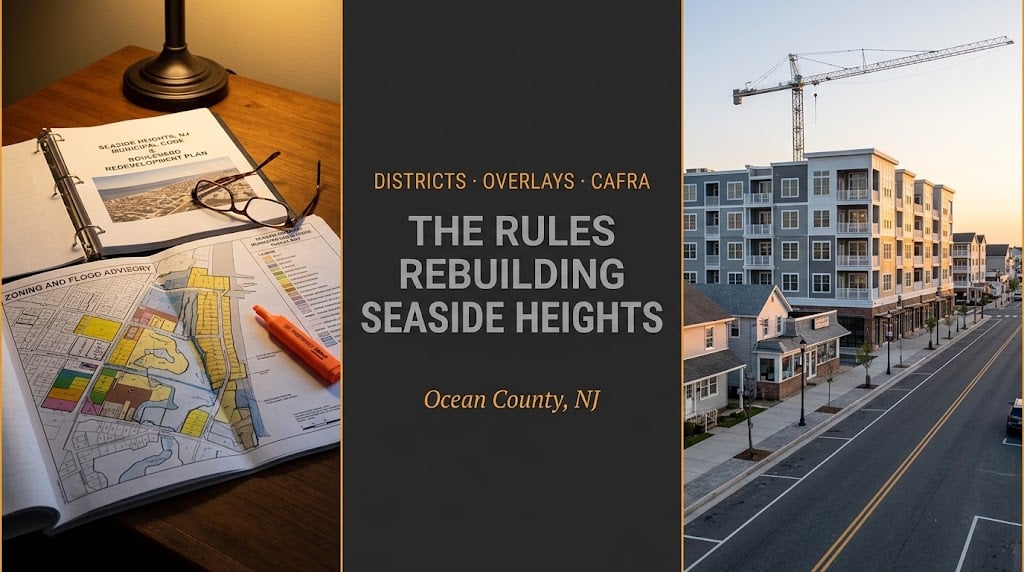
Every demolished motel and every new tower in Seaside Heights traces back to paperwork: redevelopment designations, overlay zones, and a state coastal permit regime that decides what rises where. This is the deep dive into the zoning machinery behind the borough's reinvention — the districts, the overlays, the approval path, and what it all lets an owner, buyer, or builder actually do.
Seaside Heights rebuilt its rulebook before it rebuilt its blocks. The foundation is New Jersey redevelopment law: beginning in 2002 the borough designated portions of town — notably the southeast — as areas in need of redevelopment, layered on revitalization and vision plans (2005, 2009), and consolidated them into adopted redevelopment plans that let the council hand-pick redevelopers for key sites, as it did in May 2021 when SSH Boulevard LLC was designated for the former steel-skeleton block. On top of the base districts sits the Redevelopment Overlay (RO) Zone — an opt-in set of development standards for new construction of redevelopment projects, with Planning Board site plan review required for all new development and major renovations, while ordinary remodels with no change of occupancy stay under the underlying zone's rules. A senior-housing overlay invites age-restricted residential redevelopment of dilapidated commercial parcels along a major corridor. And above it all sits the state: CAFRA coastal permits govern large projects — an 18-month process for the approved 10-story, 77-unit Boulevard tower, whose onsite-parking requirement literally shaped the building. For owners and buyers, the practical stakes are direct: which layer your parcel sits in determines what you can build, what your neighbor can become, and what your land is really worth. Here's the full map.
Zoning is the legal engine of the story we tell in our revitalization report, and its results show up in the numbers of our market analysis. One caution up front: ordinances get amended and plans get revised — always verify the current code and your parcel's exact designation with the Borough before acting.
The most powerful tool in the box is New Jersey's Local Redevelopment and Housing Law. Once a governing body designates an "area in need of redevelopment" — Seaside Heights began doing so in 2002, focused on the southeastern portion of town — it can adopt a redevelopment plan that overrides ordinary zoning for those blocks, negotiate redevelopment agreements with performance schedules, and designate specific redevelopers for specific sites. Successive planning documents — a 2005 revitalization plan, a 2009 vision plan, and consolidated redevelopment plans reorienting districts toward a tourist-and-town center — built the framework the current boom runs on.
You can watch the machinery work in one site's story: the Boulevard block where an unfinished steel skeleton stood since roughly 2009. The borough designated SSH Boulevard LLC as redeveloper in May 2021, the skeleton came down that August, and the replacement — a 10-story, 120-foot, 77-unit mixed-use tower with ground-floor retail, a fourth-floor restaurant, and a rooftop pool deck — cleared a unanimous Planning Board. That's redevelopment law doing exactly what it's designed to do: converting a stalled parcel into the corridor's anchor. Every project in our project map sits somewhere in this framework.
On top of the base residential and business districts, the borough's code adds overlays — and understanding their mechanics is where owners gain real advantage:
The RO Zone supplies its own development standards for new construction of redevelopment projects — but it's elective in a crucial way: for remodels or additions with no change in occupancy, or where the developer chooses not to use RO standards, the underlying zone's rules apply. Opting in unlocks the redevelopment standards; either path through new development or major renovation requires Planning Board site plan review. In practice: renovate quietly under the old rules, or rebuild ambitiously under the new ones.
Its stated purpose, verbatim in spirit: provide age-restricted senior housing while revitalizing and redeveloping dilapidated commercial properties on a major thoroughfare. Projects under it must deliver age-restricted units (a legal designation) — a channel that turns tired commercial parcels into year-round residents and ratables.
The code fixes a 10-foot minimum front setback borough-wide for new buildings, and a distinctive riparian-lands rule: underwater lands in Barnegat Bay or the Atlantic, if ever put to use, take the zoning of the adjacent upland district — a quietly important clause for bayfront and oceanfront owners.
The adopted plans for the Boulevard corridor encode the year-round vision — walkable mixed use, active ground floors, streetscape standards — with the county-designed sidewalks and granite curbing already in the ground and the approved tower as its proof of achievable scale.
Mechanics per the Borough of Seaside Heights municipal code (Article V, Zoning) and adopted redevelopment plans, as of publication. Ordinances are amended; standards, districts, and boundaries change. Verify your parcel's current designation and applicable standards with the Borough before acting.
No coastal project answers to the borough alone. Large developments in New Jersey's coastal zone need a CAFRA permit (Coastal Area Facility Review Act) from the state — and the Boulevard tower shows what that means in practice: its CAFRA approval took more than eighteen months, and state rules for large coastal developments required parking to be provided onsite, which is why the building grew from eight stories to ten to swallow its own 153-space garage. The state layer doesn't just delay projects; it shapes them.
For smaller owners the same lesson applies at scale: flood-zone construction standards, elevation requirements, and coastal permitting can govern additions and rebuilds well below tower size — one more reason renovated and new product carries a premium in the market data, and why buyers should always ask what a property's envelope legally allows before assuming what it could become. (Coastal ownership costs generally — insurance included — get full treatment in our Shore flood-insurance guide.)
Owners: your parcel's layer is your option value. In or near the RO Zone, the opt-in structure means you can maintain and renovate under familiar rules today while holding redevelopment-standard upside for tomorrow — and if your property is a tired commercial parcel on the senior-overlay corridor, an entire redevelopment channel exists specifically for land like yours. Buyers: before any offer, get the parcel's designation, the overlays that touch it, and what's approved on the surrounding blocks — the difference between buying next to a protected streetscape and buying next to an approved 10-story neighbor is the whole deal, and the hub guide's playbook builds this check into the process.
Builders and investors: the message of the last decade is that the borough uses its tools — designations, agreements, schedule amendments — and works with performers. Underwrite the CAFRA timeline honestly, design to the coastal parking reality, and treat the redevelopment plans as the actual entitlement map. We brief clients on specific parcels against the current code and plans — start with the inventory on our Seaside Heights listings page and bring us the block you're studying.
The single highest-leverage document in a redevelopment town isn't the zoning map — it's the redevelopment plan for your block, because where one is adopted it can supersede the base zoning entirely. Before you buy, renovate, or list, pull three things: your parcel's designation (in or out of a redevelopment area), the adopted plan text for that area, and any redeveloper agreement touching adjacent parcels. Twenty minutes with those three documents tells you your real building envelope, your neighbor's real future, and — if you're selling land a builder might want — the entitlement story that justifies your price. We pull them on every Seaside Heights deal we touch.
"In government I learned that zoning isn't red tape — it's the town's business plan written in legal language. Read Seaside Heights' rulebook and the strategy is unmistakable: make deteriorated property expensive to keep, make redevelopment attractive to build, protect the year-round vision on the Boulevard, and let the state's coastal rules shape the big stuff. For my clients, that clarity is a gift. When a town telegraphs exactly what it wants built, the smart money simply reads the plan — and buys accordingly."
— Anthony Licciardello, Broker, The Prodigy Team
Translating municipal rulebooks into client advantage is the rare edge I carry from government: I'm Anthony Licciardello, Broker of The Prodigy Team — a former Director of Community Affairs in the Bloomberg Administration, dual-licensed in New York and New Jersey, and a leading broker for cross-border New York–New Jersey transactions, bringing the New York market to New Jersey sellers and Shore investors.
Our Above the Streets cinematic drone series shows what the rulebook is building — watch the Seaside Heights episode above — with audience performance exceeding industry benchmarks for real estate media.
Anthony Licciardello · Broker, The Prodigy Team · 718-873-7345
Designation, overlays, and approved neighbors — we brief buyers, owners, and builders on exactly what the rulebook allows.
What zoning changes enabled the Seaside Heights redevelopment?
Three layers working together: New Jersey redevelopment-law designations (areas in need of redevelopment beginning in 2002, adopted redevelopment plans, and council-designated redevelopers for key sites); overlay zoning, including the Redevelopment Overlay (RO) Zone with opt-in development standards for new redevelopment construction and a senior-housing overlay for age-restricted conversion of dilapidated commercial parcels; and the state's CAFRA coastal permitting for large projects.
How does the Redevelopment Overlay (RO) Zone work?
It supplies development standards for new construction of redevelopment projects, but it's effectively opt-in: remodels or additions with no change of occupancy — or projects whose developers choose not to use RO standards — remain governed by the underlying zone. Planning Board site plan review is required for all new development and major renovation in the RO Zone. Practically, owners can renovate under familiar rules or rebuild under the redevelopment standards.
How was a 10-story building approved in Seaside Heights?
Through the redevelopment framework: the borough designated SSH Boulevard LLC as redeveloper of the former steel-skeleton site (May 2021), the project obtained a state CAFRA coastal permit after a process of more than eighteen months, and the Planning Board approved it unanimously. Notably, state coastal rules requiring onsite parking pushed the design from eight stories to ten to accommodate an internal 153-space garage — a clear example of how the state layer shapes coastal projects.
How do I find out what I can build on my Seaside Heights property?
Pull three documents: your parcel's designation (whether it sits in a redevelopment area), the adopted redevelopment plan text for that area (where one exists, it can supersede base zoning), and the current zoning chapter for your district and any overlays. Then confirm with the Borough's land-use office — ordinances are amended regularly — and factor state coastal and flood-zone rules for any significant construction. We run this exact check for clients on request.
The Seaside Heights Revitalization — Every Project, Mapped
Seaside Heights Prices — The Forensic Market Analysis
Moving to Seaside Heights — The Complete Guide
Flood Insurance on the Shore — The Owner's Guide
Seaside Heights Homes for Sale — Browse Current Listings
Zoning and redevelopment details per the Borough of Seaside Heights municipal code (Article V, Zoning, including the Redevelopment Overlay Zone provisions — development standards applying to new construction of redevelopment projects, underlying-zone applicability to remodels or additions without change of occupancy or where RO standards are not elected, and Planning Board site plan review for new development and major renovation; the senior-housing overlay's stated purpose of providing age-restricted senior housing while revitalizing dilapidated commercial properties on a major thoroughfare; the ten-foot minimum front setback; and the riparian-lands provision assigning underwater lands the district of the bordering upland), adopted redevelopment planning documents (area-in-need designations beginning 2002; revitalization and vision plans of 2005 and 2009; consolidated redevelopment plans for the southeast and Boulevard areas), and reporting by the Asbury Park Press and Shorebeat on the SSH Boulevard LLC project (redeveloper designated May 2021; predecessor unfinished structure demolished August 2021; CAFRA permit granted after a process exceeding eighteen months, with state coastal rules requiring onsite parking; unanimous Planning Board approval of a ten-story, 120-foot mixed-use building with 77 residences, a 153-space parking deck, ground-floor retail, a fourth-floor restaurant, and rooftop amenities), 2002–2026, for the Borough of Seaside Heights, Ocean County, NJ (ZIP 08751), as of publication. Age-restricted housing is a legal community designation. Ordinances, plans, designations, and project statuses change, and this article summarizes rather than reproduces the code; it is general information, not legal, zoning, or investment advice. Verify current provisions with the Borough of Seaside Heights land-use office and qualified professionals before acting.
Prodigy Real Estate is an innovative real estate company offering high-end video production, home valuation services, purchasing, and home sales. Serving New York and New Jersey.