
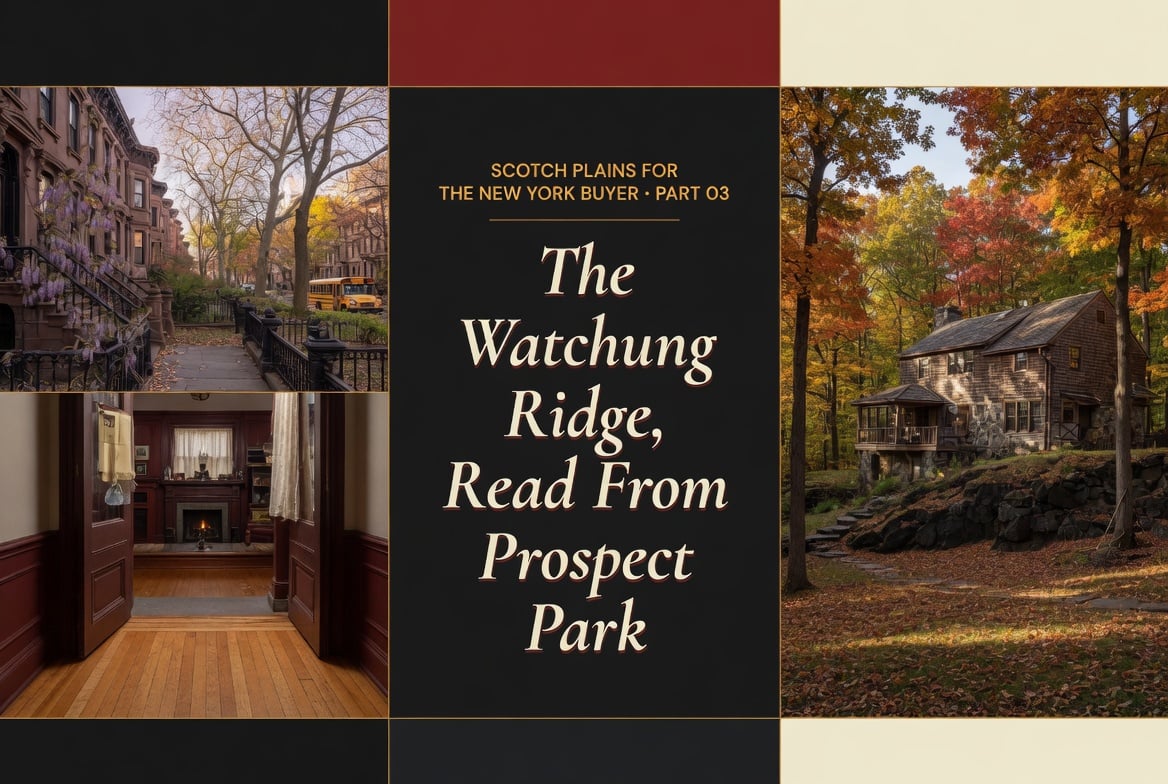
The Watchung Ridge, Read From Prospect Park
What the Park Slope and Cobble Hill family is actually trading when they leave the brownstone belt for the ridge. The 526-acre park you grew up with, traded for the 1,945-acre reservation across the street.
The Park Slope family chose the brownstone for Prospect Park, the historic district streetscape, and PS 321 — in that order. The Watchung Ridge offers a different set of those same three values: a 1,945-acre preserved reservation directly across the street instead of a 526-acre park six blocks away; a sloped, geologically distinct neighborhood with its own architectural character; and a public school district that lifts the private-school question off the family balance sheet entirely. The trade is not Brooklyn for the suburbs. It is one specific version of the urban-family deal for another, made at half the price and four times the lot.
The Park Slope family arrives in our office on a Saturday in late winter. Two children, ages four and seven. A stroller still in the trunk of the rental car. They have spent the last seven years inside the PS 321 zone, paying $1.6 million for a third-floor floor-through condo on Carroll Street that they bought in 2019 and that has lifted them to within striking distance of a brownstone — if not in Park Slope, then in Cobble Hill, or further afield in Bed-Stuy or Crown Heights. They have toured fourteen houses in the last six months. They know the math. They have done it on napkins. They are not happy about what it says.
A restored four-bedroom Park Slope brownstone, with original parlor floor details and a back garden, lists at $4.2 million. A renovated four-bedroom in Cobble Hill, slightly narrower, with a roof deck instead of a garden, lists at $3.8 million. Both come with property taxes that have crossed thirty thousand dollars a year. Both come with mortgage carries that, at current rates, eat the difference between their household income and the lifestyle they remember having before the second child. They are not poor. They are not even uncomfortable. They are facing the math problem that defines the brownstone-family demographic in 2026: the neighborhood they made their life in has appreciated past the point where their own family can stay in it.
The Brownstone Family Who Calls Us First
The brownstone family is not the West Village family from Part 01 of this series. The brownstone family did not come to Brooklyn for the bar at midnight or the gallery on Wednesday. They came for the version of urban family life that nineteenth-century Brooklyn handed them on a plate: a parlor-floor walkup, a back garden visible through tall windows, a tree-lined block, a park six minutes by foot, and a public school whose PTA outraises most private schools. They built their lives inside that architecture. By 2026, the architecture costs more than their architecture-supporting income can carry.
The numbers, as they sit in front of us in late winter 2026: Park Slope median sale price is $1.45 million, with single-family brownstones trading between $2.5 million and $5 million and restored landmark homes on Carroll Street and Montgomery Place clearing $4 million on tight blocks. Cobble Hill median sits at $1.6 million, with brownstones in the same $2.5 million to $5 million band; the neighborhood’s most expensive recent listing, a five-story Greek Revival at 205 Clinton Street, just entered contract at roughly $17 million. Days on market across the brownstone belt averages 55 days in spring 2026 — quick, but not the eight-day frenzy of 2022. Inventory is thin. Prices remain firm.
The Watchung Ridge offers this same family something that does not quite exist in either neighborhood any more: a price band where the architecture, the school district, and the green space all still scale to the household. A traditional Colonial or stone-and-shingle ridge home on a half-acre to acre lot, four to five bedrooms, finished basement, two-car garage, mature canopy, trades between $1.1 million and $2.5 million depending on the street. That is not Park Slope. It is also not nothing. It is the family’s Carroll Street equity walking into a house with the same number of children’s bedrooms, twice the square footage, and a public school district that ranks in the top decile of New Jersey high schools. The math problem closes.
“The Park Slope family does not want to leave Park Slope. They want to stay. The brownstone they need costs four million dollars, and their household income does not carry four million dollars. That is the only reason they call us.”

Prospect Park, Then Watchung Reservation
This is the gain the Park Slope family does not believe until they see it. Prospect Park is 526 acres, designed by Olmsted and Vaux, and it is one of the great urban parks of the world. The Watchung Reservation, which begins less than two miles north of the Watchung Ridge and runs along the township’s northern edge, is 1,945 acres. That is roughly three and three-quarter Prospect Parks. The Reservation extends across five municipalities, includes the Surprise Lake circuit, the Sierra Trail, the Trailside Nature and Science Center, the Loop Drive, several creeks and tributaries of the Green Brook watershed, the Watchung Stables, and tens of miles of marked hiking and equestrian trails. It is not a city park. It is a New Jersey state-county forest preserve operated by the Union County Department of Parks and Recreation, and it shapes the experience of living on the ridge.
The geographical accident at work here is the First Watchung Mountain — the basalt ridge that runs through northern Scotch Plains and gives the streets at the township’s northern edge their slope, their borrowed scenery, and their character. The houses on the ridge are not the flat-lot Colonial estates of the South Side. They are stone and shingle and stone-and-shingle hybrid, built into the slope, set on lots that step down with the topography. The mature canopy is dense. The streets are quiet in a way that Park Slope’s east-west cross streets are not, even at six a.m. The Reservation, beginning a short walk or short drive from most of the ridge, is the dominant green presence in the same way that Prospect Park is the dominant green presence in Park Slope.
The honest comparison: Prospect Park is more programmed. The bandshell, the carousel, the LeFrak Center skating rink, the summer concerts at the Prospect Park Bandshell, the Saturday farmers market at Grand Army Plaza — these are not casual amenities. They are part of the texture of weekly Park Slope life. The Watchung Reservation is less programmed and more wild. There is no carousel. There is, instead, a 1,945-acre forest preserve where you can hike for two hours on a Saturday morning and not pass another person past the first half mile. The brownstone family that came to Park Slope for Prospect Park’s amenities will miss them. The brownstone family that came to Park Slope for the park itself — for the trees, the meadow, the quiet of an early-morning loop — will find a different version of the same thing, scaled up nearly four times, on the ridge.
A Saturday on the Ridge
Saturday morning in Park Slope begins on the slope itself. The children are up first. You walk to Konditori or Cafe Regular for coffee. You walk to D’Vine Taste or the Park Slope Food Coop for whatever the week needs. By ten, the family is on Third Street or Eighth Street, walking the four to six blocks to Prospect Park West, into the park, around the Long Meadow, past the Audubon Center. By noon, you are back. By two, you are at a birthday party at the Old Stone House or the Brooklyn Children’s Museum. The week ends and begins on foot. It is the architecture of the whole life.
Saturday morning on the Watchung Ridge begins differently and ends with several of the same beats. The children are up first; this part does not change. You walk into your own backyard, which is a thing the Park Slope family has not had since they left whatever rental they had in 2017. The coffee comes from your own kitchen, or from a ten-minute drive to a Park Avenue cafe in the downtown corridor. By nine, you are at the Scotch Plains Farmers Market at Alan Augustine Village Green — smaller and less crowded than Grand Army Plaza’s, but with the cheese vendor who knows your children’s names by your second visit and the produce stand sourcing from farms thirty miles west.
By ten you can be at the Watchung Reservation. The Surprise Lake loop, three and a half miles, mostly empty. The Sierra Trail, longer, mostly wooded. The Loop Drive, if the children want to ride bikes without a stroller and without competing with a Prospect Park Saturday-morning crowd. Deer, in early morning. A pileated woodpecker, if you are lucky. The kind of trail experience that the Park Slope family thought they wanted when they joined REI and stopped buying things at REI.
Lunch is the Stage House Tavern downtown — a 1737 building, restored, with the kind of dark-wood, low-light, generationally-loyal-clientele atmosphere that the Park Slope family will recognize from the Long Island Bar or Quarters in Boerum Hill. Or you drive ten minutes to downtown Westfield: six walkable blocks, three wine bars, an independent bookstore. Afternoon: your pool, your yard, or a drive to the Jersey Shore that lands you at Asbury Park or Manasquan in ninety minutes, swimming in the Atlantic by two, home for dinner. Evening, if you want it: NJ Transit Raritan Valley Line from Fanwood station, eight minutes from the ridge, to Newark Penn, to PATH, to the West Fourth Street stop in the Village. Door to Sant Ambroeus: roughly eighty minutes. Door to Locanda Verde: roughly seventy. The Park Slope family who insists they will never come back for a dinner is usually wrong about that.
What You Lose, What You Gain
You lose the stoop. We owe you this honestly, because the stoop is what the Park Slope family talks about when they reminisce about the brownstone in five years. The stoop is the social architecture of brownstone Brooklyn. It is the thing that converts a private home into a semi-public neighborhood institution. It is where the children play, where the parents drink wine on the first warm Friday in April, where the block knows each other because the architecture forces them to. Scotch Plains has front porches in pockets — the older Colonial stock along Park Avenue, the historic district near Frazee House — but the stoop, as a typology, is a Brooklyn invention, and it is the thing the relocating brownstone family misses most.
You lose the stroller-to-everything radius. The Park Slope architecture made every weekly errand into a child-and-stroller walk. The pediatrician was six blocks away. The dentist, ten. The library, eight. The kid’s soccer field, in the park, twelve. The Watchung Ridge architecture is different. The pediatrician is a drive. The library is a drive. The kid’s soccer is a drive. Most things, in fact, are a drive. The two-car-garage that came with the house is not aesthetic preference; it is functional necessity. The household with one car will be unhappy by month six. The household with two cars adapts, but they should know going in that the daily mileage is real.
You gain the school district. Scotch Plains-Fanwood Regional High School ranks in the top decile of New Jersey public schools, and the K–8 feeder system is one of the strongest in Union County. Our schools guide walks the specifics. The number that matters to the Park Slope family considering this move: the PS 321 zone produces excellent outcomes, and so does Scotch Plains-Fanwood, and the difference is that one of those costs you 35 thousand a year in NYC property taxes plus a brownstone-mortgage carry, and the other costs you in property taxes well below half that on a smaller mortgage. The family that was considering private high school for a third child can stop considering it.
You gain the trees. This is the gain the Park Slope family does not register until they have lived on the ridge for one full October. Prospect Park has trees. The ridge has thousands of trees, and they fill the entire visual field from every window of the house, and the canopy in fall turns the streets the color of bourbon for three weeks. The Park Slope family who lived their architectural life inside the brownstone block has been getting their trees in concentrated doses — a walk to the park, a moment under a big elm. The ridge family gets trees as the background of every meal, every morning, every drive to the train.
You gain the geological character. This is the gain that distinguishes the ridge from any other Scotch Plains neighborhood and from most of the surrounding towns. The First Watchung Mountain is a basalt ridge formed 200 million years ago in the same rifting that opened the Atlantic. It is the reason the streets have slope. It is the reason the houses are built into the topography. It is the reason the Reservation sits where it sits, preserved as a forest because the geology made it hard to develop. The Park Slope family with any aesthetic sensibility — and most of them have one — will find that the ridge offers an architectural experience that flat-lot suburbs do not. We covered the appraisal mechanics of this in our Usable Acreage post.
“The brownstone family came to Park Slope for Prospect Park, the schools, and the architecture. The Watchung Ridge gives them a 1,945-acre version of Prospect Park, a top-decile version of the schools, and a stone-and-shingle architecture they did not know they were going to fall in love with.”
The Honest Verdict
The Watchung Ridge is not the right move for every Park Slope or Cobble Hill family. The family for whom the stoop, the block-party social architecture, and the eight-minute walk to the park are the foundational values of their daily life should stay in Brooklyn, accept that they will not get the brownstone they wanted in the zone they wanted, and look at Crown Heights, Bed-Stuy, or Sunset Park instead. The brownstone-belt experience continues in those neighborhoods at price points that still make sense for the household that has to stay walkable. We will tell them so on the first call. That is the honest answer for that buyer.
The family for whom the Watchung Ridge is the right answer is the brownstone family whose Park Slope or Cobble Hill life has begun to feel financially unsustainable, but who is not willing to give up the values that drew them to brownstone Brooklyn in the first place: the park, the school, the architecture, the seasonal canopy, the sense that the family is rooted in a specific built environment rather than in a generic place. The ridge delivers all four of those, in a different key, at price points that recover what the brownstone math has been taking.
That family will find, on the streets that run along the First Watchung Mountain at the northern edge of Scotch Plains, a version of family life that the brownstone-belt math no longer supports in Brooklyn. A four- or five-bedroom stone-and-shingle home built into the slope. A 1,945-acre preserved reservation within walking or short-driving distance. A public school district that produces the outcomes the brownstone PTA worked twenty years to produce, without the supplemental tutoring industry the brownstone family was already absorbing. And the children, eventually, will start describing their childhood the way the brownstone parents describe theirs: in terms of the specific place that shaped it. Just a different place.
“The brownstone family that arrives on the ridge does not pretend they are not nostalgic for what they left. They are. The ones who land well are the ones who recognize that the values they came to Brooklyn for — park, school, architecture, canopy — survive the move. The values they came for did not require the brownstone. They required the brownstone-shaped life, and the ridge delivers a different version of that.”
Door-to-door from a Watchung Ridge home to Lower Manhattan via Fanwood station, the Raritan Valley Line to Newark Penn, and PATH to World Trade Center runs roughly 75 to 90 minutes. From Park Slope to West Fourth Street on the F train is approximately 25 to 35 minutes. The commute lengthens. The brownstone families we have worked with typically rebalance to a hybrid schedule rather than five city days a week.
In the current cycle, $1.45M to $2.5M lands a four-to-five-bedroom stone-and-shingle or traditional Colonial home on a half-acre to acre lot along the Watchung Ridge. Finished basement, two-car garage, mature landscaping, often with views of the Reservation or borrowed scenery from the slope. The equity from a sold Park Slope brownstone often funds the ridge home, the mortgage carry reduction, and a substantial reserve.
The Reservation is 1,945 acres versus Prospect Park’s 526. It has more trail, less programming, no carousel, and the Trailside Nature and Science Center anchors the educational programming for kids. Families that valued Prospect Park for nature, trees, and unstructured time tend to prefer the Reservation. Families that valued it for the carousel, the bandshell, and the Saturday Greenmarket tend to miss those amenities.
Walkability on the ridge is house-specific. Some homes are within walking distance of the Reservation trailheads. Most are not walkable to the downtown Park Avenue corridor; that is a 10-to-15-minute drive. Families who want the brownstone-belt walkability radius should look at the Park Avenue walkable corridor instead, covered in Part 02 of this series.
The brownstone-relocation buying window peaks February through May, driven by families aligning to the September school calendar. Ridge listings going live in March or early April see the strongest cross-pollination from Park Slope and Cobble Hill sellers exiting on their own spring market.
We built the New York to Scotch Plains buyer pipeline.
Our 25,000-member NY/NJ/FL relocation community delivers your Watchung Ridge listing to Park Slope, Cobble Hill, West Village, and LIC families before it hits Zillow. That is not a marketing claim. It is the pipeline we have spent years building, and it is the reason Scotch Plains sellers on the ridge should be working with us.
List Your Watchung Ridge Home →