
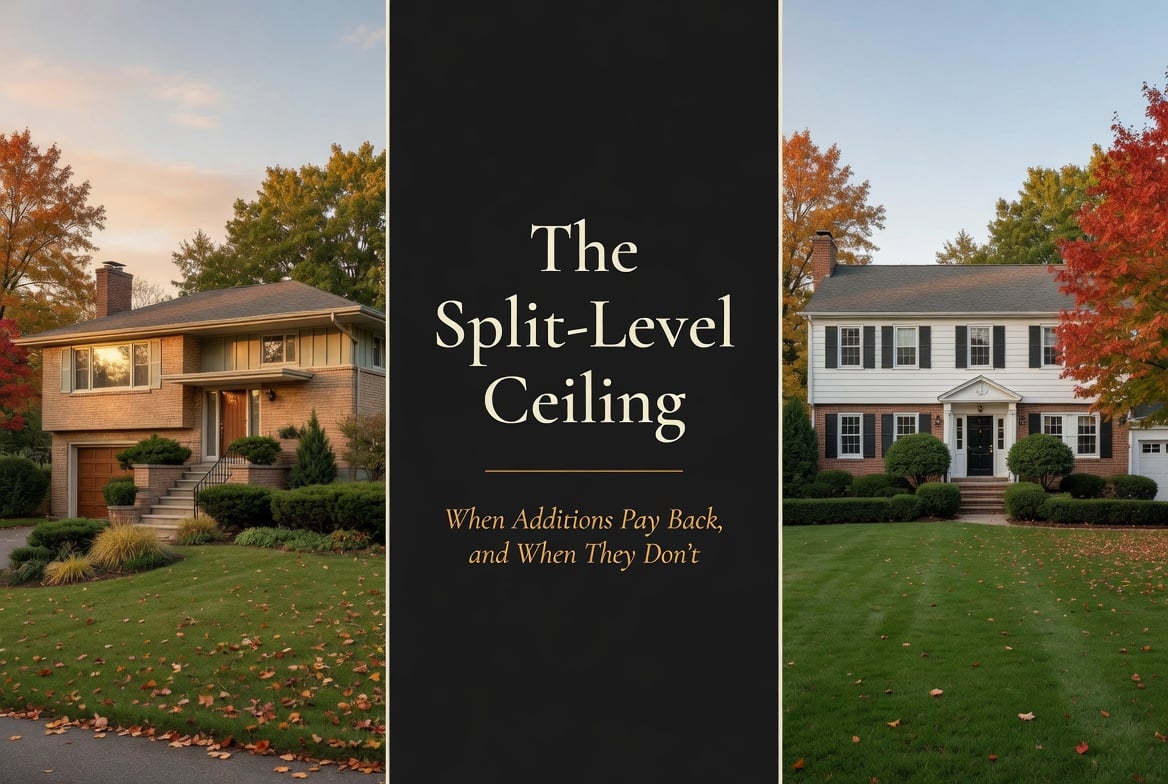
The Scotch Plains Split-Level Ceiling: When an Addition Pays Back, and When It Doesn’t
Your contractor will quote you the cost of a master-suite addition over the garage. He won’t quote you the appraisal. Here is the math on what a renovated split-level can actually carry against a true Colonial in 07076 — and when the right move is to add, sell, or trade up.
A split-level in Scotch Plains does not become a Colonial because you spend $150,000 over the garage. It becomes a renovated split-level — and the comp set will price it that way. The decision of whether to expand or trade is not about the addition’s sticker; it is about whether the resulting product clears the local appraisal ceiling for its category. Knowing the ceiling before the contractor draws is the difference between a sound capital decision and an emotional one.
The conversation almost always opens the same way. A Scotch Plains homeowner has lived in their split-level for fifteen or twenty years. The kids have outgrown the bedrooms. The kitchen wants opening up. A contractor has walked the property, sketched a master suite over the garage, and quoted a number between $150,000 and $220,000. The homeowner calls us with the question that contractor cannot answer: if I spend this, do I get it back?
The answer in Scotch Plains in the current cycle is “sometimes, partly, and almost never all of it.” The reason is structural to how this township is built. Scotch Plains carries one of Union County’s deeper inventories of mid-century split-levels — homes built between roughly 1948 and 1968, on cul-de-sacs and gridded streets that were laid out when a four-bedroom split was the era’s aspirational family home. The split-level is not undesirable. It is, however, a category. And a category has a ceiling.
This post is the second in our three-part Scotch Plains data series. The first covered the usable-acreage gap between the North Side and the South Side; the third covers the post-Ida water mitigation premium. This one is for the homeowner standing in their kitchen with a contractor’s estimate in one hand and a refinance application in the other.
The Mid-Century Inventory Problem
Drive any of the long residential blocks between Mountain Avenue and Raritan Road and you will see the era written into the streetscape: brick fronts, garage-under-bedrooms massing, three or four staggered floors that step up half a level at a time. The split-level was the era’s answer to building affordable four-bedroom homes on modest lots without a full second story. It worked. It worked so well that Scotch Plains has hundreds of them, and a meaningful share of the township’s sub-$900,000 transaction volume passes through this housing type in any given quarter.
The trouble is what came next. Buyers entering the township today, especially those migrating from school-district-driven searches, often come in pre-sold on a Colonial floor plan. They want an open kitchen-family flow on one level. They want a primary suite on a single upstairs floor. They want a basement that functions as basement, not a half-flight-down rec room masquerading as one. The split-level’s split — the very feature that defines the type — works against every one of those preferences.
This is why the renovated split-level we tracked in our Q1 market update closed at $875,000, and why an unrenovated Colonial on the same block can close higher despite older kitchens. The buyer pool prices the type before it prices the finishes. Renovating a split-level lifts the ceiling within the category; it does not move the home into the Colonial category.
“Renovating a split-level lifts the ceiling within the category. It does not move the home into the Colonial category. That is the line every owner has to price for.”

Why Splits Don’t Comp to Colonials
When an appraiser pulls comparables for a Scotch Plains split-level, the dataset they build is almost always a within-type set. Splits comp to splits. Bi-levels comp to bi-levels. Colonials comp to Colonials. The appraisal software will accept cross-type comps if the inventory is thin, but the underwriter will apply a category adjustment to anything outside the subject’s type — and that adjustment runs in one direction. Splits adjust up to Colonials and down when serving as a Colonial comp.
The practical effect on appraised value is that a fully renovated split-level in Scotch Plains is competing for buyers, but it is being valued against a peer set that caps where the type caps. In 07076 right now, that ceiling for an expanded, primary-suite-added, gut-renovated split-level on a typical North Side or central-corridor lot runs in a band that the data places between roughly $850,000 and $950,000 depending on lot size, condition, and proximity to walkable corridors. An unrenovated Colonial on a comparable lot can sit at the top of that band before a single dollar of work has been invested.
There is a second, less obvious dynamic that compounds the ceiling. A widely cited piece of remodeling industry guidance is that additional square footage on upper floors can actually reduce a home’s price per square foot when the comparison set has higher per-square-foot pricing on smaller homes. The intuition is simple. Buyers do not pay perfectly linearly for square footage; the first 2,000 feet command a higher per-foot rate than the next 1,000. A split-level that grows from 2,400 to 3,200 square feet through a master-suite addition has not necessarily improved its $/sqft — it may have diluted it.
The Math: $150K In, How Much Out?
National benchmarks for master-suite additions consistently land in the 50 to 65 percent range for cost recouped at resale, and Northeast project costs run 20 to 40 percent above the national average. Translate that into Scotch Plains numbers. A 350-square-foot primary suite addition over the garage of a split-level, built to the finish level a $900K buyer expects, will typically cost between $180,000 and $240,000 here when you include architectural fees, structural reinforcement of the existing foundation, permit costs, plumbing extensions, HVAC tie-ins, and the inevitable 15 to 20 percent overrun budget you should be carrying.
At 55 percent recoup, a $200,000 master-suite addition in Scotch Plains adds roughly $110,000 of defensible appraised value — assuming the resulting home does not exceed the category ceiling. If the pre-addition home would appraise at $800,000 and the ceiling for an expanded split-level on that block is $950,000, the addition fits inside the headroom and the math is reasonable. If the pre-addition home would already appraise at $880,000 because of recent kitchen and bath updates, the addition is pushing against the ceiling, and the recoup percentage compresses fast.
This is the appraisal ceiling problem in its simplest form. The contractor’s estimate is independent of your local market. The recoup math is not. Two identical $200,000 master-suite additions, built to identical finish, on identical split-level homes, can produce very different ROIs depending solely on whether the resulting product fits under the relevant ceiling or pokes above it. We have walked Scotch Plains homeowners through both versions of this calculation, and the cases where the math does not work are not always the obvious ones.
“A $200,000 addition recovers somewhere between $40,000 and $130,000 in resale lift, depending on what you build and which side of the ceiling you build it on. The rest is what the years of living in it cost you.”
| Scenario | Project Cost | Value Lift | Net Verdict |
|---|---|---|---|
| Split below ceiling $780K start, $950K cap |
$200K addition | +$110K to +$140K | Defensible. Stay-and-enjoy case is sound. |
| Split at ceiling $880K start, $950K cap |
$200K addition | +$60K to +$80K | Poor. Trade up to Colonial instead. |
| Kitchen + bath only No new sqft |
$80K–$120K | +$70K to +$110K | Strong. Most reliable ROI in the category. |
| Garage conversion Plus replacement parking |
$60K–$90K | Often negative | Avoid. Loss of garage hurts appraisal. |
| Full Colonial conversion Add full second story |
$350K–$550K | Variable | Case-by-case. Works only on right block. |
When Expansion Wins (and When It Loses)
Expansion wins, in our experience, in four specific scenarios in Scotch Plains. First, when the existing home is well below its block ceiling and the addition lifts it into the band without exceeding it. Second, when the owner plans to stay long enough — eight to twelve years is the rule of thumb — that the use value of the addition compounds against the recoup percentage. Third, when the alternative is buying a Colonial that requires its own renovation, and the all-in trade-up math is closer than the homeowner realized. Fourth, when the addition fixes a layout problem so severe that the home cannot be sold competitively without it.
Expansion loses when the project pushes the home above the block ceiling, when the owner intends to sell within three to five years, when the addition is structurally awkward and produces a layout the market reads as compromised, or when the budget skews to luxury finishes that the comp set will not support. We have seen all four. The most common is the third: a beautifully built addition that nonetheless leaves the home reading as “a split-level with an addition” rather than a coherent floor plan, and the appraiser’s adjustment reflects it.
There is a second category of expansion that almost always wins in Scotch Plains, and it is one homeowners ask about least: a focused kitchen-and-primary-bath renovation without any added square footage. The data on these projects is consistently stronger than full additions. The reason is that the comp set values updated kitchens and primary baths regardless of type — a renovated kitchen lifts a split-level inside its ceiling and lifts a Colonial inside its own ceiling, and the appraiser will give you credit for it in either case.
The Exit Decision: Sell Now or Add and Hold?
For a homeowner standing at the decision point, the question is not really whether the addition pays back. The question is whether the addition pays back better than the alternative — selling the current split-level and trading into a Colonial on a comparable Scotch Plains block. That is the comparison every homeowner contemplating an addition should run before they sign with a contractor.
Run the numbers honestly. The current split-level, sold today in a 104 percent sale-to-list market on the right block, may net you in the upper $800K range. A move-in-ready Colonial in the right South Side block may run $1.15M to $1.35M. The trade-up cost is real, but it includes the layout you actually want, in the category you actually want to be priced in, with no construction risk and no eighteen-month timeline. Compare that to the alternative: a $200,000 addition that leaves you in a category with a ceiling, sitting on a finished product that the next buyer will read as a renovated split — not a Colonial.
We have built this decision matrix into the listing-or-add memo we run for sellers considering both paths. It accounts for current sale price, expected trade-up cost, addition cost, ROI band, transaction friction, and the time-horizon discount. Most homeowners are surprised by the result. A meaningful share — perhaps one in three of the addition-curious homeowners who call us — end up selling instead. Another share end up adding, but with a tighter scope than they originally contemplated. The remainder build the full project with confidence because the math actually works on their address. That conversation is one phone call — and it is materially cheaper than realizing in year three that you spent $200K on the wrong move.
“The split-level is not a bad house. It is a house that prices to its peer set. Decide whether you want to be priced as a renovated split or as the Colonial buyer’s next purchase — then build to that decision.”
How much does a master-suite addition actually cost in Scotch Plains?
For a typical 300- to 400-square-foot primary suite addition over an existing garage on a Scotch Plains split-level, plan on $180,000 to $240,000 all-in, including architectural fees, structural work, plumbing extensions, HVAC, permits, and a 15 to 20 percent overrun reserve. Higher finish levels can push that to $275,000.
What is the actual appraisal ceiling for a renovated split-level in 07076?
It is block-specific, but in the current cycle the data places a fully renovated, expanded split-level on a typical Scotch Plains residential lot in a band between roughly $850,000 and $950,000. Premium blocks near walkable corridors and the better catchments can extend that ceiling; secondary blocks compress it. We pull the block-level set before quoting a number.
Can I convert my split-level into a full Colonial?
Structurally, sometimes — but the project economics rarely work. A full second-story addition on a split-level runs $350,000 to $550,000 in this market, and the result is still read by most buyers as a converted split rather than an authentic Colonial. The case where it works is a very specific combination of strong block, modest existing footprint, and an owner planning to stay a decade-plus.
What renovation has the best ROI on a Scotch Plains split-level?
Consistently, a focused kitchen-and-primary-bath update without added square footage. These projects typically run $80,000 to $120,000 and recoup at higher percentages than additions because the comp set values updated kitchens and baths regardless of housing type. They lift the home inside its existing ceiling without testing it.
Should I just sell instead?
For roughly a third of the homeowners we run this analysis for, yes. The current 104 percent sale-to-list dynamic in 07076 means a clean split-level can trade well today, and the proceeds fund a Colonial without the construction risk or the 12 to 18-month timeline of an addition. Call us at 718-873-7345 and we will run both numbers side by side.
Add or trade? Get the side-by-side math before you sign with the contractor.
We run the listing-or-add memo for free for any Scotch Plains homeowner considering a major project. You walk away with the appraisal ceiling for your block, the addition ROI band, and the trade-up alternative on one page.
Request the Memo