
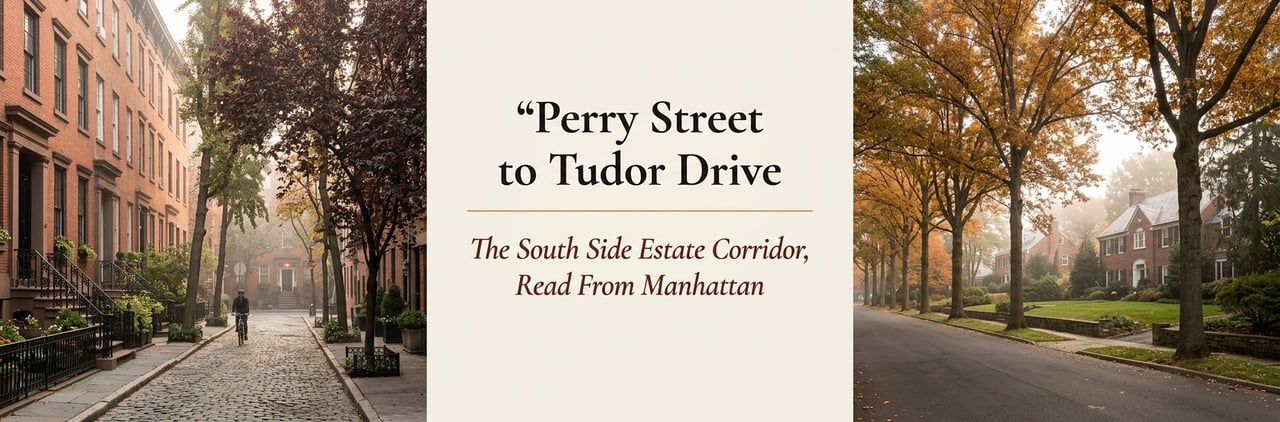
The South Side Estate Corridor, Read From Perry Street
What the West Village and Tribeca buyer is actually trading when they leave Manhattan for an acre in 07076. The honest version — the part the relocation sites don’t cover.
A West Village two-bedroom condo at $1.8M buys a South Side Colonial on a half-acre lot with a pool and a two-car garage at roughly the same number. A Tribeca three-bedroom at $3.6M buys a custom-built estate on Tudor Drive with mature trees, room to host, and a school district that costs nothing on top of the mortgage. The math is the easy part. The texture of the trade — what you actually give up at Perry Street and what you actually gain on Cooper Road — is the conversation that takes longer.
The call usually comes in February. A family in a West Village condo or a Tribeca loft has just finished another holiday season of folding the dining table into the wall, sliding the stroller past the bike past the dog bed, and watching their five-year-old measure her bedroom in steps that no longer take very long. They have looked at Westchester. They have looked at Greenwich. Someone they know — a college friend, a former colleague, the wife of the partner across the hall — mentioned Scotch Plains. They are not sure where it is. They want to know what their $2.4M actually buys, and whether they will be the only family on the block who used to walk to Joe’s Pizza on Carmine Street.
We have taken this call enough times in the last three years to know what comes next. They are coming to look at the South Side Estate Corridor — Tudor Drive, Cooper Road, the cluster of streets that runs east of Park Avenue and south of Raritan Road, where the lots widen to an acre and the houses set back far enough from the street that you can hear cardinals before you hear cars. They are coming to see whether the trade is real. This post is the conversation we have with them.
The Buyer Who Calls Us First
The West Village or Tribeca buyer arriving in Scotch Plains is not the buyer most New Jersey brokers are used to. They are not trading up from Westfield or Cranford. They are arriving from a neighborhood where the median condo trades at $2.8 million, where their morning is the F train at Christopher Street and their evening is dinner at Via Carota or Locanda Verde, and where they have been priced out of a third bedroom for three years running. They are not coming because they fell in love with the suburbs. They are coming because the math finally tipped.
The math, when they show it to us, looks something like this. Their 1,400-square-foot two-bedroom condo at the corner of Bleecker and Charles is worth roughly $2.4 million. Their monthly carry — common charges, taxes, mortgage — runs around $14,000. They have one child in private school at $58,000 a year. They are considering a second. They have stopped buying back of house in restaurants and started doing math on napkins. They are not poor. They are not even uncomfortable. But they have noticed, the way anyone with a spreadsheet eventually notices, that what they are paying for the West Village zip code is no longer purchasing the West Village they remember.
The Scotch Plains South Side number, in their range, sits between $1.5M and $3M+. Their $2.4M West Village condo equity becomes a 5,000-square-foot Colonial on three-quarters of an acre with a pool, a finished basement, a two-car garage, and a public school system whose AP roster does not require a separate annual check. Their monthly carry — mortgage, taxes, insurance — lands closer to $11,000 or $12,000. The private-school line item disappears. The math, in other words, is no longer subtle.
“The West Village buyer doesn’t leave Manhattan because they fell out of love with it. They leave because the third bedroom they need costs $4.5 million on Perry Street and $1.9 million on Tudor Drive. That gap is the post.”

A Saturday on Tudor Drive
Saturday morning on Tudor Drive begins quietly. There is no garbage truck reversing into your alarm clock at 5:40 a.m. There is no upstairs neighbor in clogs. The first sound is usually a cardinal in the white oak in your back yard, and the second sound is your child opening the back door without asking permission to take the dog onto grass that belongs to you. This is the first thing the Manhattan buyer notices about the South Side Estate Corridor, and it is the one they did not know they were buying.
By nine, the Scotch Plains Farmers Market is up at Alan Augustine Village Green. It runs Saturday mornings from late spring through October, and it is small enough that you will know the cheese vendor by your second visit. By ten, you can be on the trails at the Watchung Reservation — 1,945 acres of preserved woodland that begins about a mile and a half from Tudor Drive and crosses five municipalities. The trail system is what the Park Slope or West Village buyer expected Prospect Park or the High Line to feel like, except it is fifteen times the size and you do not share it with a college reunion picnic. Deer, in early morning. A pileated woodpecker, if you are lucky. The Surprise Lake loop, three and a half miles, mostly empty.
Lunch is the Stage House in downtown Scotch Plains — a 1737 tavern, restored, that the West Village buyer will recognize the bones of. It is the Scotch Plains equivalent of the Waverly Inn: dark wood, low light, a clientele that has been showing up for decades, and a kitchen that earns it. Or you drive ten minutes to downtown Westfield — six blocks of walkable retail, three good wine bars, and an independent bookstore that will know your name by month three.
The afternoon is open. Your pool, if you have one. Shackamaxon, if you joined. A drive to the Jersey Shore, ninety minutes door-to-door from Tudor Drive, which means you can leave at noon, swim in the Atlantic at two, and be home for dinner. Or the train back into the city at the Fanwood station, eight minutes from your front door, NJ Transit Raritan Valley Line to Newark Penn, then PATH to the World Trade Center. Door-to-Tribeca: roughly 75 minutes. The West Village buyer who insists they will never come back into the city for dinner is usually wrong about that, and the train makes it possible to be wrong about it on a weekly basis.
What You Give Up
We owe you an honest accounting. The Scotch Plains relocation pages on the big portals will tell you what you gain. They will not tell you what you lose. We will, because the buyers who arrive without the full ledger are the ones who are unhappy in year two.
You will lose the walk. The seven-minute amble from Perry Street to the Bleecker Street Market for fresh basil. The decision — made at 6:48 p.m. on a Tuesday with no advance planning — to walk to dinner at Sant Ambroeus. The fact that everything you needed for a full life sat within twelve square blocks. In Scotch Plains, the car returns to your life. You will drive to the grocery store, drive to the dry cleaner, drive your kids to most things. The downtown is walkable, and downtown Westfield is walkable, but neither is the West Village. The honest answer is that nowhere in the suburbs is.
You will lose the texture. The brownstones on Bank Street. The cobblestones on Charles. The way a 19th-century federal-style row house catches late-October light at 4:30 p.m. and turns the whole street the color of bourbon. Scotch Plains has its own character — the historic district at Stage House, the older Colonial stock along Park Avenue, the Frazee House from 1740 — but it is a different aesthetic register. The Manhattan buyer raised on West Village density and pre-war detail will need to recalibrate their eye. Some never do, and they end up back in the city by year three. Most do, and they end up amazed at what an oak tree in October looks like when there are fourteen of them in your line of sight.
You will lose the spontaneity. In the West Village, plans assemble themselves. A friend texts. You walk over. In Scotch Plains, plans require calendars. Dinner with your closest friend from the city becomes a 90-minute logistics problem instead of a 12-minute walk. The Manhattan buyer who is honest with themselves knows that this is the trade that costs the most, and it is the trade that the spreadsheet does not capture. The friends who matter will visit. The friends who matter less will not. You will discover which is which on a faster timeline than you would like.
What You Gain
You gain the square footage. Not as an abstraction — as a daily, physical fact. The 5,000-square-foot Colonial that your $2.4M West Village equity now buys has a primary suite the size of your old apartment. It has a separate office, which means the spouse who works from home is no longer working from the same table the children eat from. It has a basement that can be a playroom, a gym, a wine room, or all three. It has a garage for the car and another for the bikes. The compression that defined your Manhattan life simply stops being a factor.
You gain the school district. Scotch Plains-Fanwood Regional High School routinely sits in the top 10 percent of New Jersey public high schools by performance, and the K–8 elementary feeder system is one of the strongest in Union County. The $58,000 or $72,000 you were spending on private school in Manhattan does not get re-deployed — it gets recovered. For two children, over twelve years of K–12, that is somewhere between $1.2 million and $1.7 million in after-tax dollars you keep. We have walked relocating families through that math more times than we can count, and it is usually the single number that ends the deliberation. Our full schools guide walks the specifics.
You gain the trees. This sounds frivolous. It is not. The South Side Estate Corridor sits on lots that were laid out in the 1920s and 1930s, when one acre was the minimum and the white oaks and tulip poplars planted then are now eighty years old. Driving down Tudor Drive in late October is the closest thing in central New Jersey to driving through New England in foliage week. The light changes. The air changes. Your relationship to seasons changes — in Manhattan you experience weather; in Scotch Plains you experience season. The Manhattan buyer who has not lived under mature deciduous canopy in a decade or two is unprepared for the effect this has on their nervous system.
You gain the community structure. Manhattan friendships, by the West Village buyer’s honest admission, had thinned. Scotch Plains is the size where the same people show up at the same events — the school auction, the SPF soccer fields, the Memorial Day parade, the holiday tree lighting on Park Avenue — and friendships compound the way they used to in college. Most relocating families tell us, by month eighteen, that the social density of Scotch Plains is the surprise gain they did not price into the move. The architecture of a small town is built for repeat encounters. Manhattan’s architecture is built for the opposite.
“The square footage is what gets the West Village buyer to come look. The trees, the schools, and the social density are what keep them past year three. We track that cohort. The retention rate is high.”
The Honest Verdict
The South Side Estate Corridor is not for every West Village or Tribeca buyer. The buyer who needs the city — the bar at 11 p.m., the gallery opening on Wednesday, the sense that the door downstairs opens onto a million-person stage — should not move to Scotch Plains, and we will tell them so on the first call. The right move for that buyer is to stay in the city and pay the price, or to choose Brooklyn Heights, where the urban texture survives in lower-density form.
The buyer for whom Scotch Plains is the right answer is the one whose Manhattan life has begun to feel like a logistics problem rather than a lifestyle. The family whose child sleeps in what was supposed to be the dining nook. The couple whose dog has not seen grass in three months. The household running a six-figure annual private school bill while staring at a public-school district thirty-five miles away that outperforms most of their friends’ private options. The household who has noticed that their carrying cost has crept past their mortgage cost, and who has begun, quietly, to wonder what else that money could be doing.
That buyer will find, on Tudor Drive or Cooper Road or any of the South Side Estate Corridor streets in between, a version of life they did not know was still being built in central New Jersey. The Saturday will be quieter. The trees will be older. The school district will compound in their children’s favor for the next twelve years. And the friends who matter, the ones who used to text on Tuesday afternoons about Sant Ambroeus, will still come. They will just arrive by train.
“Every West Village buyer asks us the same question on the second tour: ‘Will I be the only one here from the city?’ The answer, increasingly, is no. We have built that pipeline ourselves over the last three years. It is the reason Scotch Plains sellers should be working with us.”
Door-to-door from Tudor Drive to Tribeca runs roughly 70 to 80 minutes via Fanwood station, the Raritan Valley Line to Newark Penn, and PATH to World Trade Center. By car off-peak, it is 45 minutes to the Holland Tunnel.
In the current cycle, that price point lands a 4,500–5,500 square foot Colonial on a half-acre to three-quarter-acre lot, typically four to five bedrooms, finished basement, two-car garage, and often a pool. The same equity in the West Village buys a renovated two-bedroom condo with no outdoor space.
Scotch Plains-Fanwood Regional High School consistently ranks in the top 10 percent of New Jersey public high schools. For most relocating Manhattan families, the academic outcomes are comparable to the private schools they were paying $58,000 to $72,000 a year for, and the recovered tuition over twelve years is the single largest financial gain in the move.
No. The Prodigy Team has built the New York to Scotch Plains relocation pipeline over the last several years through our 25,000-member NY/NJ/FL community. The South Side Estate Corridor and surrounding streets now hold a meaningful cohort of families who arrived from West Village, Tribeca, Park Slope, and Long Island City within the last three to five years.
The relocation buying window peaks February through May, driven by families aligning to the September school calendar. Listings that go live in late February through mid-April see the highest concentration of NYC-relocation buyer activity and the strongest sale-to-list ratios in 07076.
We built the New York to Scotch Plains buyer pipeline.
Our 25,000-member NY/NJ/FL relocation community delivers your South Side listing to West Village, Tribeca, Park Slope, and LIC buyers before it hits Zillow. That is not a marketing claim. It is the pipeline we have spent years building, and it is the reason Scotch Plains sellers in this price band should be working with us.
List Your South Side Home →