
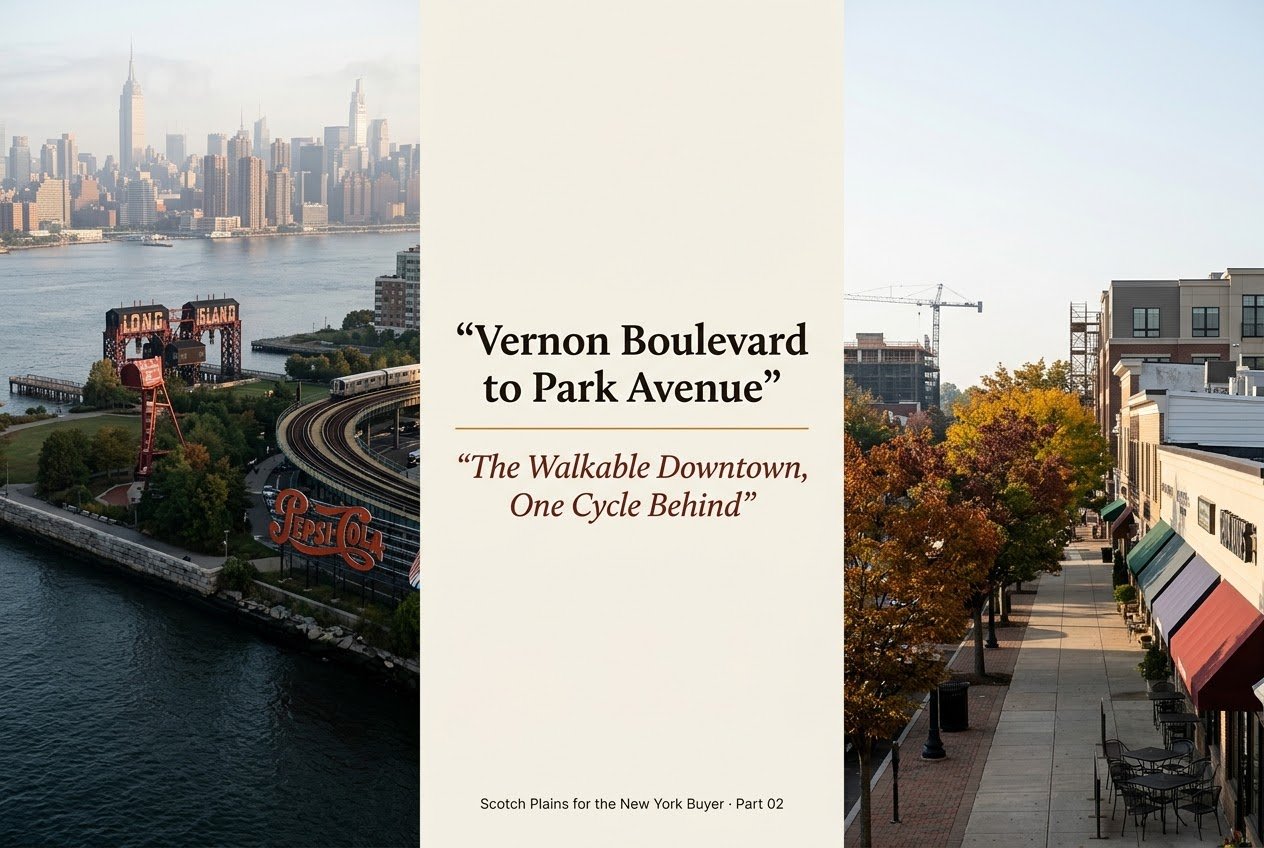
Park Avenue, Reframed for the Long Island City Buyer
What the LIC and Astoria buyer is actually trading when they leave the East River for the downtown corridor that Scotch Plains is rebuilding right now. Two transit-oriented neighborhoods, one decade apart in the construction cycle.
The LIC buyer chose Long Island City for transit, the East River walk, and a restaurant scene that compounded year over year. The Astoria buyer chose Astoria for the same reasons in a lower-density key. Both arrived in those neighborhoods after the city had already built them. Scotch Plains is offering them the opportunity to arrive somewhere before the city builds it — the nine-acre downtown is in active construction right now, with Lidl, two apartment buildings, a new Town Square, a combined library-and-town-hall, and ten thousand square feet of retail in the pipeline. The trade is not city for suburb. It is built-out for being-built.
The Long Island City buyer rarely calls a Scotch Plains broker first. They start with Hoboken. They look at Jersey City. They tour Maplewood. Eventually they find their way to us, usually after the third Saturday of touring waterfront condos that cost more than their LIC two-bedroom and offer half the space, or after the second Maplewood open house where the train into the city takes seventy minutes and the line to see the kitchen extends out the front door. By the time they sit down with us at our office on Park Avenue, they have done the work. They know what their LIC equity buys. They know what their Astoria rent compounds to over five years. They have a number in their head, and they want to know whether Scotch Plains can deliver on it.
We tell them what is true. The Park Avenue walkable corridor — the residential streets that radiate east, west, and north from the downtown core in a roughly half-mile arc — is the closest thing central New Jersey will offer to the transit-oriented urbanism they came to New York for in the first place. It is not LIC. Nothing is LIC, and the buyer who thinks they need LIC should not move. But for the LIC or Astoria household ready to trade a 2026 city for a town that is being built right now, the corridor offers something specific: a downtown in active construction, a train to Newark Penn in under fifteen minutes, and a price band that turns their condo equity into a three-bedroom Colonial with a yard.
Why the LIC Buyer Looks West
The Long Island City buyer of 2026 is not the LIC buyer of 2016. In 2016 they were a single tech worker or a young couple paying $3,200 a month for a one-bedroom in a new tower with a gym they used three times. They watched the neighborhood densify around them. By 2020 the gym had a wait list. By 2022 the rent on that same one-bedroom had crossed $4,000. Today, the average one-bedroom rental in Long Island City sits at $4,386 a month, and the median condo asking price has settled around $750,000, with closed two-bedrooms landing in the $1.27 million range. The arithmetic that justified the move into LIC in 2016 no longer justifies staying in 2026.
The Astoria buyer has a parallel story in a lower key. Astoria’s median sale price sits around $970,000 in 2026, with two-bedroom condos closing in the $1.21 million range. The neighborhood retains the Greek delis, the under-the-tracks Mediterranean restaurants, the family-owned bakeries that made Astoria feel like a city within a city. But the buyer who came to Astoria for affordability is finding less of it each year, and the buyer who came for community is finding that the friends they used to walk to dinner with have already left for Connecticut, Westchester, or central New Jersey.
When these buyers come to Scotch Plains, they are not looking for the South Side estate corridor. They are not the West Village buyer trading $2.4M of condo equity for an acre on Tudor Drive. They are the LIC two-bedroom owner with $1.27 million of equity and a question: where in Scotch Plains can I walk to a coffee shop, take the train to the city in under an hour, and not give up everything I came to New York for? The honest answer, in 2026, is the Park Avenue walkable corridor — and the answer is better than it has been in any of the previous twenty years, because of what is happening on those nine acres at the south end of it.
“The LIC buyer is not looking for a yard. They are looking for the next neighborhood that has not been built yet. We are showing them one that is being built this year, on Park Avenue, with a developer that has already broken ground.”

The Nine Acres on Park Avenue
On May 18, 2026, the Township of Scotch Plains and Woodmont Properties publicly presented the design for the downtown redevelopment plan in a meeting that residents could attend in person or stream on SPTV. The plan, in its current form, is the kind of thing the LIC buyer needs to understand before they tour a single house on Park Avenue, because it changes the value of every parcel within walking distance of it. The version of Scotch Plains they are buying into is not the Scotch Plains of 2024. It is the Scotch Plains of 2028 and 2030, and the Park Avenue walkable corridor is being priced today against a downtown that does not yet exist.
Here is what is happening, in the most concrete terms we can give: Approximately nine acres of downtown public property, designated by Township Council ordinance in 2021, will be redeveloped by Woodmont Properties under a Redevelopment Agreement now in finalization. The plan centers on a new Town Square along Park Avenue with shade trees, flexible seating, and programmable space for farmers markets, movie nights, and community events. Approximately 10,000 square feet of new retail and residential units will face the plaza. A new combined library-and-town-hall will anchor the civic side of the project. The maximum building height is capped at four stories. The Alan M. Augustine Village Green, where the Saturday farmers market already runs, will be enhanced and integrated into the new public-space network.
Two adjacent projects, on separate redevelopment plans, are further along and will deliver first. A three-story, 40-unit apartment building and Lidl grocery store at the former Snuffy’s site on East Second Street broke ground in 2024 and is nearing completion. The Lidl has begun site work on Park Avenue. A separate Front Street project is also approaching delivery. The cumulative result, by the time the larger Woodmont plan breaks ground, is more than a hundred new apartment units, a full-service grocery store, and a transformed pedestrian streetscape on the south end of the Park Avenue corridor.
The implication for the LIC or Astoria buyer is direct. Every house in the walkable arc around the redevelopment site is, by definition, an early entry into a downtown that will look meaningfully different in three years and substantially different in seven to ten. The buyer who closes on a Park Avenue colonial in 2026 owns a property whose walkability premium compounds as each phase of the Woodmont plan delivers. The buyer who waits until 2028 buys into a market where that premium has already been priced in. For the full primary-source map of the redevelopment, our Park Avenue Rebuild post goes parcel by parcel.
A Saturday Off the 7 Train
The LIC Saturday morning begins on Vernon Boulevard. Coffee from Sweetleaf or Communitea, a walk along Gantry Plaza State Park, the Manhattan skyline directly across the East River close enough to count the Citigroup Center antennas. The Astoria Saturday begins on 30th Avenue or Ditmars Boulevard, the Greek bakeries already busy by eight, the espresso strong, the produce vendors stacking crates of figs and tomatoes in the late-summer sun. Both are walkable. Both are sensory. Both are why the LIC and Astoria buyer paid the rent they paid.
The Park Avenue Saturday is quieter, and the buyer should know that going in. It begins at the Scotch Plains Farmers Market at Alan Augustine Village Green — smaller than Astoria’s Saturday morning, less dense than Vernon Boulevard, but with the cheese vendor who learns your kids’ names and the produce stand that sources from farms thirty miles west. Coffee from Cravings or one of the independent cafes on Park Avenue. A walk along the corridor where, by 2028, the Town Square will be open and the new retail spaces will be filling in. Today, in 2026, the streetscape is partly construction fence. By the time your closing photos are on the listing site for the next buyer, the construction fence will be gone.
By eleven, you walk to the Fanwood train station — under fifteen minutes from most homes in the Park Avenue walkable corridor — and board the Raritan Valley Line. Newark Penn in twenty-five minutes. PATH or NJ Transit to Midtown in another fifteen, World Trade Center in another twenty. Door-to-door from Park Avenue to Hudson Yards: roughly 70 to 80 minutes. From your LIC apartment, the 7 train to Times Square was twelve minutes. The honest answer is that the Manhattan commute lengthens. The honest answer is also that very few of our relocating LIC clients commute into the city five days a week any more, and the ones who do tell us they have learned to use the train ride for reading they had stopped doing.
Lunch is the Stage House Tavern, walkable from most of the corridor. Or you drive ten minutes to downtown Westfield for the wine bars and the bookstore. Afternoon: Watchung Reservation, where 1,945 acres of preserved woodland start three miles north of Park Avenue and offer the kind of trail system LIC buyers thought they wanted when they joined REI. Evening: dinner in your own backyard, which is something the LIC buyer has never had, or dinner downtown at the same restaurant where the waiter now knows your order. Both are options. In Long Island City, only the second was.
What You Lose, What You Gain
You lose the skyline. The view from Gantry Plaza, the way the Empire State Building lit blue and orange for a Knicks game became part of your weekly visual diet, the moment in summer when the Pepsi sign turned the river red at sunset. Scotch Plains has trees, dawn, the slow turn of seasons, and the kind of low-density night sky where you can sometimes see Jupiter. It does not have the skyline. The buyer who needs the skyline should not move.
You lose the restaurant density. Astoria’s 30th Avenue has, by any honest measure, more good restaurants in three blocks than Scotch Plains has in three square miles. The buyer who organizes their week around restaurant discovery should know this in advance. The honest answer is that downtown Westfield, ten minutes by car, partly closes the gap; that Cranford and Summit, twelve to twenty minutes away, add to it; and that the Park Avenue redevelopment will add restaurant capacity year by year as the new retail spaces fill in. But Scotch Plains is not Astoria, and pretending otherwise is the kind of thing we do not do.
You gain the square footage. Your $1.27M LIC two-bedroom condo equity translates into a 2,800 to 3,400 square foot Colonial or expanded split-level on the Park Avenue walkable corridor, with three to five bedrooms, a finished basement, a garage, and a yard. You gain the school district. Scotch Plains-Fanwood Regional High School ranks in the top decile of New Jersey public high schools, which means the LIC parent considering private school in five years can recover that line item before it starts.
You gain the construction-cycle timing. This is the gain the LIC buyer in particular tends to undervalue, because they have lived through it on the other side. The Long Island City they bought into in 2016 traded at very different numbers in 2022. The Park Avenue walkable corridor in 2026, with two apartment buildings under construction, a Lidl in site work, and a 2028–2030 Woodmont delivery already designed, is in the same place LIC was in 2016. The buyer who recognizes that pattern is the buyer who calls us before the corridor reprices.
“The LIC buyer who arrives on Park Avenue in 2026 is doing what the LIC buyer of 2016 did in Queens. The pattern is the same: walkable downtown in active construction, transit anchor in place, price point one cycle behind where it will be. The cohort that sees that recognizes itself.”
The Honest Verdict
The Park Avenue walkable corridor is not for every LIC or Astoria buyer. The buyer for whom the city itself is the lifestyle — the late dinner, the Sunday gallery, the Tuesday night at the comedy club, the friend who texts at ten p.m. asking if you want to walk to a wine bar — should stay in the city, accept the price band, and pay it. We will tell them so on the first call. The right move for that buyer is Brooklyn Heights, Hoboken, or Jersey City, where the urban texture continues in a lower-density key without disappearing.
The buyer for whom Park Avenue is the right answer is the LIC or Astoria household that has begun, quietly, to want a yard, a school district, and a downtown they are early to rather than late to. The couple whose dog has not seen grass since they signed the lease in 2019. The household running two-bedroom rent that has crossed $6,200 a month while they save for a down payment on a condo that will appreciate at the speed of New York City property tax assessments. The young family staring at K–5 zoning maps in Queens and doing math on private school. The buyer who, on quiet nights, has started to wonder whether the city they fell in love with in their twenties is the city they want to raise children in.
That buyer will find, in the half-mile arc around the Park Avenue redevelopment site, a version of suburban life that does not require giving up the things they came to New York for in the first place. A walkable downtown, in active construction, with a Town Square delivering in the next building cycle. A train to the city that does not require a car. A school district whose performance compounds in their children’s favor for the next twelve years. And a price point that — for now — still reflects 2026 Scotch Plains, not the Scotch Plains the Woodmont plan is actively building.
“Every LIC buyer asks the same question on the second tour: ‘Will I regret leaving the city?’ The buyers who arrive on Park Avenue while the construction fence is still up are the ones who, two years in, tell us they got the timing right.”
Door-to-door from a Park Avenue home to Midtown via Fanwood station and the Raritan Valley Line is approximately 70 to 80 minutes. From LIC, the 7 train to Times Square is roughly 12 minutes. The commute lengthens; most relocating LIC clients tell us they have rebalanced toward two or three city days a week.
In the current cycle, that price point lands a 2,800 to 3,400 square foot Colonial or expanded split-level in the walkable arc around the Park Avenue redevelopment site. Typically three to five bedrooms, finished basement, garage, and a yard. The same equity in LIC buys an 800 square foot two-bedroom condo with no outdoor space.
The Township and Woodmont Properties presented the current plan publicly on May 18, 2026, with the Redevelopment Agreement now in finalization. Adjacent projects on East Second Street and Front Street — including the Lidl grocery and a 40-unit apartment building — are nearing completion and will deliver before the larger Woodmont scheme breaks ground. Full Woodmont buildout is currently projected over the 2028 to 2030 window.
The historical pattern in comparable Woodmont downtown projects — Morristown, Cranford, Red Bank, Metuchen — has been measurable walkability premium expansion in the half-mile arc around the redevelopment site as each phase delivers. We can map specific comparable evidence on a tour.
For most Astoria families considering the move, yes — the Scotch Plains-Fanwood K–12 district ranks in the top decile of New Jersey public schools, and the walkable corridor preserves the in-town, on-foot lifestyle that made Astoria feel like home in the first place. We walk through specifics in our schools guide and on a buyer consult.
We built the New York to Scotch Plains buyer pipeline.
Our 25,000-member NY/NJ/FL relocation community delivers your Park Avenue listing to LIC, Astoria, West Village, and Park Slope buyers before it hits Zillow. That is not a marketing claim. It is the pipeline we have spent years building, and it is the reason Scotch Plains sellers in the walkable corridor should be working with us.
List Your Park Avenue Home →