
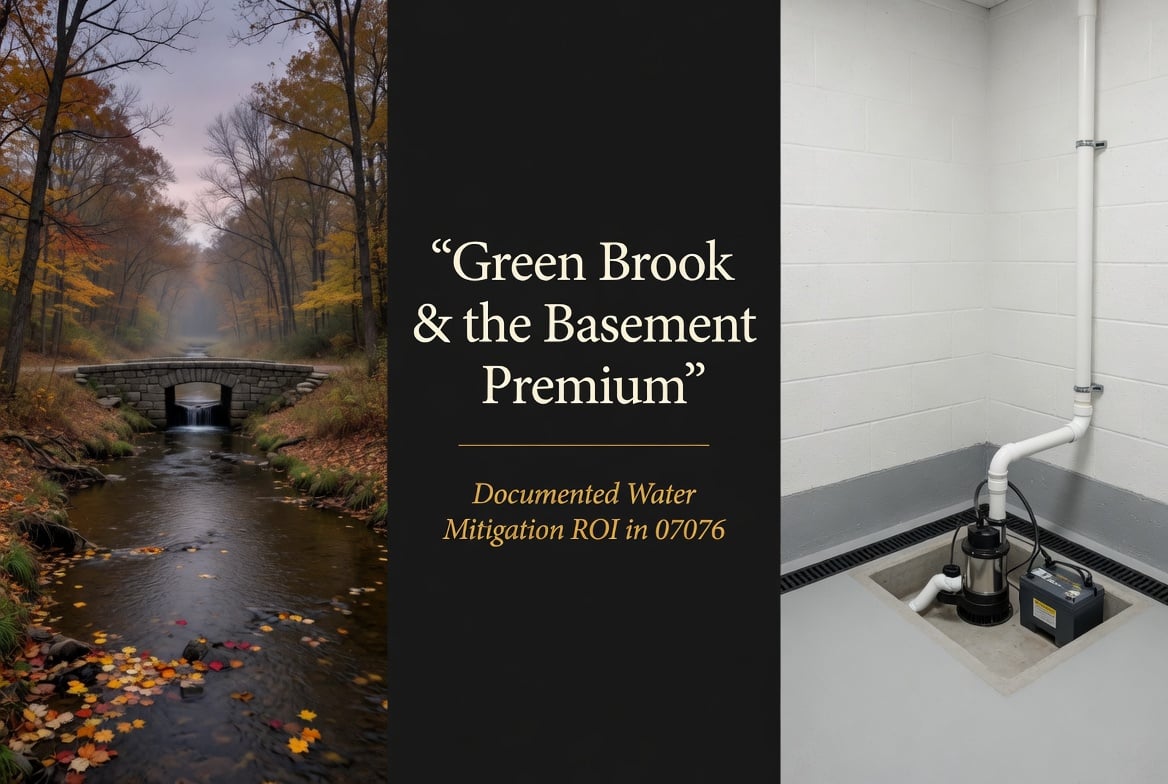
Green Brook, French Drains, and the Scotch Plains Basement Premium: A Seller’s Guide to Water Mitigation ROI
Hurricane Ida did not just flood downtown. It rewrote the buyer underwriting checklist in Scotch Plains — and New Jersey’s 2024 disclosure law made that checklist contractual. Here is what documented water mitigation is actually worth in the current cycle, and how to position for it before you list.
In a post-Ida, post-disclosure-law Scotch Plains market, a documented, professionally installed water-management system is no longer a generic upgrade. It is a category-defining feature that converts a defensible-but-questioned listing into a clean one. The direct ROI on the installation is modest — but the downside protection is enormous, because homes with undocumented water history routinely lose 10 to 25 percent of their sale price when the buyer’s inspection report surfaces an issue the disclosure form did not.
On the night of September 1, 2021, the remnants of Hurricane Ida moved across central New Jersey and dropped record-breaking rainfall across the Raritan basin. The Green Brook overflowed. Downtown Scotch Plains flooded. The Winding Brook and Bayberry sections on the South Side took on substantial water. Cars stalled. Basements filled. Total damages from the storm in New Jersey were later estimated by the National Hurricane Center at $8 to $10 billion. In Scotch Plains, the cleanup took weeks. The buyer underwriting checklist changed permanently.
Two and a half years later, on March 20, 2024, the New Jersey Flood Risk Notification Law took effect. The law amended the Property Condition Disclosure Statement to require every seller of New Jersey real property — residential or commercial — to answer eight specific flood-history questions, numbered 109 through 117, before the buyer becomes obligated under the purchase contract. Buyers in Scotch Plains now arrive at attorney review with a checklist that did not exist before Ida and a statutory framework that did not exist before March 2024. The water mitigation conversation is no longer a courtesy. It is a pricing event.
This is the third post in our Scotch Plains data series. The first covered the usable-acreage gap; the second covered the split-level expansion ceiling. This one is about the basement — and about why every seller in this township should be paying attention to it before the photographer arrives.
The Green Brook Watershed and Why It Matters
The Green Brook drains the southern slope of the First Watchung Mountain through Scotch Plains, Plainfield, and ultimately into the Raritan River at Bound Brook. Its headwaters include Blue Brook, which is impounded as Lake Surprise inside the Watchung Reservation. Scotch Plains sits in what the Army Corps of Engineers classifies as the upper basin of the Green Brook Flood Control Project — a three-part regional initiative that includes the lower basin (Bound Brook), the Stony Brook section, and our upper-basin section, where federal work to date has been largely limited to feasibility studies rather than completed levees or channel widening.
Township officials describe Scotch Plains flooding as flowing “from overrun culverts and stream channels that run generally north to south across the town,” with the Green Brook the dominant drainage feature. In ordinary storms, that drainage works. In the storms that have come to define the post-Ida era — Ida itself in 2021, and the July 14, 2025 flash-flood event most recently — the drainage backs up at culverts and spillways and reroutes through basements, garages, and the lowest streets of the township’s east-central section.
Buyers migrating from the New York metro have absorbed every one of those storms in the headlines. They arrive in Scotch Plains pre-screened by Zillow’s flood-risk score, by FEMA’s online flood map service, and by their own social-media feeds full of Ida footage. Whether or not the home they are touring is in a designated flood hazard area, the question of basement water is now the second or third inquiry of a serious tour — not the eighth.
What Ida Did, and What Buyers Remember
Ida’s damage in Scotch Plains was not uniform. The Winding Brook and Bayberry corridors on the southside took on the worst of the residential flooding. The downtown Park Avenue / Bartle Avenue corridor — the same nine acres now under conditional designation to Woodmont Properties for redevelopment — flooded with water that ran off the Reservation spillways and down toward the brook. The redevelopment plan itself was rewritten to incorporate flood resiliency engineering, with the township explicitly noting that new buildings in the district must be engineered to withstand flooding under NJDEP review.
Other parts of Scotch Plains saw localized flooding that the township has since worked to mitigate — clearing tree-limb and soil blockages near Winding Brook Way and the Bayberry apartments along the border with Clark. Township officials credit that work for the materially better outcomes those same neighborhoods saw during the July 14, 2025 event compared to Ida. The implication for sellers is double-edged. Targeted mitigation has reduced the severity of subsequent storms — but the institutional memory of Ida has not faded, and the upper-basin Army Corps work that would address it at a watershed level is, as of the current cycle, still incomplete.
In practical terms, this means a Scotch Plains buyer in 2026 walks the basement with a different set of questions than a Scotch Plains buyer in 2019. They ask about sump activity during heavy rain. They ask about the date of the most recent French drain installation. They ask whether the home took on water during Ida. They ask whether the seller has photographs of the basement after the heaviest storm in recent memory. A clean answer to each of those questions is now a competitive differentiator that the comp set will reward.
“Ida did not just damage basements. It rewrote the underwriting checklist every Scotch Plains buyer now runs before they make an offer.”

The 2024 NJ Flood Disclosure Law — Questions 109–117
Effective March 20, 2024, every seller of New Jersey real property must complete the updated Property Condition Disclosure Statement promulgated by the Department of Community Affairs. Questions 109 through 117 cover, in writing and under the Consumer Fraud Act, whether the property is located in FEMA’s Special or Moderate Risk Flood Hazard Area; whether the seller has actual knowledge of past flooding; whether flood damage has been previously remediated; whether the property is subject to federal flood insurance requirements; and several additional related disclosures. The seller signs the form. The buyer signs the form. The form is delivered before the purchase contract becomes binding.
Buyers do not have automatic rescission rights under the new law, but legal commentators across the New Jersey real estate bar — Holland & Knight, Saul Ewing, Reed Smith, and others — have all flagged that incomplete or inaccurate disclosures can support a Consumer Fraud Act claim with treble damages and fee-shifting exposure. A seller who has water history and fails to disclose it is not just inviting a renegotiation. They are inviting litigation.
This is the legal architecture inside which any Scotch Plains water mitigation decision now sits. The seller who has installed a professionally designed French drain and sump pump system, kept the invoices, and can answer questions 109 through 117 with a clean “remediated with documentation” entry is in a fundamentally stronger negotiating position than the seller who checks “no actual knowledge” on a home the inspector then writes up for water staining and efflorescence. The disclosure law has made the documentation itself a feature of the listing.
“Under the March 2024 disclosure law, what you do not say can cost you more than what you spent fixing the problem in the first place.”
The ROI Math: French Drain, Sump, and Sale Price
The direct ROI on basement waterproofing is not, on paper, exceptional. Industry remodeling data places the direct recoup at roughly 30 percent of installation cost. A $6,000 interior French drain installation appraises directly for around $1,800. On that math alone, waterproofing is among the weaker capital projects a homeowner could undertake.
That math, however, misses the entire point. The value of waterproofing in a Scotch Plains listing is not the direct appraisal lift. It is the avoidance of the discount that an undocumented or problematic basement triggers in negotiation. Industry data from waterproofing contractors and recent appraisal practice both place the sale-price hit for a home with documented or visible water issues at between 10 and 25 percent of value. On a $900,000 Scotch Plains home, that range corresponds to a $90,000 to $225,000 swing. Against a $6,000 installation, that is the math that actually matters.
A third data point reinforces the picture. Independent published analysis of waterproofing’s comparative sale impact suggests that a dry basement with documented French drain and sump pump installation appraises and trades at 5 to 15 percent higher than a comparable home with undocumented or problematic drainage history. That premium is not the addition recouping its cost in a remodeling-magazine sense. It is the comp set rewarding the seller for removing a category of risk from the buyer’s underwriting.
| Listing Scenario | Buyer Reaction | Pricing Impact |
|---|---|---|
| Dry, documented system Permits, invoices, photos |
Confidence; clean disclosure | +5% to +15% vs comparable undocumented |
| Dry but undocumented No invoices, no records |
Skepticism; inspection scrutiny | Baseline; risk of renegotiation |
| Visible staining, no system Efflorescence, watermarks |
Inspection flag; price challenge | −10% to −25% renegotiation pressure |
| Documented Ida flooding Plus remediation completed |
Caution mitigated by paperwork | Modest discount; far better than undisclosed |
| Ida flooding, undisclosed Later surfaced by inspection |
Deal-breaker; legal exposure | Deal collapse + CFA litigation risk |
What to Document Before You List
The advantage in this market goes to the seller who has the paperwork. Before listing, every Scotch Plains seller — whether they sit in a known flood corridor or two blocks from the Reservation ridge — should be assembling the same documentation package. It is the package that survives buyer scrutiny, satisfies the disclosure law, and supports the asking price against any inspection-driven renegotiation attempt.
Pull together the invoices for any French drain, sump pump, exterior grading, gutter extension, or basement membrane installation. Photograph the system in the basement — the discharge line, the sump pit, the pump itself, the battery backup if present. Locate the permit records if the work required them. Save the receipts. If the system was installed before the current owner’s tenure, request whatever records the previous owner provided at the time of your purchase, and contact the installing contractor for records reconstruction if needed.
Run the FEMA Flood Map Service Center for your address and print the result. Run the NJDEP Flood Indicator Tool, which incorporates both FEMA mapping and the New Jersey state Flood Hazard Area mapping that applies a 25 percent margin on top of the federal 100-year flood elevation. If your address is outside both designations, that is part of the listing story and a legitimate response to questions 109 and 110 on the disclosure form. If your address is inside one or both, your disclosure must reflect it accurately — and your mitigation documentation becomes the offsetting evidence.
Finally, if your basement has any visible staining, efflorescence, or evidence of past water — even decades-old — address it cosmetically and address it forensically. A reputable waterproofing inspector can produce a written assessment indicating that the visible signs are historical rather than active, which is the report that converts an inspection flag into a non-issue at attorney review. We have walked sellers through this checklist on dozens of older Scotch Plains homes where the basement was the deciding factor between two offers — and the answer was always documentation, not denial. Call us before the photographer arrives, not after the inspection report.
“A dry basement is not a premium feature in this township. A documented dry basement is. The difference, in our market, is five to fifteen percent on the sale price.”
Is my Scotch Plains home in a flood zone?
Run two checks: the FEMA Flood Map Service Center at msc.fema.gov for your exact address, and the NJDEP Flood Indicator Tool for the state-level Flood Hazard Area designation, which applies a 25 percent margin on top of FEMA’s 100-year elevations. Most Scotch Plains homes are outside FEMA Special Flood Hazard Areas, but proximity to Green Brook tributaries and culverts can place specific properties in either FEMA or state-mapped zones.
Do I have to disclose flooding from Hurricane Ida?
Yes. Question 113 on the updated Property Condition Disclosure Statement asks whether the property has ever experienced flood damage or pooled water due to heavy rainfall or natural flood events. “Ever” is the operative word. Ida flooding is disclosable. A failure to disclose it, on a property the inspector or a neighbor surfaces it on later, exposes the seller to Consumer Fraud Act claims with treble damages.
Should I install a French drain before listing if I’ve never had water issues?
Usually not, if the basement is genuinely dry and the home is outside mapped flood zones. The direct ROI is modest. But if your basement shows any historical staining, efflorescence, or evidence of past intrusion — even decades-old — addressing it with a documented system and a written waterproofing inspection report is one of the highest-leverage pre-listing investments available in this market.
How much does a French drain and sump pump system cost installed in Scotch Plains?
An interior perimeter French drain runs $3,000 to $8,000 for a standard basement, with complex installations reaching $15,000 or more. A quality sump pump with discharge plumbing adds $1,200 to $3,000. A combined system, professionally installed and properly permitted, typically lands between $5,500 and $16,500 in the current market.
How does this fit into a Prodigy Team listing strategy?
Water mitigation documentation is part of our pre-listing checklist for every Scotch Plains property. We pull FEMA and NJDEP maps for the address, request system invoices and permits, photograph the relevant infrastructure for the listing package, and prepare the disclosure form alongside your attorney so questions 109 through 117 are clean and consistent before the property hits the MLS. Call us at 718-873-7345 to walk through your property.
Get your basement documentation right before the photographer arrives.
In a post-Ida, post-disclosure-law market, the seller with the cleanest paperwork wins the negotiation. We build the water mitigation documentation package into every Scotch Plains listing memo. It is the difference between a clean close and a five-figure renegotiation.
Request a Pre-Listing Audit