
Anthony Licciardello | October 17, 2026
Port Reading, NJ
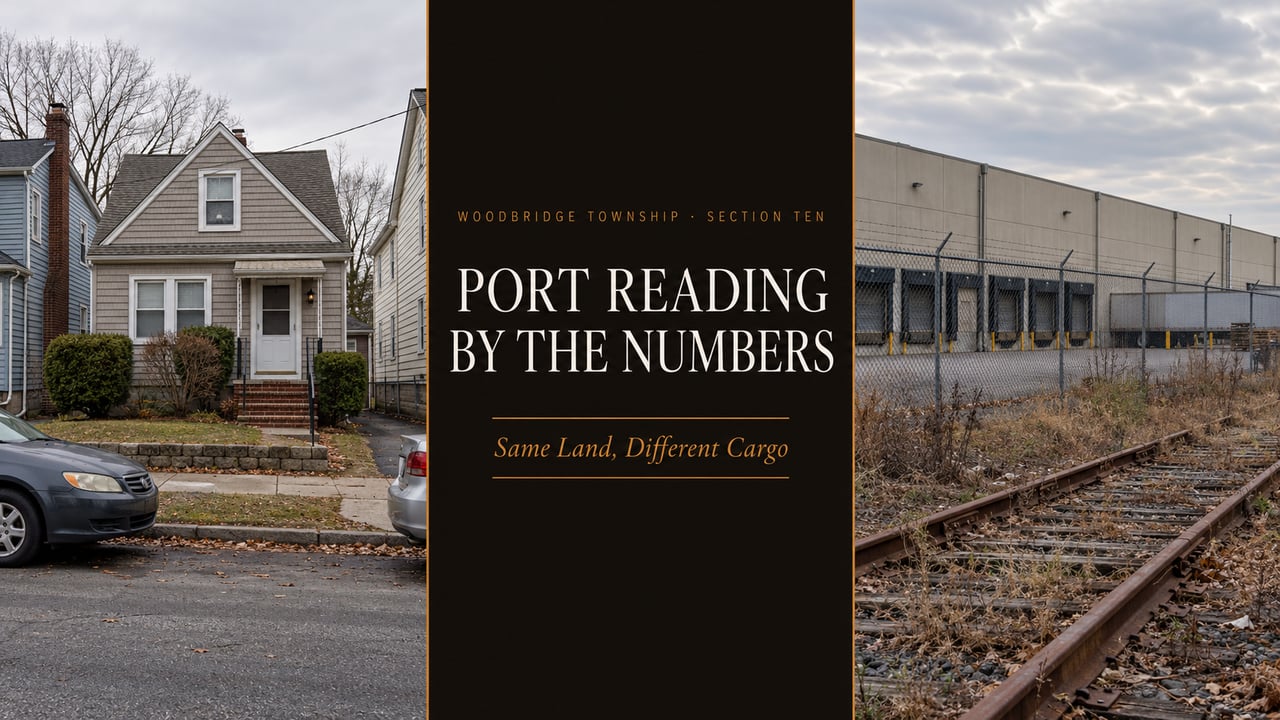
Port Reading is the one section of Woodbridge the township did not grow into. A railroad built it, on purpose, in the 1890s, to move Pennsylvania coal onto barges bound for New York Harbour. The marker commemorating that coal pier now stands on a street called Prologis Way — same land, same reasons, different cargo. And in a township where one section carries five published prices nearly $100,000 apart, four current sources put Port Reading inside about $12,500 of each other.
Port Reading is the tenth and last of Woodbridge Township's ten sections, and the only one created by a corporation rather than by settlement. The Reading Railroad of Pennsylvania built it in the late nineteenth century as a coal export terminal, connected it to its own network by a branch line in 1892, and crowned it with the McMyler Coal Dumper in 1917 — the eastern terminus of the system, where coal moved from rail cars into barges. That industrial logic never left; it only changed freight. The coal dumper fell out of use in 1982, and the marker recording it now stands on Prologis Way, a logistics address. On price, Port Reading is the most-agreed-upon section in the township. Four current sources land between $542,309 and $554,877 — a spread of about $12,568, against the roughly $99,616 that separates five published figures in neighbouring Fords. The disagreement here is not between platforms. It is between every current reading and the mid-$400s band that value-index estimates produced in spring 2026 — a band that is one full price level behind the autumn closings, and the single most important thing to get right before pricing anything in 07064.
I · The Section a Railroad Built ↓ II · Four Sources, One Band ↓ III · Five Plans, Two Square Miles ↓ IV · Buyers & Sellers ↓
Every other section of Woodbridge can be explained by geography — a crossroads, a rail stop, a stretch of waterfront, a postwar subdivision filling in farmland. Port Reading cannot. It exists because a Pennsylvania railroad needed deep water on the Arthur Kill and bought a way to reach it. Understanding that single fact explains the section's street grid, its industrial edges, its five redevelopment plans, and most usefully, why its prices behave the way they do. Confirm every figure, plan status and parcel detail with the Township of Woodbridge and current records before relying on any of it.
The Reading Railroad of Pennsylvania built Port Reading in the late nineteenth century to meet its own shipping needs — specifically, to move anthracite coal out of Pennsylvania and onto water. In 1892 a new branch line tied the place into the Reading system, running from Port Reading Junction near Bound Brook and known afterwards as the Port Reading Secondary. The section takes its name directly from that enterprise.
The physical monument to it arrived in 1917: the McMyler Coal Dumper, a coal pier complex that served as the eastern terminus of the Reading Railroad. A Woodbridge Township Historic Preservation Commission marker records its work in five lines — transferred coal from rail cars to barges, and handled millionth ton of coal 1934. It fell out of use in 1982. Preservation New Jersey placed it on its Ten Most Endangered list in 2004, and Hurricane Irene damaged it in 2011. Reporting in 2012 quoted Councilwoman Brenda Yori Velasco saying the township had tried to have it declared a historic site, that moving it "would involve a lot of money" and, plainly, "where would you put it?"
The coal dumper's marker stands on Prologis Way, east of Port Reading Avenue. Prologis is a logistics real estate company. A plaque commemorating the eastern end of an anthracite railroad now has a warehouse-park mailing address — and that is the most economical description of Port Reading available. The land was selected in the 1890s because it combined rail access and deep water, and it is used today for the same reason, with containers and pallets in place of coal. The industry did not arrive and displace a residential village. The houses were built for the industry.
Geographically the section sits at the northeastern corner of Woodbridge Township, in northeastern Middlesex County, covering about 1.98 square miles of land and 0.23 square miles of water. It borders Carteret to the north and east, Avenel to the northwest, Woodbridge Proper to the west, and Sewaren to the south, with the tidal Arthur Kill to the southeast and Staten Island across it. The ZIP is 07064. Port Reading School #9 serves the neighbourhood's elementary grades, kindergarten through six, within the township district. A Port Reading Refinery operated in the district.
Note what the borders mean for comping. Port Reading touches four places we cover separately — Carteret, Avenel, Woodbridge Proper and Sewaren — and two of them are different municipalities' worth of market behaviour away. Carteret is a separate borough with its own tax rate, its own school district and its own ferry project. A 07064 search radius wide enough to feel statistically comfortable will cross a municipal line before it crosses two miles.
This is the unusual part. Across the Woodbridge sections we have documented, the recurring problem is that published figures disagree violently — Fords carries five of them spanning roughly $99,616, and three sections return no published value at all. Port Reading does the opposite. Four separate current readings cluster tightly:
$542,309 — home value index, as of September 30, 2026, up 3.8% year over year, with eleven homes shown for sale.
$546,400 — median sold price, September 2026, up 5.82% from $516,400 in September 2025. Median list price the same month, $539,000, up 7.82% from $499,900.
$554,877 — median sale price, July 2026, down 0.91% year over year, with the three months ending July at roughly $555,000.
~$544,031 — the value-index figure for the section recorded during our Fords research.
Low to high, that is $542,309 to $554,877 — about $12,568, or roughly 2.3% of the midpoint. For a section recording single-digit to mid-teens monthly sales, that is as close to consensus as hyperlocal data gets. On pace, the same sources report a median 48 days on market, down from 69 a year earlier, a 103.4% sale-to-list ratio, and 55.6% of homes selling above list price. Nine sales closed in July against eleven a year before; fourteen closed in September against sixteen. Volume is easing slightly; competition is not.
Our own section index places Port Reading in the mid-$400s band, with renovated houses pushing toward $500,000, and sources that band explicitly to value-index estimates from spring 2026. Every reading above is autumn 2026, and every one of them is roughly $45,000 to $55,000 higher. Both can be accurate for their own moment — one is a modelled estimate from spring, the others are closings and indexes from July and September. They are reported here rather than reconciled. But for pricing a property today, the instruction is the same one we gave in Fords: use the index to rank sections against each other, and use closed sales to price a house. A mid-$400s expectation taken into a 07064 negotiation in autumn 2026 is a full price level behind the market, and it is the sellers who carry that cost.
Four sources we examined and did not use. One national platform published a median sale price and a median list price that were identical to the dollar at $548,971, with no reporting period stated — a coincidence implausible enough to disqualify the pair. The same platform reported fourteen sales in September alongside thirty-one sales across the trailing twelve months, figures that cannot both describe the same market. It also stated that 45 homes represented 45.92% of all residential properties in 07064, which would mean nearly half the section's housing stock was simultaneously for sale. That is the tenth platform-geography or platform-arithmetic failure we have logged across this library. Separately, one major portal's page summary advertised an average price of $662,000, up 24.8%, against its own body figure of $554,877 — we used the body. And we excluded one widely cited neighbourhood-data site altogether, because its Port Reading material is built on school ratings and resident demographics, which we do not publish for any community.
The Township of Woodbridge publishes an index of its redevelopment area plans, and five of them carry Port Reading in the title. For a section of under two square miles, that is a remarkable concentration — more named plans than most of the ten sections hold, and a direct consequence of the industrial land the railroad assembled.
Hess Port Reading Plan
Port Reading Area 1 Redevelopment Plan
Port Reading Area 2 Redevelopment Plan, amended 2022
Port Reading Area 3 Redevelopment Plan
Port Reading Redevelopment Plan and Site Map
We are naming these rather than describing them, deliberately. The plan documents are published as PDFs through the township's document centre, and the Hess Port Reading plan did not retrieve when we went to read it. We are not going to characterise acreages, permitted uses, height limits or unit counts we have not read. What the index does establish is structural and useful on its own: Port Reading's land-use future is governed by named redevelopment plans rather than by base zoning alone, and one of them is attached to a former refinery site. Anyone buying in 07064 should pull all five from the township and read the one nearest their parcel before they sign.
This matters more here than in Colonia or Iselin, and for a specific reason. In a section whose residential streets were platted alongside working industrial land, the boundary between the two is not a buffer of farmland or parkland — it is a property line. A redevelopment plan that changes what may be built on the industrial side changes the view, the traffic and the truck routes on the residential side, without a single house changing hands. Redevelopment plans are adopted and amended by ordinance, and amendment dates on the township's own index run as recently as 2025 across the broader list — so a plan read two years ago is not necessarily the plan in force.
Port Reading has no train station. Rail commuters drive inland to Woodbridge or Avenel on the North Jersey Coast Line, with Metropark's Northeast Corridor express service beyond that. The New Jersey Turnpike is close, Routes 1 and 9 are nearby, and the Route 440 and Outerbridge corridor reaches Staten Island in about twenty minutes. That places Port Reading in the pattern we documented along the Arthur Kill: a station is not what sets the price here. Linden has a Northeast Corridor station and closed near $549,000; Carteret has no station and ran $569,000 to $595,000. Port Reading, also without a station, now reads in the mid-$540s — which puts it in company with its neighbours rather than below them. We did not re-verify Sewaren's current figure for this report, so treat any Port Reading–Sewaren gap as unmeasured here rather than as closed.
If you are selling in Port Reading, the single largest risk is anchoring to a stale band. The mid-$400s figure is still in circulation, including on our own section index, and it is sourced to spring estimates. Four autumn sources say mid-$540s, more than half of sales are closing above list, and the median property is going in 48 days rather than 69. Price from closed sales in 07064 within the last six months, not from a value band, and not from a portal's headline average.
If you are buying, the tight consensus is a genuine advantage and you should use it. In Fords, the five-figure spread means a buyer can be argued into or out of almost any number. In Port Reading, four independent sources agree within about 2.3%, so a seller's number that sits far outside that band is answerable with evidence rather than opinion. Do two things before you commit. Check the municipality on every comparable — Carteret is a different borough with a different tax rate and sits directly across the section's northern and eastern borders. And pull the redevelopment plan covering the land nearest the house, because in this section the industrial parcel is frequently the next parcel.
On condition, the pattern reported across the section is older housing held for long tenures — capes, ranches, colonials and two-family houses on compact lots. Where a section's lots are uniform and small, condition and housing type drive price far more than land does, which is the same mechanic we documented in Fords. Two houses on the same street, one renovated and one original, can trade a six-figure distance apart, and no value band will tell you which one you are looking at.
Before you accept any Port Reading valuation, ask one question: what date is the number from, and is it a model or a closing? This section is the cleanest demonstration in the township of why that question matters. The four current readings agree within $12,568 — so if someone hands you a figure $45,000 below all four, it is almost certainly a spring value-index estimate rather than a market opinion, and nobody has noticed it aged. A modelled index is built to compare places; a closed sale is built to price a property. Use the first to decide whether Port Reading belongs on your list. Use the second, and only the second, to decide what to offer or accept. In a section closing fourteen sales in a strong month, a single stale band repeated often enough becomes the whole neighbourhood's expectation — and that is how sellers leave real money behind in a rising market.
"I like Port Reading because it never pretended to be anything. A railroad put it there to move coal, and the plaque for the coal pier sits on a street named after a warehouse company. Same land, same water, same Turnpike, different freight. What interests me now is the number. For two years the shorthand on this section was mid-four-hundreds, and I have used that shorthand myself. Then you pull four sources this autumn and they all land in the mid-five-forties, within about twelve thousand dollars of each other. That is not a platform glitch — that is four instruments agreeing while the shorthand stayed where it was. The owners who check the date on their number instead of trusting the band are the ones who price into this market instead of behind it."
Anthony Licciardello · Broker, The Prodigy Team

Port Reading sells to two buyers at once: the Middlesex County mover trading up out of a condo or a starter cape, and the Staten Island owner who can reach the Outerbridge in twenty minutes and wants a yard on the other side of it. We work both sides of that bridge every week with licences in both states, and we price from closed 07064 sales rather than from a value band — which, in this section this autumn, is the difference that shows up on the settlement sheet.
Get a valuation built on closed 07064 sales and the redevelopment plan nearest your parcel — not a value band from last spring.
What do homes cost in Port Reading, NJ?
Four current sources agree closely. A home value index reads $542,309 as of September 30, 2026, up 3.8% year over year. A median sold price reads $546,400 for September 2026, up 5.82% from $516,400 a year earlier. A median sale price reads $554,877 for July 2026, with the three months ending July near $555,000. A fourth value-index figure recorded during our Fords research reads about $544,031. Low to high that is roughly $12,568 of spread — unusually tight for a hyperlocal section. Price a specific property from closed 07064 sales, then adjust for housing type and condition.
Why do some pages show Port Reading in the mid-$400s and others in the mid-$540s?
Because they are different instruments from different seasons. The mid-$400s band comes from value-index estimates published for spring 2026 and still in circulation, including on our own section index. The mid-$540s figures are indexes and closed sales from July and September 2026. Both are accurate for their own moment, and we report them rather than reconcile them. For pricing a property today, use the index to rank sections against each other and closed sales to price the house — a mid-$400s expectation is a full price level behind the autumn market, and sellers bear that cost.
What is the McMyler Coal Dumper in Port Reading?
A coal pier complex built in 1917 that served as the eastern terminus of the Reading Railroad, transferring coal from rail cars into barges. A Woodbridge Township Historic Preservation Commission marker records that it handled its millionth ton of coal in 1934. It fell out of use in 1982, was placed on Preservation New Jersey's Ten Most Endangered list in 2004, and was damaged by Hurricane Irene in 2011. Reporting in 2012 quoted a councilwoman saying the township had tried to have it declared a historic site and that relocating it would be costly. Its marker now stands on Prologis Way, east of Port Reading Avenue. Confirm the structure's current status with the Township before relying on anything here.
Does Port Reading have a train station?
No. Rail commuters drive inland to Woodbridge or Avenel on the North Jersey Coast Line, with Metropark's Northeast Corridor express service beyond. The New Jersey Turnpike is close, Routes 1 and 9 are nearby, and the Route 440 and Outerbridge corridor reaches Staten Island in about twenty minutes. Along this stretch of the Arthur Kill a station has not been what sets price: Linden has a Northeast Corridor station and closed near $549,000, while Carteret has no station and ran $569,000 to $595,000.
How many redevelopment plans cover Port Reading?
Five carry Port Reading in the title on the Township of Woodbridge's published index of redevelopment area plans: the Hess Port Reading Plan, Port Reading Areas 1, 2 and 3, and a Port Reading Redevelopment Plan and Site Map. Area 2 is listed as amended in 2022. We are naming rather than describing them because we were unable to retrieve the plan documents, and we will not characterise acreages, permitted uses or unit counts we have not read. Pull all five from the Township and read the one nearest your parcel — in this section the industrial parcel is frequently the next parcel.
The Ten Sections of Woodbridge
Buying a Home in Woodbridge
Everything Being Built in Woodbridge Right Now
Sewaren — The Waterfront Transformation
The Arthur Kill Ladder — Sewaren, Linden, Carteret
Woodbridge Proper — The Walk-to-Train Downtown
Avenel — The Transit Village That Already Got Built
Carteret Housing Market Analysis
Figures as of publication, from the sources noted, measuring different quantities over different periods, and subject to change. Confirm all figures, plan statuses, boundaries and parcel details with the Township of Woodbridge and current records before relying on any of it. Nothing here is legal, planning, tax or investment advice. Market figures: a home value index of $542,309 as of September 30, 2026, up 3.8% year over year, with eleven homes shown for sale, per Zillow; a median sold price of $546,400 and a median list price of $539,000 for September 2026, up 5.82% and 7.82% respectively from $516,400 and $499,900 in September 2025, with fourteen homes sold against sixteen and inventory of 48 against 46, per RealtyTrac's 07064 market trends; a median sale price of $554,877 for July 2026, down 0.91% year over year, a median of roughly $555,000 across the three months ending July 2026, a median 48 days on market against 69 a year earlier, nine homes sold against eleven, a sale-to-list ratio of 103.4% and 55.6% of homes selling above list price, per Redfin's 07064 housing market page; and a value-index figure of approximately $544,031 for the section recorded during our Fords research. These are indexes, medians and modelled estimates across July and September 2026 rather than a single instrument over a single period, and they are reported rather than reconciled; the low-to-high spread of approximately $12,568 is stated as a spread between published figures, not as a margin of error. Our own published band: our section index and Port Reading neighbourhood page place the section in the mid-$400s band with renovated houses pushing toward $500,000, sourced on that page to value-index estimates for spring 2026. That band and the autumn figures above are both reported; they are not reconciled, and the autumn figures are the ones to price from. Sources examined and not used: RealtyTrac's page introduction states a median sales price and a median list price both of exactly $548,971 with no reporting period, reports fourteen sales in September alongside thirty-one sales across the trailing twelve months, and states that 45 homes represent 45.92% of residential properties in 07064 — figures we regard as internally inconsistent and have excluded; Redfin's page summary advertises an average price of $662,000 up 24.8% against its own body median of $554,877, and we used the body figure; a foreclosure-marketing site advertising 64 Port Reading foreclosure listings was not examined or used; and one widely cited neighbourhood-data site was excluded in full because its Port Reading material is built on school performance ratings and resident demographics. 🔴 The 45.92%-of-properties-for-sale claim is the tenth platform-geography or platform-arithmetic failure logged across this library, following the ZIP-level report stating that 132.00% of properties in a Cranford ZIP code were for sale. History and geography per Wikipedia's Port Reading, New Jersey entry: the Reading Railroad of Pennsylvania built the community in the late nineteenth century to meet shipping needs, developing it to ship coal and especially Pennsylvania anthracite; a new branch line connected Port Reading to the Reading system in 1892, running from Port Reading Junction near Bound Brook and known as the Port Reading Secondary; the section covers about 1.98 square miles of land and 0.23 square miles of water for a total of 2.20 square miles, sits in the northeastern part of Woodbridge Township in northeastern Middlesex County, and borders Carteret to the north and east, Avenel to the northwest, Woodbridge proper to the west and Sewaren to the south, with the tidal Arthur Kill to the southeast and Staten Island beyond; the ZIP code is 07064; Port Reading School #9 serves kindergarten through grade six; a Port Reading Refinery was located in the district; and the McMyler Coal Dumper was built in 1917. Coal dumper marker per the Historical Marker Database entry for the McMyler Coal Dumper, erected by the Woodbridge Township Historic Preservation Commission and located on Prologis Way east of Port Reading Avenue, inscribed: "Coal Pier Complex / Eastern terminus Reading Railroad / Transferred coal from rail cars to barges / Handled millionth ton of coal 1934 / 1917." Condition and preservation history per Patch reporting dated March 20, 2012: the structure went out of use in 1982, was placed on Preservation New Jersey's Ten Most Endangered list in 2004, and was significantly damaged by Hurricane Irene in 2011, with Councilwoman Brenda Yori Velasco quoted that the township had "tried to get the historic trust to declare it a historic site," that moving it "would involve a lot of money," asking "where would you put it?" and stating "we want it recognized for its historic significance." 🔴 That reporting is from 2012 and the structure's condition, ownership and preservation status today are unverified; a marker has since been erected by the Township's Historic Preservation Commission, but we have not confirmed the structure's current state and no claim is made about it. Redevelopment plans per the Township of Woodbridge's published index of Woodbridge Redevelopment Area Plans, which lists the Hess Port Reading Plan, Port Reading Area 1 Redevelopment Plan, Port Reading Area 2 Redevelopment Plan amended 2022, Port Reading Area 3 Redevelopment Plan, and Port Reading Redevelopment Plan and Site Map. The plan documents themselves were not retrieved; the Hess Port Reading plan PDF did not load when requested, and no acreage, permitted use, height limit, unit count or adoption date is asserted for any of the five. The township index gives no boundaries, so no claim is made about which other listed plans adjoin Port Reading. Commute and housing-stock description per our own published Port Reading neighbourhood page: capes, ranches, colonials and two-family homes on compact lots; the Turnpike minutes away; Staten Island about a twenty-minute drive via the Route 440 and Outerbridge corridor; Routes 1 and 9 nearby; rail commuters using Woodbridge or Avenel stations on the North Jersey Coast Line with Metropark's Northeast Corridor service beyond; and Port Reading School among the district's neighbourhood elementaries. Comparative figures for Linden at approximately $549,000 and Carteret at $569,000 to $595,000 are carried from our Arthur Kill corridor report and were not re-verified for this post; Sewaren's current figure was not re-verified and no Port Reading–Sewaren gap is asserted. School performance ratings, household income, median age, household composition, racial composition and crime data available from the sources consulted have been deliberately excluded, as we exclude such material for every community we cover. Medians, averages and value indexes are not appraisals and describe populations of transactions or modelled values rather than any individual property. Comparable sales, lot dimensions, tax bills, assessments, condition, flood exposure, environmental history and school attendance assignments must be verified for any specific property. No prediction is made about the outcome, timing or scope of any redevelopment plan or process, nor about any effect on any property's value. This is general information and market commentary, not legal, tax, or investment advice.
Prodigy Real Estate is an innovative real estate company offering high-end video production, home valuation services, purchasing, and home sales. Serving New York and New Jersey.