
Anthony Licciardello | April 16, 2026
Point Pleasant Borough
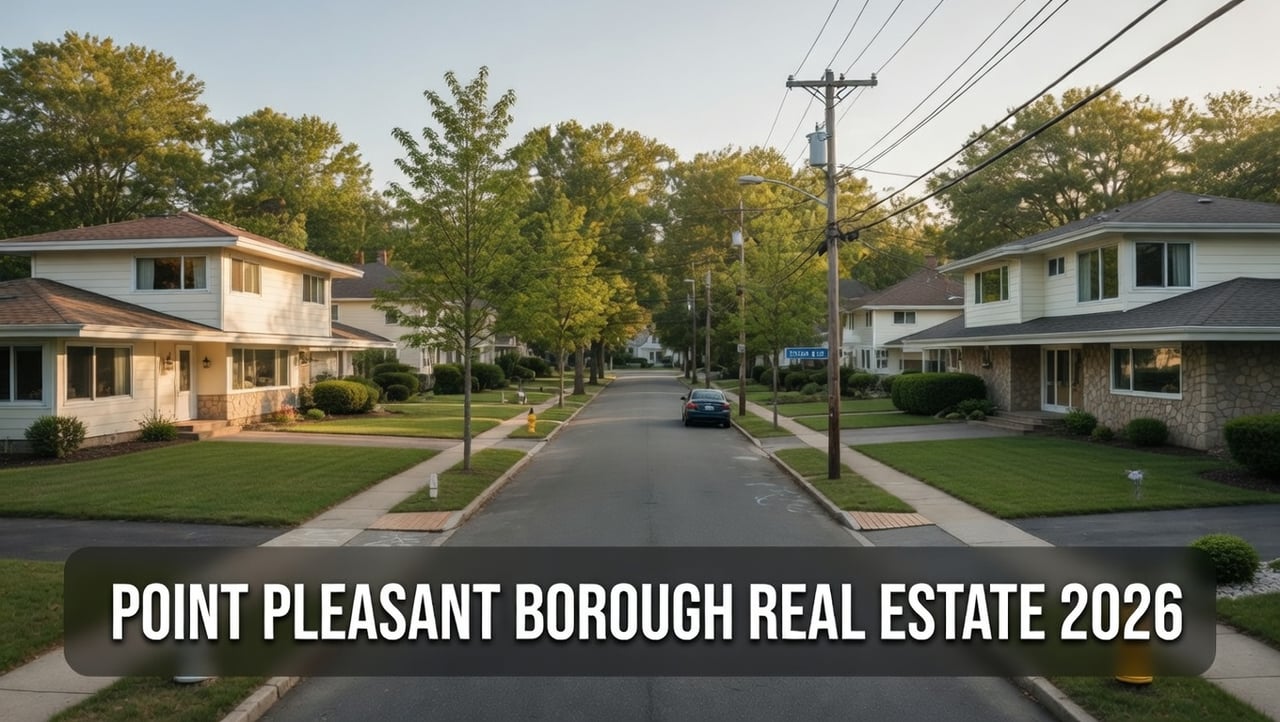
Point Pleasant Borough NJ real estate operates on entirely different fundamentals than its neighbor across the canal — and buyers who conflate the two often make expensive mistakes. These are adjacent municipalities that share a name and a border, but they serve opposite buyer profiles, run on opposite seasonal rhythms, and produce opposite market dynamics. Understanding the distinction is the first requirement for making a sound purchase decision in either town.
Point Pleasant Beach is a barrier-peninsula community built around the Atlantic Ocean, the boardwalk, and a high-turnover seasonal rental economy. According to a 2025 Realtor.com Investor Report, roughly 59% of all purchases there are made by small-scale investors chasing short-term rental yields — a figure that shapes pricing, inventory, and buyer competition in ways that have nothing to do with year-round residential demand. For a full breakdown, see our Point Pleasant Beach 2026 market report.
The Borough is the inverse. Approximately 80% of housing units are owner-occupied. The market is driven by families relocating from the New York and New Jersey metro area, buyers seeking deep-water access for serious boating, and long-term residents who stay for decades. The economic engine here is not the summer tourist season — it is the school district, the marina infrastructure, and the quiet stability of a community that functions the same in February as it does in July.
Market Data
The Point Pleasant Borough real estate market enters 2026 in a familiar condition: high demand, low supply, and prices that reward sellers while pressuring buyers who hesitate. As of early 2026, the median sale price in the Borough ranged between $700,000 and $753,000 — competitive but normalized relative to the broader Ocean County coastal market.
February 2026 closed-sale data shows the median at $753,000 — a 6.2% year-over-year adjustment from early 2025 peaks. That correction does not signal weakness. Days on market ran 12 to 17 days before pending status, reflecting active buyer demand rather than a cooling environment. The median price per square foot was recorded at $465. With only 23 homes actively listed as of February 2026, producing a 2.1-month supply figure, multiple-offer scenarios remain the rule. The 105.13% sale-to-list ratio tells you everything about negotiating leverage: buyers are routinely paying above asking price to secure properties.
Looking ahead, macroeconomic forecasts project Borough home prices to rise between 2% and 4% through the remainder of 2026. Mortgage rates are projected to hold between 6.0% and 6.8%. The average effective property tax rate sits at approximately 1.56% — favorable compared to comparable Ocean County coastal towns. For a detailed breakdown of what buyers and sellers pay at closing across New Jersey, see our 2026 NJ closing costs guide.
| Metric | Point Pleasant Borough | Point Pleasant Beach |
|---|---|---|
| Median Sale Price | $700,000 – $753,000 | ~$772,100 (premium areas $1.4M+) |
| Median Price Per Sq. Ft. | $465 | Significantly higher near ocean |
| Days on Market | 12 – 17 Days | Competitive / limited inventory |
| Active Supply | 23 homes / 2.1 months | Extremely constrained |
| Sale-to-List Ratio | 105.13% | Highly competitive |
| Owner-Occupancy Rate | ~80% | ~41% (59% investor purchases) |
| Avg. Property Tax Rate | ~1.56% | Comparable / varies by block |
The 6.2% year-over-year pricing dip is a normalization event, not a structural correction. The 2024 peak reflected compressed inventory and elevated buyer urgency that pushed prices above long-run trend. With a 105% sale-to-list ratio and 12-to-17-day marketing times running simultaneously, the data is internally consistent: prices softened slightly from an artificial high while demand remains strong enough to keep sellers firmly in control. Buyers who interpret the YOY dip as an opportunity to lowball should expect a rude awakening in the offer round.
▶ Point Pleasant Borough, NJ: The Story Behind The Town That Shares A Name Without The Beach — Prodigy / Above the Streets
Waterfront Tier
The most consequential pricing variable in Point Pleasant Borough is not square footage or school proximity — it is water access. The Borough's defining geographic feature is its intricate network of lagoons, canals, and deep-water frontage along the Manasquan River, and properties that back directly to navigable water occupy an entirely different pricing tier than the rest of the market.
Premium lagoon-backed homes consistently command median prices between $1.3 million and well over $2 million. These properties offer what no interior home can replicate: private dock or boat lift access, direct connectivity to the Manasquan River, and from there, open access to the Atlantic Ocean through the Manasquan Inlet. For a serious boating family, this is infrastructure — not aesthetics — and the market prices it accordingly.
The waterfront premium traces directly to a single infrastructure decision made a century ago. Between 1924 and 1925, the completion of the Point Pleasant Canal — a two-mile man-made waterway connecting the Manasquan River to the Barnegat Bay — physically severed the barrier peninsula from the mainland and established the Borough as a critical node on the Atlantic Intracoastal Waterway. That cut of earth transformed the Borough from an agricultural inland town into one of New Jersey's most navigable waterfront communities, and the effect on land values has been compounding ever since.
⚠ Buyer Note — Waterfront Cost Structure
Canal and lagoon properties carry a cost structure that standard suburban homes do not. Budget specifically for:
• Flood and wind insurance — mandatory for most lenders on waterfront properties
• Bulkhead replacement — $30,000 to $80,000+ depending on linear footage; lenders frequently require structural waterfront assessments before closing
• Dock, boat lift, and seawall maintenance — ongoing annual costs that compound over time
Post-Sandy elevated rebuilds typically carry significantly lower flood insurance premiums than older, non-elevated structures — worth specifically targeting for buyers managing carrying costs.
Understanding the regulatory shifts reshaping NJ Shore real estate — including current NJDEP elevation and flood zone requirements — is essential context for any waterfront purchase in the Borough. See our guide to the three rules rewriting the NJ Shore playbook.
Architecture
Because the Borough experienced its primary population expansion following World War II — rather than during the Gilded Age resort era — its architectural profile is decidedly mid-century and suburban at its core. Single-family detached homes comprise approximately 78.6% of all housing units, with owner-occupancy running close to 80%. This is a town of permanent residents, and the housing stock reflects that.
The most common home types are post-war ranch homes and split-level configurations, many built between the 1950s and 1970s on standard residential lots. These homes tend to run 1,200 to 1,800 square feet, feature attached garages, and sit on lots ranging from a quarter to a half acre. Cape Cods and bi-levels from the same era round out the standard suburban inventory. Traditional two-story colonials became more prevalent through the 1980s and 1990s and remain popular on larger interior lots today.
Superstorm Sandy in October 2012 fundamentally altered a significant portion of the Borough's housing inventory, particularly in flood-prone waterfront and near-waterfront blocks. The mandatory elevation and reconstruction wave that followed produced a distinct architectural sub-category: newer, elevated coastal construction built to current FEMA Base Flood Elevation requirements, typically raised 8 to 12 feet on pilings or fill. Buyers specifically seeking post-Sandy rebuilds should view the elevated construction requirement not as a compromise but as a financial advantage in terms of insurance cost management.
At the top of the Borough's architectural spectrum are custom waterfront estates lining the lagoon and canal system — many built or substantially renovated in the 2010s and 2020s. These properties feature contemporary coastal design: open floor plans, floor-to-ceiling rear glazing oriented toward the water, elevated decks, integrated dock and boat lift systems, and outdoor living spaces designed for boating households. The design vocabulary borrows heavily from barrier island architecture while incorporating the structural requirements of inland waterfront construction. These homes occupy their own micro-market anchored by water access, lot size, and build quality.
Schools
For the relocating family, the Point Pleasant Borough School District is frequently the decisive factor in the purchase decision. The district serves 2,659 students across four schools, operates with a student-teacher ratio of approximately 10.7:1 to 11:1, and holds an overall grade of A- with a Niche statewide ranking of #90.
On New Jersey Department of Education standardized assessments, the Borough district significantly outpaces its neighbor. Reading proficiency stands at 76% and mathematics proficiency at 43% — figures that substantially exceed the Beach district's corresponding 55% and 23%. The Borough recently earned Bronze distinction from the College Board for its Advanced Placement program, with 74 students recognized as AP Scholars.
Where the Borough's schools truly separate from statewide competition is extracurricular achievement at an elite level. Point Pleasant Borough High School fields highly competitive Group II athletic programs, with wrestling as a perennial State Sectional contender. Approximately 10% of all boys in the high school wrestle — fueling an intense inter-municipal rivalry with the Beach, where 22% of boys wrestle and the program has secured three consecutive Group I Central State Sectional Championships.
In November 2023, the Point Pleasant Boro Marching Panthers traveled to Hershey, Pennsylvania and secured the Group 3A national title at the Tournament of Bands national championships — posting a near-perfect score of 95.55 while sweeping awards in best percussion, visuals, and color guard. For a school of this size to compete and win at that level reflects an institutional commitment to performing arts that families with serious music students should factor heavily into their decision.
| Metric | Point Pleasant Borough | Point Pleasant Beach |
|---|---|---|
| Total Enrollment | 2,659 / 4 schools | 646 / 2 schools |
| Student-Teacher Ratio | 10.7:1 – 11:1 | 8.5:1 |
| Niche State Ranking | #90 (A-) | #44 (A) |
| Reading / Math Proficiency | 76% / 43% | 55% / 23% |
| Signature Academic Program | AP Scholar / core curriculum depth | STEAM Collaboratory / Gull Flight dual-enrollment |
| Signature Extracurriculars | National Champion Marching Band / Group II Wrestling | Group I Wrestling — 3 consecutive sectional titles |
Neighborhood Guide
Point Pleasant Borough is segmented by its waterways and major transit corridors — Route 88, Ocean Road, and Bridge Avenue among them — creating distinct residential pockets with materially different price points and lifestyle profiles. Approach the Borough not as a single market but as a cluster of micro-markets, each with its own inventory dynamics and buyer profile.
The premium tier. Properties backing directly to the Point Pleasant Canal, the Manasquan River, or the Borough's lagoon network represent the most sought-after addresses in the municipality. These blocks carry the $1.3 million to $2 million-plus range discussed above. The buyer here is principally a boating household. Inventory in this sub-market is exceptionally thin — when a dock-accessible property surfaces, it moves quickly.
Radiating outward from the waterfront corridor, the near-marina interior blocks offer standard suburban homes with walkable or short-drive access to marina facilities, without the waterfront premium on the deed. These neighborhoods represent the Borough's strongest value proposition for boating families who prefer to own a boat slip separately rather than pay the embedded waterfront premium in the purchase price. Homes in this tier generally run $600,000 to $850,000 depending on size, condition, and post-Sandy rebuild status.
The Borough's primary inland residential grid runs along and between these two arterials, offering the broadest selection of traditional suburban inventory. Mid-century ranch homes and colonials dominate, with post-Sandy elevated rebuilds scattered throughout flood-zone blocks. Price points here are the most accessible in the Borough, with entry-level inventory occasionally surfacing below $600,000 — though in a 2.1-month supply environment, those windows open and close fast.
Properties along the Manasquan River's northern bank offer wooded, quieter character oriented toward the river rather than the ocean inlet. This perimeter carries strong long-term appreciation fundamentals due to its visual appeal and water adjacency, while often carrying lower insurance risk profiles than the lagoon-direct properties closer to the canal mouth. For buyers who want the water lifestyle at a slight discount to the premium canal tier, the Riverfront perimeter is worth examining carefully.
Lifestyle
The most defining quality of daily life in Point Pleasant Borough is its consistency. There is no off-season here. No mass exodus after Labor Day, no boarded-up storefronts through February, no identity crisis when the tourist crowds disappear. The Borough operates as a complete, self-sustaining community twelve months a year — and for buyers relocating from the New York metro area, that stability is often the single quality they find most surprising and most appealing.
The Borough's deep-water marinas form the backbone of its recreational identity. The Manasquan River access corridor supports some of the most active recreational boating communities on the Jersey Shore, with marina slips, service yards, and launch facilities woven into the Borough's waterfront fabric. For powerboat and sailboat owners, the Borough's position — one inlet away from open Atlantic water — is a practical advantage that residents use year-round. The boating community here is not a seasonal hobby group; it is a year-round social infrastructure.
The Borough's Department of Recreation operates a robust network of municipal parks and athletic facilities built for permanent residents. Riverfront Park serves as the civic anchor of the waterfront district, hosting Earth Day events, environmental programming, and community gatherings. The broader parks system supports extensive youth and adult sports leagues — baseball, softball, soccer, basketball — that form the social backbone of Borough family life. The school district's Marching Panthers and wrestling programs extend this community identity well beyond municipal parks and into statewide competitive arenas.
Point Pleasant Borough has become an increasingly prominent destination in the ongoing migration of New York City and Northern New Jersey households to the Shore. The combination of reasonable commute access via Route 88 and the Garden State Parkway, a highly rated school district, and a price point below comparable Monmouth County coastal markets has positioned it as a logical endpoint for families making the suburban Shore transition. For a broader look at where New York metro buyers are landing across New Jersey's counties, see our NYC-to-NJ migration county breakdown.
* Median price, days on market, sale-to-list ratio, and active listing data derived from closed-sale records and listing-side market trackers for February 2026. Investor purchase concentration data per the 2025 Realtor.com Investor Report. School enrollment, proficiency, and ranking data per the New Jersey Department of Education and Niche 2025–2026 district profiles. Property tax rate is an average effective rate and will vary by assessed property.
FAQ
Q
What is the median home price in Point Pleasant Borough in 2026?
As of early 2026, the median sale price in Point Pleasant Borough ranges between $700,000 and $753,000 for standard residential properties. Waterfront and lagoon-backed homes with dock access occupy a significantly higher price tier, with median prices running from $1.3 million to well over $2 million. The market is seller-controlled, with a 105.13% sale-to-list ratio and only about 2.1 months of active supply as of February 2026.
Q
Is Point Pleasant Borough a good place for year-round families?
Yes — and it is specifically structured for them. The Borough runs a stable year-round community with an A- rated school district ranked #90 in New Jersey, a national champion marching band, competitive Group II athletics, and a parks and recreation infrastructure built around permanent residents rather than seasonal visitors. Approximately 80% of housing units are owner-occupied, reflecting a deeply established, long-term residential base rather than an investor-driven or second-home community.
Q
What should buyers know about waterfront properties in Point Pleasant Borough?
Waterfront and lagoon-front homes carry a significant cost structure beyond the purchase price. Buyers should budget for flood and wind insurance, and for the ongoing maintenance of specialized waterfront infrastructure including bulkheads, docks, boat lifts, and seawalls. A failing bulkhead replacement alone can run $30,000 to $80,000 or more depending on linear footage, and lenders frequently require structural waterfront assessments before closing. Post-Sandy elevated rebuilds typically carry lower flood insurance premiums than older non-elevated structures and are worth targeting for buyers concerned about carrying costs.
Q
How does Point Pleasant Borough compare to Point Pleasant Beach for buyers?
The two municipalities serve fundamentally different buyer profiles. The Beach is built around ocean access, short-term rental investment, and a high-energy seasonal lifestyle — roughly 59% of purchases there are made by investors. The Borough is a year-round suburban community with higher owner-occupancy, stronger standardized academic performance, larger lot sizes, and a waterway system built for serious boating rather than beach tourism. Buyers choosing between the two are not choosing a better or worse option — they are choosing between two completely different ways of living on the Jersey Shore.
Prodigy Real Estate is an innovative real estate company offering high-end video production, home valuation services, purchasing, and home sales. Serving New York and New Jersey.