
Anthony Licciardello | August 11, 2026
Ortley Beach, NJ
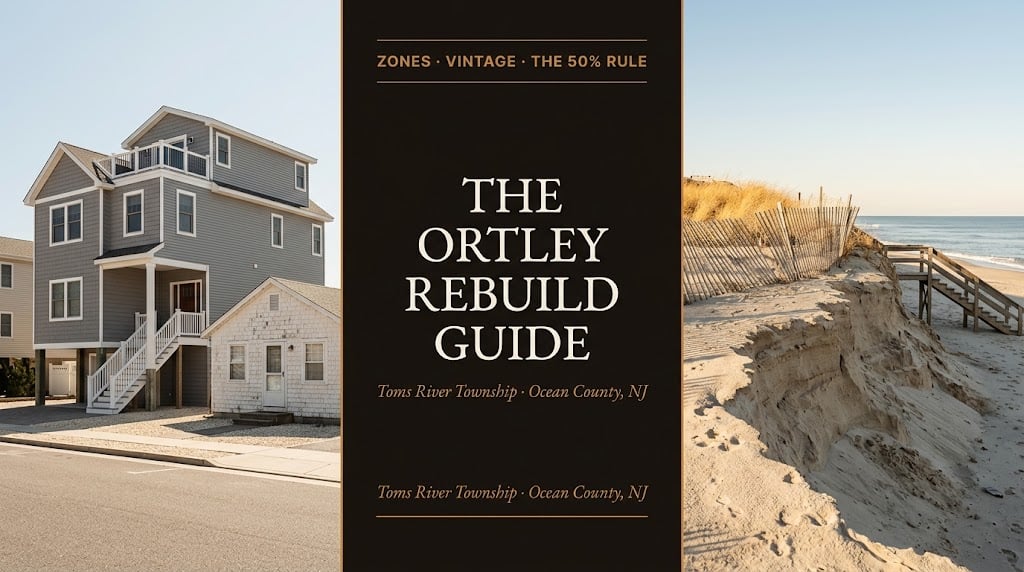
Every Ortley Beach transaction is secretly two transactions: the house, and the flood story underneath it. This is the town Sandy hit hardest and the town that rebuilt tallest — which means the gap between a 2015-built elevated home and a surviving pre-storm cottage is the widest value spread on the island, hiding in plain sight on the same block. Here's the complete owner's guide to the zones, the rules, the rebuild-vintage verification file, and the shoreline the township defends every single winter.
Ortley's flood story has three acts, and every one prices into your deal. The history: this sand once held the colonial Cranberry Inlet — the ocean has crossed here before — and in 2012 Sandy made the point again, hitting Ortley as hard as anywhere on the coast and triggering the rebuild that gave the town the island's densest stock of new, elevated, code-current homes. The rules: FEMA's AE and VE zones cover the neighborhood, making flood insurance effectively mandatory with a federally backed mortgage; Toms River Township's floodplain administration and the state construction code govern elevation; the 50% substantial-improvement rule stalks every surviving pre-Sandy cottage, converting big renovations into mandatory elevations; and the NJDEP's advancing coastal standard — four feet above base flood elevation for new and substantially improved construction — is the horizon every long-hold owner should track. The verification: because rebuild vintage is the whole value question here, we run a standard file on every purchase — rebuild year and permits, elevation certificate, claims history, Sandy-era damage determinations, V-zone construction details, and a live insurance quote — and for legacy cottages we price the eventual elevation into the offer itself. Add the honestly told shoreline-defense story (roughly $1.3 million of township replenishment since 2021, candidly called a "Band-Aid" by its own council), and you have the complete picture. The acts, the file, and the playbook follow.
This guide is the flood-and-rebuild spoke of our Ortley Beach hub, applying the barrier-island framework from our flood-regulations deep dive to the island's most rebuilt neighborhood. Maps, rules, and programs evolve — verify all current requirements with Toms River Township's floodplain administration, FEMA, and your own professionals before designing, buying, or renovating.
Geography first, because Ortley's is unusually honest: this stretch of barrier sand once held the colonial-era Cranberry Inlet, where the Atlantic flowed clear through to Barnegat Bay. The ocean has crossed here before — and in October 2012 it did again, when Superstorm Sandy struck Ortley as devastatingly as anywhere on the New Jersey coast. What followed reshaped the housing stock itself: block by block, the neighborhood rebuilt elevated, to modern code, at a scale no other island community matched — the "rebuild capital" identity our hub guide introduces.
The result, for anyone pricing property here, is a two-stock town: a broad cohort of 2013-and-later elevated homes — pilings, breakaway enclosures, current flood compliance, efficient insurance — standing beside a thinner band of pre-Sandy survivors, cottages the storm spared that still sit low. They can share a street, a view, and a listing price bracket while being fundamentally different assets: one is done with its flood reckoning; the other's is still ahead, priced in Chapter III. That spread — the widest hidden value gap on the island — is what this whole guide teaches you to see.
The regulatory stack over Ortley runs four layers. FEMA's flood maps place the neighborhood's parcels predominantly in AE and VE zones — making flood insurance effectively mandatory with any federally backed mortgage, and making the coastal V-zone construction standards (pilings, breakaway walls, restricted below-elevation use) part of the architecture you see on every rebuilt block. Toms River Township's floodplain administration and New Jersey's Uniform Construction Code govern elevation and permits — township machinery, not borough, a distinction our market report makes about the data and applies equally here to the rules. The state's Flood Hazard Area Control Act supplies the third layer.
Two provisions deserve their own paragraphs. The 50% substantial-improvement rule: improve or repair any structure by half the building's market value and the whole structure must meet current flood standards — elevation included — which is precisely the reckoning waiting for Ortley's surviving cottages, softened only by up to $30,000 of Increased Cost of Compliance coverage in standard federal flood policies when damage forces the issue. And the horizon: the NJDEP's advancing coastal rules would set new and substantially improved construction at four feet above base flood elevation — a standard that would widen the compliant-versus-legacy spread even further. Verify its adoption status before any design decision, ask the township's floodplain office how it counts cumulative improvements before phasing any renovation, and ask whether community-rating discounts apply to township policyholders — three questions, ten minutes, real money.
Because rebuild vintage is the value question in Ortley, we run the same six-item file on every purchase — and recommend every buyer demand it:
Township permits establish whether you're buying a ground-up post-Sandy rebuild, an elevated legacy structure, or an untouched survivor — three different assets.
The document that converts height into premium math. If none exists, price obtaining one into your diligence — and read its absence as information.
Prior flood claims and any Sandy-era substantial-damage determination on the parcel — ask the seller, the insurer, and the township; the paper trail outlives the paint.
Pilings versus fill, breakaway enclosures, below-elevation use, utilities height — the V-zone details that determine both survivability and insurability.
In your name, on this structure, before attorney review ends. In AE/VE territory the premium is part of the price — never inherit the seller's number sight unseen.
Buying a pre-Sandy survivor? Price the eventual elevation into the offer: any major renovation can trip the 50% rule, so the realistic cost basis is purchase plus lift — a discount today for a project tomorrow.
In Ortley, your rebuild vintage and elevation are worth real money — is your price capturing them?
Get a valuation that prices what Ortley buyers actually pay for — rebuild year, elevation certificate, insurance profile, and tier — comped against the neighborhood's own sales and backed by the New York metro buyer pool we bring to every listing.
The honest coastal conversation, plainly told: winter storms routinely carve Ortley's beach into cliffs at the dune line, and the township has answered with roughly $1.29 million of replenishment since 2021 — $430,000, $240,000, $305,000, and $314,000 in successive rounds, typically racing completion before Memorial Day. The candor comes from the town itself: a councilman calls the annual work "a Band-Aid — it's never enough," and residents note that in some years the sand ran out before crews reached Fifth Avenue. We quote that not to alarm but to equip: this is a shoreline under active, recurring, publicly funded defense, and every oceanside buyer should know it going in.
What it means by buyer type: oceanfront and east-side buyers — get the specific block's dune, easement, and walkover history, ask where recent replenishment rounds started and stopped, and treat any prospective large-scale federal or state beach project as upside you don't pay for until it's real. Bayside buyers — your water risk is bulkheads and lagoon flooding, not dune cliffs; inspect the bulkhead like it's a roof, because financially it is. Everyone — the structural answer to shoreline uncertainty is the same one this town already gave: elevation, compliance, documentation. The rebuilt house on the defended beach is the whole Ortley thesis in one image — and priced correctly, via the forensic market report, it's one of the strongest risk-adjusted buys on the island. Browse current inventory on our island listings page, or start the full community picture at the Ortley hub.
Tour Ortley twice: once in July, once in February. Summer shows you the product everyone buys — full beach, warm streets, the rebuilt town at its best. Winter shows you what you're actually underwriting: where the dune line stands after the storms, which walkovers took damage, how the block drains in a nor'easter, and whether that bayside bulkhead sits high and dry or works for its living. The February visit costs you a Saturday and typically saves the most money of any diligence step we know — sellers rarely expect a buyer who has seen the beach in both seasons, and your inspection list (and your offer) will show it.
"I flew Ortley Beach in the years after Sandy, and the transformation from above still stops me: a neighborhood that took the coast's worst punch and answered by building taller, stronger, smarter — house by house, block by block. That's not just resilience; it's an underwriting philosophy you can buy into. My rule for clients here is simple: know the vintage, hold the certificate, quote the insurance, and see the beach in winter. Do those four things and Ortley rewards you with something rare on any coast — a market where the flood story is mostly already told, and the price still hasn't fully caught up to it."
— Anthony Licciardello, Broker, The Prodigy Team
Flood files, vintage verification, and coastal underwriting are standard practice here: I'm Anthony Licciardello, Broker of The Prodigy Team — dual-licensed in New York and New Jersey, a former Director of Community Affairs in the Bloomberg Administration, and a leading broker for cross-border New York–New Jersey transactions, bringing the New York market to New Jersey sellers.
Our Above the Streets cinematic drone series has documented this rebuilt coastline from the air since the recovery years — watch the barrier island episode above — with audience performance exceeding industry benchmarks for real estate media.
Anthony Licciardello · Broker, The Prodigy Team · 718-873-7345
The six-document vintage file, the winter walk-through, and tier-true pricing — coastal diligence is our home field.
Is flood insurance required in Ortley Beach?
Effectively yes for most buyers: Ortley's parcels sit predominantly in FEMA's AE and VE flood zones, where flood insurance is mandatory with any federally backed mortgage. Premiums vary enormously with elevation, construction details, and documentation — which is why a live quote in your name, plus the structure's elevation certificate, belongs in diligence before attorney review ends, never after closing.
Are the post-Sandy rebuilt homes in Ortley Beach a better buy?
They carry structural advantages: current elevation and code compliance, V-zone construction details, cleaner insurance profiles, and a finished flood reckoning. Surviving pre-Sandy cottages can still be smart purchases — but only priced as purchase-plus-eventual-elevation, since the 50% substantial-improvement rule converts major renovations into mandatory lifts. Same block, different assets; the rebuild year is the first question, not the last.
What is the 50% rule and does it apply in Ortley Beach?
Yes — under NFIP-aligned rules administered through Toms River Township, improving or repairing a structure by 50% or more of the building's market value requires bringing the entire structure into current flood compliance, elevation included. Standard federal flood policies include up to $30,000 of Increased Cost of Compliance coverage when damage forces the issue. Before phasing any project, ask the township floodplain office in writing how cumulative improvements are counted.
Is the beach erosion in Ortley Beach a dealbreaker?
It's a diligence item, not a dealbreaker — but an honest one: winter storms cut cliffs at the dune line, the township has spent roughly $1.29 million on replenishment since 2021, and officials themselves call the annual rounds "a Band-Aid." Oceanside buyers should learn their specific block's dune and easement history and where recent sand placement started and stopped; bayside buyers should inspect bulkheads with the same seriousness. Elevation, compliance, and documentation remain the structural answers.
Moving to Ortley Beach — The Complete Guide
Ortley Beach Prices — The Forensic Market Report
Barrier-Island Flood Rules — The Full Framework Next Door
The New-Construction Ladder — Every Project, Priced
Moving to Seaside Heights — The Complete Guide
Browse the Island's Current Listings
Details as of publication for Ortley Beach, an oceanfront section of Toms River Township, Ocean County, NJ: the area's history as the site of the colonial-era Cranberry Inlet and its severe impact from Superstorm Sandy in October 2012, followed by rebuilding that regional market coverage describes as producing the highest concentration of post-Sandy elevated, code-compliant construction on the Ocean County barrier island; FEMA flood zones for barrier-island parcels including AE and VE, with flood insurance mandatory for federally backed mortgages per NFIP rules; floodplain administration and construction permitting through Toms River Township under New Jersey's Uniform Construction Code and the Flood Hazard Area Control Act; the NFIP-aligned substantial improvement and substantial damage standard (50% of structure market value triggering full compliance including elevation) and Increased Cost of Compliance coverage of up to $30,000 under standard NFIP policies; NJDEP coastal-rule changes announced with intent to adopt that would set elevation requirements for new and substantially improved construction at four feet above base flood elevation — adoption status should be verified, as rulemaking timelines change; and Toms River Township beach-replenishment expenditures at Ortley Beach totaling approximately $1,289,000 since 2021 ($430,000 in 2021; $240,000 in 2022; $305,000 in 2023; $314,000 in the round reported thereafter), with work generally targeted before Memorial Day, a councilman quoted calling the annual effort "a Band-Aid — it's never enough," and residents noting sand placement in some years ended before reaching Fifth Avenue, per Asbury Park Press reporting. Flood maps, zones, base flood elevations, rules, and programs are parcel-specific and subject to change; claims histories and damage determinations should be verified with insurers and the township; this article summarizes rather than reproduces regulations and is general information only — not legal, insurance, engineering, or floodplain-management advice. Verify all current requirements with Toms River Township, the NJDEP, FEMA, and your own licensed professionals before buying, designing, renovating, or insuring.
Prodigy Real Estate is an innovative real estate company offering high-end video production, home valuation services, purchasing, and home sales. Serving New York and New Jersey.