
Anthony Licciardello | July 31, 2026
North Plainfield, NJ
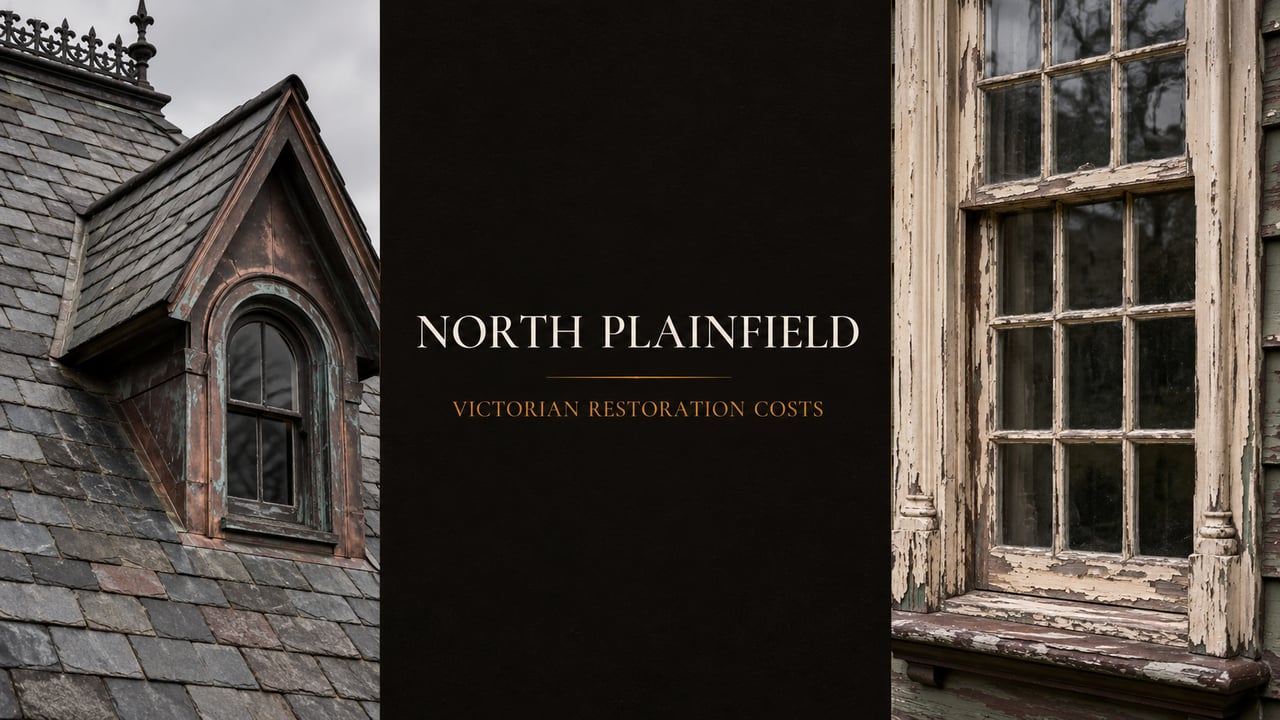
A slate roof can cost more than a fifth of the house. Thirty original windows can cost more than a kitchen. And the state tax credit that half the internet says will help you pay for it does not currently exist for homeowners. Here are the real numbers before you fall in love.
Restoration costs do not scale the way renovation costs do. A kitchen is a kitchen whether the house is from 1890 or 1990, but a slate roof, thirty original double-hung windows, and lime-mortar masonry are line items that simply do not appear on a colonial. Those three alone can approach six figures on a Washington Park house, and New Jersey labor rates — averaging $46.95 an hour for construction work in 2024, with northern and central counties at the higher end — mean national cost calculators understate what you'll actually be quoted, typically by 20 to 40 percent. There is also a widespread and expensive misconception circulating right now: New Jersey has no historic rehabilitation tax credit available to owner-occupant homeowners. The state program that exists serves business entities and income-producing property. The bill that would help homeowners was introduced in February 2026 and sits in committee. Several contractor marketing sites describe it as though it were already law. Budget as if it isn't, because it isn't.
Our guide to the Washington Park Historic District ends by telling buyers to price the five-year version of the house rather than the one they're standing in. This is that arithmetic. Every figure below is sourced and cited, and every one of them is a planning range rather than a quote — the only number that matters for a specific house is the one a contractor writes after standing in front of it. Treat this as the framework for asking better questions, not as a substitute for asking them.
A slate roof lasts 75 to 100 years or more, which is why so many of these houses still have their originals and why the number comes as a shock when one finally fails. New Jersey installed pricing for slate runs roughly $15 to $30 per square foot, putting a typical house in the $30,000 to $60,000 range. Replacing an existing slate roof costs more — $20 to $35 per square foot, or roughly $40,000 to $70,000 — because you're paying to remove and dispose of the old material first. Larger and more complex roofs run past that; one northern New Jersey contractor puts natural slate at $30,000 to $75,000-plus.
There is a structural question nobody should skip. Slate weighs 600 to 800 pounds per square against 250 to 350 for asphalt. Homes built before 1970 often need a structural assessment before slate is an option at all — and if a previous owner swapped slate for asphalt decades ago, going back may require framing work you haven't budgeted. Any contractor who quotes slate on an 1880s house without raising this point has skipped a step, and that tells you something about the rest of the bid.
Two things work in your favor. Slate is usually repairable rather than replaceable — individual slates can be swapped for a fraction of the cost of a full tear-off, and a competent slate contractor will tell you honestly which situation you're in. And Victorian roof geometry, with its turrets and dormers and multiple pitches, means square-footage estimates from floor area are meaningless here. Get the roof measured.
This is the line item that surprises people most, because the per-unit cost sounds reasonable until you count the openings. A Washington Park house can easily have twenty-five to forty of them.
There are two tiers of work. Mechanical restoration — freeing painted-shut sashes, repairing cords and pulleys, adjusting the meeting rails, making the window actually operate — runs roughly $400 to $600 per window on a 100-year-old double-hung. Full glass-out restoration, which strips and replaces the glazing putty, repairs the sash joinery, and typically adds a triple-track storm, runs about $1,000 to $1,400 per window, and specialist shops commonly start around $1,500 per opening with complex work reaching $3,500. Restoration on windows over fifty years old routinely costs double or triple what newer units do.
Do the multiplication before you decide. Thirty openings at mechanical restoration is $12,000 to $18,000. Thirty at full glass-out is $30,000 to $45,000. That second number is a kitchen. It is also, on the honest accounting, roughly what quality replacement windows would cost — one contractor puts it plainly that full glass-out restoration can cost as much as or more than replacement.
So why restore? Because a properly restored sash has an indefinite service life, while a replacement unit puts you on a twenty-to-thirty-year replacement cycle in perpetuity. Original wavy glass and period profiles are also unreproducible, and in a National Register district they are a meaningful part of what you're buying. The pragmatic middle path most owners land on: mechanical restoration on every window, good storm windows for the thermal performance, and full glass-out restoration phased over years on the windows that need it most.
Slate figures per published New Jersey contractor pricing, 2026. Window figures calculated from published per-window restoration pricing ($400–$600 mechanical; $1,000–$1,500 full glass-out) multiplied by a 30-opening house. These are planning ranges for budgeting, not quotes. Actual cost depends on roof geometry, window count and condition, access, and contractor. Get the roof measured and the windows counted before you rely on any figure here.
I'm deliberately not putting dollar ranges on the items in this section, and I want to explain why rather than just leaving a gap. Roofs and windows are quantifiable from the outside — you can count openings and measure a roof before you own the house. What's behind the plaster cannot be scoped without opening it, and published averages for this work are close to meaningless because the variance between a house that was carefully updated in 2005 and one that was patched piecemeal since 1948 is total. Anyone quoting you a number for these without inspecting is guessing.
Electrical. Knob-and-tube wiring remnants are common in houses of this vintage even where the panel is modern — a previous owner may have upgraded the service and the visible circuits while leaving original wiring in closed walls. This matters beyond safety: some insurers will not write a policy on active knob-and-tube, which turns an electrical question into a closing question. Have a licensed electrician assess it during due diligence and quote any remediation specifically.
Plaster and lath. Better acoustically and thermally than drywall, and considerably worse to open up. Every wire pull and pipe run means plaster repair, which is skilled work. This is the hidden multiplier on every other project in the house — the reason a bathroom in a Victorian costs more than the same bathroom in a colonial isn't the fixtures, it's what happens to the walls getting there.
Masonry. Foundations and chimneys from this era were laid in lime mortar, which is softer and more permeable than modern Portland cement. Repointing with the wrong mortar is actively destructive — the hard mortar survives and the soft historic brick spalls instead. This is the single most common well-intentioned mistake made on these houses, and it is expensive to undo. Ask any mason bidding the work what mortar they intend to use; if the answer isn't specific, keep looking.
Search for help paying for this work and you will find confident claims that New Jersey offers homeowners a 25% historic rehabilitation tax credit capped at $25,000. Several contractor marketing pages state it as current fact. It is not current law, and budgeting around it would be a costly mistake.
Here is the accurate picture. The Historic Property Reinvestment Act is real and in force — signed in January 2021 as part of the New Jersey Economic Recovery Act of 2020 and administered by the NJEDA. September 2024 legislation increased its credits substantially, to 50% of rehabilitation cost up to $8 million for most qualified properties and 60% up to $12 million in qualified incentive tracts. But it serves business entities and income-producing property. An owner-occupied house is not eligible.
The Homeowners' Historic Property Reinvestment Act is the bill that would change that. As S3545, it was introduced in the Senate on February 19, 2026 and referred to committee; a companion, A870, sits in the Assembly. It proposes a refundable credit of 25% of rehabilitation costs, capped at $25,000 per property over a ten-year period, for an owner who occupies the property as a principal residence. Similar versions have been introduced in prior sessions without passing. It may well become law — preservation advocates have pushed it for years — but as of this writing it is a bill in committee, and a bill in committee pays for nothing.
One nuance worth knowing, because it connects to a real strategy: the federal and state credit structures have historically been built around income-producing certified historic structures rather than owner-occupied homes. If you are considering a two-to-four unit historic property as an investment rather than a residence, the eligibility analysis is genuinely different and worth putting to a tax professional. That is not a workaround to be improvised — it is a different transaction with different financing, different insurance, and different math. But in a borough where apartment-class property makes up more than a tenth of the ratable base, it is not a hypothetical either.
Tax legislation moves. Check the current status of S3545 and A870 directly through the New Jersey Legislature before assuming either way, and confirm any credit eligibility with a New Jersey tax professional rather than a contractor's website — a contractor has an obvious incentive to tell you your project is subsidized. Preservation New Jersey and the State Historic Preservation Office are both reliable places to check what programs are actually operating.
Roof, then gutters and drainage, then masonry. Water is the only thing actively destroying the house. Everything cosmetic waits behind this.
Active knob-and-tube, an unlined chimney flue, an ungrounded panel. Not because they're urgent structurally, but because your policy may depend on them.
Get them all operating and add storms. Roughly $12,000–$18,000 across thirty openings, and it transforms daily life in the house for a fraction of glass-out cost.
Never open plaster twice. Whenever a wall comes open for any reason, run everything you might conceivably want through it while it's accessible.
Worst-condition windows first, a few each year. Spreading $30,000–$45,000 across a decade is the difference between manageable and overwhelming.
General guidance only, not engineering, legal, tax, or financial advice. Sequence and priorities depend entirely on the specific condition of a specific house. Retain qualified professionals before committing to any scope of work.
Get your roof and window numbers during the inspection contingency, not after closing. A slate contractor and a window restorer will both walk a house for a few hundred dollars or sometimes free, and what they tell you is negotiating leverage while you still have an out. Buyers routinely spend $600 on a general inspection and then discover a $50,000 roof three months after they own it — when the same two phone calls beforehand would have either repriced the deal or sent them to the next house. In a district where every listing photo is beautiful, the specialists are the only people who will tell you what you're actually looking at.
"None of these numbers are meant to scare anybody off. I'd own one of these houses. But I've watched buyers budget a Victorian like a colonial and then spend five years feeling ambushed by their own house, and that's a miserable way to live somewhere beautiful. Price the roof and the windows before you're under contract, sequence the work so water comes first, and give yourself a decade instead of a year. Do that and this is one of the best things you can buy in New Jersey."
— Anthony Licciardello, Broker, The Prodigy Team
Period houses need brokers who can price the work as well as the property. I'm Anthony Licciardello, Broker of The Prodigy Team, dual-licensed in New York and New Jersey, a member of the Staten Island Growth Management Task Force, and a former Director of Community Affairs in the Bloomberg Administration. We help buyers get specialist numbers during due diligence — while there's still leverage — and we market restored houses to the New York buyers who understand what they're looking at.
Our Above the Streets cinematic drone series extends that reach — aerial storytelling that markets entire neighborhoods rather than single listings.
Anthony Licciardello · Broker, The Prodigy Team · 718-873-7345
A restored slate roof and forty rebuilt sashes are worth real money — but only if the listing tells that story and the photography proves it. Most period houses get sold as square footage. We sell them as what they are, to buyers who know the difference.
How much does a slate roof cost in New Jersey?
New installation runs roughly $15 to $30 per square foot, or about $30,000 to $60,000 for an average-sized home. Replacing an existing slate roof costs more — approximately $20 to $35 per square foot, or $40,000 to $70,000 — because the old material must be removed and disposed of. Complex roofs run higher; one northern New Jersey contractor cites $30,000 to $75,000-plus for natural slate. Victorian roof geometry makes floor-area estimates unreliable, so have the roof measured.
Is it cheaper to restore or replace historic windows?
Full glass-out restoration costs roughly $1,000 to $1,500 per window and can run as much as or more than quality replacement. Mechanical restoration — making the window operate properly without stripping the glazing — is far cheaper at about $400 to $600 per window. The case for restoring isn't upfront price; it's that a properly restored sash has an indefinite service life while replacement units run a 20-to-30-year cycle. Most owners restore mechanically across the whole house, add storm windows for efficiency, and phase glass-out work over years.
Does New Jersey offer a historic home tax credit for homeowners?
Not currently for owner-occupants. The Historic Property Reinvestment Act, in force since 2021 and administered by the NJEDA, serves business entities and income-producing properties — not owner-occupied homes. The Homeowners' Historic Property Reinvestment Act, which would provide a 25% credit capped at $25,000 per property, was introduced as S3545 on February 19, 2026 and remains in committee. Several contractor websites describe it as though it were already available; it is not. Verify current status with the New Jersey Legislature and a tax professional before budgeting around any credit.
Is knob-and-tube wiring a problem when buying a Victorian?
It can be, and often in a way buyers don't anticipate: some insurers will not write a policy on a house with active knob-and-tube, which turns an electrical issue into a closing issue. Remnants are common in houses of this era even where the panel and visible circuits have been modernized, because earlier owners frequently left original wiring inside closed walls. Have a licensed electrician assess it during due diligence and quote any remediation specifically.
Why does mortar type matter on an old house?
Foundations and chimneys of this era were laid in lime mortar, which is softer and more permeable than modern Portland cement. Repointing with hard modern mortar is actively destructive — the mortar outlasts the brick, and the softer historic brick spalls instead. It's the most common well-intentioned mistake made on these houses and expensive to undo. Ask any mason bidding the work exactly what mortar they intend to use; a vague answer is a reason to keep looking.
The Washington Park Historic District — North Plainfield's Victorian Core
Moving to North Plainfield — The Complete Relocation Guide
North Plainfield Borough Homes for Sale
North Plainfield vs Plainfield — Two Towns, Two Counties, One Name
Slate roofing costs per published New Jersey contractor pricing, 2026: $15–$30 per square foot for new installation and $20–$35 per square foot for replacement of existing slate, with whole-project ranges of $30,000–$60,000 and $40,000–$70,000 respectively; one northern New Jersey source cites $30,000–$75,000+ for natural slate. Slate weight of 600–800 lbs per square versus 250–350 lbs for asphalt, and the resulting structural-assessment requirement for pre-1970 homes, per the same New Jersey contractor sourcing. New Jersey construction labor at an average $46.95 per hour in 2024 per U.S. Bureau of Labor Statistics data, up from $45.75 in 2023 and $43.74 in 2022; New Jersey roofing pricing reported at 20–40% above national averages. Window restoration costs per published specialist contractor pricing: mechanical restoration of a 100-year-old double-hung at approximately $400–$600 per window; full glass-out restoration at approximately $1,000–$1,400 per window, with specialist shops citing a starting point near $1,500 per opening and complex openings reaching $3,500; restoration of windows over fifty years old commonly costing two to three times that of newer units. Thirty-opening totals in this guide are calculations from those per-window figures, not quoted project prices. Historic Property Reinvestment Act enacted January 7, 2021 as part of the New Jersey Economic Recovery Act of 2020, administered by the New Jersey Economic Development Authority; credit amounts increased by legislation signed September 4, 2024 (L. 2024, A4619, c. 61) to 50% of rehabilitation cost or $8 million for qualified properties and 60% or $12 million within qualified incentive tracts or government-restricted municipalities. The Homeowners' Historic Property Reinvestment Act was introduced as S3545 in the New Jersey Senate on February 19, 2026 and referred to the Senate State Government, Wagering, Tourism and Historic Preservation Committee, with companion bill A870 in the Assembly; as of this writing it has not been enacted. Legislative status changes — verify current standing directly with the New Jersey Legislature. All cost figures are planning ranges compiled from published contractor pricing and are not quotes, estimates, or appraisals for any specific property. This is general information, not legal, tax, financial, engineering, or construction advice. Obtain written quotes from licensed contractors and confirm any tax credit eligibility with a qualified New Jersey tax professional before relying on any figure in this guide.
Prodigy Real Estate is an innovative real estate company offering high-end video production, home valuation services, purchasing, and home sales. Serving New York and New Jersey.