
Anthony Licciardello | April 30, 2026
Mountainside, NJ
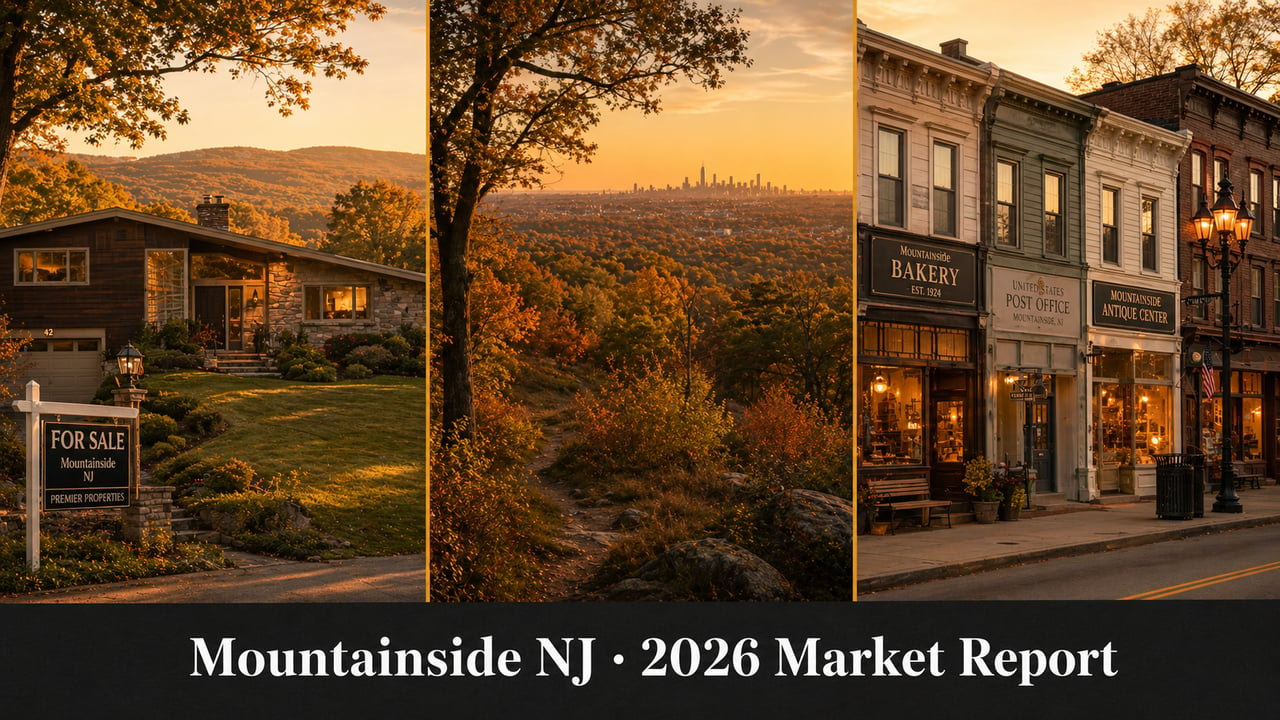

Every defining feature of Mountainside's 2026 housing market traces back to a single decision the borough made decades ago: stay small, stay residential, and refuse the density that reshaped most of its neighbors. The 50-year-old zoning ordinance bans condominiums, townhouses, and apartment buildings outright. The 4.04-square-mile borough has roughly 6,808 residents and approximately 10 active listings in any given month. Deerfield School earned a 2024 National Blue Ribbon Award — one of only 11 schools in New Jersey to receive the federal designation. The 2024 effective property tax rate of 1.600 is the second-lowest in Union County, behind only Summit's 1.554.
None of those facts is accidental. Mountainside split from Westfield in 1895, and the borough has spent the 130 years since making conscious choices that compound into the market we see today. The result is a town most NYC buyers have never heard of, sitting between Summit, Westfield, and the Watchung Reservation, clearing a $1.15M median list price on a 16-day market with single-digit active inventory.
This is the 2026 picture: a structurally scarce, deliberately preserved single-family enclave with school data that competes with Millburn and Chatham, a tax bill that runs lower than every Union County peer except Summit, and a buyer pool that finds the town through word-of-mouth more than through search. The post below walks the actual mechanics — why pricing holds, why inventory never recovers, what the commute math looks like without a train station, and what the next 12 months are likely to bring.
Active listings data placed Mountainside's median list price at $1,150,000 in March 2026, with the median price per square foot at $416. Year-over-year, list price per square foot was down approximately 1% versus March 2025, and 2% versus February 2026 — the kind of small monthly noise typical of a market that posts roughly 6 to 10 active listings at any given time. With volume that thin, individual transactions move the median substantially, which is why year-over-year comparisons matter more than month-over-month in Mountainside.
The full transactional range tells the deeper story. Recent home value data shows Mountainside transactions clearing anywhere from $350,300 at the entry tier to $1,361,000 at the top of the recent close window. New construction in 2026 is targeting the $1.5M to $2.5M tier, with renovations of 1960s split-levels and bi-levels routinely closing in the $1.3M to $1.6M band. The 16-day median time to contract signals that demand exists at every well-priced tier — what's missing is supply.
Annual transaction volume runs around 97 closed sales across the borough. For reference, that's fewer transactions in a year than Westfield posts in a strong month. The thinness is the asset. Buyers searching Mountainside specifically are competing against a small pool, and sellers listing here are reaching a buyer who has already self-selected past Summit, Westfield, and Berkeley Heights — by the time someone is shopping Mountainside actively, they know the math and the trade-offs.
Mountainside's borough zoning ordinance, enacted roughly five decades ago and largely unchanged since, prohibits multi-family residential construction across the entire municipality. No condominiums. No townhouses. No apartment buildings. Even commercial development on the 2.7-mile stretch of Route 22 that runs through the borough is restricted — most retail uses are banned along the highway, and what's permitted is concentrated in a three-block Mountain Avenue commercial strip and a small handful of Route 22 frontage parcels.
The downstream effect is structural. With multi-family development legally impossible, the borough cannot absorb the kind of density-based affordable housing obligations that have reshaped New Providence, Scotch Plains, and most of the rest of Union County over the last decade. The supply ceiling is fixed at the boundaries of the existing single-family inventory. New construction happens, but it's exclusively the teardown-and-rebuild model: a 1960s ranch on a half-acre comes down, a $2M new-build goes up.
The 4th Round Mount Laurel affordable housing obligation, which has driven planning board approvals across most of Union County in 2025–2026, runs into a different problem in Mountainside. The borough's housing element and fair share plan have to find a path that complies with state law without unwinding the residential character the zoning ordinance was written to protect. As of spring 2026, that compliance path remains under active borough planning review, and any structural change to the ordinance would represent the most significant zoning action Mountainside has taken in 50 years.
Mountainside School District serves pre-kindergarten through eighth grade across two buildings. Beechwood School covers PreK through second grade with approximately 269 students. Deerfield School covers third through eighth grade with approximately 483 students. The district employs 71.6 classroom teachers on a full-time-equivalent basis for a 10.4-to-1 student-teacher ratio, and the New Jersey Department of Education classifies Mountainside as District Factor Group "I" — the second-highest of eight socioeconomic groupings statewide.
In 2024, Deerfield School was named a National Blue Ribbon School of Excellence by the U.S. Department of Education — one of only 11 New Jersey schools to receive the recognition that year. The federal Blue Ribbon designation is reserved for schools demonstrating either exemplary achievement or substantial closing of achievement gaps, and the bar is high enough that fewer than half of one percent of U.S. public schools earn it in any given cycle. State assessment data backs the recognition: 81% of Deerfield students tested at or above proficiency in reading and 76% in math, against statewide rates of 49% and 42% respectively.
U.S. News ranked Deerfield #107 among New Jersey elementary schools and #12 among New Jersey middle schools in the most recent rankings. For ninth through twelfth grade, Mountainside students attend Governor Livingston High School in Berkeley Heights through a long-standing sending-receiving relationship — Governor Livingston enrolls roughly 936 students, offers 26 Advanced Placement courses, and provides a single high-school destination for both Mountainside and Berkeley Heights graduates.
For buyers running the comparable analysis, the Deerfield Blue Ribbon designation is the variable that moves Mountainside out of the "small affluent borough" category and into direct comparison with Millburn, Chatham, and the upper tier of Union County school districts. The premium it commands isn't always visible on the listing card. It's visible in the willingness of competing buyers to clear ask on a 16-day market.
Mountainside's 2024 effective tax rate of 1.600 sits second-lowest among Union County's major commuter towns, behind only Summit at 1.554. On a $1.15M home, that effective rate translates to roughly $18,400 in annual property tax — meaningfully lower than the equivalent bill in Westfield ($22,080), Berkeley Heights ($22,552), or Cranford ($24,449). For a buyer holding a 25-year horizon, the carrying-cost differential adds up to six figures versus most Union County peers.
The complication is the Mountainside Director's Ratio, which sat at 71.29% in the most recent New Jersey Division of Taxation filings — meaning current assessed values are at 71.29% of true market value. The state compliance threshold is 85%, and Mountainside is 13.71 percentage points below that line. When New Jersey towns drift below 85%, a state-ordered revaluation eventually follows. The borough's last townwide reassessment is far enough back that the gap to compliance has widened steadily as market values have risen faster than assessments.
For current homeowners, the future revaluation is a question of when, not if. For new buyers, the practical implication is that the tax bill listed on the MLS for any given property today is not necessarily the tax bill that will apply two or three years post-purchase. The total municipal tax levy doesn't change — but each property's share of that levy gets recalibrated to actual market value, and homes that have appreciated more than the borough average will see proportionally larger increases. The full premium-market tax appeal playbook covers the mechanics for buyers above the $18,000 annual threshold, where direct New Jersey Tax Court filing becomes available.
Mountainside has no train station within its borders. The nearest is Summit Station at 40 Union Place, approximately 2 miles north — the same Midtown Direct stop that anchors the Summit market, with one-seat service to New York Penn Station in 35 to 40 minutes during peak hours. Westfield Station, 4 miles south on the Raritan Valley Line, requires a transfer at Newark Penn during peak hours. For a Mountainside resident commuting daily to Midtown, the practical reality is a 5-to-8-minute drive to Summit Station, paid parking on a multi-year permit waitlist, and the Midtown Direct ride from there.
NJ Transit operates four bus routes through Mountainside. Routes 114 and 117 run to the Port Authority Bus Terminal in Midtown Manhattan, with peak-hour express service. Routes 65 and 66 connect to downtown Newark, where commuters can transfer to PATH or NJ Transit rail. The route that matters most operationally is the Bus Bypass Shoulder on Route 22 eastbound — a one-mile stretch within Mountainside's borders where, since New Jersey DOT regulation in 2012, peak-hour buses use the shoulder as an exclusive bus lane between 6 and 7:30 AM. The BBS materially shortens AM commute times on the Mountainside-to-Newark Liberty Airport corridor (11 miles east).
Newark Liberty International Airport is approximately 11 miles east via Route 22 or I-78. For a borough without rail of its own, Mountainside's combination of Summit Midtown Direct access, the bus rapid transit infrastructure on Route 22, and proximity to Newark Liberty produces a commute envelope that works for hybrid and three-day-a-week NYC commuters even if it's structurally weaker for daily five-day-a-week Midtown professionals than Summit or Maplewood.
The Watchung Reservation borders Mountainside on the western and northern flanks. At 2,065 acres total — spanning Mountainside, Summit, Berkeley Heights, Scotch Plains, and Springfield Township — it is the largest nature preserve in Union County. The portion within Mountainside's boundaries cuts directly into the borough's effective buildable footprint. Echo Lake Park, a 139-acre Union County park in Mountainside's southeast corner, removes another full neighborhood's worth of potential housing supply from the inventory equation. Combined with the borough's three school sites, the Mountainside Community Pool complex, and the Trailside Nature and Science Center on Coles Avenue, the share of the 4.04-square-mile borough that could ever be developed for housing is substantially smaller than the borough's nominal land area.
The eastern slopes of the Watchung Reservation produce the borough's signature housing premium: hill-section lots with line-of-sight views of the New York City skyline. Properties higher up the mountain consistently clear the upper end of the Mountainside market. The structural geography that constrains supply also creates the view-premium tier — the same hill that prevents new building in the reservation is what makes the parcels above it more valuable.
Borough recreation infrastructure compounds the value. The Mountainside Community Pool runs an annual membership of approximately $190 per household. Four municipal tennis courts run $20 annually. The Echo Lake Park Summer Music Festival runs Wednesday evenings June through August at the park's natural amphitheater. Trailside Nature and Science Center anchors the western edge of the reservation. None of these facilities show up in a Zillow listing — but they show up in why Mountainside residents stay, which keeps inventory permanently scarce.
Mountainside doesn't compete with Westfield or Summit on volume. It competes on terms most buyers don't realize they're buying: a school designation that ranks against districts twice the size, a tax rate that beats every neighbor except Summit, and structural inventory scarcity that protects pricing through every market cycle. NJ Monthly named Mountainside #16 on its "Best Places to Live" list in 2008 and moved it up to #8 in 2010. The borough doesn't make most regional rankings the way Westfield or Summit do — partly because of the size, partly because so few people think to look here.
Compared to Westfield (2 miles south), Mountainside offers a smaller downtown, lower taxes, no train station of its own, and a more restrictive housing stock. Compared to Summit (2 miles north), Mountainside offers a smaller market, slightly higher taxes, and no Midtown Direct station — but materially lower median pricing for buyers in the $900K to $1.3M band. Compared to Berkeley Heights (immediately west), Mountainside shares Governor Livingston High School but runs a smaller and more expensive market on a per-square-foot basis. The closest functional comparable is probably Scotch Plains' premium pockets — both share single-family-only character, both serve a buyer who values land and lot size — but Scotch Plains' market is roughly five times larger by transaction volume.
The lifestyle dividend that's hard to quantify is access. The Westfield downtown commercial core, with the depth of its restaurant scene and retail base, sits two miles south. Summit's Springfield Avenue corridor sits two miles north. Mountainside residents get the small-town quiet of a 6,800-person borough with two of the strongest commercial downtowns in Union County within a 5-to-7-minute drive in either direction. That access without the property-tax weight is the structural value proposition the borough has quietly held since 1895.
The 4th Round affordable housing path. Mountainside's compliance with the 2025–2035 affordable housing obligation has to navigate the existing zoning ordinance. Any structural change would be the most significant land-use action the borough has taken in 50 years and would meaningfully reset the supply equation.
The eventual townwide revaluation. At a 71.29% Director's Ratio, Mountainside is 13.71 points below the 85% state compliance threshold. A state-ordered or municipal-initiated revaluation will reshape individual property tax bills even if the total levy stays flat. The timing isn't public — the inevitability is.
The teardown-rebuild trajectory. With multi-family construction prohibited, the only meaningful supply-side activity is the redevelopment of older single-family stock. Builders are increasingly targeting the 1960s split-levels and ranches across the borough, with new construction trading $1.5M to $2.5M depending on lot. That activity is gradually pulling the median upward, transaction by transaction.
For Mountainside sellers in 2026, the controllable variables are pricing discipline against actual closed-sale comps, condition relative to new-construction competition, and clear positioning on the school and tax-rate advantages versus Westfield and Berkeley Heights. The structural buyer demand is there. With 6 to 10 active listings at any given time, well-prepared sellers are clearing in under three weeks.
For buyers, the math is straightforward and rarely understood: Mountainside's combination of Deerfield's Blue Ribbon designation, the second-lowest effective tax rate in Union County, the structural supply ceiling from the 50-year zoning ordinance, and the lifestyle access to Westfield and Summit downtowns produces a value proposition that doesn't show up in head-to-head MLS comparisons against bigger neighbors. The town that froze itself in place in 1895 is the same town that runs a 16-day market in 2026 — and the connection between those two facts is the entire story.
Sources: active listings data and median pricing, March 2026; closed-sale data, Q1 2026; New Jersey Division of Taxation 2024 General Tax Rates and Director's Ratios; U.S. News Education school rankings; National Center for Education Statistics; United States Department of Education Blue Ribbon Schools of Excellence 2024; New Jersey Department of Education District Factor Groups; Mountainside School District; Borough of Mountainside; Union County Parks & Recreation; NJ Transit Bus and Rail schedule data; New Jersey Department of Transportation Bus Bypass Shoulder regulations; United States Census Bureau; NJ Monthly "Best Places to Live" 2008 and 2010 rankings.
Active listings data placed Mountainside's median list price at $1,150,000 in March 2026, with the median price per square foot at $416. Annual transaction volume runs around 97 closed sales, and the borough typically posts 6 to 10 active listings at any given time. Pricing has held steady year-over-year despite small monthly volatility driven by the thin sample size.
Mountainside School District serves PreK through eighth grade across Beechwood School and Deerfield School. Deerfield was named a 2024 National Blue Ribbon School of Excellence — one of only 11 schools in New Jersey to receive the recognition that year. State assessment data shows 81% reading proficiency and 76% math proficiency, against statewide rates of 49% and 42%. Mountainside students attend Governor Livingston High School in Berkeley Heights for grades 9–12 through a long-standing sending-receiving relationship.
No. Mountainside has no NJ Transit rail station within its borders. The nearest is Summit Station at 40 Union Place, 2 miles north, with Midtown Direct service to New York Penn Station in 35 to 40 minutes one-seat. Westfield Station is 4 miles south on the Raritan Valley Line and requires a Newark transfer during peak hours. NJ Transit Bus routes 114 and 117 provide direct peak-hour service from Mountainside to the Port Authority Bus Terminal in Midtown Manhattan.
Mountainside's borough zoning ordinance, enacted approximately 50 years ago and largely unchanged since, prohibits multi-family residential construction across the entire municipality. No condominiums, townhouses, or apartment buildings are permitted. The result is a single-family-only housing stock — bi-levels, split-levels, capes, and colonials, most built before 1970, with newer construction limited to teardown-and-rebuild projects on existing residential lots. The 4th Round affordable housing obligation may eventually require structural changes to the ordinance, though as of spring 2026 no such change has been adopted.
Prodigy Real Estate is an innovative real estate company offering high-end video production, home valuation services, purchasing, and home sales. Serving New York and New Jersey.