
Anthony Licciardello | April 23, 2026
Montclair, NJ
By Anthony Licciardello, The Prodigy Team · April 22, 2026
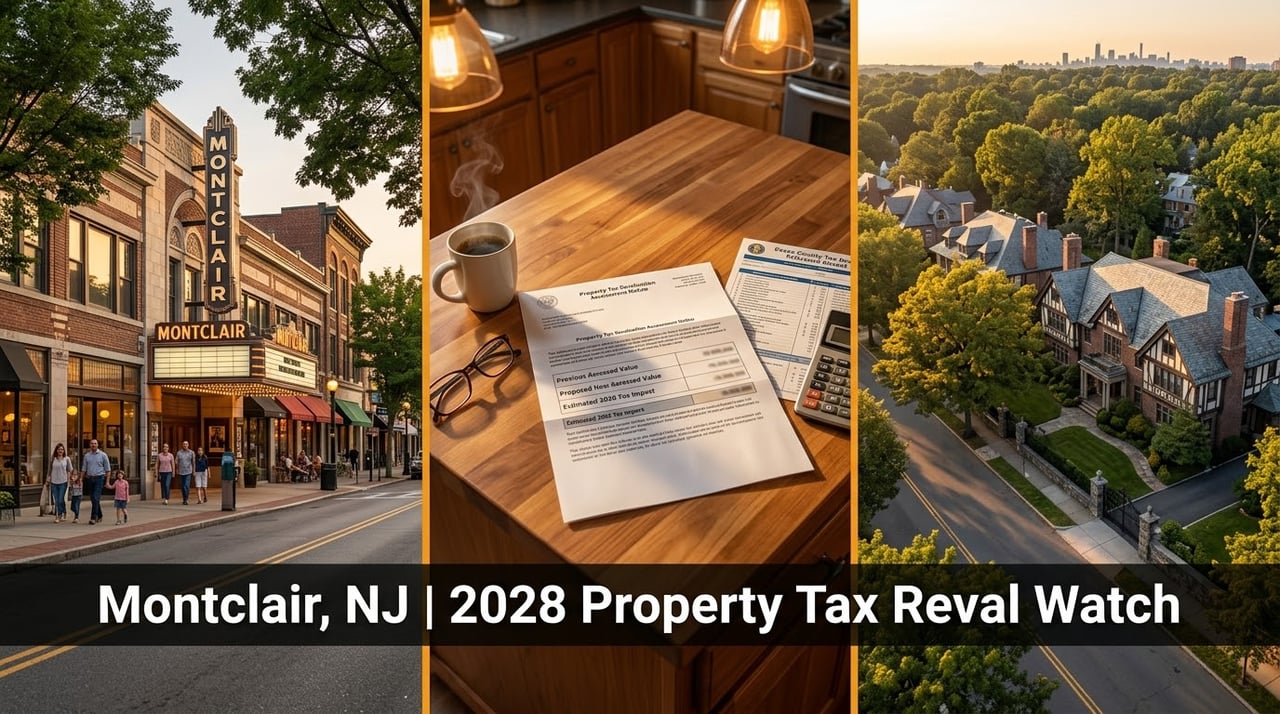
Montclair's first property tax revaluation since 2018 is ordered, funded, and moving. Assessment letters land in homeowners' mailboxes in late 2027. Tax impact hits in 2028. Here's what every Montclair homeowner, buyer, and seller needs to understand — and what to do before the letters arrive.
Montclair is the largest and most closely watched property tax revaluation on the Essex County pipeline. In November 2025, the Montclair Town Council authorized a $2 million emergency appropriation to fund the reassessment of roughly 11,000 parcels. Essex County's tax board ordered the township to complete the reval by the 2028 tax year. Letters will reach homeowners in the second half of 2027. The new assessments will reshape how Montclair's total tax burden is apportioned across every property in town — and for many homeowners, the math will shift meaningfully. This post walks through where the reval stands today, the 2018 baseline that set it up, the 1980s lawsuit that shapes how Montclair executes it, the school-funding context it's landing into, and the specific actions every Montclair homeowner should be taking now.
The Official Timeline
The Essex County Board of Taxation formally ordered Montclair to complete a town-wide property revaluation by the 2028 tax year, with the order confirmed in Essex County Tax Board meeting minutes in 2025. On November 12, 2025, the Montclair Town Council voted unanimously on second reading to authorize a $2 million emergency appropriation for the preparation and execution of the complete revaluation program, including the required tax map updates. That $2 million is the cost of doing the reval correctly — contracting a qualified revaluation firm, inspecting and photographing each of roughly 11,000 parcels, and producing the updated tax lists that will go into effect for the 2028 tax year.
The political leadership on the reval is Second Ward Councilor Eileen Birmingham, who chairs the Town Council's finance committee and has been the public face of the township's communication on the process. Township Manager Stephen D. Marks has emphasized publicly that the reval is not a revenue-generating exercise — Montclair's portion of the total tax bill is less than 25 cents on the dollar — but rather a reallocation mechanism. The goal is to bring every property's assessment into alignment with current market value so the existing tax burden is apportioned fairly across the township.
The practical timeline from here: contracting and methodology in 2026, property inspections and data collection through 2026 and 2027, informal review hearings with the revaluation firm in the second half of 2027, formal tax list certification in early 2028, and implementation on the 2028 tax year. That puts the first noticeable change in tax bills at the August 2028 quarterly payment for most Montclair homeowners, with the full-year impact felt across all four 2028 quarterly bills.
Why The Reval Is Coming Now
The structural reason Montclair's reval is happening in 2028 rather than 2033 or later is a single number: 61.52%. That's the township's current Director's Ratio — the NJ Division of Taxation's certified measure of how close Montclair's assessed values are to true market values. When that ratio drops substantially below the state's 85% compliance threshold, the county tax board has authority and responsibility to order a reval. Montclair sits near the bottom of Essex County's ratio distribution, which is why it's in the 2028 cohort along with Newark (47.77%) and Bloomfield (69.15%) — the three highest-gap towns in the county.
Mathematically, what 61.52% means is that for every $100 of actual market value in Montclair, only about $61.52 is currently being assessed. The other $38.48 per $100 is appreciation that has happened since the 2018 reval and hasn't yet been reflected in the tax rolls. Across 11,000 parcels, that's a substantial volume of underassessed property value — and it's unevenly distributed, which is the crux of what the reval is designed to correct.
Post-pandemic appreciation in Montclair has been anything but uniform. Certain neighborhoods — Upper Montclair, the First Ward adjacent to the Wellmont Theater corridor, premium blocks near Brookdale Park — have appreciated materially faster than the township average. Older inventory in less-premium sections of town has appreciated but more modestly. New construction and gut-renovated homes have added value that flowed entirely into the market rather than into assessments. The reval's job is to pull all of those divergent value trajectories back into alignment with current reality, which means some properties will see their share of the total Montclair tax burden rise, and others will see it fall.
The Precedent
The 2018 revaluation is the most useful reference point for what Montclair homeowners should expect from the 2028 process. In 2018, the average Montclair assessed value rose from $510,600 (2017) to $628,200 (2018) — an increase of about 23% across the township average. The tax rate was reduced in response, from $3.734 per $100 of assessed value in 2017 to $3.094 per $100 in 2018. Even with the rate reduction, the average Montclair homeowner saw a property tax increase of approximately $400 as a result of the 2018 reval.
What the 2018 numbers show is the essential math of every revaluation: the assessed value base expands substantially, the rate per $100 comes down to keep total levy consistent with the budget, and individual homeowners see increases or decreases depending on how their property's new assessment compares to the township average. Properties whose values rose faster than average see their share of the total tax bill increase. Properties whose values rose slower than average — or didn't keep pace — see their share decrease.
Montclair 2018 Revaluation — The Headline Numbers
| Metric | 2017 (Pre-Reval) | 2018 (Post-Reval) | Change |
|---|---|---|---|
| Average AV | $510,600 | $628,200 | +23% |
| Tax Rate per $100 | $3.734 | $3.094 | -17% |
| Avg Homeowner Impact | — | — | ~+$400/yr |
The key takeaway from 2018: Montclair homeowners should not assume the reval will be revenue-neutral for them personally, even though it is revenue-neutral for the township as a whole. About half the town's properties see their tax bill increase in a revaluation, and about half see it decrease — depending on how each property's new assessment compares to the township's new average. A home whose market value has kept pace with or exceeded the average appreciation rate will see its tax bill rise. A home whose value has lagged the average will see its bill fall or stay flat.
The Institutional Memory
Montclair has institutional memory of a landmark lawsuit in the 1980s that determined the township had not performed its revaluation fairly and was required to redo the entire process. Councilor Birmingham referenced this history explicitly at the November 2025 ordinance vote, stating the township would not allow a repeat of that outcome. Her words at the meeting — "we do not want anything like that" — signal why the 2028 timeline is deliberately longer than the minimum the county tax board required.
That longer timeline is a feature, not a bug. Montclair's 11,000 parcels span a wider architectural and value spectrum than most comparable New Jersey suburbs — historic Victorian and Tudor estates in Upper Montclair, mid-century Colonials in the Fourth Ward, condo inventory around the downtown train stations, commercial parcels on Bloomfield Avenue, and a meaningful volume of gut-renovated post-2020 inventory mixed in throughout. Properly assessing all of that requires time, data collection, public communication, and methodical property record card work. A rushed reval is precisely the kind of process that generates challenges under New Jersey law — the same kind of challenge that produced the 1980s outcome.
The township's deliberate pace is the homeowner's opportunity. The three years between the November 2025 ordinance and the 2028 implementation are precisely the window in which a homeowner can gather evidence, understand their property's market position, and prepare for the informal review in the second half of 2027.
The Math
Reporting from Montclair Local has estimated that if the current school funding environment continues, Montclair homeowners could see average annual property tax increases of approximately $1,400 per year on a home currently assessed at about $640,000 — the projected median post-reval. That's a back-of-envelope estimate and should be treated as a directional indicator, not a precise forecast, but it's the kind of figure every homeowner should be running their own numbers against.
Montclair's current property tax rate sits around 2.268%, and the current median home sale price is reported around $850,700 with existing annual tax bills often exceeding $19,000 for that median property. After the 2028 reval, those two numbers — tax rate and sale-price-to-assessed-value relationship — will both reset. The rate will come down (consistent with the 2018 pattern) and the assessed value will rise substantially to align with market value.
Which Montclair Property Types Will See the Biggest Shifts
The Fiscal Environment
The Montclair revaluation is not landing in a fiscal vacuum. In March 2026, Montclair voters narrowly passed a $1,100 one-time special tax — on a home assessed at $639,000 — to close a $12.6 million school budget deficit tied to unbudgeted prior-administration spending. The first ballot question passed by 80 votes out of more than 9,400 cast. A second ballot question, which would have imposed an additional ongoing tax increase, failed by 231 votes.
What those narrow margins signal is that Montclair voters are acutely sensitive to property tax increases right now, even when the increase is framed as crisis-response funding for schools. The reval is arriving in a township where the political environment around property taxes is already raw. For homeowners, the implication is that the reval's tax-share reallocation will be received in a context where voters may be more organized, more vocal, and more attentive to the informal review and formal appeal processes than in a typical reval year.
Market Watch
Montclair's school tax portion currently represents about 57% of the total property tax bill, and reporting has estimated it could rise toward 62% of the tax pie under current spending trajectories. Homeowners should understand that the reval's impact on their individual bill is only one variable — the school levy, municipal levy, and county levy all combine to set the final 2028 tax bill. The reval reallocates the pie; it doesn't determine the pie's size.
For Buyers and Sellers
For buyers and sellers transacting Montclair real estate during the reval preparation window — roughly now through late 2027 — the environment is distinct from either a compliant non-reval market or a just-completed reval market. The current assessment and tax bill remain valid for the 2026 and 2027 tax years, but both sides of every transaction need to understand that the rules change for 2028.
For a broader view of the Essex County reval landscape — including Verona, Glen Ridge, Cedar Grove, and the other municipalities with reval orders in place — see our complete Essex County reval status map. For a step-by-step walk-through of how NJ revaluation letters work, the informal review process, and what evidence wins a formal appeal, see our NJ reval letter guide.
The Preparation Playbook
Work With The Prodigy Team
Anthony Licciardello and The Prodigy Team work Montclair and Essex County buyers, sellers, and long-term owners. Whether you need a current comparative market analysis to benchmark your property before the reval firm's inspection, a strategic conversation about listing timing within the 2026-2027 window, or an honest read on how your specific property is likely to be affected — we're here.
Anthony Licciardello · NYS/NJ Licensed Real Estate Broker · ProdigyRE.com
FAQ
Q
When will Montclair homeowners receive their new assessment letters?
Proposed new assessment letters from the contracted revaluation firm are expected to arrive in homeowners' mailboxes in the second half of 2027, with informal review hearings available shortly thereafter. The final tax list will be certified in early 2028, with the new assessments taking effect for the 2028 tax year. The formal appeal deadline for reval-year assessments is May 1, 2028 — a one-month extension from the standard April 1 deadline.
Q
Will my Montclair property taxes go up or down after the 2028 reval?
It depends entirely on how your property's market value has moved relative to the Montclair township average since the 2018 revaluation. Properties that have appreciated faster than the average — particularly gut-renovated homes, expanded homes, and properties on premium blocks — will likely see their tax share rise. Properties that have appreciated slower than the average — older inventory without capital improvements — may see their tax share fall. Based on the 2018 precedent, about half of Montclair properties saw increases and about half saw decreases, with the average homeowner impact approximately +$400 per year. Reporting from Montclair Local estimated that continued school funding pressure could drive an average annual increase of about $1,400 per year over the years following 2028 implementation.
Q
What can I do now to prepare for the Montclair reval?
Six things: get a current comparative market analysis from a local broker, document all capital improvements and condition issues with photographs and invoices, monitor comparable sales on your specific block or section, attend the township's public communication meetings as they're scheduled, cooperate with the revaluation firm's property inspection when it occurs in 2026 or 2027, and be ready to engage the informal review process when letters arrive in late 2027. The three years between now and the 2028 implementation are the preparation window.
Q
Should I buy or sell in Montclair before the 2028 reval?
The transaction-timing answer depends on property type and personal situation. Sellers of homes likely to see a post-reval tax increase (gut-renovated, expanded, premium-block inventory) may benefit from listing in 2026 or 2027 before the new assessment becomes part of buyer affordability math. Sellers of older unrenovated homes likely to see decreases may benefit from waiting until after 2028 when the lower post-reval tax bill becomes a marketing asset. Buyers should underwrite 2028 tax exposure into any pre-reval offer — the seller's current tax bill is not the tax bill you'll pay starting in 2028. Long-term holders should focus on documentation and informal review preparation rather than transaction timing.
Sources: Essex County Board of Taxation meeting minutes (June 5, 2025 and November 2025), confirming revaluation orders and 2028 implementation cohort for Montclair; Montclair Township Council ordinance authorizing $2 million emergency appropriation (November 12, 2025 second reading vote); Montclair Local reporting on Town Manager Stephen D. Marks and Councilor Eileen Birmingham public statements regarding revaluation purpose and methodology; Montclair Local coverage of 2018 revaluation historical data ($510,600 to $628,200 average assessed value shift, tax rate change from $3.734 to $3.094 per $100); Montclair Patch coverage of November 2025 ordinance vote and 1980s lawsuit historical context; The Jersey Bee reporting on 2028 completion requirement; New Jersey Division of Taxation 2025 Chapter 123 Certification showing Montclair pre-reval Director's Ratio of 61.52%; Fox 5 New York and Montclair Patch reporting on March 2026 school funding ballot results; Essex County Tax Board notification regarding appeal deadlines for reval and non-reval districts; Montclair Municipal Assessor's Office (George F. Librizzi, CTA, IFAS, SCGREA). Buyer and seller framing and preparation playbook drawn from The Prodigy Team's experience working Essex County reval-active markets including Verona, Millburn/Short Hills, and the Montclair-adjacent Caldwell and Cedar Grove corridors.
About the Author
Anthony Licciardello is a dual-state New York and New Jersey licensed Real Estate Broker/Owner and leads The Prodigy Team. Over a 16+ year career, he has been responsible for more than 5,000 real estate transactions across New York and New Jersey, including the largest residential home sale in Staten Island history at $4.4 million on Nicolosi Drive, and a $2.4 million Far Hills, NJ mansion sale in 2022. A recognized innovator in digital real estate marketing, Anthony was named top Realtor.com blogger in 2009 and 2010, and has been featured in The New York Times, AM New York, and The Real Deal. He produces the Above the Streets cinematic aerial video series and operates one of the largest digital real estate marketplaces in the region — including a 25,000-member New York to New Jersey and Florida relocation community and over 250,000 monthly views across channels.
Licensed: NYS/NJ Real Estate Broker · Serving: New York & New Jersey · Contact: Full profile · prodigyre.com/contact
Prodigy Real Estate is an innovative real estate company offering high-end video production, home valuation services, purchasing, and home sales. Serving New York and New Jersey.