
Anthony Licciardello | April 17, 2026
Point Pleasant Borough
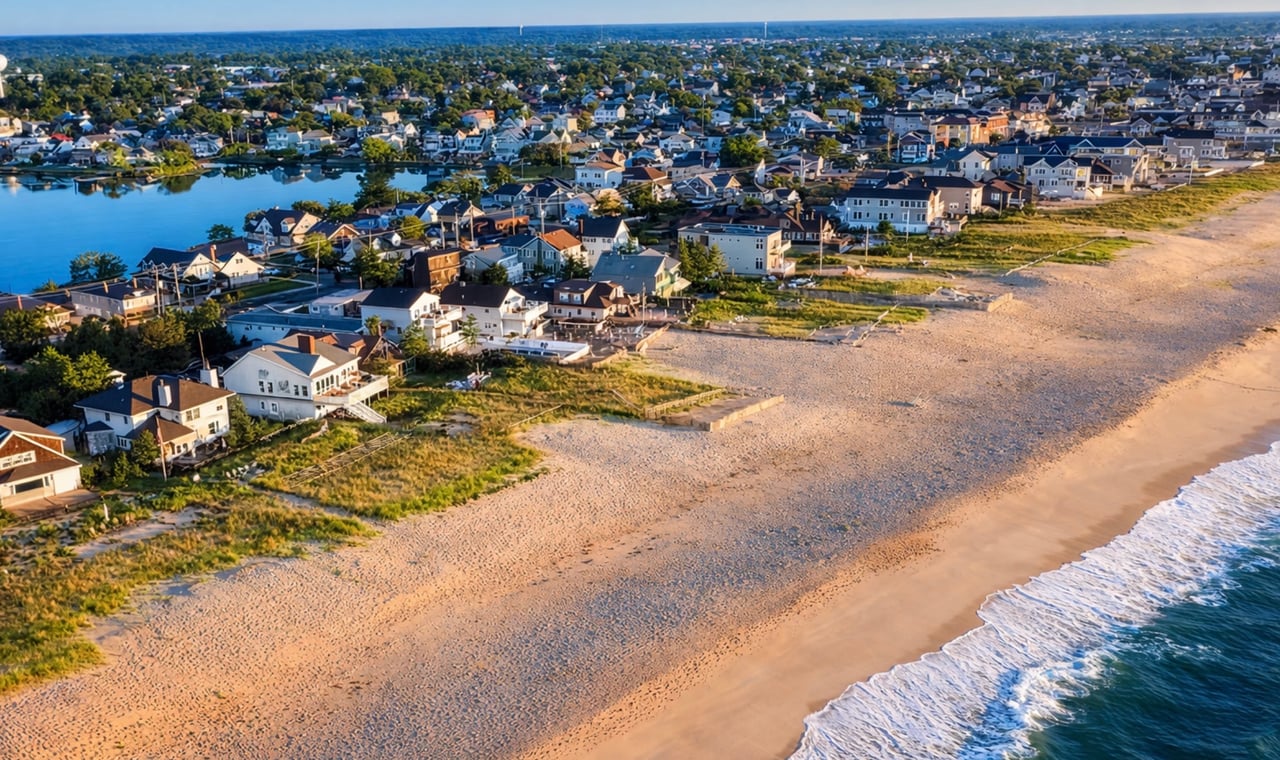
Point Pleasant Beach and Point Pleasant Borough share a border, a postal region, and — to the perpetual frustration of both communities — a name. Beyond that, the resemblance ends. These are two municipalities with different economic engines, different buyer profiles, different architectural identities, and different rhythms of daily life. A buyer who approaches them as interchangeable is making a category error that the market will quickly and expensively correct.
Point Pleasant Borough is the larger, inland, year-round suburban community built around lagoons, deep-water marinas, and a school district that competes at a national level in both academics and extracurriculars. It serves families making permanent relocations. Its market is driven by owner-occupants. For a full picture of that market in 2026, see our Point Pleasant Borough 2026 market report.
Point Pleasant Beach is something else entirely. It is a compact, dense, oceanfront barrier-peninsula community with a boardwalk at its center, a historic district covering roughly 30 square blocks, and a real estate market where nearly 60% of all purchases are made by small-scale investors. The seasonal rental economy here is not a side effect of beach proximity — it is the dominant economic logic that shapes pricing, inventory, and the character of the neighborhood fabric itself.
What this post addresses is the question that market data alone cannot answer: what does it actually look and feel like to live here full-time? That is the intelligence a genuine buyer needs — and that is what the sections below are built to deliver.
Who's Buying
The buyer composition in Point Pleasant Beach is unlike any other town on the Jersey Shore, and understanding it is essential context before a purchase decision. According to a 2025 Realtor.com Investor Report, small-scale investors account for approximately 59.2% of all property purchases in the area. For a detailed breakdown of the pricing data and inventory dynamics that flow from that investor concentration, see our Point Pleasant Beach 2026 structural market report.
The investor calculus here is straightforward: Jenkinson's Boardwalk, direct Atlantic Ocean access, and a nationally recognized summer destination produce short-term seasonal rental yields that justify purchase prices well above the national investor average. The average investor purchase price in the Point Pleasant Beach area runs approximately $849,000 — a figure that reflects deliberate, yield-driven capital deployment rather than speculative buying. These investors are running a seasonal hospitality business from a residential address, and the numbers support that business model consistently.
The second tier of the market is the second-home buyer — typically a household from Northern New Jersey, New York City, or Philadelphia seeking a dedicated Shore property they can use personally during peak season and rent during weeks they are not present. For this buyer, Point Pleasant Beach offers something more remote Shore markets cannot: urban-caliber dining, a functioning town center on Arnold Avenue, and boardwalk infrastructure that makes the property attractive to renters without requiring the owner to manage it as an elaborate production. The Beach does the work for the owner.
The smallest but most interesting buyer category is the full-time resident — the household that chooses Point Pleasant Beach not as an investment vehicle or vacation property but as a primary address. These buyers make a deliberate, eyes-open choice to live inside a seasonal economy and accept the summer density as the price of admission for an off-season lifestyle that the Beach's most devoted full-timers describe as irreplaceable. This post is primarily written for them.
Architecture & Historic District
Point Pleasant Beach possesses one of the most intact concentrations of late-19th-century resort architecture on the entire Jersey Shore. The town's designated historic district spans approximately 30 square blocks and is listed on both the New Jersey and National Registers of Historic Places, encompassing over 380 well-preserved buildings. That designation is not merely a civic honor — it is a material factor in how properties in those blocks are valued, financed, and renovated.
The dominant architectural idiom in the historic district is the Queen Anne style, brought to the Shore by Gilded Age resort developers following the arrival of the Central Jersey Railroad in 1880. These homes are characterized by asymmetrical facades, steeply pitched cross-gabled rooflines, decorative wood shingle detailing in the gable fields, wrap-around porches with turned spindle balustrades, and bay windows that maximize natural light and ocean breezes. Many feature original decorative millwork — vergeboard, porch brackets, and corner boards — that represents craftsmanship effectively irreproducible at current labor costs. When a well-maintained Queen Anne comes to market in the historic core, the premium over comparable non-historic properties is immediate and significant.
Alongside the Queen Annes, the Beach features a strong representation of Shingle Style architecture — a distinctly American coastal typology from the 1880s, characterized by continuous wood shingle cladding over exterior walls and rooflines, broad horizontal massing, deep covered porches, and a design philosophy emphasizing harmony with the natural landscape rather than architectural ornamentation. These homes read quieter than the Queen Annes but age exceptionally well and are prized by buyers who want historic authenticity without the high maintenance demands of elaborate Victorian millwork. Craftsman bungalows from the early 20th century round out the historic inventory — smaller footprints, lower price points, and an enduring appeal for first-time Beach buyers.
A significant inventory of post-World War II beach cottages occupies the blocks between the historic core and the oceanfront — smaller structures built for seasonal use rather than year-round habitation. Many have been expanded, elevated, or fully reconstructed following Superstorm Sandy's 2012 impact. Post-Sandy elevated rebuilds in the Beach carry meaningful practical advantages: lower flood insurance premiums, modern mechanical systems, and FEMA-compliant construction that substantially reduces long-term risk exposure.
⚠ Buyer Note — Historic District Renovations
Properties within the designated historic district carry renovation restrictions administered through the local Historic Preservation Commission. Exterior alterations visible from the public right-of-way — window replacements, siding changes, porch modifications, additions — require review and approval before work begins.
This is not merely a bureaucratic obstacle. The same rules that constrain what you can do to your property also constrain what your neighbors can do to theirs. The historic district is the reason the streetscape looks the way it does in 2026 — and that streetscape is why property values in the core have held and appreciated through multiple economic cycles.
▶ Point Pleasant Beach, NJ: Discover the Rich History and Real Estate — Prodigy Real Estate / Above the Streets
Neighborhood Guide
Point Pleasant Beach is a compact municipality — roughly 1.7 square miles of land area — but within that footprint, the difference between one block and the next can represent a material shift in price, character, and daily experience. Buyers who approach the town as a single homogeneous market miss the nuance that separates a $900,000 purchase from a $1.5 million one.
The Library District is the Beach's most coveted residential address — a pocket of tree-canopied streets concentrated around the historic district's core, named informally for its proximity to the local library and bounded by the town's densest concentration of intact Victorian and Shingle Style architecture. Buyers here are making a long-term commitment to historic stewardship. Prices in this pocket consistently run $1.4 million to $1.5 million and above for well-preserved larger Victorians, with premium examples breaching $2 million.
The blocks immediately adjacent to the Atlantic represent the highest-density investor and second-home concentration in the town. Properties here are optimized for rental yield: proximity to the beach, Jenkinson's, and the Arnold Avenue commercial corridor translates directly into premium short-term rental rates. Architectural character in this zone is mixed — original cottages and mid-century structures sit alongside post-Sandy elevated rebuilds — and the premium is entirely driven by location rather than building quality.
Arnold Avenue — the primary commercial spine, named for Captain John Arnold who financed its construction in the 1870s — functions as the civic and commercial center of the town. Residential blocks immediately flanking the corridor offer walkable access to boutique retail, the seasonal farmers market, and the arts festival circuit, at price points that sit slightly below the Library District premium. These properties attract buyers who want to be inside the town's social life lrather than removed from it.
The southern end of the Beach, where the Manasquan River meets the Atlantic through the Manasquan Inlet, carries its own distinct character. Properties along the inlet and river frontage offer water views and boating access without the oceanfront density of the beachfront blocks. The commercial fishing docks concentrated here supply the Beach's best seafood restaurants — and the working waterfront character of this zone is considered a feature, not a liability, by buyers drawn to it.
Schools
The Point Pleasant Beach School District presents one of the more genuinely interesting analytical puzzles in Ocean County education. On paper, a Niche statewide ranking of #44 with an overall A grade outperforming the Borough's #90 and A- would appear to be the straightforward choice for academic families. The reality is more layered — and buyers making a school-driven relocation decision deserve the honest version of that story.
The Beach district serves 646 students across just two schools, maintaining a student-teacher ratio of approximately 8.5:1. Parents, alumni, and reviewers consistently describe the experience as resembling a private school education within a public school structure: teachers who know every student by name, administrators who are accessible rather than bureaucratic, and a counseling environment where no student falls through the cracks.
Point Pleasant Beach High School — home of the Garnet Gulls — runs a deliberately future-oriented curriculum. The school houses a state-of-the-art Innovation and Engineering Collaboratory, a K-8 STEAM program focused on computer science and design, and the flagship "Gull Flight School" dual-enrollment program, which partners with Ocean County College to allow students to earn a full associate degree concurrent with their high school diploma. The district reports 75% of ninth-grade students complete an Advanced Placement course, and 80% participate in extracurricular activities.
Important — Test Score Context
New Jersey Department of Education standardized assessment data shows the Beach district at 55% reading proficiency and 23% mathematics proficiency — figures that sit well below the Borough's 76% and 43% respectively, and below statewide averages.
A district ranked #44 in New Jersey posting a 23% math proficiency rate is a genuine contradiction that buyers should not rationalize past. The most plausible interpretation is that the Niche ranking is driven heavily by program quality, staff ratio, and college preparation outcomes rather than baseline standardized test performance. Both data points are real — and the question of which more accurately predicts outcomes for a specific student requires a direct conversation with the district.
| Metric | Point Pleasant Beach | Point Pleasant Borough |
|---|---|---|
| Total Enrollment | 646 / 2 schools | 2,659 / 4 schools |
| Student-Teacher Ratio | 8.5:1 | 10.7:1 – 11:1 |
| Niche State Ranking | #44 (A) | #90 (A-) |
| Reading / Math Proficiency | 55% / 23% | 76% / 43% |
| Signature Program | Gull Flight dual-enrollment / STEAM Collaboratory | AP Scholar program / core curriculum |
| Signature Extracurriculars | Group I Wrestling — 3 consecutive sectional titles | National Champion Marching Band / Group II Wrestling |
Seasonal Life
No honest account of life in Point Pleasant Beach omits the summer. From late June through Labor Day, the town's population multiplies dramatically. Jenkinson's Boardwalk operates at full capacity. Arnold Avenue is congested. Parking is a daily negotiation. The seasonal rental economy is running at peak throughput, cycling through new occupants on weekly or biweekly schedules. The Beach in July is a functioning amusement destination, not a quiet coastal suburb — and buyers who are surprised by this have not done adequate research.
Full-time residents do not experience the summer as a disruption so much as a seasonal condition they have chosen to accept — and they accept it because of what comes after.
The transition that begins on Labor Day weekend is abrupt and, to those who experience it for the first time, almost startling in its completeness. The rental households depart. Traffic normalizes within days. The restaurants that were running 90-minute waits through August become immediately accessible. The beach — the same Atlantic Ocean, the same sand — is now effectively a private amenity for the people who live here. This period runs through October and delivers everything the peak season promised in terms of weather and coastal environment, with none of the density that accompanied it. For year-round residents, it is the reward for the summer they endured.
From November through April, Point Pleasant Beach operates as a genuinely quiet coastal town. Some seasonal businesses close entirely. The boardwalk scales back to a skeleton operation. The aquarium remains open year-round and becomes a de facto community amenity. The town's full-time residential identity becomes visible in a way it never is during summer. Buyers who visit the Beach only in peak season are evaluating the wrong product — the off-season version is the one they will inhabit for seven or eight months of the year.
Local Establishments
The boardwalk gets the headlines. The establishments that define daily life for Point Pleasant Beach residents operate on a different model — open year-round or close to it, serving the community that was there before the tourists arrived and will be there long after they leave.
Red's Lobster Pot is the most cited dining destination in the Beach among serious food travelers. Positioned directly on the commercial fishing docks at the Manasquan Inlet, it operates as a BYOB seafood house with outdoor patio seating and a menu anchored by whatever the boats brought in that morning. The coconut cream pie has achieved a level of local mythology that is either a cliché or a fact depending on whether you have eaten it. Either way, it is the kind of place that does not exist because of tourism — it exists because of the fishing docks, and the fishing docks predate the boardwalk by generations.
Jack Baker's Wharfside has occupied its position on the inlet since 1963, offering panoramic water views and a menu that covers the full range from casual to formal dining. It is one of the rare Shore establishments old enough to have served the parents and grandparents of current residents — which gives it a civic weight that newer restaurants cannot manufacture. Spike's Fish Market — operating since 1926 — functions as both a retail fish market and a casual dining counter, and its century of longevity is itself a statement about the permanence of the Beach's working waterfront identity.
Local Anchors — Est. Dates
Spike's Fish Market — Est. 1926 · Fresh catch retail and casual counter
Jack Baker's Wharfside — Est. 1963 · Panoramic inlet views, full dining
Red's Lobster Pot — Dockside BYOB, market-fresh menu, year-round
Frankie's Bar & Grill — Neighborhood tavern, consistent year-round community anchor
Shore Fresh Seafood Market — Local catch retail, casual dining counter
Frankie's Bar and Grill operates as a neighborhood tavern in the truest sense — a consistent gathering place that serves the local population on a Tuesday in January with the same reliability it brings to a Saturday in August. Shore Fresh Seafood Market fills a similar role in the culinary infrastructure, providing residents with direct access to fresh local catch without the formality of a sit-down restaurant. These are the establishments that make year-round life in the Beach logistically coherent rather than dependent on summer infrastructure.
Arnold Avenue's commercial corridor supports a rotating but increasingly stable mix of independent boutique retail, art galleries, and casual dining that operates well beyond peak season. The seasonal farmers market runs spring through fall and functions as both a food source and a community social event for full-time residents. The Beach has invested meaningfully in cultivating a cultural identity that extends beyond boardwalk and beach — and for buyers weighing full-time residency, that investment is directly relevant to their quality of life calculation.
* Investor purchase concentration data and average investor purchase price per the 2025 Realtor.com Investor Report. Median home value and household income figures per home value index data and census estimates. School enrollment, proficiency, and ranking data per the New Jersey Department of Education and Niche 2025–2026 district profiles. Historic district building count per Point Pleasant Beach Historic Preservation designation records.
FAQ
Q
What is it like to live in Point Pleasant Beach year-round?
Year-round life in Point Pleasant Beach follows a distinct seasonal arc. The summer months bring heavy tourist density and full boardwalk activity. After Labor Day, the town transitions rapidly into the Locals' Summer — mild weather, empty beaches, and accessible restaurants through October. The November-through-April off-season is quiet and coastal, with a tight-knit year-round community that becomes fully visible once the seasonal population departs. Full-time residents consistently describe the off-season as the primary reason they choose to live here permanently.
Q
What architectural styles are most common in Point Pleasant Beach?
Point Pleasant Beach's 30-square-block historic district — listed on the National Register of Historic Places — features over 380 buildings predominantly in Queen Anne, Shingle Style, and Victorian vernacular traditions dating from the resort development era of the 1880s and 1890s. Beyond the historic core, the town includes post-World War II beach cottages and a significant inventory of post-Sandy elevated rebuilds. Properties within the historic district carry renovation restrictions that function as both a constraint and a structural price protection for buyers in those blocks.
Q
How are the schools in Point Pleasant Beach compared to Point Pleasant Borough?
The Beach district ranks #44 in New Jersey with an overall A grade and maintains an 8.5:1 student-teacher ratio across 646 students — frequently described as a private school experience within a public school structure. The Borough district ranks #90 with an A- grade across 2,659 students. On standardized assessments, the Borough significantly outperforms the Beach — 76% vs. 55% in reading, 43% vs. 23% in math. The Beach offsets this with its Gull Flight dual-enrollment college degree program and STEAM Collaboratory. Families should evaluate both districts against their specific student's needs rather than relying solely on rankings.
Q
Is Point Pleasant Beach a good investment property location?
The market data strongly supports the investment case. Approximately 59.2% of all purchases in the Point Pleasant Beach area are made by small-scale investors, with an average investor purchase price of approximately $849,000 — well above the national investor average. The seasonal rental economy driven by Jenkinson's Boardwalk, direct beach access, and the Arnold Avenue commercial district produces yields that consistently justify the premium entry price. Buyers should model flood insurance requirements, short-term rental ordinances, and property management costs carefully before closing.
Prodigy Real Estate is an innovative real estate company offering high-end video production, home valuation services, purchasing, and home sales. Serving New York and New Jersey.