
Anthony Licciardello | April 15, 2026
Keyport, NJ
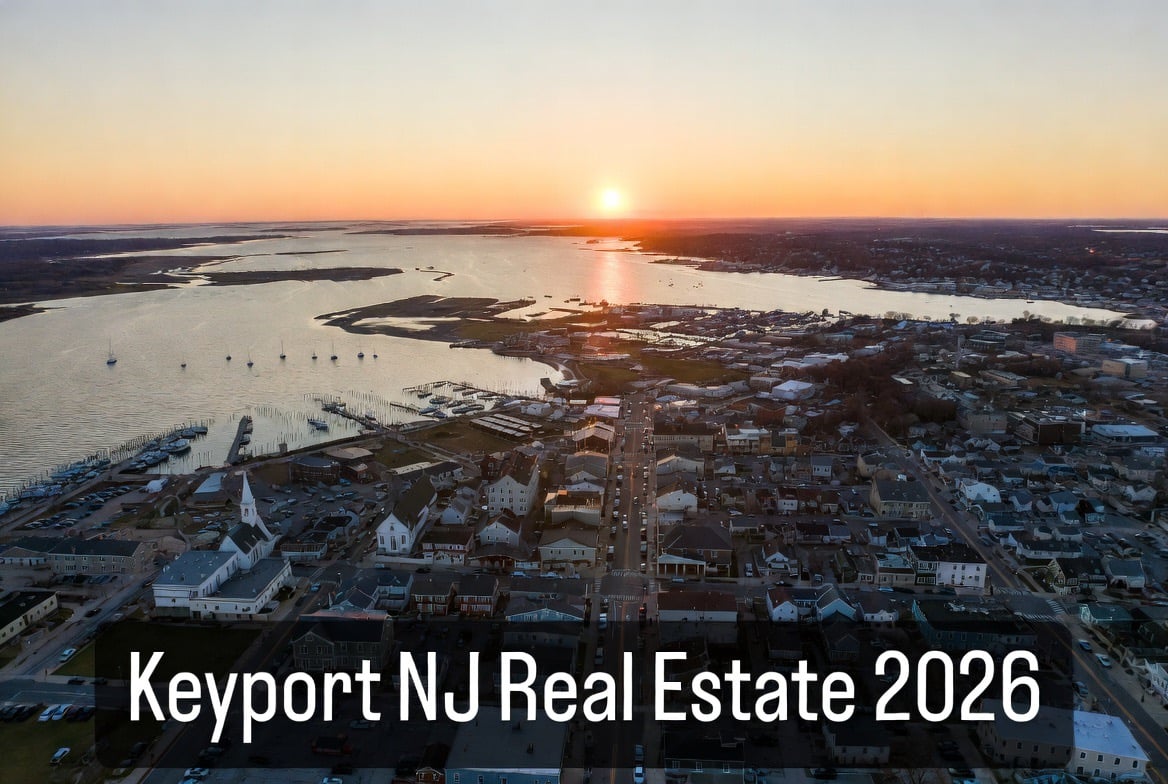
Keyport NJ real estate doesn't get talked about the way Red Bank or Asbury Park does. It does not have the institutional development activity of Matawan or the luxury land market of Holmdel. What it has is something harder to quantify but increasingly easy to see: a compact waterfront downtown, an affordable entry point that is still accessible to first-time buyers and investors alike, and a slow-building redevelopment momentum that is just starting to show up in pricing.
In 2026, Keyport is in the early stages of a transition — from historic bayfront town to emerging lifestyle and redevelopment market. That transition is not happening at the speed or scale of a major urban comeback story. But it is happening, and the buyers, investors, and developers paying closest attention are the ones who got there before the story was obvious.
01
Keyport's market data reflects its position as a still-affordable waterfront-adjacent town with strengthening fundamentals — and the numbers are moving faster than the borough's reputation would suggest. Closed-sale data* puts the most recent median in the $540,000 to $565,000 range, with average sales running between $500,000 and $575,000 depending on property type and location. Year-over-year appreciation has been running well into double digits — closed-sale trackers* reported roughly +21% in the most recently tracked period — though that figure reflects a small sample in a low-volume borough and should be read as directional rather than precise. The trend is clearly upward and moving faster than most buyers expect from a market at this price point.
Inventory is tight, with roughly 2.5 to 3 months of supply at any given time. Homes are moving quickly once listed — recent closed-sale data puts median days on market in the 18 to 25 day range, which is meaningfully faster than Keyport's historical pace and consistent with a market where qualified buyers are competing for limited product. The list-to-sale ratio is holding near 99%, which means sellers are generally getting what they ask and bidding competition is real, if not frenetic.
The most important data point, however, is not the median. It is the spread. Waterfront and bayfront homes — on Front Street, American Legion Drive, and the bayshore blocks — are trading between $700,000 and $1.3 million or more, depending on renovation quality and view orientation. Interior residential neighborhoods west of downtown are still finding buyers in the $375,000 to $600,000 range. That gap between the waterfront premium and the interior baseline is what makes Keyport interesting as a market: there is significant upside potential in the parts of the borough that haven't yet been repriced to reflect the waterfront's growing appeal.
02
Like most towns at this stage of a redevelopment cycle, Keyport does not trade as a single uniform market. Understanding which layer a given property sits in is more useful than tracking the boroughwide median.
Waterfront Core
$700K – $1.3M+
Raritan Bay exposure, Front Street, American Legion Drive. Premium views, walkable downtown. Still undervalued vs. comparable NJ bayfront markets.
Downtown Mixed-Use
$450K – $700K+
Front Street corridor and surrounding blocks. Value increasingly tied to commercial viability and redevelopment yield.
Interior Residential
$375K – $600K
West of downtown. Older stock, smaller lots. Best investor entry point. Appreciation follows waterfront premium over time.
The waterfront and bayshore core — Front Street, American Legion Drive, and the streets with direct or near-direct Raritan Bay exposure — is Keyport's highest-value submarket and its most compelling long-term story. Renovated homes are selling in the $700,000 to $1.1 million range; new construction and elevated properties with premium views are pushing $900,000 to $1.3 million and above. The value case here is not complicated: Raritan Bay views, walkability to a functioning downtown, and a lifestyle that compares favorably to far more expensive NJ waterfront towns. Relative to what equivalent bayfront access costs in Atlantic Highlands or the northern Shore, Keyport's waterfront is still meaningfully underpriced — and that discount has been shrinking every year.
The downtown and mixed-use core — the Front Street corridor and the surrounding blocks where residential, retail, and redevelopment potential overlap — is where value is increasingly tied to commercial viability and what a building can generate rather than just what it currently houses. Residential properties here are running $450,000 to $700,000, while mixed-use buildings trade across a wider range depending on income and entitlement potential. As downtown Keyport continues its slow activation — more restaurants, more foot traffic, more renovation of older commercial buildings — this layer is the one most directly exposed to the upside.
The interior residential market west of downtown is where first-time buyers are landing and where investors are making acquisition plays in the $350,000 to $500,000 range, betting that the lifestyle value of the downtown and waterfront will continue to bleed into pricing for the interior blocks over time. Entry-level homes are still accessible in the $375,000 to $500,000 range, with renovated product pushing toward $600,000. The housing stock is older, lots are smaller, and the commuter logic is less immediate than in a train-station town. But the gap between the waterfront premium and interior baseline pricing is what makes the risk-reward case for this layer real.
03
Keyport's development story is not about mega-projects or institutional capital. There are no mixed-use towers under construction, no developer-driven master plan reshaping entire blocks. What is happening is smaller, slower, and in some ways more durable: incremental redevelopment driven by individual property owners, small investors, and the borough's own public investment in waterfront infrastructure — and an architectural character that has been quietly taking shape for years.
The waterfront promenade improvements and public access upgrades Keyport has been investing in are not headline-grabbing, but they matter for the same reason that similar investments in other Monmouth County towns mattered before their profiles rose. Public realm quality — walkability, water access, visible investment — is the infrastructure that lifestyle buyers and restaurant operators respond to. Keyport has been building that infrastructure steadily, and the shift in buyer perception is visible in the pricing data.
Downtown, the pattern is mixed-use conversion: residential units added above retail, adaptive reuse of older commercial buildings, small-scale infill on underutilized parcels. The borough's zoning framework is generally supportive of residential above commercial, which makes these conversions more straightforward than in towns with more restrictive downtown codes. The result is a gradual density increase and more year-round activity — which in turn supports the retail and restaurant base that drives further lifestyle appeal.
Beyond the downtown, the dominant development form is the small-scale investment play: duplexes, small multifamily conversions, renovation-to-rental repositioning of older single-family stock. This is Phase 1 development activity in a market like Keyport — the stage where individual investors accumulate before larger-scale capital takes notice. For a broader look at how this type of incremental momentum is playing out regionally, our Monmouth County development pipeline report tracks how the same pattern is unfolding across the county.
04
Keyport's zoning structure is generally aligned with the kind of organic, small-scale redevelopment the borough is experiencing. Downtown zoning permits residential above commercial, which encourages mixed-use investment without requiring a formal redevelopment designation or a variance process. That flexibility has allowed the conversion and infill activity downtown to proceed without the political friction that often delays larger projects in other towns.
Like every municipality in New Jersey, Keyport is also working through its Round 4 affordable-housing obligations under the state's updated Fair Housing Act framework. The borough's approach leans on inclusionary development and small-scale housing additions rather than a single large compliance project — consistent with Keyport's development character overall.
The constraint side of the equation is equally important. Keyport's downtown and residential neighborhoods are low-scale, with a density ceiling that is modest by Monmouth County standards. High-density zoning does exist along the Route 36 Highway Commercial corridor, but that corridor is distinct from the downtown and waterfront areas that define Keyport's redevelopment story. In the areas that matter most for lifestyle and residential value, the low-rise character remains intact. That limits the pace of transformation — you are not going to see a hundred-unit transit-oriented development appear on Front Street the way you might in a designated redevelopment area. But it also preserves the small-town character that is, in many ways, a core part of Keyport's value proposition.
05
Keyport is easiest to understand by comparing it to the towns around it. Red Bank, roughly ten minutes to the south, is a fully activated downtown market where commercial rents are high, residential prices are premium, and the redevelopment story is largely written. Keyport is earlier on that curve — more accessible, more raw, but trending in the same direction. Atlantic Highlands, to the east along the bayshore, has already been repriced as a lifestyle destination; entry points there are higher and the affordability window has largely closed. Asbury Park, the most prominent comeback story in Monmouth County, is further along in its transformation and commands prices that reflect it.
| Town | Stage | Entry Point | Waterfront Access |
|---|---|---|---|
| Keyport | Early emerging | $375K–$565K median | Raritan Bay — still underpriced |
| Red Bank | Fully activated | Premium — story written | Navesink River — priced in |
| Atlantic Highlands | Repriced lifestyle dest. | Affordability window closed | Sandy Hook Bay — fully priced |
| Asbury Park | Mid-to-late transformation | Reflects transformation | Ocean — priced at premium |
Keyport's position in that hierarchy is straightforward: less built out than Red Bank, less expensive than Atlantic Highlands, earlier stage than Asbury Park. For buyers and investors with a three-to-seven-year perspective, the combination of waterfront access, functional downtown, and still-accessible pricing is the same setup that defined the early stages of every one of those markets before they repriced. For context on how mortgage conditions are shaping buyer decision-making across markets at this price point, our breakdown of the rate-and-sales feedback loop explains the financing dynamics that are keeping interest focused on more affordable entry points.
06
For buyers, the waterfront and bayshore core remains the strongest long-term value proposition in the borough — not because it is cheap, but because it is still undervalued relative to equivalent access in other Monmouth County coastal markets. The lifestyle case is there. The pricing discount relative to comparable NJ bayfront towns is real. The question is how long it persists as more buyers discover the market.
For investors, the interior neighborhoods west of downtown represent the clearest entry-point opportunity. The $350,000 to $500,000 acquisition range for older homes that can be renovated or repositioned offers a favorable risk profile in a market where the waterfront premium is already established and the gap to interior pricing has historically closed as lifestyle markets mature. Mixed-use buildings in the downtown core offer a different kind of upside — one tied to commercial activation and the long-term growth of foot traffic rather than just residential resale appreciation.
For developers, Keyport's mixed-use zoning and the supply of underutilized downtown parcels creates a relatively accessible environment for small-scale projects. The constraint is density — the low-rise character of the town means project yields are modest and the economics work best at small scale. But for developers comfortable with that format, the constraint also means less competition from institutional capital than in a denser redevelopment market.
Bottom Line
The boroughwide median closed-sale price is now approaching $565,000 — higher than most buyers expect from a market still described as an emerging story. The waterfront premium is real but not yet prohibitive. The downtown is activating without losing the small-town texture that makes it worth activating. And the investor community has noticed — quietly, incrementally, in the $350,000 to $500,000 range that typically signals early-stage accumulation before a market finishes repricing.
*Closed-sale data, median price, days on market, and year-over-year appreciation figures: closed-sale tracker and market page data, Keyport NJ, 2025–2026 tracking period. Figures reflect a low-volume borough sample and should be interpreted as directional. NJ market-aggregate sale-to-list ratio based on 2026 statewide closed-sale data.
FAQ
Q
What is the average home price in Keyport, NJ?
The most recent closed-sale median for Keyport is in the $540,000 to $565,000 range. That borough-wide figure includes everything from interior ranch homes in the $375,000 to $500,000 range to waterfront and bayfront properties trading between $700,000 and $1.3 million or more. The spread between those tiers is more useful than the median alone.
Q
Is Keyport, NJ a good place to buy a home?
Keyport offers one of the better combinations of waterfront lifestyle access and relative affordability in Monmouth County. Homes are moving in 18 to 25 days on average and appreciation has been running well above the county average. For buyers with a three-to-seven-year horizon, the combination of an improving downtown, a functioning bayfront, and pricing that still sits below comparable NJ coastal markets makes the setup compelling.
Q
Is Keyport, NJ waterfront real estate affordable compared to other Shore towns?
Yes, meaningfully so. Equivalent bayfront access in Atlantic Highlands or Sea Bright commands significantly higher prices. Keyport's waterfront tier — roughly $700,000 to $1.3 million for renovated or newer construction with Raritan Bay views — represents a discount relative to those markets that has been narrowing but has not yet closed. For buyers seeking NJ bayshore lifestyle at a lower entry point than the more established waterfront towns, Keyport is one of the most direct paths in.
Q
Does Keyport have a train station or easy NYC commute?
Keyport does not have its own NJ Transit station, but it sits close to the Aberdeen-Matawan station on the North Jersey Coast Line, which provides service to Penn Station in approximately 60 to 75 minutes. Bus access via Route 35 provides additional options. That commute profile makes Keyport more of a lifestyle-driven market than a pure transit commuter town — buyers are weighing waterfront access and affordability against commute time, not choosing it purely for rail convenience.
Prodigy Real Estate is an innovative real estate company offering high-end video production, home valuation services, purchasing, and home sales. Serving New York and New Jersey.