
Anthony Licciardello | May 25, 2026
Ststen Island
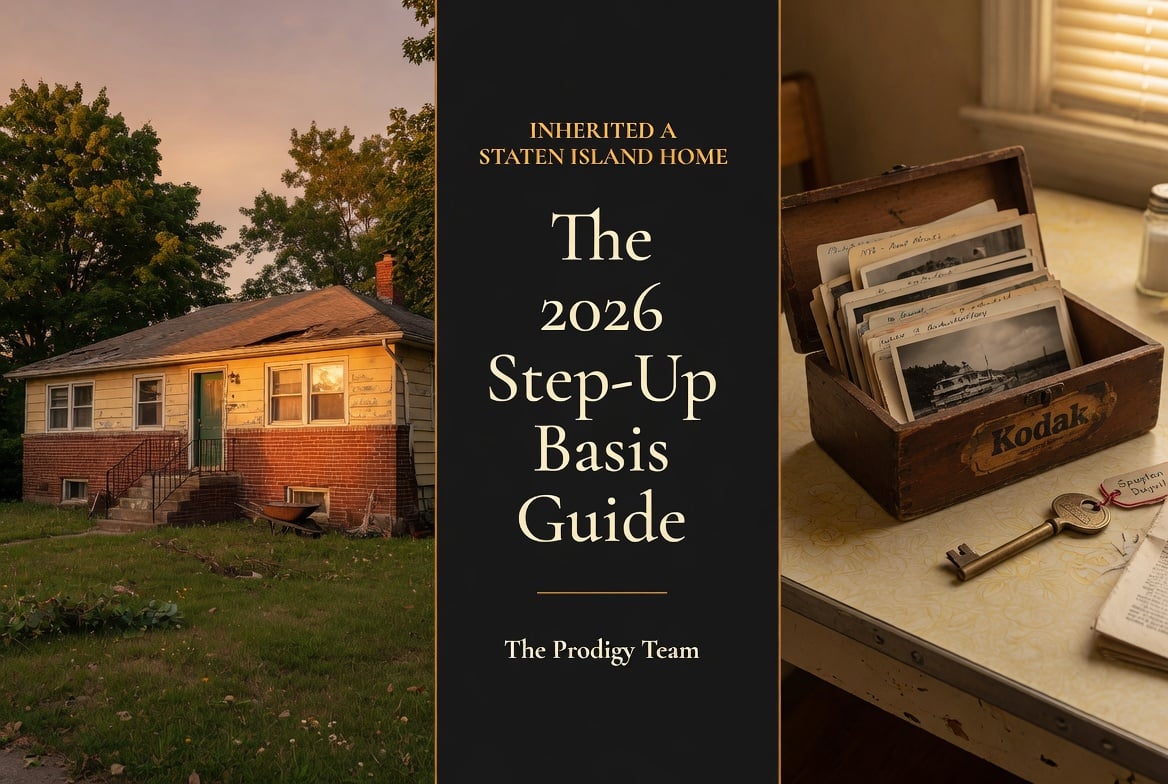
By Anthony Licciardello, The Prodigy Team · May 27, 2026
Staten Island has the highest concentration of multi-decade homeownership of any borough in New York City. Generations of Italian, Irish, Polish, and Eastern European families settled the borough's South Shore, Mid-Island, and North Shore neighborhoods from the 1950s onward, bought modest homes for $25,000 to $80,000, raised families, paid off mortgages, and held the properties for forty, fifty, sometimes sixty years. When those owners pass away, their heirs inherit homes whose original cost basis is meaningless and whose current market value sits anywhere from $600,000 to $4 million depending on neighborhood. The transaction that follows is mechanically and legally different from a typical primary-residence sale in ways that surprise most heirs.
Two structural differences shape every inherited sale. First, the federal step-up in basis rule under Internal Revenue Code §1014 resets the property's tax basis to its fair market value on the date the original owner died — potentially wiping out hundreds of thousands of dollars of capital gain that would otherwise be taxable. Second, the property typically must clear Richmond County Surrogate's Court probate before it can be sold, a process that takes 9 to 12 months in routine cases and longer when wills are contested or estates are complex. Heirs who understand both mechanics can structure the sale to legally pay zero capital gains tax; heirs who don't sometimes pay six-figure tax bills that were entirely avoidable.
The step-up in basis is the single most valuable tax provision in the U.S. code for heirs of appreciated real estate. The mechanic is simple but enormous in dollar consequence: when someone inherits property, the tax basis is reset to the fair market value on the date of death rather than carrying over the decedent's original cost basis. A Staten Island home bought in 1967 for $32,000 with $45,000 of improvements over the years — an original basis of $77,000 — gets a stepped-up basis equal to the property's appraised value on the day the owner died. If the home was worth $850,000 on that date, the new basis is $850,000. The heir who sells for $880,000 ninety days later reports a capital gain of $30,000 (essentially the appreciation during the brief ownership period plus selling costs), not the $773,000 gain that would have applied without the step-up.
The single most important administrative step in any Staten Island inherited home sale is obtaining a formal date-of-death appraisal. This is not the same as a sales-price appraisal during the listing process. It is a retrospective appraisal as of the day the owner died, performed by a licensed New York appraiser, documented in writing with comparable sales from that specific period, and retained in the estate's permanent records. Without this document, the IRS will challenge any claimed stepped-up basis — particularly on higher-value Staten Island properties where the dollar consequences are largest. The cost of the appraisal is typically $400 to $700; the cost of not having one when audited can run into six figures of avoidable capital gains tax plus penalties.
The holding-period rule is the second layer of the step-up's value. Capital gains tax distinguishes between short-term (held one year or less, taxed at ordinary income rates up to 37% federal) and long-term (held more than one year, taxed at preferential 0%, 15%, or 20% federal rates). Inherited property bypasses this distinction entirely — any gain on a sale by the heir is automatically deemed long-term, regardless of how briefly the heir actually held the property. An heir who sells inherited Staten Island property four months after taking title still gets long-term rates. This is a meaningful benefit that does not require any planning to capture; it applies by operation of law to every inherited real estate sale.
The Russo family example illustrates how dramatic the step-up's effect can be. Maria Russo passed away in February 2026 at age 87. She had owned her three-bedroom Cape Cod on Eltingville's Amboy Road since 1967, purchased with her late husband for $32,000. Over the decades the family put $45,000 of qualifying improvements into the home — new roof, finished basement, expanded kitchen, vinyl siding, central air. Maria's original adjusted basis at death: $77,000. The three Russo children inherited equally as tenants-in-common and decided to sell. Their CPA obtained a $700 date-of-death appraisal valuing the property at $850,000 in February 2026. The home sold in July 2026 for $880,000.
The Russo heirs not only owe zero capital gains tax across federal, state, and city — they actually realize a $38,000 capital loss because selling costs exceeded the modest post-appraisal appreciation. That paper loss can offset other capital gains the heirs may have during 2026 or carry forward into future tax years. Without the step-up, the same transaction would have produced a capital gain of roughly $735,000 ($812,000 minus $77,000 original basis), generating a combined federal/state/city tax bill in the range of $180,000 to $260,000 depending on each heir's income bracket. The step-up did not save the family some money — it eliminated essentially the entire potential tax bill. This pattern repeats on virtually every multi-decade inherited Staten Island sale.
No Staten Island home can transfer from an estate to a buyer until Richmond County Surrogate's Court has issued either Letters Testamentary (when the decedent left a will) or Letters of Administration (when they did not). These documents identify the personal representative legally authorized to sign closing documents on behalf of the estate. Without them, a contract of sale signed by heirs is not enforceable, title insurance cannot issue, and the closing cannot happen. This is the single most important timing constraint on any inherited Staten Island sale: the listing process can begin before Letters issue, but the closing cannot.
Routine Staten Island probate where the will is clear, heirs agree, and assets are simple typically takes 9 to 12 months from death to closing. Complications extend this. A contested will — one heir challenging the validity of the document or claiming undue influence — routinely adds 12 to 36 months and can consume meaningful estate assets in litigation. An estate with significant out-of-state real property requires ancillary probate in that state. An estate with missing or uncooperative heirs requires court-supervised searches. The most common Staten Island complication is multi-property estates — the family home plus a Florida condo plus a rental on the South Shore — each requiring its own administrative coordination.
A Staten Island-specific shortcut deserves mention: properties held jointly with right of survivorship or as tenants by the entirety pass automatically to the surviving owner outside of probate. A married couple who held title together does not need probate when one spouse dies — the home transfers by operation of law to the surviving spouse with the appropriate death certificate filing. Probate only kicks in when the second spouse dies or when the property was held individually. Surviving spouses on Staten Island who inherit through joint title can list the home immediately without waiting for Surrogate's Court.
Estate tax is separate from capital gains tax. Capital gains tax applies when an heir sells inherited property; estate tax applies when the original owner dies, calculated on the total value of their estate at the date of death. For most Staten Island families, federal estate tax is a non-issue because the 2026 federal exemption is $13.99 million per individual and $27.98 million for married couples using portability — far above the value of a typical estate. But New York's estate tax structure is more aggressive and produces a specific trap that catches Staten Island families with larger estates.
New York's "cliff" provision is the dangerous mechanic. Unlike the federal system where only the excess above $13.99M is taxed, New York's $7.16M exemption phases out completely if the estate exceeds 105% of the exemption (roughly $7.52M in 2026). Estates falling between $7.16M and $7.52M are taxed only on the excess; estates above $7.52M are taxed on the entire estate value from dollar one, with rates running from 3.06% to 16%. A Staten Island estate worth $7.5M owes roughly $20,000 in NY estate tax. An estate worth $7.6M — just $100,000 more — owes roughly $680,000. The marginal hundred thousand triggered a cliff penalty of more than half a million dollars.
For Staten Island families with substantial total estate value — multiple properties, retirement accounts, business interests, life insurance — the NY estate tax cliff is a planning issue that needs to be addressed during the decedent's lifetime through trusts, charitable giving, lifetime gifting, or other strategies. By the time the death has occurred, the cliff has either been triggered or avoided based on choices made years earlier. For heirs of estates clearly below the $7.16M threshold (the vast majority of Staten Island estates), the cliff is not a concern. For estates within $1M of the threshold either direction, this is a conversation to have with the estate's tax attorney immediately.
The single most underestimated risk in an inherited Staten Island home sale is not the market, not the taxes, and not the probate process. It is family disagreement. The typical Staten Island estate scenario involves two to four adult sibling heirs with different financial situations, different emotional attachments to the home, different timelines, different views on price, and different opinions about whether to sell at all. Twenty-two years of estate transactions tells me that two-thirds of multi-heir Staten Island inherited sales encounter meaningful family conflict at some point in the process, and roughly one in ten collapses or significantly delays because heirs cannot align.
| Conflict Type | Typical Trigger | Resolution Path |
|---|---|---|
| Keep vs sell | One sibling wants the family home; others want cash | Buyout via appraised value; refinance to fund |
| Price disagreement | Emotional value vs market reality | Two independent broker price opinions averaged |
| Timing | One sibling needs immediate cash; others want to wait | Estate loan or advance against future distribution |
| Property condition | Repair-or-list-as-is decision | ROI analysis on specific upgrades vs as-is comp |
| Personal effects | Jewelry, furniture, photographs, sentimental items | Inventory + rotation pick or formal mediation |
| Executor decisions | Sibling-executor accused of self-dealing | Court accounting; possibly removal of executor |
| Tenant siblings | One sibling lived in the home as caretaker | Rent credit against share or holdover negotiation |
The most common scenario on Staten Island is the keep-vs-sell conflict where one sibling has been living in the parents' home (often as caretaker during the decedent's final years) and wants to remain there, while two or three other siblings want their share of the equity. The cleanest resolution is a sibling buyout funded by a refinance: the staying sibling takes out a mortgage against the property at its appraised value, uses the loan proceeds to pay the other siblings their inheritance shares, and continues to own and occupy the home. This works when the staying sibling has the credit and income to qualify for the mortgage; it does not work when they don't, in which case the only alternative is sale and distribution of proceeds.
The legal mechanism of last resort when heirs cannot agree on disposition of inherited real property is a partition action — a lawsuit filed in New York Supreme Court asking the court to either physically divide the property (impractical for a single-family home) or order a court-supervised sale with proceeds distributed per ownership shares. Partition actions cost $15,000 to $40,000 in legal fees, take 12 to 24 months, and almost always damage family relationships permanently. The goal of every advisor on a multi-heir Staten Island estate should be reaching a voluntary agreement before partition becomes necessary. The fact that the option exists puts pressure on heirs to compromise.
The most expensive mistakes in inherited Staten Island sales happen in the first 90 days after the death — the period when grief is fresh, paperwork feels overwhelming, and heirs default to "we'll deal with it later." Several actions are cheap or free if done in the first 90 days, and expensive or impossible if deferred.
Hire a licensed appraiser within the first 60 days. Cost is $400–$700. This document protects the entire step-up basis claim and is irreplaceable months or years later.
A NY estate attorney files the Surrogate's Court petition, manages creditor notices, and coordinates Letters issuance. Routine SI probate runs $4,000–$8,000 in legal fees.
Notify the carrier of the death. Vacant home riders may apply. Change locks, forward mail, maintain utilities, winterize if needed. Vacant properties attract theft and damage.
Hold a family meeting. Document keep-vs-sell decision, target listing timeline, agent selection process, and personal-effects allocation. Written family agreement prevents 80% of later disputes.
Use the probate waiting period productively. Vet brokers, plan the listing strategy, photograph and stage the home so the property is ready to launch the day Letters issue.
Inherited Staten Island sales in 2026 are a meaningful segment of the borough's overall transaction volume — estimates from local attorneys put estate-related sales at 12 to 18 percent of annual closings, and the share is rising as the generation that bought into Staten Island during the 1960s and 70s reaches life expectancy. The financial mechanics on these transactions are favorable to heirs in ways most do not appreciate until they sit down with a competent CPA. The step-up in basis routinely erases $300,000 to $700,000 of taxable gain. The automatic long-term capital gain treatment removes the holding-period concern. And the federal estate tax exemption is so high that virtually no Staten Island family encounters federal estate tax in practice.
What gets sellers in trouble is not the tax law — it is the operational and family-management side. The probate process takes time, executors get inexperienced advice, heirs disagree about price or timing, the property sits vacant for too long and develops issues, and the listing process gets started without the proper documentation in place. The brokers who handle estate sales well on Staten Island are the ones who coordinate with the estate attorney, manage family expectations carefully, and time the listing launch to coincide with Letters issuance so the closing can happen without delay. The brokers who treat estate sales like any other transaction tend to produce the conflicts, delays, and reduced net proceeds that frustrate heirs.
For families currently navigating an inherited Staten Island home sale, the highest-leverage move is assembling the right team early: an experienced NY estate attorney, a CPA familiar with step-up basis mechanics, a licensed appraiser for the date-of-death valuation, and a broker who has handled estate sales before and understands the rhythm. The cost of building this team is roughly $5,000 to $10,000 in professional fees against transactions that typically clear $700,000 to $1.5M+ on Staten Island. The ROI on getting the inheritance right is among the highest in any residential real estate decision an heir will ever make.
Usually no — or very little. The federal step-up in basis under IRC §1014 resets the property's tax basis to its fair market value on the date the original owner died. If you sell the home for approximately that same value, your taxable capital gain is approximately zero. The capital gains tax applies only to the appreciation between the date of death and the date you sold — not to the gain that accumulated during the decedent's lifetime. For most Staten Island heirs who sell within 6 to 18 months of the date of death, the capital gains tax bill is minimal or zero, regardless of how much the home appreciated during the prior decades.
Routine Staten Island probate where the will is clear, heirs agree, and the estate is straightforward typically takes 9 to 12 months from death to closing. Letters Testamentary (with a will) or Letters of Administration (without) usually issue within 3 to 6 months of filing the petition with Richmond County Surrogate's Court. Contested wills, missing heirs, complex assets, or out-of-state ancillary probate extend the timeline significantly. The listing process can begin before Letters issue, but the closing cannot happen until they do.
The most common resolution is a sibling buyout: the heir who wants to keep the home refinances against the property at appraised value and uses the loan proceeds to pay the other siblings their inheritance shares. When buyout is not feasible and siblings cannot agree on disposition, the legal mechanism of last resort is a partition action in New York Supreme Court, which asks the court to order a court-supervised sale with proceeds distributed per ownership shares. Partition actions cost $15,000 to $40,000 in legal fees, take 12 to 24 months, and typically damage family relationships permanently. The fact that the option exists usually pressures heirs to reach a voluntary agreement first.
Yes, always. The date-of-death appraisal documents the stepped-up basis claim and is the primary evidence supporting the property's fair market value on the day the original owner died. Without it, the IRS can challenge the claimed basis during audit, particularly on higher-value Staten Island properties where the dollar consequences are substantial. The appraisal must be performed by a licensed New York appraiser as a retrospective valuation specifically dated to the date of death — a current sales-price appraisal does not satisfy the requirement. Cost is typically $400 to $700 for a Staten Island residential property. Order the appraisal within the first 60 days after the death while the appraiser can still access comparable sales records from that specific period.

Over a 22-year career, Anthony has been responsible for more than 5,000 real estate transactions across New York and New Jersey, including the largest residential home sale in Staten Island history at $4.4 million on Nicolosi Drive, and a $2.4 million Far Hills, NJ mansion sale in 2022. A recognized innovator in digital real estate marketing, Anthony was named top Realtor.com blogger in 2009 and 2010, and has been featured in The New York Times, AM New York, and The Real Deal. He produces the Above the Streets cinematic aerial video series and operates one of the largest digital real estate marketplaces in the region — including a 25,000-member New York to New Jersey and Florida relocation community and over 250,000 monthly views across channels.
Licensed: NYS/NJ Real Estate Broker · Phone: (718) 873-7345 · Profile: prodigyre.com/agents/anthony-licciardello
Prodigy Real Estate is an innovative real estate company offering high-end video production, home valuation services, purchasing, and home sales. Serving New York and New Jersey.