
Anthony Licciardello | May 23, 2026
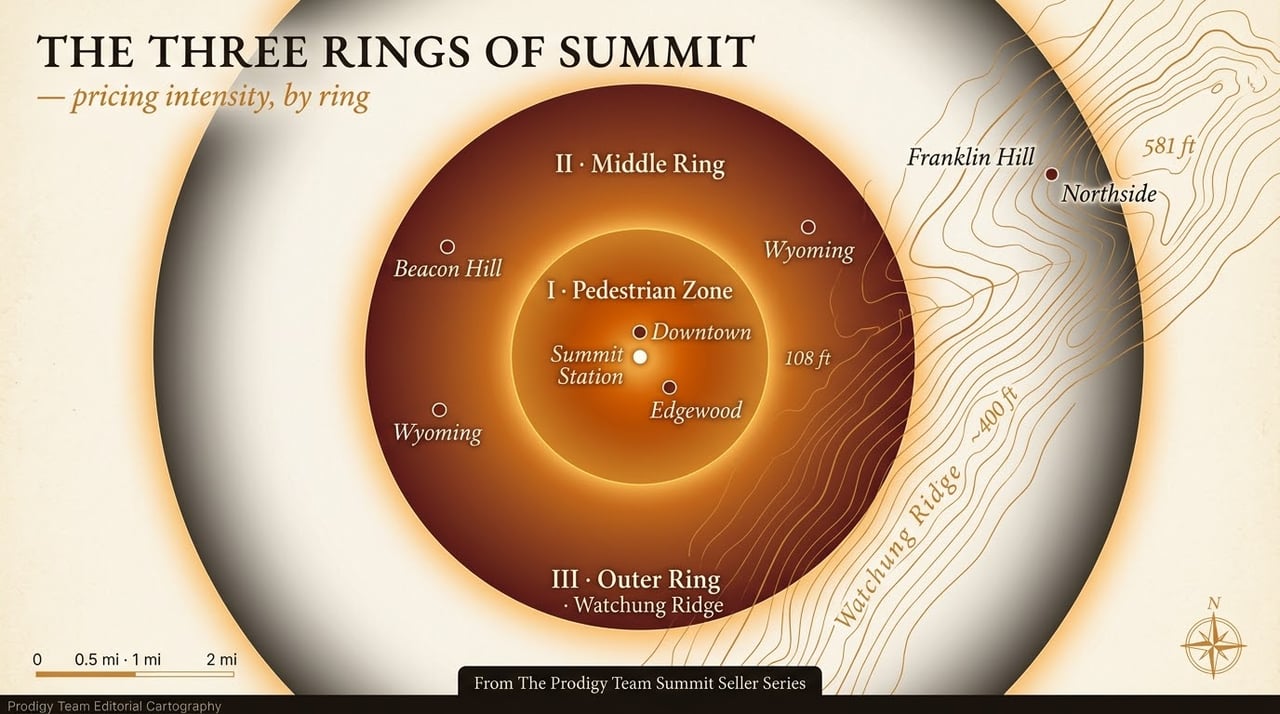
,The Summit Seller’s Decision Tree.
Five posts of framework. One operational guide. The seven decisions a Summit homeowner makes — in order — before pricing, photographing, or speaking to a single buyer.

This post is not a summary of the preceding five. It is a working document. The Summit homeowner who reads it with a notebook, answers each of the seven decision-tree questions honestly about her own property, and arrives at the end with concrete answers in hand is ninety percent of the way to a defensible list price. The remaining ten percent is the conversation with an agent who has actually seen the comp pool. The framework below replaces guessing, anchoring to the Zestimate, and trusting that location alone will carry the listing. None of those approaches has ever served a Summit seller well. This one does.
The previous five posts in this series have been arguments. This one is a tool. Across the preceding installments, the Summit seller framework has been built piece by piece: the three-ring pricing geography in Part I, the Watchung viewshed economics in Part II, the Middle Ring revaluation in Part III, the Pedestrian Zone buyer profile in Part IV, the AVM mispricing analysis in Part V. Each post stood on its own as an analytical argument. Read together, they describe a market that the standard automated tools cannot price and that the standard listing playbook does not address.
Reading the arguments is not the same as applying them. This final installment converts the framework into a working decision tree — seven sequential questions a Summit homeowner answers about her own property, in order, before any of the formal pricing, comp selection, photography scheduling, or listing remark drafting begins. The questions are answerable. Each one has a clear set of outputs. Each one feeds the next. By the time the seller reaches Question Seven, she has identified her ring, scored her parcel on the relevant amenities, audited her condition, reconciled the AVM consensus, drafted a listing thesis, and arrived at a defensible price range.
The right way to use this post is with a notebook open. Read the question. Write the answer. Move to the next. The framework is designed to be walked through in a single sitting of roughly thirty minutes. At the end, the seller has the inputs she needs for an informed conversation with a listing broker — not a Zestimate to be talked into accepting or arguing against, but a structured set of analytical inputs that can be tested, refined, and operationalized. The conversation that follows is a different conversation than the one most sellers in Summit have. The list price that follows is a different list price.
This is the foundational question, and it is more frequently answered incorrectly than any other in the framework. Take a current map, plot the walking route — not driving, not straight-line — from your front door to the Summit Station platform, and time it under normal conditions. The minutes matter more than the miles. Under ten minutes by sidewalk places you in the Pedestrian Zone. Between ten minutes and roughly thirty places you in the Middle Ring. Beyond that places you in the Outer Ring.
The walking route is not the same as the route Google Maps suggests. Walk it yourself. Note where the sidewalks end, where the arterials cross, where the slope becomes meaningful, where there are or are not safe crossings at busy intersections. The buyer evaluating your home is going to walk this route herself, mentally if not physically, before she ever makes an offer. The seller who has walked it first knows what she will see.
Edge cases matter here. A property at 0.55 miles by clean sidewalk to a station entrance, with a downtown corridor along the route, functions much more as a Pedestrian Zone property than its raw mileage suggests. A property at 0.42 miles that requires crossing the railroad tracks via the only safe pedestrian crossing two blocks away functions more like a Middle Ring property in terms of buyer behavior, regardless of what the distance field shows. Honest scoring beats spreadsheet scoring at this stage.
Write down your answer: Pedestrian Zone / Middle Ring / Outer Ring. Note the actual measured walking time. Note any edge-case factors that complicate the designation. This is the input that drives every subsequent decision in the framework.
Identify your ring before you do anything else. Get this wrong and every subsequent decision compounds the error. Get it right and the rest of the framework does the work for you.
Each ring carries a dominant asset that drives the most pricing weight. The seller’s job in Decision Two is to score the parcel honestly on the headline asset relevant to her ring, before any other variable enters the analysis. Different rings, different headline assets, different scoring exercises.
For the Pedestrian Zone, the headline asset is network walk-time and amenity overlap. Score the walk: under seven minutes (premium), seven to ten minutes (full price), past ten minutes (functionally Middle Ring). Note the route’s amenity density: does it pass restaurants, cafes, the library, the community center, the Summit Public Library? Properties whose walking route overlaps with the downtown commercial spine carry compounding value the AVM cannot read.
For the Middle Ring, the headline asset is the post-2016 rideshare-enabled commute story. Score the property’s relationship to the program: does the 40 Railroad Avenue Lyft pickup work for this specific household? Is the home in the 1.0-to-1.8-mile sub-band where the revaluation effect is strongest? Are there comp parcels in the same band that have transacted post-2022 to anchor the price?
For the Outer Ring, the headline asset is viewshed, scored on four geometric variables. Azimuth (western Reservation-facing is permanent and most valuable; eastern is fragile). Elevation angle. Unobstructed distance. Target quality and permanence. The four-tier scorecard from Part II of the series applies here in full — Permanent, Treetop, Seasonal, or Altitude-Only. Honest scoring is essential, because the wrong tier designation flows into every downstream decision.
Write down your headline asset score in the language of your ring. This becomes the lead of the eventual listing narrative.
Decision Three is where sellers most often deceive themselves. The same home a homeowner has lived in for fifteen years carries an emotional weight that distorts the condition assessment. A kitchen renovated in 2009 reads as recent to its owner because she remembers selecting the cabinets. To a 2026 buyer it reads as seventeen-year-old finishes. The seller who scores her own kitchen as "updated" because of how she feels about it leaves real money on the table when the buyer scores it as "dated."
The discipline here is to look at the home through the buyer’s eyes — specifically, through the eyes of the buyer profile relevant to the ring. In the Pedestrian Zone, the dominant buyer is intolerant of deferred maintenance and outdated finishes; she has explicitly chosen to exit the renovation phase of life. In the Middle Ring, the move-up family buyer absorbs some condition gap more readily but still discounts visibly outdated kitchens and bathrooms. In the Outer Ring, the ridge-section buyer is often paying premium prices and expects condition that matches.
Walk through the home as a stranger would. Photograph every room with your phone in normal light, no styling, no staging. Look at the photos a day later. The honest condition assessment is what those photos show, not what you remember about the home. Then triage. The big-impact updates — kitchen, primary bath, paint, lighting fixtures, flooring at high-traffic transitions — usually pay back several times over at sale, especially in the Pedestrian Zone. The lower-impact updates are situational.
Write down your condition tier: turnkey, near-turnkey (1-2 cosmetic updates needed), substantive update needed (kitchen and/or bath), or significant renovation required. This designation drives Decision Five.
Comp selection is the single most consequential analytical exercise in the entire framework, and the one most readily distorted by lazy methodology. The discipline is to build the comp set from within the same ring as the subject property, from sales transacted in 2022 or later, weighted toward sales from the most recent twelve months, and adjusted for the specific headline asset score from Decision Two.
In the Pedestrian Zone, the comp set should be other Pedestrian Zone properties on streets with comparable walk-times and similar amenity overlap. Pulling in Middle Ring or Outer Ring sales to "round out" the comp pool, even when proximate, contaminates the analysis with pricing regimes governed by entirely different variables. In the Middle Ring, the comp set should consist of post-2022 sales within the same sub-band of the ring; in particular, Middle Ring sales before 2022 reflect the friction-discount regime that the rideshare program had not yet fully repriced through, and should be weighted carefully or excluded.
In the Outer Ring, the comp set must be filtered by viewshed tier from Part II. A Permanent-tier viewshed comp cannot be cleanly compared to a Treetop-tier comp without explicit adjustment. The MLS distance field cannot distinguish between them. The agent or the seller has to.
A useful exercise: identify five to seven candidate comps. For each, write down the ring, the headline asset score, the condition tier, the sale date, the sale price, and the price-per-square-foot. Then ask which two or three of the seven most closely resemble the subject property on the variables that actually drive value. Discard the others. The remaining two or three are your real comp set. The eventual list price is built from this small, disciplined set rather than the broader pool.
Write down your three best comps with the variables above. This is the analytical core of your list price.
Three honest comps beat thirty lazy ones. The agent who picks comps to support a desired price is the agent who lists at the wrong price. The agent who picks comps to find the right price is the one who sells the home.
With the ring designation, headline asset score, condition tier, and comp set in hand, Decision Five asks the question that determines the actual pre-list workflow: refresh the home before listing, or list as-is and price accordingly? The right answer is ring-dependent, condition-dependent, and timeline-dependent.
A near-turnkey home in any ring almost never benefits from a substantive refresh — a coat of paint and a careful staging walkthrough is usually enough. A turnkey home benefits from nothing more than excellent photography and tight staging.
A home with a visibly dated kitchen or primary bath is the more consequential case. In the Pedestrian Zone, the math typically favors a pre-list refresh strongly: the dominant buyer is the downsizer, who discounts aggressively against an unknown renovation budget, and a thirty-to-fifty-thousand-dollar kitchen update will usually return three to five times that figure at sale. In the Middle Ring, the math is closer to neutral but still slightly favors refresh, because the move-up family buyer increasingly expects renovated kitchens and bathrooms at the same price points. In the Outer Ring, the calculus depends on the headline asset: a Permanent-tier viewshed home with a dated interior should generally be refreshed, because the buyer paying ridge-section premiums expects condition to match the location; an Altitude-Only home with a dated interior is better priced realistically and listed as-is.
Write down your refresh scope and budget, or your decision to list as-is. If refreshing, identify the specific scope, the realistic timeline, and the expected return. If listing as-is, note the corresponding price adjustment from the comp set.
By Decision Six, the seller has a comp-built price range derived from her three best comps, her ring designation, her headline asset score, and her condition tier. Pull the current AVM estimates — the Zestimate, the Redfin estimate, the bank or lender AVM if one is available — and write them down beside the comp-built range. Then ask whether they agree.
If the AVM consensus sits roughly at or slightly below the comp-built range, the framework is being applied consistently and the seller’s price is broadly defensible. If the AVM consensus sits significantly below the comp-built range — which is the typical outcome in the Pedestrian Zone and the Middle Ring — the AVM is being underweighted appropriately, and the comp-built range is the better guide. If the AVM consensus sits above the comp-built range, the seller should pause and re-audit the comp selection in Decision Four, because either the comp set is missing strong recent transactions or the AVM is reading something the comps have not yet captured.
The discipline is to treat the AVM as a sanity check, not a baseline. Disagreement with the comp-built range is information; it tells you which input to interrogate. Agreement with the range is mild confirmation that the analysis is broadly aligned with what the algorithm can see — though as established in Part V of this series, agreement among AVMs is not independent confirmation, because they share the same blindspots.
Write down your reconciliation note: AVM consensus position relative to your comp-built range, and any action taken (re-audit, adjustment, or proceed with confidence).
The final decision in the framework is the one that connects all the analytical work back to the marketing of the home. Decision Seven is the seller’s listing thesis — the one-paragraph articulation of what the home actually is, who it is for, and why it is worth the price the framework has produced. Every photograph, every line of the listing remarks, every showing strategy flows from this thesis. Get the thesis right and the marketing builds itself. Get the thesis wrong and even excellent execution underperforms.
The listing thesis names the headline asset (the variable from Decision Two), the buyer profile (drawn from the ring and the structural feature set), and the supporting evidence (the comps, the condition assessment, the amenity overlap if applicable). It does not claim every conceivable amenity. It does not list every feature. It does not try to be everything to everyone. The Summit listings that sell at the top of their range are the listings whose thesis is sharp, specific, and confidently named.
A Pedestrian Zone thesis might read: "A turnkey 1925 center-hall colonial, eight minutes by sidewalk to Summit Station and four minutes to the Springfield Avenue corridor, for the downsizer or transit-dependent professional who has chosen walkable Summit over the larger lots farther out." A Middle Ring thesis might read: "A renovated five-bedroom on a 0.4-acre lot in Beacon Hill, 1.3 miles to Summit Station via the 40 Railroad Avenue Lyft pickup, for the growing family that wants full Summit schools and Midtown Direct access without the Pedestrian Zone trade-off in space." An Outer Ring thesis might read: "A 1929 stone manor on the western edge of the Watchung ridge, with a documented Permanent-tier viewshed across the Watchung Reservation, for the architectural buyer prioritizing privacy and line of sight over commute proximity."
Note how each thesis includes the headline asset, the buyer profile, and the supporting evidence in three short clauses. The thesis is not a tagline. It is the analytical conclusion of the framework, expressed in language a buyer can read.
Write down your listing thesis. Three clauses, one paragraph, no more than four sentences. This becomes the seed of the property remarks and the organizing principle for everything that follows.
A listing thesis is not a tagline. It is the analytical conclusion of the framework, expressed in language a buyer can actually read. The Summit homes that sell at the top of their range are always the ones whose thesis is sharp, specific, and confidently named.
For convenience, the scorecard below summarizes all seven decisions, the input required for each, and the output that feeds the next. Walk through it with your notebook before any conversation with a listing agent begins.
| Decision | Input | Output |
|---|---|---|
| I · Ring | Network walk-time to Summit Station | Pedestrian / Middle / Outer designation |
| II · Headline Asset | Ring-relevant scoring (walk + amenity / rideshare + comps / viewshed tier) | A clearly named primary asset |
| III · Condition | Honest buyer’s-eye walk-through | Turnkey / near-turnkey / substantive update / major renovation |
| IV · Comp Set | In-band, post-2022, three best comps filtered by headline asset | A defensible comp-built price range |
| V · Refresh Decision | Condition tier × ring × timeline | Refresh scope & budget, or list-as-is price adjustment |
| VI · AVM Reconciliation | AVM consensus vs. comp-built range | Confirm, re-audit, or adjust the comp set |
| VII · Listing Thesis | Synthesis of Decisions I – VI | A three-clause thesis: headline asset + buyer profile + supporting evidence |
The seller who walks through this scorecard with discipline arrives at a list price that is grounded in the local market, defensible to an appraiser, accurate to the buyer’s actual willingness to pay, and structurally distinct from the AVM consensus in the predictable ways the framework identifies. The list price is not a guess. It is the analytical output of seven sequential decisions, each of which can be revisited and refined as new information emerges through the listing process.
The seller who chooses to skip the framework, anchor to a Zestimate, and rely on location alone is making the same set of decisions implicitly — with worse inputs, weaker reasoning, and a list price that almost always leaves money on the table. The six posts in this series have argued, in detail, why. This final installment has converted that argument into a tool. The tool is yours. Use it before any of the formal pricing or marketing work begins, and the price that follows will be the right one.
Not strictly — but the seller who has walked the framework first has a meaningfully different conversation with the agent than the seller who has not. With the seven decisions answered in writing, the agent conversation becomes a refinement exercise rather than a baseline exercise, and the resulting list price is almost always sharper. The framework is a thirty-minute exercise; it consistently saves the seller hours of subsequent back-and-forth and tens of thousands of dollars in final sale price.
Boundary parcels are the cases that most reward careful analysis. The honest practice is to score the parcel against both adjacent rings — use the headline assets relevant to each — and identify which framing produces the stronger comp set and the more defensible price. Some boundary parcels are best marketed as the upper end of the lower ring; others are best marketed as the entry point of the higher ring. The decision depends on the structural feature set and the buyer profile most likely to bid.
Roughly thirty minutes for the framework itself, plus an additional hour or so for the comp pull in Decision Four if you are doing the research yourself rather than working with an agent. The total time investment from "I am thinking about listing" to "I have a working list price thesis" is meaningfully under an afternoon. The downstream value — in pricing accuracy, listing efficiency, and final sale outcome — consistently dwarfs the time spent.
Yes — this is the framework The Prodigy Team uses internally for every Summit listing engagement, and the structure of the thirty-minute pricing audit follows it directly. Sellers who have already walked the framework themselves before scheduling the audit get more out of the conversation, because the discussion shifts from establishing the framework to refining the specific inputs.
Part I (the three-ring framework), Part II (Watchung viewshed pricing), Part III (the Middle Ring revaluation), Part IV (the Pedestrian Zone), and Part V (the AVM mispricing analysis) are all available on The Prodigy Team blog. Each stands on its own as an analytical argument; together they form the full framework this synthesis post operationalizes. Sellers who have not yet read the earlier installments will get more out of this post by reading them in order, but the decision tree above is usable on its own.
The pricing audit covers ring designation, headline-asset scoring, condition triage, comp selection, refresh-versus-as-is analysis, AVM reconciliation, and a drafted listing thesis — the full framework, applied to your specific home, with a defensible list-price recommendation at the end.
Request Your AuditProdigy Real Estate is an innovative real estate company offering high-end video production, home valuation services, purchasing, and home sales. Serving New York and New Jersey.