
Anthony Licciardello | September 23, 2026
Woodbridge, NJ
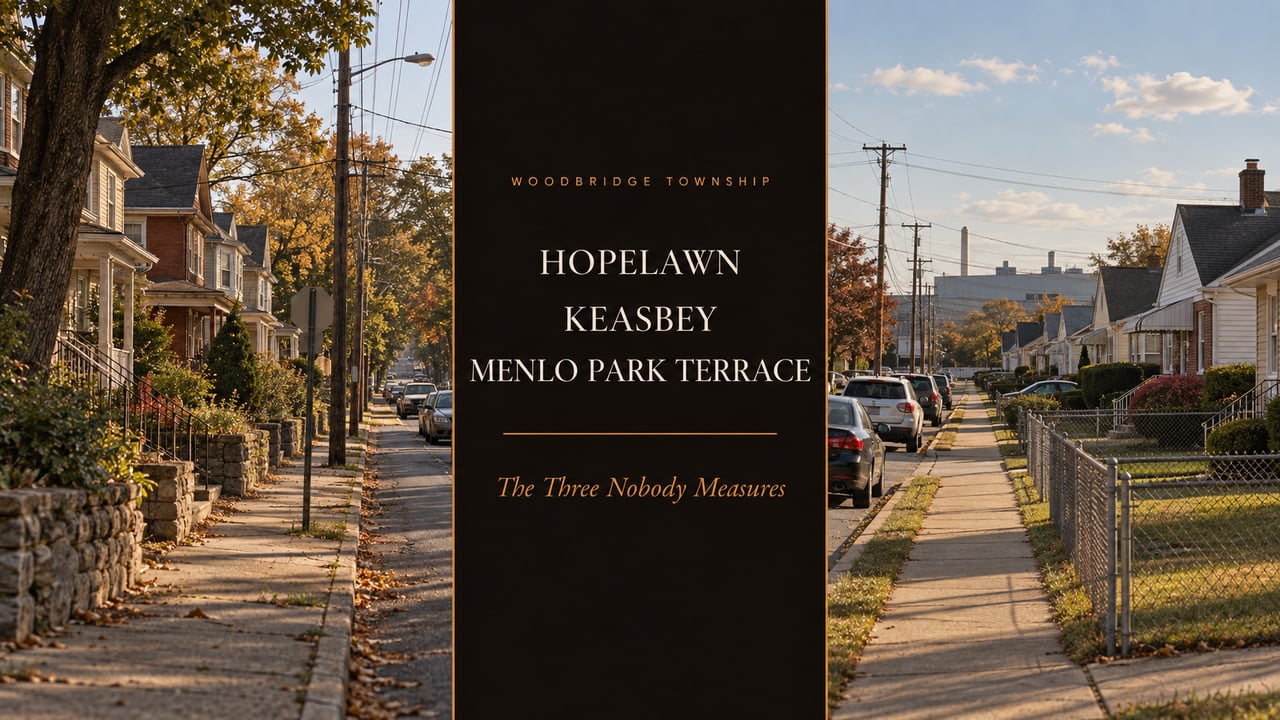
Three of Woodbridge's ten sections return no published home value on any major index. Not a stale figure — nothing at all. The usual explanation is that they are small. That is not the reason, and the real one tells you something useful: two of them carry another town's ZIP code, and all three were only counted separately for the first time in 2020.
The data void has two structural causes, and neither is obscurity. All three first appeared as census-designated places in the 2020 census — so there is no historical series for an index to build on. And two of them carry other municipalities' ZIP codes: Menlo Park Terrace uses Metuchen's 08840, Hopelawn uses Perth Amboy's 08861. Because every platform indexes by ZIP, their transactions are absorbed into other towns' figures entirely. Our buyer's guide shows how ten ZIP codes make portals read ten cities. Here the problem inverts — three sections whose post says they are somewhere else.
This is a post about method, because in these three sections there is no benchmark to fall back on. Nothing here applies to a specific property, and everything in it should be tested against actual closed sales for the address you are considering.
Start with the census, because it is the cleaner of the two reasons. Woodbridge Township officially recognises ten sections — reflected in its own slogan, "Ten small towns, one great community." But the U.S. Census Bureau only draws boundaries around some of them, and Hopelawn, Keasbey and Menlo Park Terrace were each first listed as census-designated places in the 2020 census.
Hopelawn — 0.44 square miles, 2,603 residents (2020), ZIP 08861 — Perth Amboy's
Keasbey — 3,027 residents (2020), first CDP in 2020, at the foot of the Driscoll Bridge
Menlo Park Terrace — 0.372 square miles, 2,806 residents (2020), ZIP 08840 — Metuchen's
Combined: roughly 8,436 people — fewer than Colonia's 17,795 on its own
A value index needs a time series. It models how prices in a defined area move relative to a base, and a boundary that has existed for one census has no base to move from. That is a methodology limitation, not a judgement about the places — and it will resolve on its own as the series accumulates.
The ZIP problem will not resolve on its own. Menlo Park Terrace's mail is addressed Metuchen; Hopelawn's is addressed Perth Amboy. Every listing platform indexes by ZIP code, so those transactions are counted into Metuchen's and Perth Amboy's figures — two municipalities the properties are not in. Search Fords on a major portal and Hopelawn appears among its "popular neighborhoods." The data does not know where these houses are.
Which produces a genuinely strange situation for a buyer. A Menlo Park Terrace house may be compared by an automated model against Metuchen sales — a separate, generally more expensive borough with its own school district, its own tax rate and its own government. A Hopelawn house may be modelled against Perth Amboy, a separate city. Neither comparison is legitimate, and neither is visible to the person reading the estimate.
There is a third factor, and it is the most human one. Township documentation notes that residents of the central section describe themselves as being from "Woodbridge," while people in the other sections describe themselves as being from those particular communities instead. So a seller in Hopelawn says Hopelawn, their mail says Perth Amboy, the portal says Fords, and the deed says Woodbridge Township. Four answers to one question — and the data picks whichever it was built to pick.
Hopelawn was the homestead and farm of Luther M. Hope in the nineteenth century, and after its establishment the original streets were named after Hope's children — Juliette, Loretta, May, Luther, Lee, Warren, James, Howard, Clyde, John, Ellen, Charles, Herbert, Erin, Emmitt and William. Sixteen names, and most of them are still on the map.
It was originally two communities: Ellendale Terrace, from May Street south to New Brunswick Avenue, and Hopelawn, from May Street north to West Pond Road — taking in Washington Heights, the Pennsylvania Avenue and Garden State Parkway area, and Florida Grove along Florida Grove Road. And it was known for its abundance of high-quality clay, worked by the Such Clay Company — part of the clay-mining and brick-making heritage that built this township's industrial base.
What that means today: the street grid is old and irregular by township standards, the housing is older than the postwar sections, and the industrial history is not distant. This is also where the Township is helping the Raritan Bay Area YMCA open a 28-unit permanent supportive housing building — covered in our development pipeline report.
Keasbey was originally known as Florida Grove — the same name that survives on the road through Hopelawn, which tells you these two were once read as one place. It sits at the foot of the Driscoll Bridge, close to the Raritan River, abutting Perth Amboy — the southern corner of the township, where Woodbridge runs out.
And it is the one of the three where something is visibly happening. A recently marketed new-construction centre-hall colonial in Keasbey offered four bedrooms, two and a half baths, an open plan, white shaker cabinets, a centre island and quartz counters. Separately, the Township has planned to sell the Keasbey firehouse lot to a private developer for warehouse construction. New residential build and new industrial build in the same small section is an unusual combination, and it will pull the section's economics in two directions at once.
0.372 square miles off U.S. Route 1, between Menlo Park Mall and Woodbridge Center, at Exit 130 of the Garden State Parkway, within the watershed of the South Branch of the Rahway River. Named for Menlo Park — Edison's — rather than for anyone local.
Its identity is twenty years old, and it was deliberate. John McCormac, who served as the township's mayor, originated from this area, and in 2006 he advocated for recognising it as a distinct community — after which residents began describing themselves that way. Before that, it was an area with a Metuchen postmark and no name of its own.
Which explains the Metuchen orientation that everyone notices. The mail says Metuchen, the retail either side is Menlo Park Mall or Woodbridge Center, and the Parkway exit is at the door. Residents shop and dine in Metuchen because the geography and the postmark both point that way — but the taxes, the schools and the government are Woodbridge's. That gap is the single most important thing to understand before buying here.
Three sections, three completely unrelated origins — a farm, a river landing, and a postwar area that named itself in 2006. They have nothing in common except the absence of a published number, which is precisely why treating them as one undifferentiated "rest of the township" is a mistake. Our Ten Towns guide covers the seven that do have figures.
There is no automated estimate for your section — which means there is also no wrong number anchoring your buyer.
In most of this township a seller spends the first conversation arguing with a model. Here there is no model to argue with — the valuation comes down entirely to which closed sales you can defend as comparable, and that is a skill rather than a lookup. We build the set from the section outward, adjust for what actually differs, and market to the New York metro buyer pool that reaches this township in about forty minutes. Backed by 22 years and 5,000 transactions across both states.
This is a hybrid rather than a formula, and it is the same method that works anywhere transactions are thin.
Comparable closed sales in the same section, matched on house style, size, condition, lot and street location. All five, not the first two — street location does as much work as square footage in sections this small, and condition does more than either.
Extend the window before you extend the map. An older sale in the right section, adjusted for how the market has moved, is more reliable than a recent sale in the wrong one. Time is adjustable with published data. Location is a judgement call every time.
For these three that genuinely means across municipal lines — Keasbey abuts Perth Amboy, Menlo Park Terrace sits against Metuchen and Edison. Crossing a border deliberately, with an adjustment, is legitimate. Crossing one by accident because a search box did it for you is not.
And adjust honestly. The single most expensive mistake in this township is overestimating a house because you have underestimated its location — Routes 1 and 9 and the Parkway run through here, and backing onto traffic is a different house from the same house on a quiet interior street. Stand in the back garden. Listen from inside. You can change the kitchen; you cannot move the house.
Years of doing this let you recognise a likely price range quickly — but the sales still have to support it. Experience narrows the search; it does not replace the evidence. Anyone who gives you a number in a section like this without showing you the comps behind it is guessing out loud.
A neighbourhood with limited sales requires more judgement, not less rigour — and a townwide median alone will never tell you what a particular house is worth. In Hopelawn, Keasbey and Menlo Park Terrace there is not even a section median to misuse. That makes the discipline the entire valuation.
And one check that applies specifically to these three: ask whether the comp is actually in the section. Because portals blur Hopelawn into Fords and index Menlo Park Terrace under Metuchen's ZIP, a comp set assembled from a search box will contain properties from three municipalities without flagging it. The full discipline is in our Fords section guide, where the same drift problem runs the other way.
Here is the question that does more work than any rule about radius or timeframe, and it is the one to apply to every comparable before you accept it.
"A short distance on a map doesn't automatically make two houses comparable. You have to ask whether the same buyer would realistically consider both properties."
Two nearby houses can offer very different experiences because of traffic exposure, access, drainage, or the trip to the station. Proximity is a proxy for comparability, and in sections this small and this varied it is a poor one. A house on Florida Grove Road and a house four streets away on a quiet interior block in Hopelawn may not be competing for the same person at all — and if they are not, they are not comps, whatever the distance says.
Drive the route, walk the block, and spend time in the back garden before you choose anything — as a buyer or as the person pricing it. That is not soft advice in a section with no published benchmark; it is the primary evidence.
And be clear with yourself about what the move is meant to improve — more space, a different commute, lower monthly cost. Those priorities lead to genuinely different houses and different sections, and in a corner of the township where the data will not decide for you, knowing your own priority is what decides instead.
Two practical notes before you offer anywhere in these three. Low-lying parts of Keasbey carry documented flood exposure, as do parts of Woodbridge Proper, Sewaren and Port Reading — which does not mean every property in any of them floods. Check the specific property's flood information, read the disclosures, and get an insurance quote early, in your own name. You evaluate the address; you do not make assumptions about a section. And all ten sections share one tax rate, so the assessment on your parcel — not the ZIP code on your mail — is what sets your bill.
The township overview is in our Woodbridge guide, the comping discipline in our buyer's guide, and the tax mechanics in our property tax guide.
If you are buying in Menlo Park Terrace or Hopelawn, check what your mortgage application, your insurance quote and your title work each call the property — because they may not agree. Menlo Park Terrace carries a Metuchen ZIP code; Hopelawn carries a Perth Amboy one. Automated systems built on postal geography can attach the wrong municipality to your file, and while the deed and the tax record are what legally govern, a mismatch surfacing during underwriting is a delay you did not budget for. Flag it to your lender, your insurer and your attorney at the start rather than fixing it at the end. It takes one sentence and it is the single most avoidable friction in these two sections.
"Three of the ten sections have no published value at all, and people assume it's because they're small. It isn't. All three were only counted separately for the first time in the 2020 census, so there's no history for an index to build on. And two of them use somebody else's ZIP — Menlo Park Terrace has a Metuchen postmark, Hopelawn has Perth Amboy. Every platform indexes by ZIP, so those sales get counted into towns the houses aren't even in. So how do you price one? Same section first, on style, size, condition, lot and street. Not enough matches, go back in time before you go sideways. Then bordering towns, deliberately, with an adjustment. And test every single comp with one question: would the same buyer realistically look at both of these houses? If the answer's no, it's not a comp — no matter what the map says."
— Anthony Licciardello, Broker, The Prodigy Team

Pricing a house where no index reaches is the part of this job that does not automate: I'm Anthony Licciardello, Broker of The Prodigy Team, dual-licensed in New York and New Jersey, a former Director of Community Affairs in the Bloomberg Administration, and a leading broker for cross-border New York–New Jersey transactions.
Anthony Licciardello · Broker, The Prodigy Team · 718-873-7345
We build the comp set from the section outward — and show you every sale behind the number.
Why is there no home value data for Hopelawn, Keasbey or Menlo Park Terrace?
Two structural reasons. All three first appeared as census-designated places in the 2020 census, so there is no historical series for a value index to build on — a methodology limitation that will resolve as data accumulates. And two of them carry other municipalities' ZIP codes: Menlo Park Terrace uses Metuchen's 08840, Hopelawn uses Perth Amboy's 08861. Because every listing platform indexes by ZIP, those transactions are absorbed into Metuchen's and Perth Amboy's figures instead. That one will not resolve on its own.
How do you value a home in a section with no published median?
A hybrid, in order. Start with closed sales inside the section, matched on house style, size, condition, lot and street location. If there are not enough matches, extend backwards in time before extending the map — time is adjustable with published data, location is a judgement call. Only then look to nearby competing neighbourhoods including bordering towns, deliberately and with an adjustment. Then adjust for location and market movement. Experience narrows the range quickly, but the sales still have to support it.
What are these three sections actually like?
Entirely different from one another. Hopelawn was the nineteenth-century homestead and farm of Luther M. Hope, whose original streets were named after his sixteen children; it was once two communities, Ellendale Terrace and Hopelawn, and was known for high-quality clay worked by the Such Clay Company. Keasbey was originally Florida Grove, sits at the foot of the Driscoll Bridge near the Raritan River abutting Perth Amboy, and is currently seeing both new residential construction and planned warehouse development. Menlo Park Terrace is 0.372 square miles off Route 1 at Parkway Exit 130, and its distinct identity dates only to 2006, when then-mayor John McCormac — himself from the area — advocated for its recognition.
How do I know whether a comparable sale is actually comparable?
Ask whether the same buyer would realistically consider both properties. A short distance on a map does not automatically make two houses comparable — two nearby homes can offer very different experiences because of traffic exposure, access, drainage or the trip to the station. If the same person would not have toured both, it is not a comp whatever the distance says. And because portals blur Hopelawn into Fords and index Menlo Park Terrace under a Metuchen ZIP, a comp set assembled from a search box can contain properties from three municipalities without flagging it.
Iselin — The Best Commute and the Most Misleading Median
The Ten Towns of Woodbridge — Every Section, Explained
Buying in Woodbridge — Four Sources, Four Prices
Fords — Five Published Prices, One Section
Colonia — The Most Uniform Section in the Township
Avenel — The Transit Village That Already Got Built
Sewaren — Rebuilding the Cheapest Waterfront
Everything Being Built in Woodbridge Right Now
Woodbridge Homes for Sale — Browse Current Listings
Details as of publication, from the sources noted, and subject to change. Section status and geography per Wikipedia and U.S. Census Bureau data: Woodbridge Township's municipal administration officially recognises ten geographical sections, reflected in its slogan "Ten small towns, one great community" — Avenel, Colonia, Fords, Hopelawn, Iselin, Keasbey, Menlo Park Terrace, Port Reading, Sewaren and Woodbridge (Woodbridge Proper) — and residents of the central section describe themselves as being from "Woodbridge" while people in other areas describe themselves as being from those particular communities instead. Hopelawn is an unincorporated community and census-designated place with a 2020 population of 2,603 across 0.44 square miles at an elevation of 98 feet, ZIP Code 08861, named after Luther M. Hope; it was Hope's homestead and farm in the 19th century, and after its establishment the original streets were named after Hope's children — Juliette, Loretta, May, Luther, Lee, Warren, James, Howard, Clyde, John, Ellen, Charles, Herbert, Erin, Emmitt and William; it was originally two communities, Ellendale Terrace from May Street south to New Brunswick Avenue and Hopelawn from May Street north to West Pond Road, including sections such as Washington Heights, the area of Pennsylvania Avenue and the Garden State Parkway, and Florida Grove along Florida Grove Road from West Pond Road to Lee Street; and it was known for its abundance of high quality clay, associated with the Such Clay Company. Keasbey is an unincorporated community and census-designated place which first appeared as a CDP in the 2020 census with a population of 3,027; it is located at the foot of the Driscoll Bridge close to the Raritan River, was originally known as Florida Grove, and abuts neighbouring Perth Amboy. Menlo Park Terrace is an unincorporated community and census-designated place with a 2020 population of 2,806 across 0.372 square miles, all land, ZIP Code 08840 — a Metuchen ZIP code — named after Menlo Park; it lies in the western part of Woodbridge Township within the watershed of the South Branch of the Rahway River, off U.S. Route 1 between Menlo Park Mall and Woodbridge Center at Exit 130 of the Garden State Parkway; it was first listed as a census-designated place in the 2020 census; and John McCormac, who served as mayor, originated from this area and in 2006 advocated for recognising it as a distinct community, after which point residents began doing so. Colonia's population of 17,795, cited for comparison, is from a national real-estate site whose other figures we have discarded elsewhere; it is used here only as an order-of-magnitude contrast. Keasbey new construction and the Keasbey firehouse warehouse plan, and the Hopelawn supportive housing project, are covered with their sources in our Woodbridge development pipeline report. Median age, age-band shares, sex ratios, household income, household composition, racial composition and school rating data available from the sources consulted have been deliberately excluded, as we exclude such material for every community we cover. No published home value index figure exists for these three sections as at the date of writing; nothing in this article should be read as an estimate of value for any property. Comparable sales, lot dimensions, build year, flood determinations, tax bills, assessments and condition must be verified for any specific property with the Township of Woodbridge and your own professionals. This is general information and market commentary, not legal, tax, or investment advice.
Prodigy Real Estate is an innovative real estate company offering high-end video production, home valuation services, purchasing, and home sales. Serving New York and New Jersey.