

On This Page
A market of one
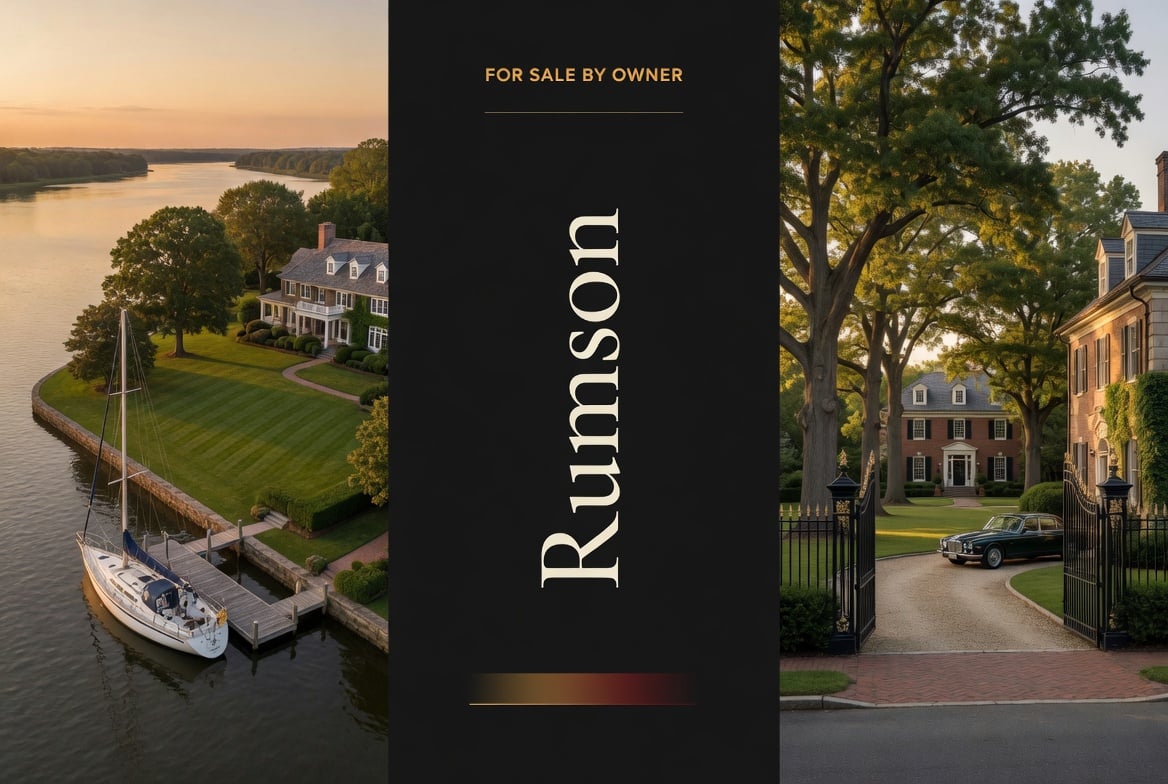
Rumson is not a market in the ordinary sense. It is the wealthiest town in Monmouth County, a place of riverfront estates, gated enclaves, and private docks, where the median sale price is the highest in the county and waterfront homes routinely trade between four and ten million dollars — some well beyond. At those prices, no two homes are interchangeable. A six-bedroom on the Navesink with deep-water frontage is not a comparable for a restored colonial three streets inland, even if a spreadsheet insists they’re both “Rumson, 6BR.”
That uniqueness changes the entire FSBO calculation. In an ordinary market, selling yourself risks a modest discount. At the top of this one, the home is effectively singular, the buyer pool is small and private, and the price is a matter of judgment rather than lookup. Get that judgment wrong by a few percent and you are not leaving thousands on the table — you are leaving the price of an ordinary house somewhere else entirely.
When your home has no true comparable, the price isn’t looked up — it’s built, defended, and marketed. That is judgment work an automated estimate cannot do, and the stakes scale with the price.
The pricing trap at the top
High-end mispricing is uniquely punishing, and it cuts both ways. Price an estate too low and you may sell quickly — to a delighted buyer who just captured a million dollars of equity that was rightfully yours. Price it too high with no strategy behind the number and it sits; in a small luxury market, a stale trophy listing becomes conspicuous, and the longer it lingers the more buyers assume something is wrong with it. Either way, the seller pays.
Pricing correctly here means understanding what actually drives value at this level: water frontage and dock rights, lot size and privacy, architectural pedigree, renovation quality, and proximity to the beach clubs and the Rumson–Fair Haven school district that draws families. It means reading the handful of genuinely comparable closings, not list prices, and knowing which sales were anomalies. That is bespoke analysis, and it is precisely the work a FSBO seller has no apparatus to perform.
On a multimillion-dollar home, a pricing error of even a few percent is measured in hundreds of thousands of dollars. There is no “undo” on a stale luxury listing — in a small market, everyone serious already saw it sit.
Where the luxury buyer actually is
The buyer who clears a Rumson price is not browsing the local classifieds. The pool skews to New York finance professionals, returning empty-nesters from Manhattan, and trade-up families relocating from elsewhere in the county — people who are private, time-poor, and often searching discreetly. They do not respond to a yard sign. They respond to a polished presentation that reaches them through the right channel at the right moment, frequently before they have formally begun a search.
This is the exposure gap that a FSBO listing cannot close. Syndication to the public portals reaches people already typing “Rumson” into a search bar. It does almost nothing to reach the qualified, out-of-market buyer who would fall for the home if it were placed in front of them — through video, through a relocation network, through content that has been quietly building authority for months.
The buyers who clear these prices are few, discreet, and often not yet searching. Reaching them is a targeting and presentation problem — not something a public listing accomplishes on its own.
The flat-fee mirage
A flat-fee MLS service is honest about what it is: for a few hundred dollars, it enters your home into the MLS and pushes it to the major portals. At a starter-home price, that can be a defensible trade. On a multimillion-dollar estate, the same service is wildly mismatched to the asset — it is the equivalent of advertising a rare painting with a classified line and a snapshot.
What the flat fee does not buy is everything that actually sells a luxury home: a defensible pricing strategy for a unique property, cinematic production worthy of the architecture and the setting, discreet access to qualified buyers, skilled negotiation when offers carry contingencies and egos, and transaction management across attorneys, inspectors, and lenders at a level where the details are unforgiving. The flat fee assumes the buyer arrives on their own. At this price, you have to find them, court them, and present the home as the singular thing it is.
A flat fee lists the home. It does not present it — and at this level, presentation and access are the entire job.
A trophy property marketed like a tract house signals the wrong thing to exactly the buyers you need.
Why two agents in the same office are not the same product
Here is the part of the industry rarely said out loud, and it matters even more at the top of the market: real estate agents are independent contractors. An agent under a luxury franchise is not an employee delivering a standardized service. They are an independent business owner who pays the brokerage for affiliation and decides, personally and out of their own pocket, how much to invest in marketing your home.
So a prestigious sign guarantees almost nothing about what your listing actually receives. One agent at a famous luxury office orders a quick photo set and a single open house. Another agent at the same office commissions architectural cinematography, drone work, a printed brochure, and a targeted campaign to qualified buyers. Same name on the sign. Two entirely different products. When you interview an agent for a home like this, you are not hiring the brand — you are hiring that one contractor’s personal investment, standards, and reach.
Don’t hire a prestigious logo. Ask the individual: what do you personally invest in a home at this price, and what is produced in-house versus outsourced or skipped? At the top of the market, that gap is widest of all.
The Prodigy Team is built deliberately against that randomness. Rather than depending on whatever a single contractor decides to spend, the team runs shared, in-house infrastructure — the same cinematic production, the same distribution machine, the same NYC pipeline — behind every listing. The standard does not drop because the property or the agent changed.
Presentation worthy of the asset — and the one-day feed
At this level, presentation is not decoration; it is the price. A buyer deciding between your estate and a comparable elsewhere is buying a feeling as much as a floor plan, and that feeling is created — or squandered — in the first images they see. The Prodigy Team treats every Rumson listing as a piece of marketing worthy of the asset, then carries it through infrastructure a single transaction’s budget cannot buy.
A capability we own, not a vendor we book — so a riverfront estate is filmed the way it deserves: the water frontage, the grounds, the architecture at the right light, the footage that makes a buyer feel the home before they ever walk it.
Our branded series, Above the Streets, presents Rumson’s waterfront character to affluent relocators months before they engage an agent — building familiarity and desire that a one-off listing never can.
Neighborhood pages for Rumson, Fair Haven, and Little Silver rank for the searches an affluent buyer runs while still deciding where to land — and keep ranking long after a social post is gone.
An owned audience already weighing the move your buyer is making — so a singular home is placed in front of warm, self-selected, qualified demand rather than a cold public feed.
Set that against where most FSBO marketing actually lives: a single Instagram post. Its working shelf life is roughly a day — the feed surfaces it, a sliver of followers see it, and within twenty-four hours the algorithm has moved on. A story is gone in twenty-four hours by design. Boosting it only buys reach to an audience that still cannot afford or doesn’t want a multimillion-dollar Rumson estate.
Assets that compound behave differently. A cinematic YouTube tour is searchable in two years. An SEO page accrues authority every month. A relocation network grows. The Prodigy difference is not posting more often — it is building presentation and reach that keep working long after the feed has buried the post.
| Capability | FSBO alone | Flat-fee MLS | The Prodigy Team |
|---|---|---|---|
| MLS & portal syndication | — | ✓ | ✓ |
| Estate-grade cinematic film & drone | — | — | ✓ |
| Defensible pricing for a unique home | — | — | ✓ |
| Discreet reach to qualified NYC buyers | — | — | ✓ |
| Evergreen YouTube & SEO presence | — | — | ✓ |
| High-stakes negotiation & transaction mgmt | You | You | Team |
| Who carries the cost & risk | You | You | The Team |
What makes a Rumson home stop a New York scroll
Selling at this level to a city buyer means showing them a life that money in Manhattan cannot buy: space, water, and privacy thirty-some miles from the office. These are the specifics that make an affluent New York homeowner stop scrolling — and what a Rumson listing has to lead with:
The water. Frontage on the Navesink and Shrewsbury rivers, private docks, and deep-water access are the defining luxury here — and exactly what a city buyer cannot replicate. Lead with it, shot from the air.
The schools. The Rumson–Fair Haven school district is among the most sought-after in the state and is a primary draw for relocating families. For a certain buyer it is the headline, not a footnote.
The privacy. Gated drives, mature landscaping, and generous lots offer the seclusion that wealth seeks — the opposite of apartment life. Drone and ground footage should sell the sense of arrival.
The clubs & the coast. Proximity to historic yacht and beach clubs and to the Sea Bright shoreline frames the lifestyle a buyer is purchasing — not just a house, but membership in a way of life.
The commute that still works. Nearby ferry and rail let a principal keep a foot in the city without living in it — the reconciliation of estate life and a Manhattan career that makes Rumson possible for the working wealthy.
The questions to ask before you sign — or go it alone
At this price, the cost of the wrong answer is enormous, so interview the marketing investment, not the personality. Whether you’re weighing FSBO, a flat fee, or a luxury agent, ask the same hard questions and judge by the answers.
- How will my unique home be priced — which specific closings, and what makes them truly comparable?
- What is actually produced for a home at this level, and is the cinematography shot in-house or outsourced?
- How, specifically, will qualified out-of-market buyers be reached — and how is that audience owned?
- What happens to my marketing after week one, once the launch buzz fades?
- Who personally absorbs the cost and risk of all of this — me, or the team?
FSBO answers all five with “you.” A flat fee answers them with “you, plus syndication.” The Prodigy Team answers every one with presentation and reach worthy of a singular home — infrastructure you don’t have to build, fund, or maintain yourself.
Can I sell a luxury Rumson home for sale by owner?
You can — FSBO is legal at any price. But a Rumson estate is effectively unique, with thin and unusual comparable sales and a small, private buyer pool. The risk isn’t a small discount; it’s mispricing a one-of-a-kind home or failing to reach the qualified buyer who would pay the most.
How do you price a home that has no real comparables?
By building the price rather than looking it up: weighing water frontage and dock rights, lot size and privacy, architectural quality, and the handful of genuinely comparable closings — actual sales, not list prices — while discounting anomalies. It is bespoke analysis, not an automated estimate.
Is a flat-fee MLS listing appropriate for a multimillion-dollar home?
Rarely. A flat-fee service enters your home into the MLS and syndicates it, which reaches people already searching. It does not provide a defensible pricing strategy, estate-grade cinematography, discreet access to qualified buyers, or high-stakes negotiation — the work that actually drives a luxury sale price.
Why do two agents at the same luxury brokerage market my home differently?
Because agents are independent contractors, not employees. Each personally decides how much to invest in your listing, so a prestigious sign guarantees little about the production you receive. At the top of the market, that investment gap is widest — hire the individual’s standards and reach, not the logo.
How does The Prodigy Team reach affluent New York City buyers?
Through owned infrastructure rather than one-off posts: in-house 4K drone and cinematic production, the evergreen Above the Streets YouTube series, a hyperlocal SEO engine, and a large NY/NJ/FL relocation network — a sustained pipeline that presents a singular home to qualified buyers and carries it back to the city.