
Anthony Licciardello | May 13, 2026
Belmar, NJ
The Belmar Field Guide
A six-part broker's field report on the Jersey Shore's most quietly transformed mile.
Part Two · The Boardwalk Story
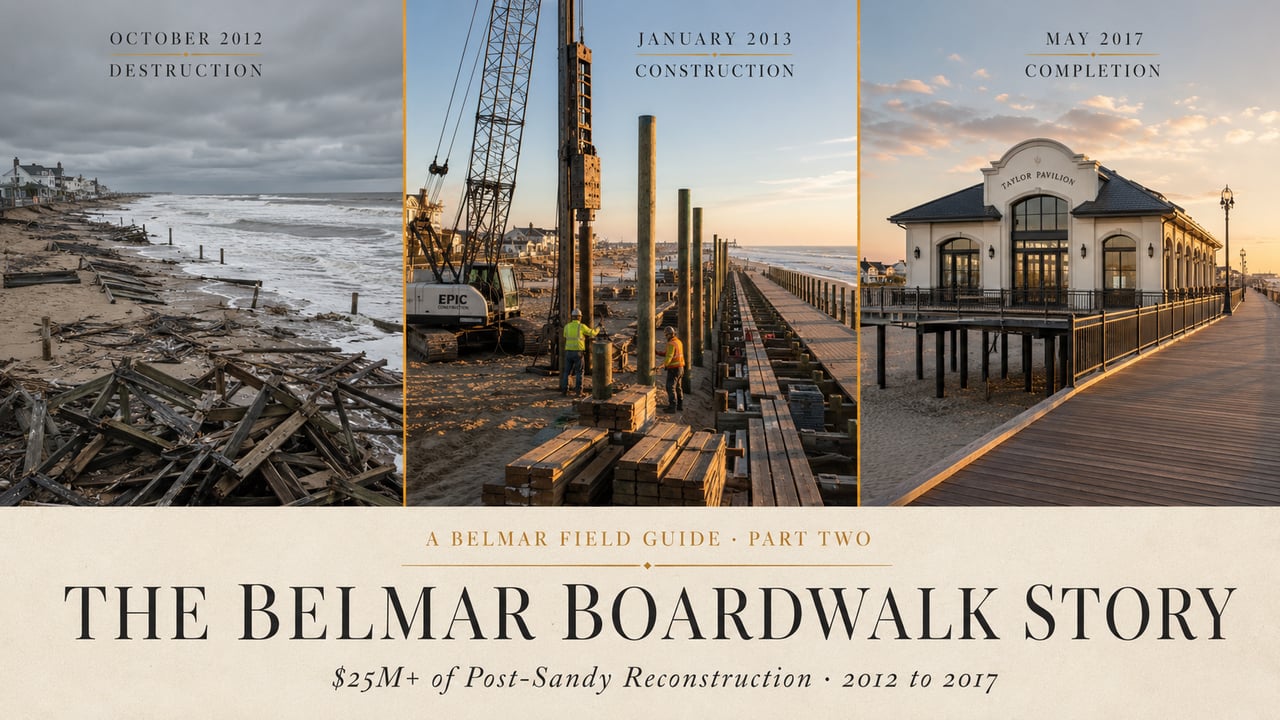
Sandy destroyed the entire 1.3-mile Belmar boardwalk on October 29, 2012. By Memorial Day weekend 2013 — just 134 days later — it was reopened. A broker's anatomy of the $20 million bond, the 14,000 Trex boards, the $5.45 million pavilion war, and why this 1.3-mile stretch still anchors every property value within five blocks of the ocean.
$20M
Total Bond
Authority
134
Days From First Piling
to Reopening
14,000
Trex Boards
Installed
$5.45M
Final Pavilion
Construction Cost
In This Installment
01 October 29, 2012: Sandy
02 The 134-Day Rebuild
03 The Pavilion War
04 Taylor & Cruz Bay: The Final Build
05 The Property Value Impact
FAQ Frequently Asked Questions
The Belmar boardwalk is the single most important capital project in modern Belmar history. The story of its destruction by Hurricane Sandy on October 29, 2012, its $20 million reconstruction completed in 134 days from first piling to Memorial Day weekend 2013, and the political war over the pavilions that followed — settled four years later with the May 2017 dedication of the Taylor Pavilion — explains more about how Belmar property values behave in 2026 than any other single piece of infrastructure history.
A boardwalk is not just decking. It is a piece of municipal infrastructure that anchors property values for every parcel within roughly five blocks of the ocean, signals the borough's level of public-asset stewardship to every potential buyer, and creates the daily lifestyle amenity that distinguishes Belmar from inland Monmouth County markets. When the boardwalk works, the market works. When the boardwalk is broken — as it was for seven months between October 2012 and May 2013 — the entire beach-block submarket waits.
This installment walks the boardwalk story in detail: the verified construction cost data, the political timeline of the pavilion controversy, the technical specifications of Taylor and Cruz Bay pavilions, and the broker's read on why this $20 million capital project remains the structural anchor of every Belmar property value in 2026.
01
October 29, 2012: Sandy
Hurricane Sandy made landfall along the New Jersey coast on the evening of October 29, 2012, with sustained winds and storm surge that produced unprecedented damage along the entire Monmouth Shore. In Belmar, the storm surge breached the boardwalk's beachfront edge and methodically lifted, twisted, and scattered the timber decking, the railings, the pavilions, and even sections of the underlying pilings. By the morning of October 30, the borough did not have a partially-damaged boardwalk; it had no boardwalk at all. The 1.3-mile stretch from First Avenue to L Street was, for practical purposes, gone.
The political and economic stakes were immediate and obvious. Without a boardwalk, the 2013 summer season — the borough's economic engine — was structurally at risk. Mayor Matt Doherty's administration moved within days to assess damage, engage emergency contractors, and frame the reconstruction not as a multi-year rebuild but as a single-season sprint. The choice was deliberate and consequential: a slower rebuild would have produced a more deliberative design process; the faster rebuild would prioritize having a boardwalk by Memorial Day 2013 over any other consideration.
02
The 134-Day Rebuild
The Belmar Borough Council awarded the boardwalk reconstruction contract to Epic Construction at a bid price of $6.559 million in early 2013. The contract included an aggressive performance structure designed to force the May 2013 reopening: $7,500 per day in liquidated damages for any day past the Memorial Day weekend completion deadline, and a $100,000 performance bonus for early completion. The total bond authority for the project was $20 million, with FEMA reimbursement at the 75–90% target level for eligible storm-recovery costs.
Epic Construction drove the first piling in mid-January 2013. The boardwalk reopened on Wednesday, May 22, 2013 — exactly 134 days from first piling to ribbon-cutting, ahead of the Memorial Day weekend deadline. The contractor earned the $100,000 bonus and the $7,500-per-day penalty was never triggered. By the metrics that mattered to the borough, the project was an extraordinary success: the 2013 summer season opened on schedule, the beach-block rental market recovered without missing a peak week, and the broader narrative of "Belmar back from Sandy" anchored borough identity for the next decade.
The technical specifications of the rebuild are worth understanding because they explain the boardwalk's expected service life. The new boardwalk uses 14,000 Trex composite boards — engineered for substantially longer outdoor service life than traditional cedar decking and resistant to splintering, warping, and the daily salt-air corrosion that limited the original wood boardwalk's lifespan. The underlying pilings are 20–25 feet long, driven deep into the beach substrate to provide stability against future storm surge events. This is not a like-for-like replacement of what Sandy destroyed; it is a meaningfully upgraded piece of infrastructure designed to survive the next century of Atlantic weather.
The borough also launched an Adopt-a-Board program during reconstruction, allowing residents and businesses to sponsor individual boards with engraved name plates affixed to the decking. The program raised approximately $700,000 toward total project costs and produced one of the more enduring community-engagement legacies of the rebuild — a walk along the Belmar boardwalk today reveals hundreds of small brass plates dedicated to families, businesses, organizations, and individuals who contributed to the campaign.
03
The Pavilion War
The boardwalk decking was the easy part. The political war that followed was over the pavilions — the larger architectural structures along the boardwalk that house concessions, banquet space, and public restrooms. The original three Sandy-destroyed pavilions had to be replaced; the question was how big, how expensive, and where to put them. The fight lasted four years and produced one of the more consequential local-government referendums in recent Monmouth County history.
In 2014, Mayor Doherty's administration introduced an ordinance authorizing $7.1 million in bond funding for new pavilion construction, including a substantial new pavilion at 8th Avenue. The ordinance passed the Belmar Borough Council on a 3-1 vote, with then-Councilwoman Jennifer Nicolay Bean casting the lone dissenting vote on grounds of cost and process. A grassroots citizens' group called "Let The Citizens Decide" formed shortly afterward and organized a referendum petition that ultimately forced the borough to reconsider the pavilion plan substantially.
The referendum forced two material design changes. First, the 8th Avenue pavilion was scrapped entirely — the borough would not build a third pavilion on the boardwalk's southern stretch. Second, the planned Taylor Pavilion (named for Doris Taylor, longtime Belmar resident and community fixture) was reduced from a two-story design to a single-story design, significantly lowering total construction cost and reducing the structure's visual mass against the ocean. The political compromise that emerged in early 2016 was a two-pavilion design totaling $5.45 million in final construction cost — substantially below the original $7.1 million plan.
The pavilion war is the part of the boardwalk story most outside observers miss. Sandy destroyed the boardwalk in October 2012. The decking was rebuilt in 134 days. The pavilions took four more years and a citizens' referendum. The Belmar that emerged in 2017 with Taylor and Cruz Bay was meaningfully different from the Belmar that the original 2014 ordinance would have built.
— Anthony Licciardello · Broker, The Prodigy Team
04
Taylor & Cruz Bay: The Final Build
The final pavilion contract was awarded in January 2016 at $5.45 million for two structures: the Taylor Pavilion at 5th Avenue and the Cruz Bay Cafe pavilion at 10th Avenue. Both were single-story builds, deliberately scaled to match the boardwalk's horizontal aesthetic rather than impose new vertical mass against the ocean view. Construction proceeded through 2016 and into early 2017, with the Cruz Bay Cafe's Merri-Makers concession opening in May 2017 alongside the formal Taylor Pavilion dedication.
Taylor Pavilion Specifications
6,800 SF total footprint on 81 foundation pilings driven 40 feet deep. Base floor elevation 9 feet above boardwalk grade (FEMA post-Sandy flood zone compliant). Interior split: 1,400 SF oceanfront concession (Cruz Bay Cafe / Merri-Makers) + 4,300 SF banquet space.
The Taylor Pavilion's engineering reflects the lessons of Sandy. The 81 foundation pilings are driven 40 feet deep into the beach substrate — substantially deeper than the original pre-Sandy pavilion piles. The base floor elevation sits at 9 feet above the boardwalk grade, designed to clear projected future flood elevations under FEMA's post-Sandy revised flood zone designations. The 6,800-square-foot single-story footprint contains a 1,400-square-foot oceanfront concession (the Cruz Bay Cafe's Merri-Makers operation) and a 4,300-square-foot banquet/event space available for weddings, community events, and private functions.
The formal dedication ceremony was held on May 1, 2017, and produced one of the more memorable images in modern Belmar civic history: U.S. Senator Bob Menendez, U.S. Senator Cory Booker, U.S. Representative Frank Pallone, Mayor Matt Doherty, and 99-year-old Doris Taylor herself standing at the pavilion entrance for the ribbon-cutting. The political theater was substantial — three senior federal officials attending a local pavilion dedication is not a routine event — and reflected the broader political significance of Belmar's post-Sandy recovery as a state and federal narrative anchor.
05
The Property Value Impact
The capital investment in the 2013-2017 boardwalk reconstruction would matter primarily as a public-infrastructure story were it not for what happened next in the Belmar real estate market. Between 2019 and 2024, the borough's average sale price went from $713,493 to $1,559,393 — a five-year appreciation of 118.6%. The pace puts Belmar in the top tier of all Jersey Shore municipalities for percentage appreciation during that window. The boardwalk reconstruction is not the only driver of that appreciation, but it is the single largest discrete capital project signal of borough commitment to the beach-block submarket.
The mechanism is straightforward. A buyer underwriting a Belmar beach-block purchase in 2026 is, implicitly or explicitly, evaluating the borough's commitment to maintaining the boardwalk and its associated public amenities for the next 20-30 years. A $20 million capital investment completed in 2013-2017, with 14,000 Trex boards rated for half-century service life and pavilions built on 40-foot pilings at 9-foot base elevation, sends a strong signal that the borough takes that commitment seriously. That signal materially affects the underlying value proposition of every beach-block parcel within five blocks of the ocean.
For investors and year-round buyers underwriting Belmar acquisitions in 2026, the boardwalk capital project is the structural foundation under everything else covered in this Field Guide. The Tier 1 beach-block rental rates documented in Part 4 ($45,000-$50,000+ for the Memorial Day-to-Labor Day season) exist in part because the boardwalk works. The structural appreciation engine of the beach-block submarket detailed in Part 1 rests on the same foundation. Without the 2013-2017 reconstruction, the Belmar real estate market in 2026 looks materially different.
The Belmar boardwalk is the single most important piece of infrastructure underwriting every property value within five blocks of the ocean. Buyers who tour beach-block inventory without understanding the 2012-2017 capital story are evaluating the asset on incomplete information.
— Anthony Licciardello · Broker, The Prodigy Team
Question
The Belmar boardwalk reopened on Wednesday, May 22, 2013 — just 134 days after Epic Construction drove the first new piling. The reopening was ahead of the Memorial Day weekend deadline, the contractor earned the $100,000 early-completion bonus, and the $7,500-per-day liquidated damages penalty was never triggered. Sandy had destroyed the entire 1.3-mile boardwalk approximately seven months earlier on October 29, 2012.
Question
The Belmar Borough Council authorized $20 million in total bond authority for the boardwalk reconstruction project. The initial Epic Construction contract for the boardwalk decking itself was awarded at $6.559 million. The two pavilions (Taylor and Cruz Bay Cafe) were contracted separately in January 2016 at $5.45 million following the citizens' referendum that reduced the original $7.1 million pavilion plan. Approximately $700,000 was raised through the Adopt-a-Board program. FEMA reimbursement covered an estimated 75–90% of eligible storm-recovery costs.
Question
The Taylor Pavilion is named for Doris Taylor, a longtime Belmar resident and community fixture who attended the formal dedication ceremony on May 1, 2017 at age 99 and personally cut the ribbon to open the pavilion. The dedication ceremony was attended by U.S. Senator Bob Menendez, U.S. Senator Cory Booker, U.S. Representative Frank Pallone, and Mayor Matt Doherty alongside Mrs. Taylor.
Question
The Cruz Bay Cafe is the concession operation in the Taylor Pavilion at 5th Avenue on the Belmar boardwalk, operated by Merri-Makers (a regional hospitality and catering group). The cafe opened in May 2017 alongside the Taylor Pavilion's formal dedication. It occupies approximately 1,400 square feet of oceanfront concession space within the pavilion's 6,800-square-foot single-story footprint, with an additional 4,300 square feet of banquet/event space available for weddings and private functions.
Question
The Belmar boardwalk runs approximately 1.3 miles along the Atlantic Ocean from First Avenue at the southern Lake Como Borough border up to L Street at the Shark River Inlet. The reconstructed boardwalk uses 14,000 Trex composite boards on 20-25 foot pilings driven into the beach substrate. The walk takes most pedestrians approximately 25-30 minutes one way at a leisurely pace.
The Prodigy Team
Thirty minutes. We'll walk you through verified 2026 comps for your specific block, the post-Sandy capital project context for your address, and what a serious beach-block buyer is actually willing to pay this season. No obligation. No sales pitch.
Call (718) 873-7345 · Anthony Licciardello
Conversations are confidential.
Sources & Data Notes
1. Hurricane Sandy NJ landfall and Belmar boardwalk damage: October 29, 2012 storm; full 1.3-mile boardwalk destroyed; all three original pavilions destroyed. Source: National Weather Service Sandy post-storm reports; Belmar Borough damage assessment; Asbury Park Press coverage.
2. Boardwalk reconstruction contract terms: Epic Construction bid $6.559M; $20M total bond authority; $7,500 daily liquidated damages (never triggered); $100,000 early-completion bonus earned; 134 days from first piling to May 22, 2013 reopening; 14,000 Trex boards; 20-25 foot pilings; FEMA 75-90% reimbursement target. Source: Belmar Borough Council ordinance records; Epic Construction contract documentation; Asbury Park Press reconstruction coverage.
3. Pavilion war timeline: Original 2014 ordinance authorized $7.1M for pavilions including 8th Avenue; Borough Council 3-1 vote with Councilwoman Bean dissenting; "Let The Citizens Decide" forced referendum; 8th Avenue pavilion scrapped; Taylor Pavilion reduced from two-story to single-story. Source: Belmar Borough Council records; Asbury Park Press pavilion controversy coverage; Coast Star.
4. Final pavilion specifications: January 2016 contract awarded at $5.45M for Taylor (5th Ave) + Cruz Bay Cafe (10th Ave); Taylor Pavilion 6,800 SF on 81 piles 40 feet deep, 9-foot base elevation, 1,400 SF concession + 4,300 SF banquet space; Merri-Makers opening May 2017; dedication May 1, 2017 with Sens. Menendez and Booker, Rep. Pallone, Mayor Doherty, and Doris Taylor. Source: Belmar Borough construction records; Asbury Park Press.
5. Belmar appreciation: 2019-2024 average sale price $713,493 to $1,559,393 (+118.6% 5-year); NeighborhoodScout 10-year cumulative 110.55%. Source: MOMLS annual data; NeighborhoodScout Belmar residential real estate data.
Construction cost figures reflect documented contract awards and may not include change orders or final closeout adjustments. Appreciation figures reflect aggregated MOMLS data and are not substitutes for individual property appraisals. This is broker market commentary and is not a substitute for licensed real estate counsel.
Coming Next in the Series
Silver Lake and Lake Como: the parallel submarket priced on different fundamentals than the beach blocks. The cross-boundary tax math between Belmar Borough (0.988 effective) and Lake Como Borough (1.180 effective), the Belmar Elementary K-8 sending/receiving relationship, the three-tier lakefront pricing structure, and the structural scarcity story behind the corridor's quiet appreciation. Read Part 3 →

Broker · The Prodigy Team
20+ years and 5,000+ closed transactions across New Jersey and Staten Island, with active broker presence across the Belmar / Lake Como / Spring Lake / Asbury Park corridor. Direct: (718) 873-7345
Prodigy Real Estate is an innovative real estate company offering high-end video production, home valuation services, purchasing, and home sales. Serving New York and New Jersey.