
Anthony Licciardello | May 29, 2026
Summit
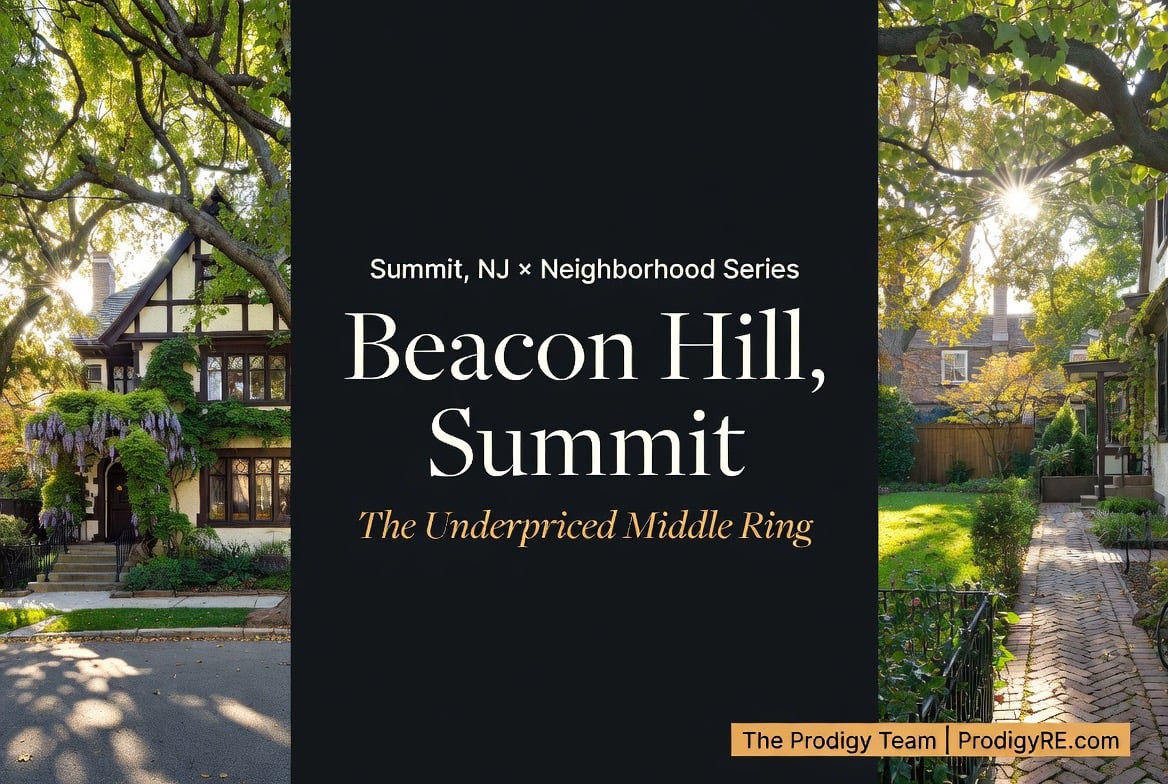
Beacon Hill, Summit: The Middle Ring at Its Most Underpriced.
A sub-mile commute, mature canopy, full-sized lots, and an architectural fabric the AVMs cannot read. Beacon Hill sits at the geographic and economic center of the 2016 rideshare revaluation — and most sellers in the neighborhood are still listing as if the revaluation never happened.

Beacon Hill is the neighborhood where the Summit pricing framework matters most. A 1.0-to-1.3-mile distance from Summit Station places nearly every parcel inside the Middle Ring sub-band most repriced by the 2016 rideshare program. Full-sized 1920s architecture, generous lots, and a quiet residential character draw the move-up family buyer who needs more space than the Pedestrian Zone offers without giving up Midtown Direct access. The combination produces a neighborhood that is structurally underpriced by every AVM in the market — and where sellers who price by Zestimate routinely list below what the comp set will support.
Beacon Hill sits squarely in the Middle Ring of Summit, in the 1.0-to-1.3-mile band that the broader seller framework series identifies as the most consistently mispriced geography in the city. The neighborhood’s identity is rooted in its 1920s architectural fabric — Tudor-revival, center-hall colonial, and Dutch colonial homes built when Summit was establishing itself as one of the early Midtown Direct commuter towns. The lots are generous by Summit standards. The canopy is mature. The streetscape is among the most quietly elegant in the city.
The neighborhood’s commercial reality, however, is a different story. Beacon Hill is the kind of place that automated valuation models broadly miss. The Zestimate sees a 1925 colonial at 1.1 miles from Summit Station and prices it the way it would price any 1925 colonial at 1.1 miles from any New Jersey commuter station — with no knowledge of the post-2016 rideshare program that effectively brought every Beacon Hill home functionally closer to the platform, no model of the neighborhood’s architectural specificity, and no recognition of the buyer profile that gravitates here. The result is a systematic underprice that has compounded over the better part of a decade and persists today.
This post applies the broader Summit seller framework specifically to Beacon Hill. It works through the neighborhood’s ring designation, headline assets, buyer profile, architectural character, and pricing logic in the detail that anyone considering listing in Beacon Hill needs — and that the framework's earlier installments treat at the citywide level. The companion piece is Part III of the Summit Seller Series, which establishes the Middle Ring revaluation argument. This post applies that argument to one specific neighborhood with the operational detail Beacon Hill homeowners need.
Beacon Hill’s position in the three-ring framework is essentially uniform: nearly every parcel in the neighborhood sits squarely inside the Middle Ring, in the 1.0-to-1.3-mile distance band from Summit Station. There are no boundary cases of consequence. The inner edge of the neighborhood does not push into the Pedestrian Zone. The outer edge does not approach the two-mile threshold that would place properties in the Outer Ring. Beacon Hill is, in framework terms, the cleanest case of a Middle Ring neighborhood that exists in Summit.
This matters because the Middle Ring is the band where the 2016 rideshare revaluation had the largest effect. As established in Part III of the seller series, the band carried an infrastructure friction discount in the years leading up to 2016, when commuter parking at Summit Station was chronically saturated and Middle Ring residents could not reliably access the Midtown Direct line they were paying a premium to live near. The launch of the municipal Lyft program in the fourth quarter of 2016 dissolved that constraint at the 40 Railroad Avenue pickup, effectively bringing every Beacon Hill home functionally closer to the platform without changing the physical distance by an inch.
For Beacon Hill specifically, the program is exceptionally well-suited to the neighborhood’s geography. The walk from most Beacon Hill addresses to a sensible Lyft pickup point is short. The Lyft ride to the station is direct and brief. Total elapsed door-to-platform time is competitive with driving and parking, and meaningfully more reliable. The household that purchased in Beacon Hill before 2016 because they accepted the commuting trade-off is, today, no longer trading off. The household that purchases in 2026 is buying a structurally improved access regime — one most AVMs still have not learned to price correctly.
The practical implication for a Beacon Hill seller is that the pricing exercise begins from a framework-aware baseline rather than from the AVM estimate. The Zestimate, the Redfin estimate, and the bank’s appraisal AVM are all drawing from comps that partially reflect the pre-2016 friction discount. The right list price for a 2026 Beacon Hill home is built from post-2022 in-band comps, not from the lagged consensus the algorithms produce.
Beacon Hill is where the framework matters most. The neighborhood is Middle Ring from edge to edge, in the exact sub-band the 2016 rideshare program revalued. A seller who lists here on a Zestimate is leaving real money on the table on every parcel.
Beacon Hill’s housing stock is one of the most architecturally coherent in Summit. The neighborhood was developed predominantly in the 1920s and early 1930s, during the period when the recently-extended rail service to Manhattan was driving a wave of suburban construction in the Watchung-adjacent towns of central New Jersey. The dominant architectural styles — Tudor-revival, center-hall colonial, Dutch colonial, with occasional Cape Cod and Colonial-revival outliers — reflect the design vocabulary that defined American suburban prestige at the moment Beacon Hill was being built.
What makes the neighborhood’s architectural fabric valuable, however, is not just the styles themselves but the integrity with which they have been preserved. A meaningful percentage of Beacon Hill’s 1920s homes retain their original architectural detail — leaded-glass windows, original hardwood flooring, plaster moldings, slate roofing, the brickwork and stonework that defined the period. The neighborhood has avoided the wave of teardown-and-rebuild activity that has reshaped other Middle Ring sections of Summit. Where modernization has occurred, it has tended to be sympathetic — kitchen and bath renovations that respect the home’s era rather than gutting it.
For pricing purposes, this matters. An intact 1925 Tudor-revival on a Beacon Hill street is a different asset than a teardown-and-rebuild 2018 colonial on a similar lot. The buyer paying premium Beacon Hill prices in 2026 is often paying explicitly for the architectural specificity — the wisteria-covered stone facade, the herringbone-pattern wood floors, the cast-iron radiators that still function. These features do not appear in the AVM input fields. They do appear in the buyer’s offer.
The corollary is that Beacon Hill sellers should think carefully before renovating in ways that strip the home’s architectural identity. A 1925 Tudor stripped of its original detail and finished with contemporary surfaces is a meaningfully less valuable asset than the same home left as a sympathetically updated original. The renovation calculus that produces strong returns in Pedestrian Zone Summit homes (turnkey kitchen and bath modernization) does not automatically apply here. The Beacon Hill buyer is paying for character. Preserve it.
The buyer who purchases in Beacon Hill in 2026 has, with notable consistency, made a specific set of trade-offs that the listing strategy should address head-on. She is rarely the downsizer who dominates the Pedestrian Zone. She is rarely the ridge-section buyer who dominates the Outer Ring. She is, in the dominant majority of cases, a move-up family buyer in her late thirties or early forties, often relocating from Manhattan or Hoboken, with one to three children either entering or already in the Summit school system.
This buyer is looking for three things in roughly the following order. First, the full-sized family home that the Pedestrian Zone cannot offer at her price point — meaningful square footage, multiple bedrooms, a real backyard, a true family floor plan. Second, the Midtown Direct access that brought her to Summit in the first place, with the post-2016 reliability that the rideshare program now provides. Third, the architectural and neighborhood character that distinguishes Beacon Hill from a generic suburban subdivision — the mature canopy, the 1920s housing stock, the streetscape that reads as established and intentional rather than developer-built.
The selling implication is that the listing narrative should lead with the family-buyer story rather than the commuter story or the architectural story alone. The headline of the listing should communicate, within the first 150 words, the specific combination Beacon Hill uniquely offers: the school access, the lot size, the architectural integrity, and the rideshare-enabled commute. Listings that lead with only one of these elements typically underperform; listings that integrate all four in a coherent narrative consistently sell at the top of the comp range.
A note on competing geographies. The Beacon Hill family buyer typically also considered — or is currently considering — comparable price points in the Wyoming section of Summit and in adjacent municipalities like Chatham Borough and Maplewood. Each carries a slightly different mix of advantages. Beacon Hill’s differentiator, when the listing is properly framed, is the combination of architectural integrity, lot generosity, and the Summit school district access at a sub-Pedestrian-Zone price point. That is a specific value proposition. Sellers should make it explicit in the listing rather than hoping buyers will infer it.
Beacon Hill is where a family can buy a full-sized 1920s Summit home, in the Summit school district, with Midtown Direct access via the Lyft program, on a real lot, without paying Pedestrian Zone prices. That is a specific value proposition. The listings that name it directly are the ones that sell at the top of the range.
Building a defensible comp set for a Beacon Hill listing is more nuanced than it appears. The temptation, particularly for AVMs and for less-experienced agents, is to draw comps from the broader 1.0-to-1.3-mile distance band regardless of neighborhood character. This produces a comp set that includes structurally different Middle Ring properties — teardown-rebuild colonials, more contemporary construction, neighborhoods with different architectural character — and that systematically misprices the architectural integrity premium Beacon Hill carries.
The disciplined approach is to filter the comp set in two passes. First pass: post-2022 sales within the broader 1.0-to-1.3-mile Middle Ring band. Second pass: filter that set to architecturally comparable homes — 1920s-1930s era, original or sympathetically updated, lot size within 0.1 acre of the subject property. The intersection is usually a small set, often only three to five properties from the past eighteen months. That small set is the real comp pool for a Beacon Hill listing. Pulling in additional comps to "round out" the analysis contaminates it with pricing regimes governed by different variables.
A particular trap to avoid: pre-2020 Beacon Hill sales should be weighted carefully or excluded outright from the comp set. Those transactions reflect both the pre-2016 friction discount and the partial early innings of the rideshare revaluation. They do not reflect the current pricing regime, and using them as comps anchors the analysis to a stale market state. The post-2022 set is the right anchor. The post-2024 set is even better where the depth is available.
For sellers preparing to list, the most useful exercise is to identify three Beacon Hill sales from the past eighteen months that most closely match the subject property on the variables that matter — architectural style, condition, lot size, square footage — and to use those three transactions as the empirical anchor for the list-price decision. The AVM consensus across Zillow, Redfin, and the bank’s appraisal model should be reconciled against this comp-built range. In Beacon Hill specifically, the AVM consensus is almost always below the comp-built range. That gap is the underpriced premium the framework was built to capture.
The Beacon Hill pricing exercise integrates everything established above. The scorecard below summarizes the practical operational framework for any homeowner preparing to list in the neighborhood.
| Pricing Input | Beacon Hill-Specific Treatment | Common Mistake |
|---|---|---|
| Ring Designation | Clean Middle Ring across the entire neighborhood — no boundary effects | Pricing on raw distance from station rather than post-rideshare access |
| Headline Asset | Family-sized 1920s home + Midtown Direct access via Lyft + Summit schools | Listing as "convenient to train" instead of naming the structural access regime |
| Comp Set | Post-2022, in-neighborhood, filtered for architectural era and integrity | Pulling in Middle Ring teardown-rebuilds and post-2010 construction |
| Renovation Strategy | Sympathetic updates only — preserve original architectural detail | Stripping period detail in favor of contemporary surfaces |
| AVM Treatment | Treat as floor; the comp-built range almost always sits meaningfully above | Anchoring to the Zestimate as if it reflected current Beacon Hill economics |
The operational discipline for a Beacon Hill seller is straightforward but specific. Identify the comp set as described in Chapter Four. Score the property honestly against the headline asset variables. Reconcile the AVM consensus against the comp-built range and recognize that, in this neighborhood, the AVM almost certainly sits below where the listing should price. Treat the architectural integrity of the home as a primary asset rather than a footnote, and resist the temptation to renovate in ways that strip the character buyers are paying for. Frame the listing narrative around the family-buyer story, leading with the school district, the lot size, the architectural specificity, and the post-2016 access regime.
For the broader Summit framework that contextualizes this neighborhood-specific analysis, the full seller series begins with Part I of the Summit Seller Series, which establishes the three-ring framework and works through each subsequent dimension of the analysis across the next five posts. Beacon Hill homeowners preparing to list will benefit from reading at minimum Part III on the Middle Ring revaluation and Part V on AVM mispricing, both of which apply with particular force to this neighborhood.
For three structural reasons. First, the neighborhood sits in the 1.0-to-1.3-mile Middle Ring sub-band most affected by the 2016 rideshare revaluation, which AVMs systematically miss. Second, the architectural integrity of Beacon Hill’s 1920s housing stock is a meaningful pricing variable that no automated model can read — original detail, period character, sympathetic preservation. Third, the buyer profile that gravitates to Beacon Hill (move-up family from Manhattan or Hoboken, prioritizing Summit schools plus family-sized home plus Midtown Direct access) is not the buyer profile the AVM’s comp-selection methodology assumes for a Middle Ring property.
Carefully and selectively, if at all. The Beacon Hill buyer is paying explicitly for architectural integrity and period character. Renovations that strip original detail — replacing leaded glass with vinyl, ripping out plaster walls, gutting original kitchens to install contemporary surfaces — can meaningfully reduce the home’s appeal to the buyer pool. Sympathetic updates that preserve character while modernizing function (a kitchen refresh that respects the era, a bath renovation that uses period-appropriate materials, mechanical-system upgrades that are invisible to the eye) tend to pay back well. The discipline is to preserve the asset the buyer is actually paying for.
Beacon Hill is one of the neighborhoods where the program’s effect is most pronounced. The pre-2016 friction discount — the implicit penalty for being a Middle Ring property dependent on chronically-saturated commuter parking — was material for Beacon Hill. The post-2016 rideshare regime effectively dissolved that penalty, providing structurally reliable Midtown Direct access via the 40 Railroad Avenue Lyft pickup. The neighborhood has been quietly repricing upward against the new equilibrium for the better part of a decade. Most AVMs and many listing agents have not yet caught up.
The dominant buyer profile is a move-up family in her late thirties or early forties, often relocating from Manhattan or Hoboken, with one to three school-age or pre-school-age children. She prioritizes the Summit school district, a family-sized home with meaningful square footage and lot, and reliable Midtown Direct access without paying the Pedestrian Zone premium that would constrain her on space. Secondary buyer profiles include the local upsizer moving from a smaller Pedestrian Zone home, and the architectural enthusiast specifically drawn to Beacon Hill’s 1920s housing stock.
Each neighborhood occupies a distinct position in the Summit pricing geography. Beacon Hill is the cleanest Middle Ring example with strong 1920s architectural character. Wyoming sits in a similar Middle Ring band but with a different architectural mix, slightly different buyer profile, and varying lot configurations. Edgewood sits inside the Pedestrian Zone, with a fundamentally different access regime and buyer pool. The right neighborhood for a given buyer depends on the specific combination of priorities — for the move-up family prioritizing architectural integrity, lot size, and Summit schools without Pedestrian Zone pricing, Beacon Hill is often the strongest fit.
A 30-minute Beacon Hill pricing audit with The Prodigy Team covers your neighborhood-specific comp set, architectural-integrity scoring, family-buyer profile narrative, and a defensible list-price recommendation grounded in the framework above — not in the AVM that has not yet caught up to current Beacon Hill economics.
Request Your AuditProdigy Real Estate is an innovative real estate company offering high-end video production, home valuation services, purchasing, and home sales. Serving New York and New Jersey.
