
Anthony Licciardello | May 19, 2026
Asbury Park, NJ
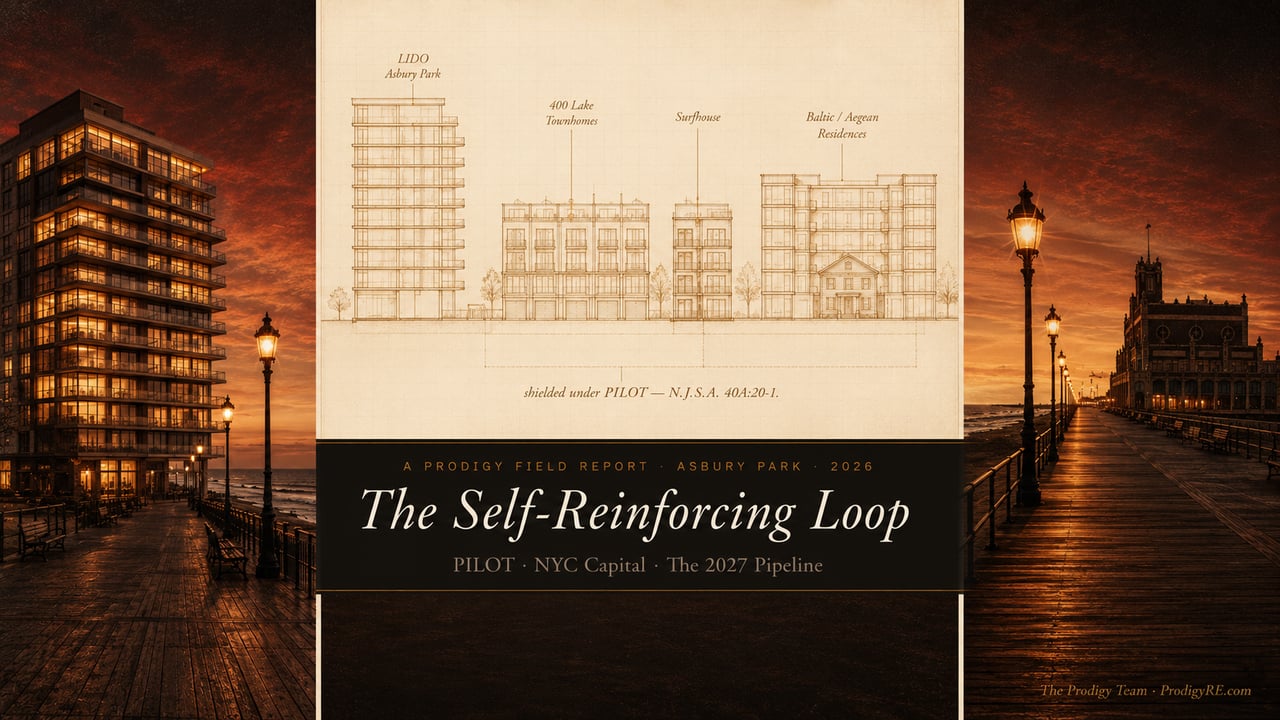
The Asbury Park Development Economics Report · 2026
A New Jersey tax mechanism, a Manhattan capital pipeline, and a two-square-mile city. Why Asbury Park's development economics don't behave like the rest of the Jersey Shore.
The Argument in Brief
Most Jersey Shore towns attract seasonal buyers, absorb a development cycle or two, and plateau. Asbury Park has done something structurally different. Over the past decade, the city has built a self-reinforcing investment loop: a municipal tax instrument that makes luxury development financially viable, a high-equity capital migration pipeline from the New York metropolitan area, and a brand identity strong enough to command unprecedented pricing.
The supply side is engineered by New Jersey's Payment in Lieu of Taxes (PILOT) program. The demand side is funded by NYC capital migrating into Monmouth County at unprecedented intensity. The combination has produced an active development pipeline running through 2027 and beyond — and a delivered inventory that includes a $7.6 million penthouse sale at LIDO that set the all-time New Jersey condominium record before the project had even broken ground.
This post unpacks the financial mechanics, the migration economics, and the new construction pipeline with the specificity serious buyers and investors require.
A Definition for the Reader
The PILOT Program
Payment in Lieu of Taxes — a long-term agreement authorized under New Jersey's Long-Term Tax Exemption Law (N.J.S.A. 40A:20-1). A municipality grants a developer a multi-decade exemption on the assessed value of new building improvements. The underlying land remains conventionally taxed. In exchange, the developer (or the eventual condominium owners) pays an annual service charge to the city instead of conventional property taxes.
The mechanism's appeal to municipalities: under conventional New Jersey taxation, a city must share collected property taxes with the county and school district. Under a PILOT, the municipality typically retains 95% of the annual service charge and remits only a mandatory 5% to the county — bypassing school-district funding entirely.
Why it matters here: the PILOT is the financial engine that makes resort-scale luxury condominiums and rental towers economically viable to build in a two-square-mile city of roughly 15,000 residents. Without it, the math on most of Asbury Park's pipeline does not work.
Most Jersey Shore towns absorb a development cycle or two and plateau. Asbury Park has not. The city has, over the past decade, constructed something more durable: a feedback loop in which municipal tax policy attracts institutional capital, which drives valuations, which attracts the next wave of developers, who originate the next round of PILOT-supported projects.
The loop is not speculative. It is structurally underwritten by two independent forces that have arrived at the same place at the same time: a state-authorized financial mechanism, and a population shift powered by remote work, equity-rich New Yorkers, and a permanent reorganization of how affluent professionals choose where to live. This post examines both forces, surveys the active pipeline, and identifies the two risks every Asbury Park buyer should price into a long-term hold.
For the consumer-facing breakdown of every existing condominium building by tier and price — LIDO, Ocean Club, North Beach, Vive, South Grand, Griffin, Santander, and more — see our Asbury Park Condo Market Guide. The analysis below focuses on the financial mechanics behind those buildings — the engine, not the inventory.
Chapter
The Supply Engine
Why the city benefits, why developers benefit, and what individual buyers inherit at closing.
Every major waterfront and downtown development in Asbury Park — LIDO, Asbury Ocean Club, Wesley Grove, South Grand, Vive, and others — was made financially viable in part by a long-term PILOT agreement. The structure is consistent across projects, though the specific terms vary.
For rental developments, the service charge is typically calculated as a percentage of the property's gross annual revenue, in a tiered structure that steps up over time. For fee-simple condominium sales, the PILOT is calculated through a specialized assessment formula tied to the initial sale price, designed to produce a lower annual obligation than conventional taxation during the early years of the agreement.
For the prospective buyer, purchasing a unit inside an active PILOT directly lowers annual carrying costs. The service charge is designed to produce a lower annual obligation than conventional taxation on a multi-million-dollar luxury property would otherwise generate. That suppressed tax burden improves monthly cash flow, allows buyers to justify higher purchase prices, and supports stronger resale liquidity — because future buyers inherit the same advantage for the remaining life of the agreement. Buildings marketing active PILOTs with significant runway remaining command a measurable premium in the resale market specifically because of this inheritance.
The Critical Distinction
PILOT agreements are not permanent.
Most are structured with service charge tiers that step up over time, gradually increasing the annual obligation as the agreement matures. When agreements eventually expire, properties transition back onto conventional, fully assessed tax rolls — a re-rating event that introduces downward price pressure on specific buildings as their remaining PILOT runway shortens. Sophisticated buyers price the eventual transition into their long-term hold strategy from the day they acquire.
Chapter
The Demand Engine
Equity-rich capital, permanently decoupled from commute geography.
The demand side of the Asbury Park thesis is underwritten by one of the most consistent capital migration patterns in the Northeast. U.S. Census data shows New Jersey's population reached 9.5 million in 2024, driven primarily by international immigration that offset a net domestic outbound loss of roughly 35,554 residents to other states. The headline outmigration narrative, however, obscures a more relevant reality: the residents leaving are disproportionately retirees and lower-income households, while the residents arriving — and the wealth flowing in from the New York metropolitan area into Monmouth County specifically — represent high-earning professionals and equity-heavy households.
The value proposition is mathematically compelling. A household liquidating a Staten Island or Brooklyn property at peak valuation can often acquire substantially more space, land, and amenity in Monmouth County for equal or less total capital outlay — even after a decade of dramatic Jersey Shore price appreciation. That equity transfer funds cash purchases, compresses negotiation timelines, and creates a buyer pool largely insulated from elevated mortgage rates.
Cash dominance at the upper tiers is a documented structural feature of this migration. When that buyer demographic crosses into Asbury Park, the same behavior follows. The result is a luxury tier that is functionally decoupled from rate sensitivity — a critical distinction for investors modeling yield and exit scenarios.
“
Rutgers Professor James Hughes put it plainly: with declining births and net domestic migration losses, immigration is now the only source of population growth in New Jersey. For Asbury Park, the implication is structural — the buyers shaping the city are no longer arriving by commuter rail. They are arriving by equity transfer.
Anthony Licciardello · Broker · The Prodigy Team
The structural shift in relocation motivation reinforces this dynamic permanently. A decade ago, nearly half of interstate moves were driven by corporate transfers or new employment. By 2025, that share had fallen by roughly half. Lifestyle, family proximity, and environmental amenity now lead as the primary relocation drivers. For Asbury Park, the practical implication is that the condo market is no longer a secondary-home or seasonal play for most buyers. Hybrid and remote work infrastructure has made it a viable primary and co-primary residence market — which demands year-round retail, services, and amenities at a level that directly shapes the programming of every new development in the pipeline.
Chapter
Newly Delivered
K. Hovnanian's quietly architecturally unusual delivery — and the one house they could not buy.
Among the most architecturally unusual deliveries of the current cycle is the Baltic and Aegean development by K. Hovnanian. The Baltic sits at 216–218 Third Avenue with 17 condominiums. The Aegean sits at 215 Second Avenue with 27 condominiums. Both buildings rise three stories over secure below-grade garage parking on approximately 0.8 acres of previously vacant land. Designed by MVMK Architecture, both feature K. Hovnanian's Loft Look aesthetic — clean geometric lines, floor-to-ceiling Pella windows, GE Café stainless appliances, quartz countertops, and frameless glass shower enclosures.
The Baltic's three floor plans deliver two to three bedrooms across up to 1,329 square feet. The Aegean offers up to three bedrooms across up to 1,364 square feet. Rooftop decks with BBQ grills serve both buildings, with The Baltic adding an indoor clubroom shared by Aegean residents. Deeded garage parking with elevator access completes the package.
The development has attracted regional attention for a reason that has nothing to do with its floor plans. The two structures are built in a U-shape around an existing single-family home on Bergh Street whose owner declined to sell to the developer. The result is modern luxury condominiums effectively encircling a century-old colonial — a scene reminiscent of the Pixar film Up and a vivid physical illustration of the density pressure driving development strategy in Asbury Park's constrained waterfront zone. As of early 2026, The Aegean was approaching sellout, signaling strong absorption at this price tier even in a normalized market.
Chapter
Active Sales
A Fortune 500 builder's bet on rooftop-terrace townhomes at the Wesley Lake waterfront.
On February 5, 2026, Toll Brothers officially launched sales at 400 Lake at Asbury Park, with the sales center open at 400 Cookman Avenue. The community delivers three- and four-story waterfront townhomes across four floor plans ranging from 1,625 to 2,108+ square feet, with two to four bedrooms, 2.5 to 3.5 bathrooms, and one- or two-car garages. Pricing starts at $1,190,000, with move-in ready inventory available for spring occupancy.
The defining feature is the rooftop terrace — each home includes one, with panoramic views of Wesley Lake and the Atlantic. The Toll Brothers Design Studio allows buyers to personalize finishes from a curated selection, positioning the project squarely at buyers who want new-construction peace of mind alongside the spatial generosity of townhome living — without the overhead of a high-rise tower. The community is within walking distance of Cookman Avenue and the boardwalk, including The Stone Pony and The Wonder Bar.
| Floor Plan | Bed / Bath | Square Footage | Starting At |
|---|---|---|---|
|
Entry Plan 3-story townhome |
2 BR / 2.5 BA | 1,625 sq ft | $1.19M |
|
Mid-Plan 3-story townhome |
3 BR / 3 BA | ~2,013 sq ft | $1.49M+ |
|
Top Plan 4-story townhome |
4 BR / 3 BA | 2,108+ sq ft | $1.67M+ |
Source: Toll Brothers active listings and press materials, February–April 2026. Floor plan names abstracted for clarity. Prices and availability subject to change at the developer's discretion.
Chapter
The Rental Tier
When the institutional play is rental, not for-sale.
A critical structural nuance in the Asbury Park pipeline is the deliberate strategic shift by some institutional developers toward condo-quality rental properties rather than fee-simple condominiums for individual sale. This is not a concession to market weakness. It is a capital play designed to capture a specific demographic: the affluent NYC migrant who wants immediate, uncompromising luxury coastal living without committing to a multi-million dollar purchase in a transitional rate environment.
The clearest example is Surfhouse at 1150 Kingsley Street. The 226-unit project — developed by Starfield Companies, with architecture by Lessard Design and interiors by Fogarty Finger — opened for leasing in August 2025 as the first purpose-built luxury rental in Asbury Park's history. The building contains 206 apartments ranging from studios to three-bedrooms (700 to ~1,200 square feet), plus 20 four-story townhomes with two-car garages and private rooftop terraces. The entire project is rental — not for sale — but built to a standard indistinguishable from a for-sale luxury condominium.
The amenity package supports the positioning: 15,000 square feet of amenity space anchored by a resort-style heated pool and 15,000-square-foot landscaped courtyard, a resident-only rooftop lounge with ocean views, an indoor fitness studio, EV charging stations, and dedicated secure surfboard storage — a detail that signals how precisely the developer understands its target resident. The site also includes 3,500 square feet of ground-floor retail. Studios start at $2,700, with two- and three-bedroom apartments and four-story townhomes commanding meaningfully higher rents.
Surfhouse · 1150 Kingsley · Current Asking Rents
Studio
from $2,700 / month
One-Bedroom
from $3,200 / month
Two-Bedroom
from $3,685 / month
Three-Bedroom
from $5,400 / month
Four-Bedroom Townhome
from $9,235 / month
Asking rents sourced from active Surfhouse listings, April 2026. Townhome pricing may reflect net rents inclusive of concession periods. Subject to change.
For the buyer watching this market, Surfhouse provides a useful data point: monthly townhome rents approaching $10,000 in a building with no for-sale comparand validate the depth of demand for high-end product at this location, and support the long-term income potential of comparable for-sale units in the surrounding blocks.
Chapter
The Headliner
The single transaction that redefined New Jersey's luxury condominium ceiling.
Anchoring the current pipeline is LIDO Asbury Park, an eight-story waterfront condominium at 1201 Ocean Avenue developed by Inspired by Somerset Development — the team behind the Bell Works office complex in Holmdel. The project delivers 112 residences across one- to four-bedroom floor plans ranging from approximately 970 to 3,800+ square feet, with interiors by award-winning Clodagh Design, architecture by Minno & Wasko, nearly 50,000 square feet of resort-caliber amenities, and an anticipated 2027 delivery.
In the summer of 2025 — before the project had even broken ground — a triplex penthouse at LIDO sold for $7.6 million, setting the all-time New Jersey condominium sale record. The four-bedroom unit spans approximately 3,626 square feet indoors with an additional 2,366 square feet of outdoor space, including a private rooftop plunge pool, summer kitchen, double-height ceilings, and a marble fireplace. The transaction worked out to roughly $2,111 per square foot. The previous state record had been held by a $5.9 million sale at Asbury Ocean Club in 2020.
Pricing across the LIDO building runs from approximately $825,000 at the entry tier to over $8 million for the multi-story penthouses, with marketing handled by Corcoran Sunshine Marketing Group. The amenity package — saltwater spa pool, Turkish hammam, Vichy shower, hot and cold plunge pools, oceanfront fitness center, library lounge, screening room, pet spa, multisport simulator — is positioned to compete with five-star resort programming. LIDO broke ground in December 2025, with first closings anticipated in 2027.
Chapter
The Western Pivot
When PILOT economics work inland, the entire western corridor signals readiness.
Perhaps the most significant signal in the current pipeline is not what is being built on the oceanfront — it is what is being built inland. The 900–904 Springwood Avenue project, headed by Memorial Avenue Holdings Urban Renewal LLC, demonstrates that large-scale amenitized development is now financially viable in the city's historically under-invested western corridors, well beyond the immediate waterfront zone.
The project delivers a four-story mixed-use building containing approximately 92 residential apartments — including a 19-unit affordable housing component — roughly 7,250 square feet of office space, and a 107-space structured parking facility. The geographic pivot matters: when PILOT economics make a project at Springwood Avenue viable, the entire western corridor is effectively signaling readiness for the next wave of investment. Municipal planning documents also indicate conceptual presentations for additional projects near the downtown and waterfront zones — signaling that developer appetite for every available parcel remains essentially unabated, even as the most prominent oceanfront sites approach buildout.
Chapter
Strategic Outlook
Three structural supports. Two risks every long-term holder should be pricing today.
The Asbury Park investment thesis rests on three durable structural supports. The value gap between New York City real estate and Monmouth County persists and shows no sign of closing in any meaningful near-term timeframe. Hybrid work infrastructure has permanently expanded the radius within which affluent professionals will establish primary or co-primary residences. And the PILOT framework continues to make luxury development in this city financially viable for the developers who originate it and financially attractive for the buyers who absorb it.
Against those supports, two risks deserve serious attention.
Risk One
Incoming inventory competition.
LIDO's 2027 delivery will introduce 112 ultra-luxury units into a market that has never absorbed inventory at that price tier in volume. The Aegean and Baltic have already been delivered. Toll Brothers is actively selling 400 Lake. Surfhouse is leasing 226 units of rental product. Buyers in mid-tier buildings — North Beach, Wesley Grove, older sections of Ocean Club — will face intensifying competition from newer, more amenitized product. Buildings that fail to invest in active maintenance, lobby renovation, and infrastructure upgrades will face valuation pressure as baseline expectations rise.
Risk Two
PILOT normalization and statewide scrutiny.
Early-2010s agreements governing some Asbury Park buildings are aging into their higher service-charge tiers and will eventually expire. As that happens, secondary-market pricing in those communities will need to reflect the coming re-rating. The political landscape is also tightening: on January 21, 2026, newly-elected Jersey City Mayor James Solomon signed an executive order launching a comprehensive audit of all long-term tax exemptions in that city, targeting a July 1, 2026 completion. While localized to Jersey City, the action signals a broader statewide shift in how municipalities — and state legislators — are beginning to view long-term PILOT agreements. Buyers in PILOT-governed Asbury Park buildings should model the eventual transition to conventional taxation into their long-term hold and exit strategy.
The bottom line is what the transaction data already says. A $7.6 million penthouse sold in Asbury Park before the building broke ground. Toll Brothers is selling waterfront townhomes from $1.19 million in a market where new supply continues to be absorbed. The western corridor is beginning its own development cycle. This market has moved past the revitalization narrative and into the maturation phase — which means the investment window for ground-floor pricing has largely closed, but the window for intelligent, data-driven acquisition in a maturing luxury market is very much open.
A Private Consultation
PILOT status, building age, finish quality, and incoming new-supply competition affect every position differently. A 20-minute conversation usually identifies the one or two variables that move the number most.
Anthony Licciardello · The Prodigy Team · Conversations are confidential.
Appendix
Reader Questions
Common questions on Asbury Park investment and development.
Question One
What is a PILOT tax abatement in New Jersey real estate?
A PILOT — Payment in Lieu of Taxes — is a long-term agreement authorized under N.J.S.A. 40A:20-1 under which a developer receives an exemption on the assessed value of new building improvements in exchange for paying an annual service charge to the municipality. In Asbury Park, these agreements typically run multiple decades and are structured to produce a lower annual tax obligation than conventional property taxation on the same asset would generate. For buyers, an active PILOT means lower carrying costs and improved monthly cash flow. For the city, it means retaining 95% of the service charge revenue locally rather than sharing conventional tax collections with the county and school district.
Question Two
Is Asbury Park a good place to invest in real estate in 2026?
The case for Asbury Park is structural rather than speculative. The value gap between New York City real estate and Monmouth County continues to funnel cash-heavy buyers into the market. PILOT agreements suppress carrying costs on new construction, supporting valuations. The $7.6 million LIDO penthouse sale — the highest condominium sale in New Jersey history — and absorption velocity at Aegean, Baltic, 400 Lake, and Surfhouse all signal genuine depth of demand. The variables to evaluate carefully are PILOT runway remaining on any specific building, the building's competitive exposure to incoming new supply, and the long-term carrying-cost impact of eventual PILOT expiration.
Question Three
What new construction is coming to Asbury Park?
As of mid-2026, the most significant active projects are LIDO Asbury Park (112 condominiums at 1201 Ocean Avenue by Inspired by Somerset Development, anticipated 2027 delivery) and 400 Lake at Asbury Park by Toll Brothers (waterfront townhomes with sales launched February 2026, move-in-ready inventory available). The Baltic and Aegean by K. Hovnanian were completed and approached sellout in late 2025 / early 2026. Surfhouse at 1150 Kingsley opened for luxury rental leasing in August 2025. The 900 Springwood Avenue mixed-use project represents the next wave of western-corridor development.
Question Four
How do Asbury Park condo prices compare to the Hamptons?
Asbury Park is not at Hamptons price parity — but the gap is narrowing faster than most regional observers expected. The $7.6 million LIDO penthouse set a new all-time New Jersey condo record and drew direct comparisons from buyers who would historically have looked exclusively at the Hamptons, Palm Beach, or Miami. At the standard two-bedroom tier, top Asbury Park buildings approach pricing that begins to overlap with entry-level Hamptons product. The critical difference remains brand legacy and land scarcity: the Hamptons has decades of established ultra-high-net-worth positioning. Asbury Park has momentum, municipal infrastructure investment, and a value gap that continues to attract capital.
Sources & Methodology
PILOT framework per New Jersey Long-Term Tax Exemption Law (N.J.S.A. 40A:20-1). Jersey City Executive Order signed January 21, 2026 by Mayor James Solomon, with audit completion targeted for July 1, 2026 (Genova Burns LLC; HudPost). LIDO Asbury Park figures sourced from Inspired by Somerset Development press materials, Corcoran Sunshine Marketing Group, Patch, Robb Report, NJBIZ, and The Real Deal coverage of the July 2025 record-setting $7.6 million penthouse sale. Surfhouse details sourced from Starfield Companies, Real Estate NJ, NJBIZ, and RentCafé active listings (April 2026). 400 Lake at Asbury Park details sourced from Toll Brothers press releases (February 5, 2026), Globe Newswire, and ROI-NJ. The Baltic and Aegean details sourced from K. Hovnanian's official community pages, Richard Nagel real estate listings, and Jersey Digs coverage of the original 2021–2022 zoning approval. U.S. Census Bureau population data and Pew Research analysis (March 2025); James Hughes commentary via NJBIA. Nothing in this article constitutes legal, tax, or investment advice; consult a qualified New Jersey real estate attorney, tax professional, and licensed financial advisor before making any acquisition, hold, or exit decision.
Prodigy Real Estate is an innovative real estate company offering high-end video production, home valuation services, purchasing, and home sales. Serving New York and New Jersey.