
The original 1806 "Oranges" anchor city that spawned East Orange, South Orange, and West Orange. Orange HS Tornadoes (est. 1869). +14.3% post-2010 growth. Median sale ~$425K.
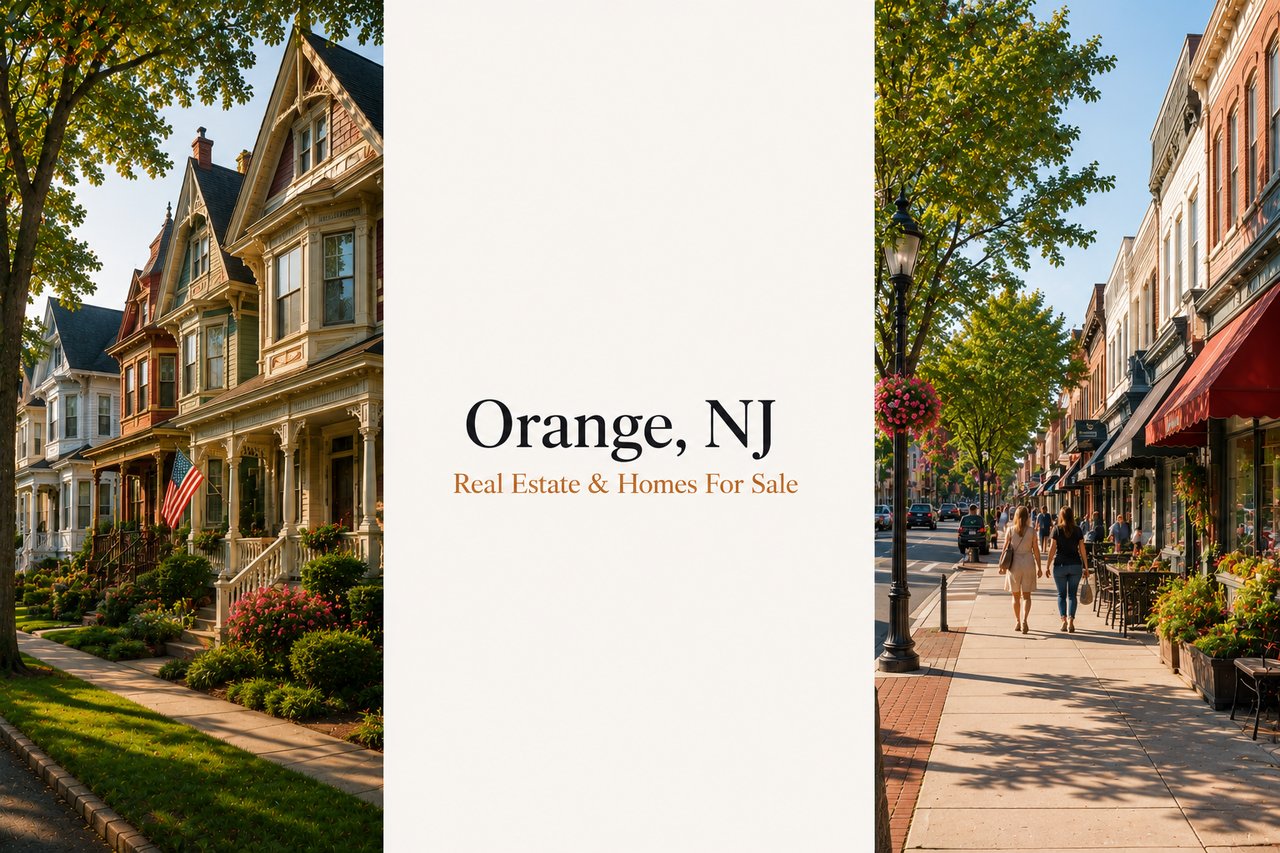
If you're searching for homes for sale in Orange, NJ, you're looking at the historic anchor city of "the Oranges" — the 1806 township that spawned East Orange, South Orange, and West Orange from the original Newark territory. Officially known as the City of Orange Township, the city is home to 34,447 residents (2020), estimated at 35,079 in 2024 — making it the 8th-most-populous municipality in Essex County (69th of 565 in New Jersey).
Compact land area of 2.21 square miles (19th of 22 in Essex by area) yields one of the densest profiles in the county: 15,565.7 residents per square mile ranks 3rd in Essex, behind only East Orange and Newark. The city has seen +4,313 (+14.3%) growth post-2010 — among the strongest demographic turnarounds of any Essex municipality in the 2020 census cycle.
Orange's history runs deeper than most NJ cities. The community was originally part of Newark and called "Newark Mountains." In 1780, residents voted to call their town Orange; full separation from Newark came in 1806. Orange was incorporated as a township on November 27, 1806 from portions of Newark, then reincorporated as a city on April 3, 1872. In 1982 the city was one of four Essex County municipalities to pass a referendum reclassifying as a township to qualify for federal revenue-sharing aid — hence its current official name, the City of Orange Township.
The city operates under the Faulkner Act mayor-council form of government with a City Council legislative body. Mayor Dwayne D. Warren currently serves with a term ending June 30, 2028; Administrator Christopher Hartwyk; Deputy Clerk Joyce L. Lanier. Orange shares borders with East Orange, West Orange, and South Orange — the three other "Oranges" that descend from the same 1806 township boundary.
The Orange Board of Education serves PreK-12 students across 12 schools, headquartered at 451 Lincoln Avenue. The district enrolls 5,629 students (2020-21) at an 11.1:1 ratio, classified DFG A and a Former Abbott district under Superintendent Gerald Fitzhugh II. Orange High School (Tornadoes) at 400 Lincoln Avenue is the district's comprehensive 9-12 high school — established 1869, making it one of New Jersey's oldest continuously operating high schools (predating both East Orange's Campus HS and most Essex County secondary schools). The school enrolls 1,370 students (2023-24) at a 16.4:1 ratio under Principal Jason Belton; colors are Orange and Black; motto "EDUCATE, ELEVATE, EMPOWER"; newspaper "Tornado"; Super Essex Conference and North Jersey Super Football Conference; Middle States accredited.
Orange real estate trades at competitive urban Essex County pricing with a median sale around $425,000. The market is anchored by exceptional transit access (NJ Transit Morris & Essex Line service to NYC Penn Station and Hoboken), one of the deepest multi-family investment inventories in Essex, the historic-anchor identity within "the Oranges," and the strongest population growth (+14.3%) of any major Essex city this past census cycle. ZIPs are 07050 and 07051; area code 973; elevation 197 ft.
Orange offers something none of the other "Oranges" can claim: it's the original. Founded as a township in 1806 from portions of Newark, Orange is the parent municipality from which East Orange, South Orange, and West Orange each broke off over the 19th and 20th centuries. That deep historical identity — combined with one of the most dramatic population recoveries in Essex County (+14.3% from 2010 to 2020) — makes Orange a market in genuine transition.
For buyers, the value case is direct. Median sale pricing around $425,000 puts Orange well below Bloomfield, West Orange, and Montclair, while the city offers NJ Transit Morris & Essex Line rail service to Penn Station and Hoboken, direct access to I-280 and the Garden State Parkway, and proximity to Newark Liberty International Airport. For investors, Orange holds one of the densest 2-family, 3-family, and small multi-family inventories in Essex — much of it dating to the late-19th-century industrial expansion that followed the 1872 city incorporation. Orange High School (Tornadoes), founded in 1869, is among NJ's oldest continuously operating public high schools and grounds the city's civic identity.
Incorporated as a township November 27, 1806 from portions of Newark — the parent municipality from which East Orange, South Orange, and West Orange all descend. Reincorporated as a city April 3, 1872; reclassified as township 1982 for federal revenue sharing.
Population grew from 30,134 in 2010 to 34,447 in 2020 — a +4,313 increase, +14.3%. Among the strongest growth rates of any major Essex County city this census cycle. 8th of 22 Essex by population; 3rd-densest at 15,565.7 per square mile.
Orange High School (Tornadoes, Orange and Black, motto "EDUCATE, ELEVATE, EMPOWER") at 400 Lincoln Avenue was established in 1869 — one of New Jersey's oldest continuously operating public high schools. Principal Jason Belton, 1,370 students, Middle States accredited.
Orange's 2.21-square-mile urban footprint concentrates housing stock around four broad eras: late-19th-century Victorians, Italianates, and Brownstones from the post-1872 industrial city period; early-20th-century Foursquares, Colonial Revivals, Tudor Revivals, and Center Hall Colonials; mid-century Cape Cods, ranches, bi-levels, and brick rowhouses; and a substantial base of 2-family, 3-family, and 4-family multi-family residences alongside walk-up apartments. Newer post-2000 transit-oriented mixed-use developments along the Brick Church Station corridor round out the upper tier. The buyer pool reflects the range — first-time owner-occupants, NYC commuters, multi-family investors, and corporate professionals seeking inner-ring access at substantially lower entry pricing than the surrounding "Oranges" and Bloomfield.
Two-family, three-family, and four-family residences anchor the entry segment, alongside condos, townhomes, walk-up apartments, brownstones, brick rowhouses, and smaller Cape Cod and bungalow stock. First-time buyers, young NYC commuters, and investors targeting the city's substantial rental market dominate this tier.
Single-family Center Hall Colonials, Victorians, Italianates, Foursquares, Tudor Revivals, Colonial Revivals, larger Cape Cods, splits, and bi-levels in established 1890s-1950s neighborhoods. Primary-residence demand driven by Orange HS Tornadoes access, Brick Church Station NJ Transit, and I-280/GSP commuter corridors.
Larger Victorian, Queen Anne, Tudor Revival, and Colonial Revival heritage residences from the post-1872 city-era expansion, plus newer post-2000 custom-build and transit-oriented mixed-use development near Brick Church Station. Buyers include NYC executives, established professionals, and selective investors.
Orange's 2.21-square-mile footprint organizes around the historic civic spine of Main Street and Lincoln Avenue, the Brick Church Station / Highland Avenue Station commuter rail corridor, and the cluster of 12 schools that the Orange Board of Education operates citywide.
At 400 Lincoln Avenue, the Tornadoes practice and study in the fourth building to serve as Orange High School since the school's 1869 founding. The current facility was dedicated October 7, 1973. 1,370 students 9-12, 16.4:1 ratio, Orange and Black colors, motto "EDUCATE, ELEVATE, EMPOWER." Principal Jason Belton. Middle States accredited. The Orange Middle School sits on the same Lincoln Avenue / Central Avenue campus.
The Orange Board of Education is headquartered at 451 Lincoln Avenue. The district operates 12 schools serving PreK-12 — including Cleveland Street School, Forest Street Community School, Heywood Avenue School, Lincoln Avenue School, Rosa Parks Community School, Oakwood Avenue Community School, Park Avenue School, Central Elementary, Orange Preparatory Academy, S.T.E.M. Innovation Academy of the Oranges, and the John Robert Lewis Early Childhood Center. 5,629 students at an 11.1:1 ratio, DFG A, Former Abbott. Superintendent Gerald Fitzhugh II.
Two NJ Transit Morris & Essex Line stations serve Orange — Brick Church Station and Highland Avenue Station — providing direct weekday rail service to New York Penn Station in Midtown Manhattan and to Hoboken Terminal. The Brick Church corridor has been the focus of recent transit-oriented mixed-use redevelopment.
The Main Street and Lincoln Avenue corridors form Orange's civic spine — anchoring City Hall, the Orange Public Library, the Board of Education, the high school campus, and the city's historic commercial district. The First Presbyterian Church of Orange (the former 1869 mother church of the original high school site) remains a defining landmark.
Orange borders East Orange, South Orange, and West Orange. Together, the four municipalities are commonly referred to as "the Oranges" — each having broken off from the original 1806 Orange Township during the 19th and 20th centuries.
"Orange is the most overlooked of the four 'Oranges' — and the most undervalued. It's the original 1806 township from which East Orange, South Orange, and West Orange all descended, it has two NJ Transit Morris & Essex Line stations with direct service to Penn Station and Hoboken, and it grew +14.3% in the last census cycle — among the strongest demographic rebounds in Essex County. Median pricing around $425,000 still sits well below the surrounding Oranges and Bloomfield, and the Brick Church Station redevelopment corridor offers genuine transit-oriented upside. Orange High School (Tornadoes), founded in 1869, is one of NJ's oldest public high schools — and the city's civic anchor."
Buyers shopping Orange typically cross-shop against the other "Oranges" and surrounding inner-ring municipalities: East Orange ("Crossroads of NJ," Jaguars HS, +8.3% growth), West Orange Township (Edison NHP, Mountaineers), South Orange Village (Seton Hall, DFG I), Bloomfield Township (Bengals HS, 4th-largest Essex), and Newark (NJ's largest city, Branch Brook Park, Newark Liberty Airport).
| Town | Median Sale | Population | Land Area |
|---|---|---|---|
| Orange ★ | $425,000 | 34,447 | 2.21 mi² |
| East Orange | $435,000 | 69,612 | 3.93 mi² |
| West Orange Township | $650,000 | 48,843 | 12.00 mi² |
| South Orange Village | $1,025,000 | 18,484 | 2.85 mi² |
| Bloomfield Township | $525,000 | 53,105 | 5.34 mi² |
★ Subject town. Sources: U.S. Census 2020, Essex County government, and NJ Department of Education. Orange (officially the City of Orange Township) population 34,447 (2020), est. 35,079 (2024); +4,313 (+14.3%) from 30,134 in 2010; ranks 69th of 565 in NJ + 8th of 22 in Essex County. Land area 2.21 sq mi (2.21 land + 0.0039 water = 0.09%); 392nd of 565 in NJ + 19th of 22 in Essex. Density 15,565.7/sq mi, ranking 17th of 565 in NJ + 3rd of 22 in Essex County. Elevation 197 ft. ZIPs 07050-07051. Area code 973. Incorporated as township November 27, 1806 from portions of Newark; reincorporated as city April 3, 1872; reclassified as township 1982 for federal revenue sharing. Mayor Dwayne D. Warren, term ends June 30, 2028. Government: Faulkner Act mayor-council form with City Council body. Schools: Orange Board of Education (PreK-12, 12 schools at 451 Lincoln Avenue, 5,629 students 2020-21, 11.1:1, DFG A, Former Abbott district, Superintendent Gerald Fitzhugh II). Orange High School (Tornadoes, 400 Lincoln Avenue, established 1869, 1,370 students 2023-24, 16.4:1, Orange and Black colors, motto "EDUCATE, ELEVATE, EMPOWER," newspaper "Tornado," Super Essex Conference, North Jersey Super Football Conference, Middle States accredited, Principal Jason Belton). NJ Transit Morris & Essex Line: Brick Church Station + Highland Avenue Station with service to NYC Penn Station and Hoboken. Pricing varies substantially by neighborhood and product type — historic Victorians and post-2000 transit-oriented developments can reach $550K-$800K+. Verify property-specific pricing with The Prodigy Team before contract.
The 1806 Original Township That Spawned the Other "Oranges." Orange was originally part of Newark, called "Newark Mountains." Residents voted in 1780 to rename the community Orange; full separation came when the township was incorporated November 27, 1806. The reincorporation as a city followed on April 3, 1872. Over the following decades, three other municipalities broke off from the original Orange territory — East Orange, South Orange, and West Orange — each developing its own civic identity but all sharing the original Orange heritage. In 1982, Orange (along with three other Essex municipalities) passed a referendum reclassifying as a township for federal revenue-sharing purposes; the official name became the City of Orange Township.
+14.3% Growth Signals a Real Demographic Rebound. Orange added 4,313 residents between the 2010 and 2020 censuses — a +14.3% increase. This is one of the strongest growth rates of any major Essex County city this cycle, and it follows a long stretch of demographic decline through the 1980s and 1990s. The current 34,447 population places Orange 8th of 22 in Essex; at 15,565.7 per square mile, it ranks 3rd-densest in the county behind only East Orange and Newark. The growth has pulled investment toward the Brick Church Station transit-oriented corridor and into the city's deep stock of 2-family and small multi-family inventory.
Orange High School Tornadoes — Est. 1869, NJ's Living Heritage. Orange High School at 400 Lincoln Avenue traces its lineage to September 13, 1869 — the dedication of the school's first building adjacent to the First Presbyterian Church of Orange. The Tornadoes have occupied four buildings in their 156-year history; the current facility was dedicated October 7, 1973. With 1,370 students at a 16.4:1 ratio under Principal Jason Belton, the school anchors the Orange Board of Education's 12-school PreK-12 system (5,629 students, DFG A, Former Abbott district, Superintendent Gerald Fitzhugh II). Colors are Orange and Black; motto "EDUCATE, ELEVATE, EMPOWER"; newspaper "Tornado"; Middle States accredited.
Two Train Stations, Faulkner Act Government, and the Original Civic Spine. NJ Transit's Morris & Essex Line operates two stations within Orange — Brick Church Station and Highland Avenue Station — providing direct weekday service to NYC Penn Station and to Hoboken Terminal. The city operates under the Faulkner Act mayor-council form of government with a City Council legislative body; Mayor Dwayne D. Warren serves a term ending June 30, 2028; Administrator Christopher Hartwyk; Deputy Clerk Joyce L. Lanier. Borders include East Orange, West Orange, and South Orange. ZIPs are 07050 and 07051; area code 973; elevation 197 ft.
Median sale pricing in Orange runs around $425,000, with variation by neighborhood and product type. Two-family, three-family, and multi-family inventory plus smaller condos and rowhouses trade in the $250K-$425K entry tier. Single-family Center Hall Colonials, Foursquares, Tudors, and renovated Victorians occupy a $400K-$575K family tier. Larger historic Victorians from the post-1872 city era and newer post-2000 transit-oriented developments near Brick Church Station can reach $550K-$800K+. Orange consistently delivers meaningful value relative to the other "Oranges" and Bloomfield while offering two NJ Transit stations and direct NYC rail access.
Orange students attend the Orange Board of Education, headquartered at 451 Lincoln Avenue. The district operates 12 schools serving PreK-12 students — 5,629 enrolled at an 11.1:1 ratio, DFG A and Former Abbott district, under Superintendent Gerald Fitzhugh II. Orange High School (Tornadoes) at 400 Lincoln Avenue is the comprehensive 9-12 high school, established in 1869 — one of New Jersey's oldest. 1,370 students, 16.4:1 ratio, Orange and Black colors, motto "EDUCATE, ELEVATE, EMPOWER," Principal Jason Belton, Middle States accredited.
Orange was originally incorporated as a township on November 27, 1806 from portions of Newark, then reincorporated as a city on April 3, 1872. In 1982 the city was one of four Essex County municipalities to pass a referendum reclassifying as a township in order to qualify for federal revenue-sharing aid available only to townships. The official municipal name became the City of Orange Township — but the community is still commonly referred to simply as Orange.
"The Oranges" refers to the four neighboring Essex County municipalities that all share a common origin in the 1806 Orange Township: Orange (the original), East Orange, South Orange, and West Orange. Each broke off from the original township during the 19th and 20th centuries to form its own municipal identity. Orange is the historic anchor; East Orange is the largest by population; South Orange is the most affluent (anchored by Seton Hall University); West Orange has the largest area (anchored by Thomas Edison National Historical Park).
The Prodigy Team covers Orange's full inventory — historic Victorians and Italianates from the post-1872 city-era expansion, early-20th-century Foursquares and Tudors, the city's substantial 2-family and multi-family investment stock, transit-oriented mixed-use developments near Brick Church Station, and newer post-2000 custom-builds across the city's five wards. Cinematic 4K aerial drone marketing, NY/NJ broker representation, and 20+ years of Monmouth Coast and Manhattan/Brooklyn relocation experience — now serving the original "Oranges" anchor.
Contact The Prodigy TeamProdigy Real Estate is an innovative real estate company offering high-end video production, home valuation services, purchasing, and home sales. Serving New York and New Jersey.