
Anthony Licciardello | April 13, 2026
New Jersey Real Estate Market
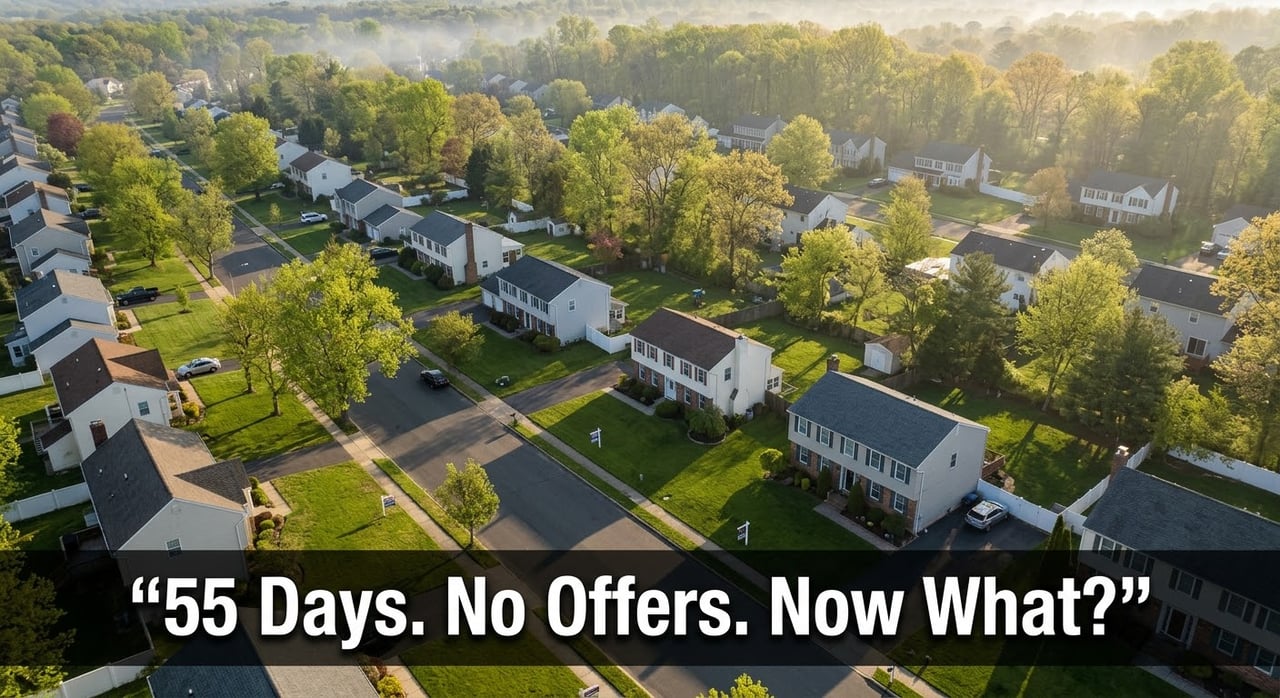
If your home is sitting on the market longer than you expected — or if you've been watching the spring unfold and wondering why activity feels so muted — you're not imagining it. New Jersey homes are averaging 55 days on market right now, up sharply from 38 days just two years ago. Showings are down. Offers are slower. Sellers across Monmouth, Union, and every county in between are asking the same question. Here's the honest answer.
Spring was supposed to be different this year. By late February 2026, the average 30-year fixed mortgage had briefly dipped to 5.98% — the lowest reading in over three and a half years. For the first time since the rate shock of 2022, a window below 6% appeared. The expectation was logical: cheaper financing would unlock enormous pent-up demand, and the spring selling season would finally deliver the activity that buyers and sellers had been waiting for.
Then the Strait of Hormuz closed.
The escalation of military conflict in the Middle East in early 2026 triggered an immediate global energy supply shock. Benchmark crude surged. National gasoline prices crossed $4.00 per gallon for the first time in three years. The March Consumer Price Index came in at 3.3% annualized — the highest reading since summer 2024 — driven by a single-month 10.9% spike in the energy index. The disinflationary trend the Federal Reserve had carefully guided since late 2023 reversed course in thirty days.
The bond market reacted immediately. Mortgage rates marched steadily upward over five weeks, erasing every affordability gain from the winter:
A temporary ceasefire announcement in the second week of April triggered a relief rally. Freddie Mac data for the week ending April 9 shows the 30-year fixed rate easing to 6.37%. But housing economists are uniformly cautious: with the Federal Reserve facing 3.3% inflation, robust job growth of 178,000 positions added in March, and unemployment holding at 4.3%, rate cuts remain off the table for the foreseeable future. Volatility — not relief — is the operating environment.
For a deeper read on how mortgage rate movements translate directly into buyer and seller behavior cycles, see our earlier analysis: The Rate and Sales Feedback Loop.
One number defines the spring 2026 market above all others.
University of Michigan Consumer Sentiment — April 2026
The lowest reading ever recorded in the survey's history — falling below the previous record set during the 2008 financial crisis. Down 10.7% from March's reading of 53.3. Economists had forecast 52.0.
The internal breakdown is stark. The Current Economic Conditions Index dropped to 50.1 — also its lowest reading on record. Consumer Expectations fell to 46.1, a level not seen since 1980. Survey respondents, in rare bipartisan agreement, cited the conflict in the Middle East as the primary driver of deteriorating conditions.
Perhaps most consequential for housing: year-ahead inflation expectations surged from 3.8% in March to 4.8% in April — the largest one-month jump in over a year. Long-run five-year inflation expectations also drifted upward to 3.4%.
When consumers expect persistent future inflation, they stop making large discretionary financial commitments. A home purchase is the largest. The survey data is showing up directly in how buyers are behaving right now.
Assessments of personal finances fell 11% in a single month. High-income earners who might otherwise be rate-insensitive are sitting on elevated stock portfolios battered by market volatility — and they are acting accordingly. The wealth effect cuts both ways.
The psychological freeze is not a collapse. Prices have not cratered. Inventory has not flooded the market. What it looks like instead is this: buyers who are fully pre-approved are choosing not to transact. Sellers who listed expecting a spring bidding war are watching their homes sit. And many sellers who haven't yet listed are deciding not to bother.
Nationally, homes are taking longer to sell for the 24th consecutive month. In New Jersey, the statewide average has extended to 55 days — up sharply from 38 days just two years ago. If your listing is sitting without offers, the cause is almost always one of three things:
The Three Most Common Reasons Homes Aren't Getting Offers Right Now
Overpriced for 2026
Sellers anchored to 2022 peak comps. Today's buyers are running numbers against current closed sales — and walking away from the gap.
Condition Standards Have Shifted
At 6.4% financing, buyers paying top dollar demand perfection. Aging roofs, dated kitchens, and deferred maintenance are deal-killers — not negotiating chips.
The Qualified Pool Is Smaller
High rates have pushed many buyers past debt-to-income limits. The pool isn't gone — but it is genuinely narrower than 2021 or 2022.
Sellers, rather than capitulating with price reductions, are pulling listings entirely. Delistings jumped approximately 28% nationally in early 2026. Sellers who cannot get their aspirational price within the first few weeks are retreating to the security of their existing low-rate mortgages rather than engaging with a market that no longer operates on 2022 rules.
Homes that do remain listed past the 30-day mark are increasingly vulnerable to negotiated concessions — rate buydowns, closing cost credits, repair allowances — as buyers recognize that leverage has quietly shifted on stale listings. As of February 2026, roughly 15.5% of all national listings had required explicit price reductions.
Despite the macro-level headwinds, New Jersey's structural fundamentals remain firmly in the seller's favor. Statewide, the median home price reached $531,000 in early 2026, representing a 4.8% year-over-year gain. Single-family homes command a median of $592,000 (+5.1%), while the condominium and townhome segment — often the entry point for first-time buyers — sits at $415,000 (+4.2%).
Active inventory climbed approximately 11.2% year-over-year to roughly 25,100 homes statewide. That sounds meaningful until measured against what a balanced market requires: 4 to 6 months of supply. New Jersey is at 3.2 months. The inventory growth reflects new multifamily pipeline deliveries and some investor repositioning — not a mass exit of single-family owners choosing to move. The fundamental scarcity that has defined this market for five years has not resolved.
| County | Median Price | YoY Price | YoY Inventory | Mos. Supply |
|---|---|---|---|---|
| Bergen | $742,000 | +3.9% | +7.4% | 1.6 |
| Monmouth | $585,000 | +5.2% | +12.8% | —* |
| Hudson | $560,000 | +3.4% | +9.8% | —* |
| Middlesex | $528,000 | +4.1% | +13.5% | 3.4 |
| Essex | $495,000 | +3.8% | +14.2% | 3.6 |
* Months-of-supply data not available at county level at time of publication. NJ closed-sale data, early 2026. Prodigy Real Estate compilation.
Bottom Line
NJ is slow in velocity, not in price. Prices are up 4.8% year-over-year statewide. At 3.2 months of supply, sellers still hold structural leverage. The era of effortless, rapid-fire sales has paused — and homes that ignore that reality are the ones sitting.
Monmouth County is showing the largest inventory gain of any tracked county in the state — up 12.8% year-over-year — while pricing remains the strongest outside Bergen, sitting at $585,000 with a 5.2% annual gain. That inventory growth matters. More options are surfacing for buyers than at any point in recent memory, which is beginning to shift negotiating dynamics in specific submarkets. But 5.2% price appreciation tells the other side of that story: demand has not evaporated. It has been suppressed by rate anxiety, not by any fundamental weakening of the market's underlying appeal. As NYC-to-NJ migration continues to apply sustained upward pressure on pricing — our county-by-county migration breakdown details exactly where those buyers are landing — the floor for Monmouth County values remains firmly supported.
For Union County — home to Westfield, Scotch Plains, Cranford, Berkeley Heights, and Fanwood — the picture mirrors the broader statewide dynamic. These are transit-accessible, inventory-constrained communities where median prices in desirable towns frequently exceed the statewide figure. The affordability math in Union County right now is genuinely challenging: a 6.4% rate on a $650,000 home means principal and interest approaching $4,000 per month before property taxes layer in an additional $800 to $1,200 per month. That carrying cost equation is forcing some buyers out of the market entirely and prompting others to recalibrate target towns — moving slightly further from the transit core in search of a price point that mortgage underwriters will actually approve.
For town-level data in these markets, see our recent reports on Westfield and Scotch Plains, as well as the full Monmouth County development pipeline breakdown.
The question buyers consistently ask is the obvious one: with rates this high and consumer sentiment at a record low, why aren't home prices falling?
The answer is the mortgage lock-in effect. As of early 2026, the vast majority of New Jersey homeowners with mortgages carry rates secured during the pandemic — at 3%, 3.5%, or 4%. Trading that mortgage for a new one at 6.37% means accepting an enormous reduction in purchasing power on their next acquisition. In most scenarios, a seller listing today would have to significantly downgrade their living situation simply to maintain the same monthly payment on a similarly priced home. The math is unambiguous.
Unless compelled by major life events — death, divorce, or a mandatory corporate relocation — those homeowners are staying put. That decision, multiplied across hundreds of thousands of New Jersey households, is what keeps inventory structurally suppressed and what prevents the kind of price correction that buyers hoping for a 2008-style reset continue to anticipate. The floor is not built on speculation. It is built on arithmetic.
Geography compounds this structural reality. Unlike the Sunbelt, where new subdivisions can be continuously constructed on cheap, abundant land, the Northeast operates within fixed coastal boundaries and dense existing development. In many New Jersey markets, the land itself accounts for 40% to 70% of a home's total value. That underlying land value has increased substantially. The mathematical floor for housing prices in this region is extraordinarily high — and it is not going anywhere.
Sellers face longer days on market and more friction than expected. Buyers face limited inventory frequently priced beyond what current rates support. Correctly priced homes in move-in condition are still selling. Everything else is sitting.
▸ If You're a Seller
The market has not turned against you — but it has turned demanding. Buyers financing at 6.4% have no tolerance for deferred maintenance, cosmetic shortcuts, or pricing calibrated to peak-era comps rather than current closed sales. The 28% surge in delistings means fewer active competitors than the inventory numbers suggest. But entering at the ceiling and waiting for a bidding war is the strategy most likely to end with an extended DOM count, a price reduction, and a transaction that closes for less than a well-priced opening would have commanded.
▸ If You're a Buyer
The calculus right now is genuinely difficult. Rates are elevated, prices are not correcting, and waiting for a structural crash in one of the most geographically constrained markets in the country has historically been a losing strategy. Monmouth County's 12.8% inventory growth gives you more options than last spring — use that leverage carefully. Homes sitting past 30 days are increasingly open to substantive concessions: rate buydowns, closing cost credits, inspection repair allowances. Understand your full carrying cost picture before you reach the offer stage. For a complete breakdown of what buyers are actually paying at closing, see our NJ closing costs guide.
▸ If You're Watching from the Sidelines
The decisive variable for the rest of 2026 is whether the current ceasefire holds, energy prices continue to moderate, and inflation resumes its downward path. If that sequence materializes, mortgage rates could ease toward the high 5s by late summer — and buyers currently sitting on the fence will move quickly and simultaneously. If conflict escalates and rates stay elevated through fall, the standoff persists. Neither outcome is guaranteed. Planning in this environment means being ready to act when the window opens, not waiting for certainty that won't come.
Prodigy Real Estate — Monmouth & Union Counties, NJ
Not sure what this market means for your situation?
We know these markets at the street level. Whether you're buying, selling, or trying to decide — we'll give you a straight answer.
Q · Seller
Why isn't my house selling in New Jersey?
The most common reasons right now are overpricing relative to current closed sales (not 2022 comps), condition issues that buyers at 6.4% financing refuse to accept, and a buyer pool that has shrunk due to affordability constraints. Homes that are priced correctly and in move-in condition are still selling — the market hasn't collapsed, it's become selective. If your home has been sitting past 30 days without an offer, a pricing or presentation adjustment is almost always the answer. The market is not going to come back and bail out an overpriced listing.
Q · Market Conditions
Is the housing market slow in New Jersey right now?
Yes — transaction volume is down and homes are sitting longer. The statewide average days on market has extended to 55 days, up from 38 days two years ago, and homes nationally have taken longer to sell for 24 consecutive months. Delistings jumped approximately 28% as sellers pull homes rather than accept lower-than-expected offers. But prices are not falling: the NJ statewide median reached $531,000, up 4.8% year-over-year. It's a slow market in velocity, not in price — a critical distinction for both buyers and sellers.
Q · Mortgage Rates
Will mortgage rates go down in 2026?
The Federal Reserve faces competing pressures: inflation running at 3.3% and robust job growth argue for holding rates steady, while geopolitical uncertainty argues for eventual relief. A temporary ceasefire in early April pulled the 30-year rate down to 6.37%, but housing economists characterize this as fragile. Sustained relief requires geopolitical stabilization, moderating energy prices, and a resumption of the disinflationary trend. If those conditions hold, rates could approach the high 5s by late 2026. If conflict escalates, elevated rates persist through the fall.
Q · Timeline
How long does it take to sell a house in NJ in 2026?
The current statewide average is 55 days, compared to 38 days in 2024. That said, well-priced and well-presented homes in inventory-constrained areas — particularly parts of Monmouth and Union counties — still move in under 30 days. The extended average is driven by overpriced and poorly maintained homes sitting without offers. If you want to sell in the shortest time frame, correct pricing from day one and strong presentation are far more important than the macro market environment.
Prodigy Real Estate is an innovative real estate company offering high-end video production, home valuation services, purchasing, and home sales. Serving New York and New Jersey.