
Anthony Licciardello | April 11, 2026
Sayerville
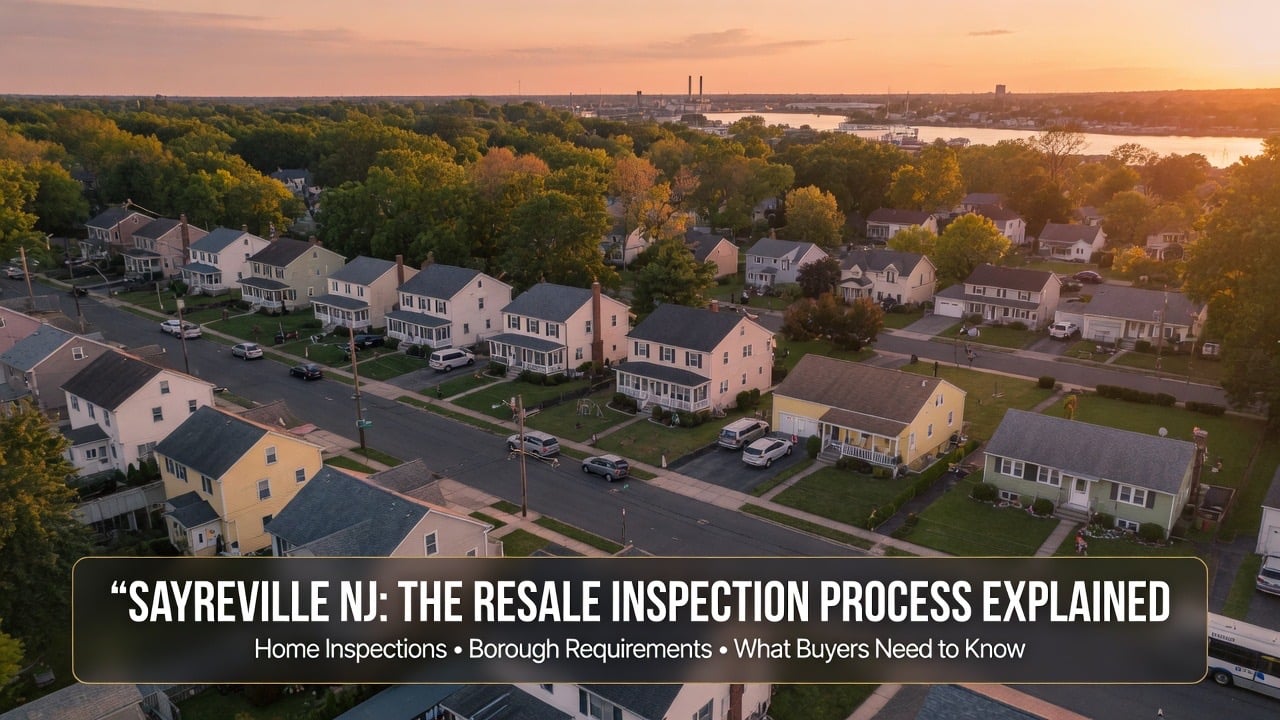
Sayreville is one of Middlesex County's most active resale markets — a steady mix of colonials, ranches, and townhomes that move quickly once they hit. But the closing process here has layers that catch sellers off guard, especially first-timers who assume the borough runs like every other town in the area. It doesn't. Sayreville requires not one but two separate municipal sign-offs before a deed can transfer, and if you're not tracking open permits from the moment you list, you can find yourself scrambling in the final week before closing. This is what the process actually looks like, step by step, and how it stacks up against what's required in Old Bridge, South Amboy, and Perth Amboy.
01
The first thing to understand is that Sayreville does not require a traditional "Certificate of Occupancy" for residential resales. New Jersey state law does not mandate a resale CO statewide — that obligation falls to each municipality individually. Sayreville has instead built a two-track system: a Resale Inspection Certificate issued through the borough's Code Enforcement office, and a separate Fire Prevention Resale Certificate issued by the Fire Marshal. Both are required. Both must be in hand before closing. Miss either one, and closing doesn't happen.
The distinction matters because these two inspections look at completely different things. Code Enforcement is focused on the physical condition of the home and whether any unpermitted work was done — finished basements, replaced water heaters, new furnaces, additions. The Fire Marshal is focused strictly on life-safety: smoke alarms, carbon monoxide detectors, and (since early 2025) no longer fire extinguishers. Getting both scheduled at the same time is smart. Scheduling them independently and out of sequence is how closings get pushed.
02
Here is how the process unfolds in practice:
Step 1 — Start the moment you list. Sayreville's Code Enforcement office strongly recommends that sellers and agents contact the borough as soon as the home hits the market — before attorney review, before an offer is accepted. The reason is open permits. If a previous owner pulled a permit for a roof replacement, a deck, or an electrical panel upgrade and never closed it out, that permit is still sitting open in Sayreville's system. The inspector will find it. Closing out an open permit takes time, sometimes weeks if a re-inspection is required. Discovering it on the Thursday before a scheduled Friday closing is a worst-case scenario that happens more than it should.
Step 2 — Create an online account and apply. Applications are submitted through Sayreville's online portal at sayrevillenj.portal.fasttrackgov.com. You'll need to create an account, complete the application with accurate property information, and submit. Incomplete applications slow everything down — make sure the property address, owner information, and contact details are correct before you hit submit.
Step 3 — Receive and pay the fee. Once submitted, the Code Enforcement office reviews the application and typically emails the fee within one business day. You pay online. There's no scheduling until payment is confirmed.
Step 4 — Request your inspection appointment. Resale inspections in Sayreville are conducted on Mondays and Wednesdays only. After payment is confirmed, you request a preferred date and the office either confirms it or offers alternates via email. Plan for this: if you're targeting a closing date, count backward from that date and make sure there's enough runway to complete any required remediation and a potential re-inspection.
Step 5 — Complete the Fire Prevention inspection. Separate from the Code Enforcement visit, the Fire Marshal's office conducts its own inspection focused on smoke and CO alarm compliance. This can be coordinated through the same portal. The borough publishes a Fire Prevention Resale Checklist that should be reviewed thoroughly before either inspection takes place — agents should provide it to sellers as early as possible.
Step 6 — Pass, remediate, or re-inspect. If the home passes both inspections, the certificates are issued and the transaction can proceed to closing. If either inspection uncovers violations — outdated smoke alarms, unpermitted finished space, open permits — the seller must remediate and schedule a re-inspection. For questions, contact Joan Kemble at the Code Enforcement office directly: 732-390-7077 or [email protected].
03
The resale inspection covers the physical condition of the home against local property maintenance standards. The areas that most commonly generate problems are what the borough explicitly flags: newly installed water heaters, furnaces, finished basements, and similar improvements. If a seller replaced a furnace two years ago without pulling a mechanical permit, or converted a basement recreation room without a construction permit, those items will likely surface during the inspection.
The borough's standard guidance is blunt on this point: filing for required permits ahead of time dramatically reduces the risk of holding up a closing. An unpermitted finished basement isn't automatically a dealbreaker, but it does trigger a permit application, a construction inspection, and potentially corrections before a final approval can be issued. In a competitive transaction with a fixed closing date, that timeline creates real pressure.
04
The Fire Prevention inspection is governed by N.J.A.C. 5:70-2.3 and 5:70-4.19. The rules are specific, and the most common failure points are smoke alarms that are over ten years old or were installed as standalone battery units when the home originally had a hardwired system.
Smoke Alarms: Required on every finished level of the home — basement, first floor, second floor, finished attic — and in or within ten feet of every separate sleeping area. As of January 1, 2019, all battery-powered units must be ten-year sealed battery alarms. Any alarm over ten years old must be replaced regardless of type. If a home has an existing hardwired or interconnected system, it must be maintained as installed — you cannot substitute wireless battery-powered units in place of a wired system. A licensed electrician may be required if wiring repairs are needed to ensure all alarms sound simultaneously.
Carbon Monoxide Alarms: Required within ten feet of all sleeping areas. CO alarms must be less than seven years old, or less than ten years old for sealed battery or combination smoke/CO units. Combination units are permitted and must follow the same placement rules as smoke alarms near sleeping areas.
Fire Extinguishers: No longer required. Effective February 3, 2025, portable fire extinguishers were removed from the resale inspection checklist statewide under an amendment to the Uniform Fire Safety Act (P.L.2025 c.19). Any existing extinguishers should be properly disposed of at a Middlesex County Household Hazardous Waste Drop-off event — they cannot simply be left behind.
05
New Jersey's approach to resale inspections is famously fragmented — every municipality sets its own rules, its own fees, and its own scope. What's required in Sayreville is meaningfully different from what a seller faces in the surrounding area. Here's how the key neighbors compare:
| Municipality | Certificate Type | Scope | Approx. Fee | Key Distinction |
|---|---|---|---|---|
| Sayreville | Resale Inspection Cert + Fire Prevention Cert | Property condition, open permits, smoke/CO alarms | Varies (confirmed at application) | Two separate inspections; Mon/Wed only for resales; proactive permit check strongly advised |
| Old Bridge | Certificate of Occupancy (CCO) + Smoke/CO Certificate | Zoning, building code, property maintenance, lead clearance | $250 CO; $250 CCO; $100 lead clearance | Broader scope than Sayreville; lead-based paint clearance is a distinct, additional step |
| South Amboy | Certificate of Occupancy (required for all sales) | Property maintenance code compliance; applies to every disposition of property | $50 inspection; $50 re-inspection | Lower fee but CO required for literally every sale — no exemptions for straightforward resales |
| Perth Amboy | Certificate of Code Compliance | Multi-department review: Code Enforcement, Zoning, Fire | $125 for homes under 2,500 sq ft | Offers "as-is" temporary certificate option (6 months) for buyers who intend to renovate; more structured appeal process |
The practical takeaway: Sayreville's dual-inspection model is more administratively involved than some neighbors — particularly compared to South Amboy, which runs a single streamlined CO process for a flat $50 fee. But Sayreville's system is less sweeping in scope than Old Bridge, which tacks on lead-based paint clearance as a separate step and applies a more comprehensive zoning and building code lens. Perth Amboy is the most structurally complex of the group, with a multi-department review and a formal appeal mechanism — though it also offers the most flexibility for distressed properties via its temporary "as-is" certificate option.
06
The sellers who have the smoothest closings in Sayreville are the ones who think like contractors about their own home before the listing goes live. They check their permit history through the borough, confirm that any renovation work done in the last ten to fifteen years had a permit pulled and properly closed, and do a smoke/CO alarm walk-through before the inspector ever sets foot inside. The ones who run into trouble are the ones who treat the resale inspection as a formality — something to handle in the final weeks of a transaction — rather than as a parallel workflow that needs to start at listing.
The Prodigy team works routinely with Sayreville sellers and has seen the difference that early coordination makes. The borough offices are responsive and clear about what's needed — but they can only work on their own timeline. The Monday-Wednesday inspection schedule is fixed. Fees must be paid before appointments are confirmed. Open permits require their own resolution track. None of those constraints bend because a closing date is approaching.
For buyers, Sayreville's system actually provides meaningful protection. The fact that Code Enforcement is actively checking for unpermitted work means the buyer is less likely to inherit a problem that will create headaches when they eventually go to sell. That's a real benefit — and one worth understanding before making an offer in a market where finished basements and aging mechanicals are common.
Questions about what to expect from Sayreville's resale inspection process — or what's required in a neighboring town — are exactly the kind of thing the Prodigy team handles before a contract is signed, not after. Start there, and the paperwork takes care of itself.
Prodigy Real Estate is an innovative real estate company offering high-end video production, home valuation services, purchasing, and home sales. Serving New York and New Jersey.