Anthony Licciardello | May 4, 2026
Westfield, NJ
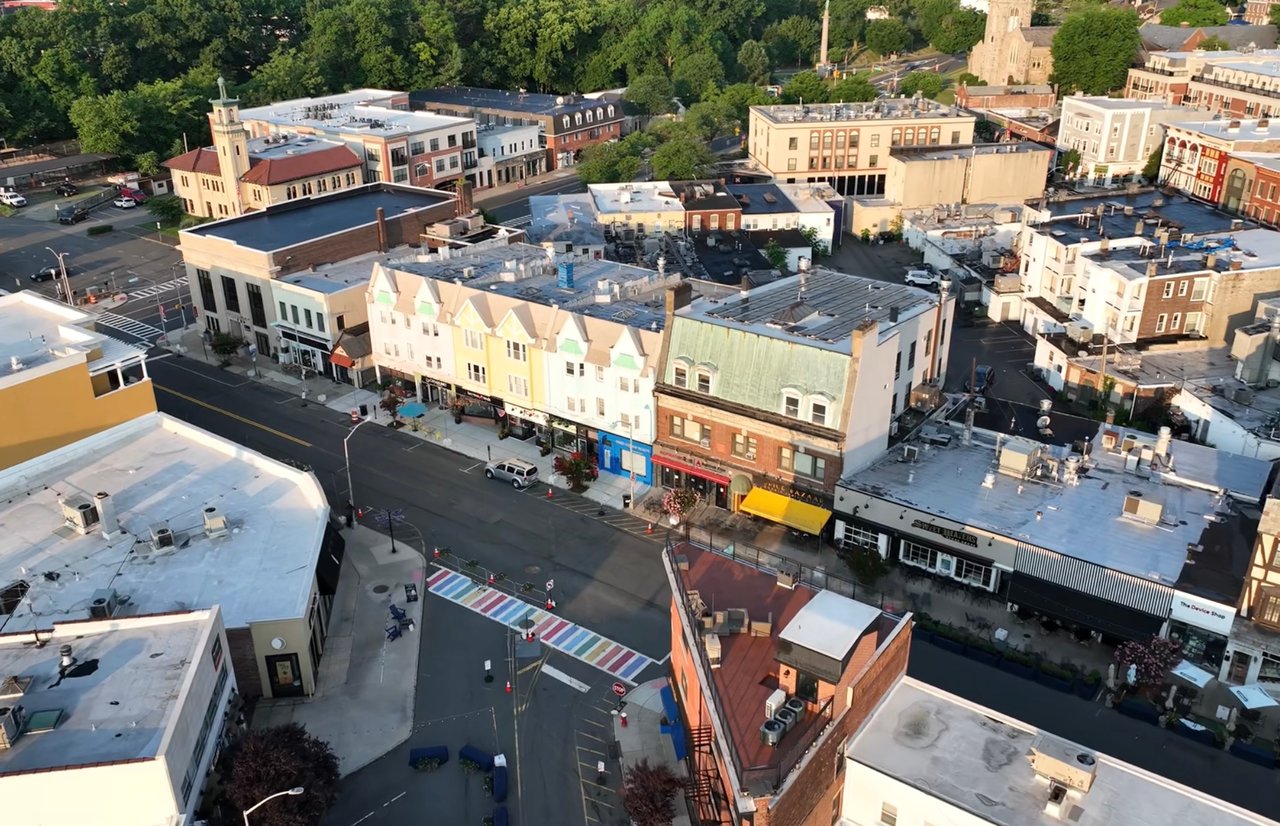
Most American towns of Westfield's vintage have lost the things that made them feel like the towns you remember. The downtown got hollowed out. The movie theater closed and stayed closed. The diner became a chain. The independent bookstore became a pharmacy that became an empty storefront. The streets people walked as children became streets they now drive through, on the way to somewhere else.
Westfield, New Jersey did not lose those things. Or rather, when it lost them, it fought to get them back. The 1922 Rialto Theatre at the corner of East Broad and Central did close, on August 22, 2019, after 97 years of continuous operation. But the town did not let it stay closed. A community group of Westfield residents bought the building, raised a $5 million anonymous donation, and is in the process of bringing it back to life as the Rialto Center for Creativity. The cartoonist who walked past 411 Elm Street every morning on his way to school in the 1920s is now celebrated by an annual October festival that has run since 2018. The 1890s train station is still in service. The duck pond at Mindowaskin Park still has a footbridge.
This is a piece about what makes Westfield feel the way it feels. Not the schools, not the median sale price, not the commute time to Manhattan — those numbers are covered in Prodigy's Westfield 2026 market update, with the live inventory and current market data on Prodigy's Westfield neighborhood page. This is about the things that don't show up in market data: the 1922 marquee, the Victorian house on Elm Street, the chalk skeleton in a barn on Dudley Avenue, the gravestones young Charles Addams used to walk past on his way to school. The reasons people who grew up here come back to raise their own kids. And why people who didn't grow up here, but who buy in anyway, often say it reminds them of the town they did.
The Rialto Theatre opened on the evening of September 1, 1922, on the corner of East Broad Street and Central Avenue, with two silent films: Buster Keaton's Cops and Richard Barthelmess in Sonny.1 It was one of thousands of "movie palaces" built across America during the 1920s — ornate, single-screen, balcony-equipped venues designed to make a night at the movies feel like a night at the opera. Most of them are gone now.
The Rialto held on. It was badly damaged in a fire in 1931 and rebuilt later that year. United Artists took it over in 1966. Two more screens were added in 1978. Three more in 1997. Various corporate owners came and went — Digiplex, Carmike, New Vision — through the late twentieth and early twenty-first centuries. People in Westfield kept going, generation after generation. They saw Jaws there in 1975. They saw The Sting, American Graffiti, Smokey and the Bandit. They had first dates and birthday parties and Saturday afternoons in the dark. The Rialto, as the saving group later put it, became part of the fabric of Westfield's social and cultural life.
It closed on August 22, 2019, in what was reported as a tenant-landlord dispute. Then a global pandemic shut everything down. Then a flood damaged the building. For a while it looked like the Rialto was going to be one more story about a town that lost the thing that made it feel like home.
Every town has a long-standing institution, something that's been around for so long it's embedded in a place's collective memory. For Westfield, it's the Rialto.
In 2024, a Westfield-resident-led group called the Westfield Arts Collective, a 501(c)(3) nonprofit founded by Bill Crandall and others, signed an agreement to purchase the Rialto building.2 An anonymous Westfield resident contributed $5 million. The Tee & Charles Addams Foundation provided seed capital, with the intention of eventually endowing the building with Charles Addams works in perpetuity. Local foundations and Union County contributed. The plan: a flexible 450-seat performance space, four classrooms and studios, gallery spaces. The Rialto, in other words, will not be a movie theater again. It will be something else — a gathering place. A place to make things, and to see things made. A continuation, not a restoration.
In a 2021 community vote organized by the Mr. Local History Project, Westfielders chose the Rialto, from over six hundred lost local businesses, as the historic "Greatest of All Time." A small wooden keepsake of the building entered a New Jersey historic village collectible series. The town did not let go.
Charles Samuel Addams — "Chill" to his friends, "Chas" on his cartoons — was born in Westfield on January 7, 1912.3 The Addams family lived on Summit Avenue when he was born, then moved several times before settling permanently at 522 Elm Street in 1920, where Charles lived until 1947. He attended Westfield public schools, was art editor for the Westfield High School yearbook (the Weather Vane), and got into trouble as a boy for breaking into a house on Dudley Avenue with a group of neighborhood boys. There, on the second floor of the garage behind the main house, he drew a chalk-and-pencil skeleton on the wall.
That skeleton, "Dudley," is roughly 90-to-100 years old now. The current homeowners donated it on long-term loan to the town. It is brought out every October for AddamsFest. Standing in front of it, you are looking at the earliest known surviving artwork by the man who would later draw the most famous American family that never existed.
Addams's first cartoon for The New Yorker appeared in 1932. The first Addams Family panel — a vacuum cleaner salesman calling on a "well-appointed" home full of cobwebs and bats — appeared in the August 6, 1938 issue. He drew the family for the rest of his life. They didn't have names until the 1964-1966 ABC television sitcom, when network producers needed to call them something on screen: Gomez, Morticia, Pugsley, Wednesday, Uncle Fester, Lurch, Cousin Itt, Thing. Addams died in 1988. The family kept going.
If you walk down Elm Street today and stand in front of 411 — one of the houses widely identified as inspiration for the Addams Family mansion — you can see what Addams saw. White wood paneling. Turn-of-the-century shutters. Quaint, painfully normal. And then, if you let yourself, you see what he saw: the wood goes black, the shutters go dilapidated, a dark cloud rolls in. The mind that drew that house was a mind shaped by walking past it every day on the way to school, then continuing past the colonial-era headstones in the Westfield Presbyterian Church burial ground on Mountain Avenue, then arriving at school and drawing cartoons in the yearbook.
The town began celebrating this in 2018. Westfield Councilwoman Dawn Mackey and Mayor Shelley Brindle launched the first AddamsFest as a month-long October celebration of the town's most famous resident.4 It now includes the Wicked Windows of Westfield (sixty-five to seventy storefront windows hand-decorated by local artists), thirty-five themed street signs (Addams Way, Pugsley Path), the Gallery on Elm Street, lantern tours of the Presbyterian Church burial ground, the Morticia and Gomez Masquerade Ball at the James Ward Mansion, and Addams Family Fun Day on Quimby Street. It runs every year. People come from out of state.
Westfield is more than just a town — it's a community filled with artists and dreamers. Transforming the Rialto into a creative hub ensures that these voices have a place to be heard and that the arts have a permanent home.
A few blocks from where the Rialto sits, on East Broad Street and steps from Town Hall and the Westfield Memorial Library, is Mindowaskin Park. The park was laid out in the early twentieth century. It has a duck pond, footbridges over the water, walking paths, landscaped gardens, and a historic gazebo. Town concerts happen there in the summer. People take their wedding photos in front of the gazebo. Kids feed the ducks. Generations of Westfield families have a photograph of themselves as children on the same bridge.
The bridge is still there. The ducks are still there. The gazebo is still there. There is something almost defiant about that, in 2026. American towns have, on the whole, not been kind to their public spaces over the last fifty years. Many have replaced their downtown parks with parking lots, or quietly let them fall into disrepair, or sold them off to developers. Westfield kept Mindowaskin. The park exists today because the town kept choosing, year after year, to keep it.
It's a small thing. It's also exactly the kind of small thing that makes a place feel the way Westfield feels. You cannot manufacture a hundred-year-old park. You cannot build a hundred-year-old duck pond. You can only inherit one, and then you can keep it.
Westfield has had passenger rail service since the mid-1800s. The current station building dates to the 1890s. NJ Transit's Raritan Valley Line still runs through it, taking commuters into Newark and on to Manhattan. The platforms are essentially the same platforms that nineteenth-century commuters stood on. The architecture is the architecture. The bricks are the bricks.
For people who grew up in Westfield, the train station is not a piece of infrastructure. It is the place their parents used to drop them off when they took the train into the city as teenagers. It is the place they came back to from college on Thanksgiving. It is the place a parent or grandparent waited for them on a platform under a 130-year-old roof. It is one of those rare American buildings that has been doing exactly the same job, in exactly the same way, for longer than any living person can remember.
There is a particular kind of nostalgia that lives inside a working train station. It is not the nostalgia of a museum — nothing is preserved behind glass. It is the nostalgia of a building that has refused to retire. It is still working. The 7:42 to Newark Penn still pulls in. People still hurry across the platform with coffee. The continuity is the point.
Westfield has more old buildings still standing and still in use than most New Jersey towns its size. Not in a museum sense. In a working sense — people live in them, eat in them, walk past them on the way to the train. Five anchor places, presented as a town's working memory:
| Place | What It Is | Why It Still Matters |
|---|---|---|
| Miller-Cory House | 614 Mountain Avenue · living history museum | Colonial farmhouse with active hearth-cooking demonstrations |
| Reeve House | Historic home, Westfield Historical Society HQ | The town keeps its own memory here |
| Westfield Train Station | 1890s building · NJ Transit Raritan Valley Line | Continuously operating commuter rail since the 1800s |
| Presbyterian Church & Burial Ground | Mountain Avenue · colonial-era headstones | Charles Addams's childhood inspiration; AddamsFest lantern tours |
| The Rialto | East Broad & Central · opened 1922 | Becoming the Center for Creativity at the Rialto |
Sources: Westfield Historical Society; Town of Westfield; Rialto Center for Creativity; Miller-Cory House Museum.
In 2004, Westfield won the Great American Main Street Award. The award goes to towns that have preserved a walkable, mixed-use, locally-owned commercial downtown without succumbing to the strip-mall, big-box, drive-everywhere pattern that consumed most American main streets in the second half of the twentieth century.5 Westfield won because it was a place where the buildings had not been torn down, the storefronts had not been chained, and the streets were still walkable.
It is still that. The downtown business district is included in the National Register of Historic Places, with buildings dating from the late nineteenth and early twentieth centuries. East Broad Street and Elm Street still run with the same orientation they ran with when Charles Addams walked them. The retail mix has changed — the hardware store may now be a yoga studio, the five-and-dime may be a third-wave coffee roaster — but the buildings, the sightlines, the proportions, the way the trees hang over the sidewalks: all of that has stayed.
Town traditions accumulate on top of those streets. FestiFall every September. The annual Christmas tree lighting in front of Town Hall. The replica of the Presbyterian Church on Mindowaskin Pond at Christmas time. The replica of the Addams Family house there in October. The Westfield Symphony Orchestra. The Westfield Jazz Festival. The list is long, and it keeps growing, and the older traditions never quite get displaced. They just share the calendar with newer ones.
For a fuller picture of what Westfield's downtown is doing in 2026 specifically, the Westfield restaurant scene guide covers how the dining culture has evolved while staying anchored in the same downtown footprint. The Westfield property tax breakdown covers the carrying-cost math behind owning here. The macro pricing context appears in the 2026 Westfield market update. And the live inventory of homes available in town sits on Prodigy's Westfield neighborhood page.
Most Westfield children grow up with three parks in their bones: Echo Lake, Tamaques, and Mindowaskin. The names alone work as time machines. Adults who left and came back are sometimes startled by how much of their internal landscape is still organized around them.
Echo Lake Park spans more than a hundred acres along the Westfield-Mountainside border. The lake itself is suitable for paddle-boating and fishing. Walking trails loop the perimeter. There are picnic areas, playgrounds, and Union County's only dog park. For decades, Echo Lake was where Westfield families went on Sunday afternoons. It still is.
Tamaques Park is where the youth soccer leagues play, where joggers loop in the early morning, where summer camps happen. It is the working-park of the three, the one most active on a Tuesday afternoon. Mindowaskin is the contemplative one, the one with the duck pond and the gazebo and the wedding photos. Echo Lake is the one for the long Sunday afternoons. Different parks for different parts of the same childhood.
All three are essentially the same parks they were sixty years ago. The trees are bigger. The playgrounds have been replaced. But the geography, the routes, the way the morning light falls on the water at Echo Lake — that is the same. Children growing up in Westfield in 2026 are growing up in the same places their parents and grandparents grew up. There is something rare about that, in 2026 America.
A meaningful percentage of every Westfield real estate transaction Prodigy closes involves a buyer who grew up in or near Westfield, left for college and a career in New York or Boston or San Francisco, and is now coming back to raise their own children. The pattern is so consistent that Westfield brokers have a working term for it: the boomerang. Sometimes it is the original Westfield child. Sometimes it is their spouse, who heard about Westfield for fifteen years and finally agreed to look. Sometimes it is the second wave: someone who grew up two towns over, in Cranford or Scotch Plains or Summit, and always remembered Westfield as the town to aspire to.
When these buyers walk into a house with their broker, they are usually not just buying the house. They are buying the morning walk to the train station they remember from being a teenager. The Saturday morning at Mindowaskin with their kids. The trip to Echo Lake on a Sunday afternoon. The Halloween that turns the whole town into AddamsFest. The Christmas tree at Town Hall. The Friday-night-at-the-Rialto that is about to come back, in a different form, in a building they grew up walking past.
A real estate transaction, properly understood, is not a financial event. It is a decision about what kind of life you want to put your family inside of. Westfield's case for itself in 2026 is unusual: it is not selling itself as the next big thing, the up-and-coming neighborhood, the town that will be hot in five years. Westfield is selling itself as the town that has been good for one hundred years and intends to keep being good. The Rialto is being saved. The duck pond is still there. The gazebo is still there. The 1890s train station still works. AddamsFest gets bigger every year. The town keeps choosing itself, every year, on purpose.
In twenty years writing real estate in this part of New Jersey, the buyers who walk into Westfield with the most certainty are almost always the ones who already know what they are walking into. They are not discovering Westfield. They are coming back to it. That is a different kind of transaction, and a different kind of town.
1. Rialto Theatre opening (September 1, 1922), opening films (Buster Keaton's Cops and Richard Barthelmess's Sonny), 1931 fire and rebuild, ownership history, August 22, 2019 closing: Cinema Treasures (cinematreasures.org); Mr. Local History Project; New Jersey Stage.
2. Westfield Arts Collective ($5M anonymous donation, Tee & Charles Addams Foundation seed capital, Bill Crandall, planned 450-seat performance space): Rialto Center for Creativity (rialtowestfield.org); Westfield Arts Collective announcements.
3. Charles Addams biographical detail (born January 7, 1912, Summit Avenue / 522 Elm Street residence, Westfield High Weather Vane, first New Yorker cartoon 1932, first Addams Family panel August 6, 1938, character names from 1964-66 ABC sitcom, death 1988): Town of Westfield (westfieldnj.com/addams); Den of Geek; SlashFilm; Patch.
4. AddamsFest founding (2018, Councilwoman Dawn Mackey, Mayor Shelley Brindle), Wicked Windows of Westfield, Dudley skeleton donation by Khichi family: ABC7 New York; PIX11; Be Your Best Mom; New Jersey Stage.
5. 2004 Great American Main Street Award; downtown National Register of Historic Places designation: Town of Westfield; Cinema Treasures.
Mindowaskin Park, Echo Lake Park, Tamaques Park, Miller-Cory House, Reeve House, and Westfield Train Station details verified through Town of Westfield, Westfield Historical Society, and Union County Parks & Recreation public information.
Prodigy Real Estate is an innovative real estate company offering high-end video production, home valuation services, purchasing, and home sales. Serving New York and New Jersey.