
March 26, 2026
Spring Lake, NJ
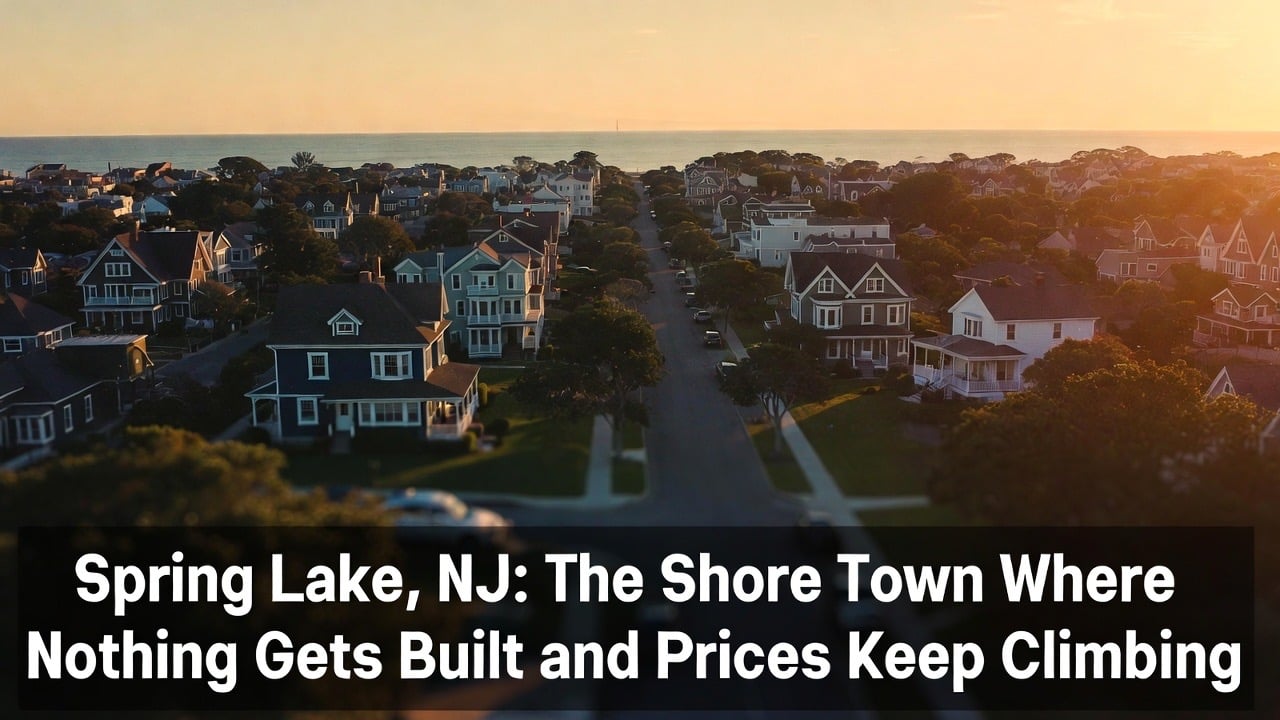
A ground-level look at what's actually happening with development, zoning, and the rental clampdown in the "Irish Riviera" — 2026 edition
Walk the streets of Spring Lake on a Tuesday in March and you won't see a lot of construction trailers. You won't see earthmovers or crews framing new foundations. What you will see is a town that has quietly, methodically made it very hard to add housing — and is watching its property values reflect that reality with almost mechanical consistency.
The borough's own 2025–2035 Housing Plan puts it plainly: Spring Lake has "virtually no available developable vacant land." That line, buried in a planning document most residents will never read, is actually the clearest explanation for why home values are up double digits year over year. Scarcity isn't a side effect of this market. It's the product.
Spring Lake Market Snapshot — February 2026
The first thing to understand about Spring Lake's market data is that the gap between Zillow's $1.36 million ZHVI and Redfin's $5.74 million median sale price is not a data error. Both figures are accurate. They're just measuring different things in a town where sales volume is thin enough that a single oceanfront closing — often north of $10 million — can swing monthly averages dramatically.
That volatility is actually its own development signal. When only four to six homes trade in a typical month, there is no averaging-out effect. One estate deal reshapes the data. And because the town is producing almost no new construction to add volume, that condition isn't going to change.
What developers have figured out is that the same supply constraint creating that data volatility is also creating an opportunity: acquire a dated interior home in the $2 million to $3 million range, tear it down, and deliver a luxury custom rebuild into a market where your only real competition is other teardown projects. There are no new subdivisions eating into demand. There is no competing product pipeline. The borough's own planning framework has all but guaranteed that.
"There are no new subdivisions eating into demand. There is no competing product pipeline. The borough's own planning framework has all but guaranteed that."
The biggest development news in Spring Lake this year isn't a $10 million oceanfront spec build. It's a three-unit apartment project above a future restaurant at the corner of Third Avenue and Morris Avenue — the former Wells Fargo site that the borough has been sitting on for years.
That project — 1123 3rd Avenue, Block 69, Lot 3 — is how Spring Lake is meeting its state-mandated affordable housing obligation. The borough's Fourth Round Housing Plan identifies its Realistic Development Potential as just three units. Three. In a town of this size and wealth, the answer to "how many affordable homes can we realistically build" is three. And those are the three.
Ordinance 2026-002, passed in February, authorized a lease agreement with the Affordable Housing Alliance to make it happen. The structure: ground-floor commercial — a restaurant — with three affordable two-bedroom units on the second floor. Applications opened March 12, 2026 and run through July 7.
1123 3rd Avenue — Project Details
Ordinance
2026-002
Block / Lot
Block 69, Lot 3
Application Window
Mar 12 – Jul 7, 2026
Ground Floor
Restaurant (commercial)
Very-Low Income Rent
$648 / month
Low Income Rent
$1,254 / month
Moderate Income Rent
$1,557 / month
Managed By
Affordable Housing Alliance
This project matters beyond its size. It's the model the borough is using to satisfy a legal obligation — municipal land, mixed-use overlay zoning, a nonprofit operator, and a commercial tenant anchoring the ground floor. In a town with nothing left to develop, this is what development looks like.
Outside of the affordable housing project, Spring Lake's 2026 development story is written almost entirely at the Planning Board. Every significant private project on the docket this year involves some form of variance relief — setbacks, coverage, use. There are no rezonings. No master-plan amendments. No new zones being carved out for density. Just individual addresses, one at a time, making their case to the board for why their project deserves an exception.
Feb 25, 2026 — Special Meeting
1312 Third Avenue
Faherty LLC — Block 80, Lot 8 — Site plan & bulk variances for luxury build
Mar 11, 2026 — Regular Meeting
410 Essex Avenue
Block 47, Lot 22 — Reconstruction; front & side yard setback relief
Mar 11, 2026 — Regular Meeting
312 Ocean Road
Block 15, Lot 14 — Coastal project; bulk variances to maximize lot coverage
Mar 11, 2026 — Regular Meeting
2 Worthington Avenue
Block 122, Lot 1 — Use variance & bulk variances; high-profile coastal project
Read the docket and the pattern is obvious: every developer working in Spring Lake right now is fighting for inches. Front yard setback relief. Side yard relief. Coverage maximums that were written for a different era. The lots haven't gotten bigger. The architecture expectations have.
This is the part of the Spring Lake regulatory picture that doesn't get enough coverage. Over the past two years, the borough has quietly but deliberately moved to limit rental churn — the kind of high-turnover, revolving-door rental activity that the town sees as incompatible with its character as a residential enclave.
Here is what's now on the books:
Ordinance 2025-006
Maximum 4 Rental Certificates of Occupancy per unit, per calendar year. High-turnover short-term rental strategies are effectively capped.
Liability Insurance Mandate
Landlords must carry a minimum of $500,000 in liability coverage for rental activities. Proof required to obtain or renew a rental certificate.
Ordinance 2026-003
$150 fee for homes with 5+ bedrooms. Mandatory $50 re-rental fee for any tenancy change within 90 days. The message to investors: slow-turnover only.
For any investor underwriting a rental property in Spring Lake, these ordinances need to be in the pro forma. The compliance layer is no longer theoretical. The borough is actively using fees, insurance mandates, and CO limits to push the rental market toward long-term, stable tenancy — and away from the kind of seasonal-turnover model that has altered the character of other Shore towns.
The 2025–2035 Housing Element, formally codified by Ordinance 2026-001, locks in the rules that govern everything above. Two provisions in particular shape the entire development environment:
Mandatory Affordable Set-Aside
Any new residential project of 5 or more units must include a 20% affordable set-aside. Very few projects in Spring Lake reach that threshold — but the provision changes the math for anyone who tries.
Mixed-Use Overlay Height Cap
Heights in the commercial core are strictly capped at 35 feet. That means residential uses above commercial can go two floors — and not three. This is what kept the Wells Fargo site at three units instead of six.
Fourth Round Affordable Housing Obligations
That gap between obligation and realistic development potential — 68 units required, 3 units achievable — is the honest summary of Spring Lake's housing situation. The borough acknowledges it cannot come close to meeting its state mandate. What it can do is point to one municipal parcel, one overlay zone, and one rehab project per year through the Monmouth County Housing Improvement Program, and call that compliance.
Spring Lake in 2026 is a borough that has made a very deliberate choice about what it wants to be — and is using every available planning and regulatory tool to stay that way. The rental clampdown, the height caps, the variance-by-variance development pipeline, the reuse of the last few municipal parcels to satisfy affordable housing obligations without meaningful density: all of it is pointing in the same direction.
"For buyers, that calculus is simple: a town that cannot build its way out of a supply problem is a town where your property doesn't have much competition."
For developers, that means understanding that Spring Lake is a precision entitlement market. You are not acquiring a tract. You are acquiring a constrained parcel in a town that scrutinizes lot coverage, enforces setbacks without much flexibility, and expects the product to match the neighborhood. Board approval is not automatic, and the cases on the current docket prove it.
For investors, the rental regulatory picture has changed materially. The 4-CO-per-year limit, the $500,000 insurance requirement, the re-rental fees — these are real friction, and they are structured to push the market toward long-term occupancy. Underwrite that layer carefully, because the borough is enforcing it.
For buyers, that calculus is simple: a town that cannot build its way out of a supply problem is a town where your property doesn't have much competition. Spring Lake's 2025–2035 plan doesn't just acknowledge that reality. It cements it.
Prodigy
Looking at the Spring Lake or Monmouth County Shore market? We work with buyers, sellers, and investors across the coast — and we know these ordinances, these board calendars, and these streets. Let's talk.
Contact ProdigyProdigy Real Estate is an innovative real estate company offering high-end video production, home valuation services, purchasing, and home sales. Serving New York and New Jersey.