
Anthony Licciardello | July 1, 2026
Ocean Grove, NJ
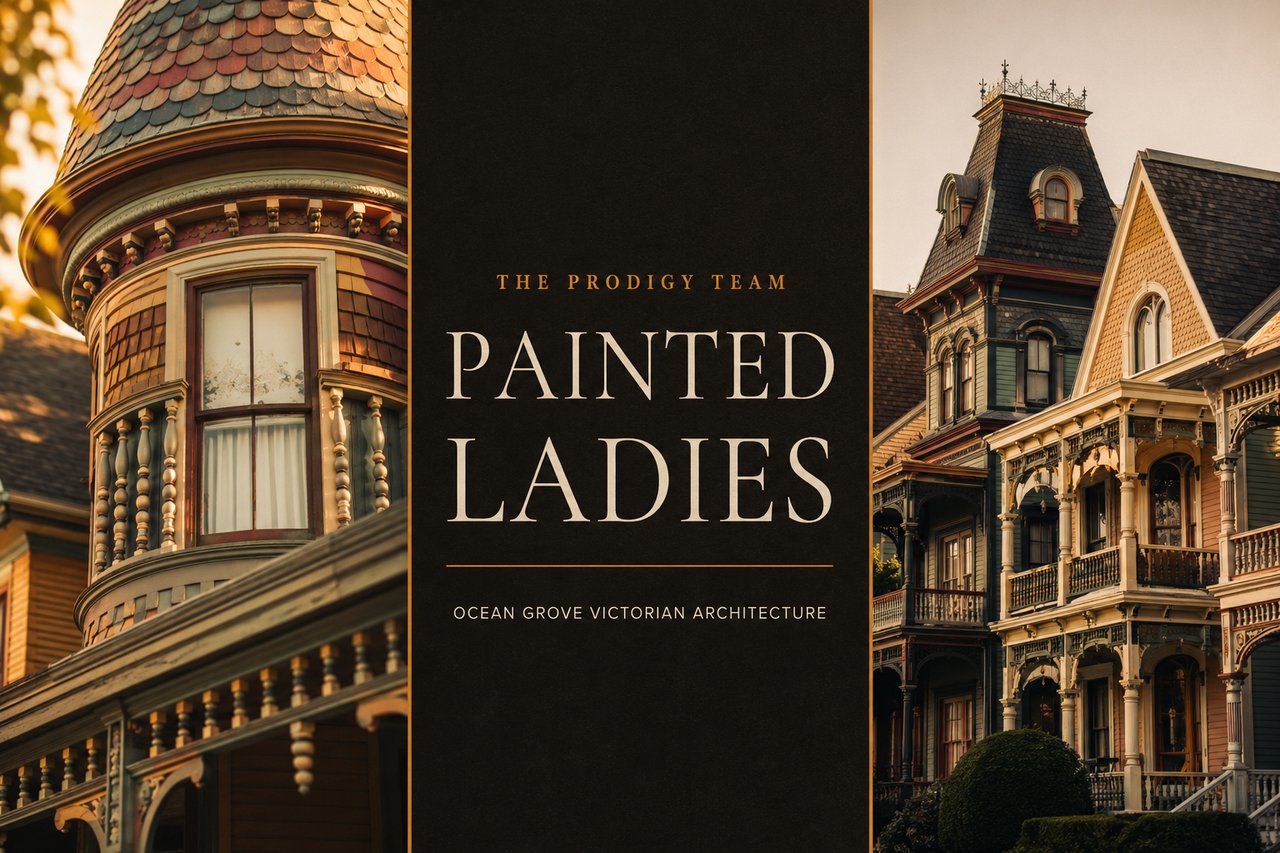
History & Preservation · Ocean Grove, NJ
Walk one block in Ocean Grove and you pass more Victorian architecture than most towns hold altogether. But those “painted ladies” aren't all the same — they're a living catalog of distinct 19th-century styles, each with its own signatures in the rooflines, porches, and trim. Learning to tell them apart turns an ordinary stroll into a treasure hunt, and helps any buyer or owner understand exactly what they're looking at. Here's how to read the Grove.
See the painted ladies up close — Watch on YouTube →
This is part of our history and preservation series. Planning changes to one of these homes? See the renovation guide.
Queen Anne
Turrets, asymmetry, wraparound porches.
Stick Style
Exposed “stickwork” and steep gables.
Carpenter Gothic
Pointed arches and gingerbread trim.
Italianate
Bracketed eaves and tall windows.
When people picture a Victorian “painted lady,” they're usually picturing Queen Anne — and the Grove is full of them. Look for deliberate asymmetry, a corner turret or tower, steeply pitched roofs with projecting gables, and a generous wraparound porch. The surfaces are a riot of texture: fish-scale and patterned shingles, turned-spindle porch posts, decorative brackets, and bay windows. If a house looks like a wedding cake that learned to have fun, it's almost certainly Queen Anne.
Did You Know
The term “painted lady” refers to a Victorian painted in three or more colors to pick out its architectural detail — the trim, brackets, and shingles that make these homes so photogenic.
Two related styles give the Grove much of its distinctive texture. Stick style wears its structure on the outside: flat boards applied over the siding in horizontal, vertical, and diagonal patterns — “stickwork” that echoes the frame beneath — paired with steep gables and trusswork in the peaks. Carpenter Gothic, meanwhile, brings the church to the cottage: pointed-arch windows, steeply pointed gables, and lacy, elaborate bargeboard — the “gingerbread” trim — sawn by carpenters newly armed with the scroll saw. Many of the Grove's most charming small homes belong to this family.
A few grander styles round out the collection. Italianate homes read as tall and dignified — low-pitched roofs with wide, bracketed eaves, tall narrow windows, sometimes a cupola or a square tower. Second Empire is unmistakable for one feature: the mansard roof, a steep double-sloped roof, usually studded with dormer windows, that gives a home a distinctly French silhouette. Spot a mansard roofline in the Grove and you've found a Second Empire.
The Grove has one vernacular all its own. As summer families outgrew their canvas tents, many built small, narrow cottages on the same tight lots — often just a room or two wide, with a prominent front porch facing the street and modest Victorian trim. These camp-meeting cottages are the architectural link between the tents and the grand homes, and their scale is a big part of why the Grove feels so intimate and walkable. Charming, compact, and full of character, they're often the entry point into the market.
A whole century of American style, standing shoulder to shoulder on one square mile.
You don't need to be an architect to name what you're seeing — just look in order. Start with the roofline: is it a steep gable, a corner turret, or a mansard? Move to the porch: wraparound and spindled, or a simple street-facing stoop? Then read the trim: fish-scale shingles and brackets, exposed stickwork, or pointed-arch gingerbread? Three quick looks — roof, porch, trim — will place most Grove homes in the right family. For buyers and owners, that literacy pays off, because a home's style guides what renovations are appropriate and how the market values it.
Insider Tip
Knowing a home's style isn't just trivia — it shapes what the Historic Preservation Commission will approve. Matching materials and details to the original style makes renovations far smoother.
“
From the Broker
Buyers fall for a house before they know its name. Part of my job is teaching them to see the turret, the stickwork, the gingerbread — because that's where the Grove's value lives.
Found a painted lady you love?
Every style comes with its own charms and its own upkeep. The Prodigy Team helps buyers — many from New York and Staten Island — understand a home's architecture, condition, and preservation rules before they fall too hard. We work both sides of the water.
Anthony Licciardello, Broker, The Prodigy Team · 718-873-7345
See What Your Ocean Grove Home Is Worth →
Ocean Grove is dominated by Victorian styles — especially Queen Anne, Stick style, and Carpenter Gothic — with Italianate and Second Empire homes and the town's own small camp-meeting cottages mixed in. It's considered one of the most extensive collections of Victorian architecture in the country.
A painted lady is a Victorian house painted in three or more colors to highlight its architectural details — the trim, brackets, shingles, and ornament. The multicolor schemes are a big part of the Grove's photogenic appeal.
Look in order at three things: the roofline (steep gable, turret, or mansard), the porch (wraparound and spindled, or a simple stoop), and the trim (fish-scale shingles, exposed stickwork, or pointed-arch gingerbread). Those clues place most Grove homes in the right style family.
It can. Style influences a home's character, its upkeep, and what renovations the Historic Preservation Commission will approve, all of which factor into value. A well-preserved example of a sought-after style tends to command strong interest in the Grove's tight market.
Prodigy Real Estate is an innovative real estate company offering high-end video production, home valuation services, purchasing, and home sales. Serving New York and New Jersey.