
Anthony Licciardello | April 23, 2026
Ocean County
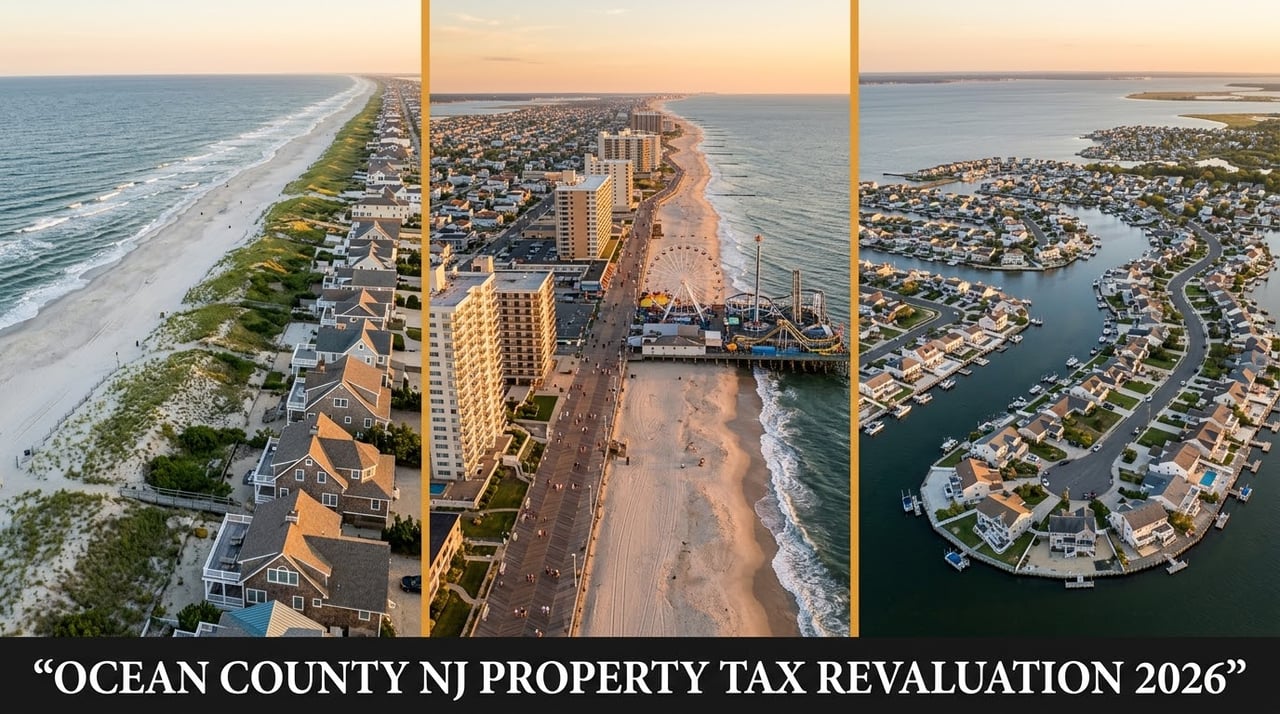
The Ocean County NJ property tax revaluation picture is not a local story about Berkeley Township. It's a countywide story about 30 of 33 municipalities running assessments below the state's 85% compliance threshold, with barrier island and bay-adjacent towns sitting furthest from market reality. Berkeley, currently under revaluation contract with Professional Property Appraisers (PPA) for the 2027 tax year, is one of the first towns the Ocean County Board of Taxation moved on — but it is structurally representative of the problem across the county, not an exception to it.
This post maps the full Ocean County ratio landscape using data from the New Jersey Division of Taxation's Chapter 123 certification (Oct 1, 2024, applicable to 2025 tax appeals), identifies where the biggest assessment-to-market gaps exist, explains what the data means for anyone buying or selling Ocean County property through 2026 and 2027, and flags which towns appear most likely to receive reval orders next.
Under New Jersey law, every taxable property must be assessed at 100% of fair market value. The NJ Division of Taxation publishes a Director's Ratio for every one of the state's 565 municipalities annually — the average relationship between assessed values and actual sale prices across the town. A ratio below 85% indicates non-compliance with the state standard.
Of the 33 municipalities in Ocean County, only three have a current Director's Ratio above the 85% compliance line: Ocean Township (99.33%), Ocean Gate (97.63%), and Lakehurst (90.83%). Every other Ocean County municipality — 30 of 33, or roughly 91% of the county's taxable base by municipality count — sits below the threshold.
The reason this matters is mechanical. The Ocean County Board of Taxation uses the Director's Ratio every year to equalize the county tax burden across the 33 municipalities. Without equalization, towns with older, lower assessments would underpay their fair share of the county levy. With equalization, the county tax math works — but the reason it works is because the state formula is overriding what the assessment rolls actually say. That's a sustainable arrangement for a year or two. It is not a sustainable arrangement for a decade.
A Director's Ratio below 85% does not automatically trigger a reval. The Board of Taxation weighs the ratio alongside the coefficient of deviation — a separate measure of how uniform assessments are within the town. When both numbers drift too far, the order comes. Berkeley Township's order was the first of what is likely to be a multi-year reval cycle across Ocean County.
The following table shows every Ocean County municipality ranked by Director's Ratio, from highest (closest to compliance) to lowest (furthest from market value). These figures were certified by the NJ Division of Taxation as of October 1, 2024 and apply to 2025 tax appeals. They are the same numbers the Ocean County Board of Taxation uses to equalize the county tax burden in 2026.
| Rank | Municipality | Ratio | Status |
|---|---|---|---|
| 1 | Ocean Township | 99.33% | Compliant |
| 2 | Ocean Gate Boro | 97.63% | Compliant |
| 3 | Lakehurst Boro | 90.83% | Compliant |
| 4 | Pine Beach Boro | 84.55% | Borderline |
| 5 | Toms River Township | 80.22% | Below Compliance |
| 6 | Long Beach Township | 72.88% | Below Compliance |
| 7 | Eagleswood Township | 67.81% | Below Compliance |
| 8 | Island Heights Boro | 65.79% | Below Compliance |
| 9 | Lacey Township | 64.80% | Below Compliance |
| 10 | Seaside Park Boro | 62.46% | Below Compliance |
| 11 | Plumsted Township | 62.10% | Below Compliance |
| 12 | Tuckerton Boro | 61.39% | Below Compliance |
| 13 | Lavallette Boro | 61.10% | Below Compliance |
| 14 | Surf City Boro | 61.05% | Below Compliance |
| 15 | Point Pleasant Beach Boro | 60.93% | Below Compliance |
| 16 | South Toms River Boro | 60.47% | Below Compliance |
| 17 | Manchester Township | 60.15% | Below Compliance |
| 18 | Barnegat Township | 59.96% | Below Compliance |
| 19 | Point Pleasant Boro | 59.35% | Below Compliance |
| 20 | Brick Township | 59.18% | Below Compliance |
| 20 | Harvey Cedars Boro | 59.18% | Below Compliance |
| 22 | Bay Head Boro | 58.51% | Below Compliance |
| 23 | Mantoloking Boro | 58.28% | Below Compliance |
| 24 | Little Egg Harbor Township | 58.17% | Below Compliance |
| 25 | Berkeley Township (in reval) | 57.87% | Reval 2027 |
| 26 | Ship Bottom Boro | 56.61% | Below Compliance |
| 27 | Lakewood Township | 56.28% | Below Compliance |
| 28 | Jackson Township | 56.23% | Below Compliance |
| 29 | Beachwood Boro | 56.17% | Below Compliance |
| 30 | Stafford Township | 55.89% | Below Compliance |
| 31 | Beach Haven Boro | 53.84% | Below Compliance |
| 32 | Barnegat Light Boro | 53.74% | Below Compliance |
| 33 | Seaside Heights Boro | 53.03% | Below Compliance |
The bottom five towns in the ranking — Seaside Heights (53.03%), Barnegat Light (53.74%), Beach Haven (53.84%), Stafford Township (55.89%), and Beachwood (56.17%) — share a pattern. Four of the five are coastal barrier island or bay-front municipalities with significant post-Sandy rebuilding, second-home concentrations, and rapid post-pandemic appreciation. Stafford is the interior exception — mainly a size story rather than a market story — but the pattern on the other four is consistent.
Ocean County's lowest Director's Ratio reflects a decade-plus of redevelopment along the boardwalk, the construction of new oceanfront condominiums, and sustained pricing pressure from post-Sandy rebuild premium. Current assessments were set in a market that no longer exists. A property assessed at $300,000 in Seaside Heights has an implied market value near $566,000 under the state's equalization math — often less than what similar properties are currently selling for.
The two lowest-ratio Long Beach Island municipalities share the LBI story. Multi-million-dollar oceanfront rebuilds, the full replacement of the first row of homes in both towns after Sandy, and the broader LBI price runup since 2020 have driven assessments far below actual market. Beach Haven's recent transaction data includes single sales above $5 million; both municipalities have inventory at sub-1% sold-to-list price gaps in peak season. Neither has been formally ordered for a reval yet. Both appear structurally due.
Stafford is the largest Ocean County municipality by population in this bottom group — a mix of mainland residential, commercial, and the Ocean Acres and Mill Creek sections — and its ratio reflects scale as much as specific mispricing. Individual properties within Stafford vary significantly by section; the township-wide ratio averages across extreme variance. A reval here, when it comes, will be particularly complex.
Beachwood's bay-front and interior residential neighborhoods have seen steady appreciation since the last assessment cycle. As with other small Ocean County boroughs, Beachwood's ratio drift reflects the simple math of rising sales prices against static assessments rather than any specific market event.
Berkeley Township is a useful benchmark for what lies ahead in the other 29 non-compliant Ocean County towns. The Ocean County Board of Taxation ordered Berkeley's revaluation based on the same two-factor test — Director's Ratio plus coefficient of deviation — that applies to every municipality. The contract went to Professional Property Appraisers (PPA) of Delran, the same firm handling active revaluations in Essex and Union County municipalities. Field inspections are underway. New assessments take effect for the 2027 tax year, with assessment letters expected to mail in late 2026 or early 2027.
The mechanics for Berkeley are the same as for every NJ reval. Residential properties are analyzed using the Sales Comparison Approach, benchmarked to market conditions as of October 1, 2026. Homeowners receive letters with new assessed values and placeholder estimated 2027 taxes. An informal review period opens for direct conversations with PPA. Formal appeals are filed with the Ocean County Board of Taxation by May 1, 2027. For a complete walk-through of how the Berkeley process unfolds, see our full Berkeley Township 2027 revaluation guide.
For the other 29 non-compliant Ocean County municipalities, Berkeley's process is the likely template. The Board of Taxation evaluates the ratio and deviation coefficient each year. When the data crosses the threshold, the order comes — typically with 18 to 24 months between the order date and the first tax year in which new assessments take effect. Towns further from compliance and with greater internal deviation face earlier orders. Towns closer to the line and with more uniform internal assessments have longer windows.
Long Beach Island is the structural outlier in the Ocean County ratio data, and it illustrates why reval pressure is strongest along the barrier coastline. The six LBI municipalities — Barnegat Light, Harvey Cedars, Surf City, Ship Bottom, Long Beach Township, and Beach Haven — cluster in a narrow band of 53% to 73% Director's Ratios. Long Beach Township, the largest by geography and the most mixed in terms of subcommunity character, sits highest at 72.88%. Barnegat Light and Beach Haven, the premier northern and southern bookends, sit at the bottom.
| LBI Municipality | 2025 Director's Ratio | Gap to Compliance |
|---|---|---|
| Long Beach Township | 72.88% | 12.12 points |
| Surf City Boro | 61.05% | 23.95 points |
| Harvey Cedars Boro | 59.18% | 25.82 points |
| Ship Bottom Boro | 56.61% | 28.39 points |
| Beach Haven Boro | 53.84% | 31.16 points |
| Barnegat Light Boro | 53.74% | 31.26 points |
Three structural factors drive the LBI ratio pattern. First, Sandy displaced original housing stock across the island and the rebuilds came in with fundamentally different valuations — larger homes, raised foundations, modern finish levels, floor-area increases triggering full property record card reclassifications. Second, LBI has become a concentration point for NYC, Philadelphia, and northern New Jersey second-home buyers, with sustained demand that tracks above general Ocean County patterns. Third, the new coastal elevation standards under the NJDEP REAL Rule have pushed rebuild costs — and therefore replacement-cost valuations — materially higher.
The practical consequence for LBI property owners is that any future reval in these six municipalities will produce substantial assessment increases for newer oceanfront construction and significant assessment-share reallocation toward post-Sandy rebuilds. For a broader look at how Shore regulatory changes are reshaping the economics of coastal property, see our piece on the three rules rewriting the NJ Shore playbook.
The Director's Ratio data is not abstract. It has specific, actionable implications for anyone transacting Ocean County real estate in 2026 or 2027. The implications are different for buyers and sellers.
The tax bill a seller shows you reflects the current (low-ratio) assessment. The tax bill you will inherit after a reval reflects the new (100%-of-market) assessment. In a town with a 55% Director's Ratio, that transition can mean your post-reval tax bill is meaningfully higher than what the seller is paying — not because Ocean County is collecting more tax revenue, but because your property's share of the total levy has been recalibrated to reflect actual market value.
Three specific checks before closing on Ocean County property:
In a low-ratio town, your current tax bill is likely the strongest pricing argument you have. A buyer looking at a $3,500 annual tax bill on a $650,000 home may conclude that's a meaningful affordability advantage over comparable inventory elsewhere — and for the period before the reval takes effect, they're right. Once a reval is ordered and implementation begins, that advantage compresses.
The practical timing consideration: if you are planning to list in a town with a low Director's Ratio and there is no reval order currently in place, selling before an order is issued preserves your tax-bill pricing advantage. In Berkeley Township, the gap between "no reval in progress" and "reval implementation begins" closed quickly once the Board of Taxation moved. Other low-ratio Ocean County towns will likely follow the same pattern.
The current low-ratio environment is not permanent. Ocean County's 30 non-compliant municipalities will be revalued over the coming decade. Sellers in low-ratio towns have a timing window that will not stay open forever.
Predicting the exact sequence of future reval orders is not possible — the Ocean County Board of Taxation weighs multiple factors and the political calendar matters — but the data suggests a probable priority order based on how far each town has drifted from compliance and the size of its assessment base.
| Tier | Municipalities | Rationale |
|---|---|---|
| High Priority | Seaside Heights, Barnegat Light, Beach Haven, Beachwood, Stafford Twp | Lowest ratios (53–56%); largest assessment-to-market gaps countywide |
| Mid Priority | Lakewood, Jackson, Ship Bottom, Brick, Barnegat, Point Pleasant | Ratios 56–60%; large assessment bases; mainland and bay-front mix |
| Lower Priority | Long Beach Twp, Eagleswood, Island Heights, Lacey, Seaside Park | Ratios 62–73%; closer to compliance; more uniform internal assessments |
| Not Expected | Toms River Twp, Pine Beach, Lakehurst, Ocean Gate, Ocean Twp | Already compliant or near-compliant; recent revals or small bases |
This is analysis, not prediction. The actual order in which the Board of Taxation moves will depend on staffing capacity at the municipal and county levels, available budget for contracting revaluation firms, and the coefficient-of-deviation data that isn't public at the municipality level. Berkeley was ordered first; it may not be representative of what comes second or third. But the direction of travel is clear.
For practical guidance on what happens when you receive a revaluation letter — the informal review, the formal appeal, the May 1 reval-year deadline, and Chapter 123's reval-year exception — see our complete NJ revaluation letter guide.
The Director's Ratio for every NJ municipality is published annually by the NJ Division of Taxation. Current ratios range from 53.03% in Seaside Heights to 99.33% in Ocean Township. All Ocean County ratios for tax year 2025 are listed in the ranking table in Section Two of this post. The ratio is updated annually based on the prior October 1 certification and applied to the following tax year's appeals.
Not directly, and not necessarily. The Director's Ratio measures assessment-to-market drift; it does not determine how much tax a municipality collects. When a reval eventually corrects the ratio, total tax collections stay the same — but the distribution across properties changes. Homes that have appreciated faster than the town average typically see their tax share rise; homes that have appreciated more slowly or stayed flat typically see their tax share decline. Your individual outcome depends on how your property compares to the town average, not on the ratio itself.
The Ocean County Board of Taxation evaluates each municipality annually and issues reval orders as data and capacity permit. No specific dates have been announced beyond Berkeley Township's 2027 implementation. Based on current Director's Ratio data, the municipalities most statistically overdue are Seaside Heights, Barnegat Light, Beach Haven, Beachwood, and Stafford Township — though the Board weighs other factors including coefficient of deviation, municipal cooperation, and capacity of available revaluation firms.
Yes, but the math is different. In non-reval years, NJ Chapter 123 creates a common level range — your municipality's Director's Ratio plus or minus 15 percent. If your property's implied assessment-to-market ratio falls within that range, your assessment is presumed correct. If it falls outside (typically if you're over-assessed by more than 15 percent), the County Board is required to reduce your assessment. The appeal deadline in non-reval years is April 1. Ocean County operates on the standard calendar (not the Monmouth/Burlington/Gloucester January 15 system).
Anthony leads Prodigy Real Estate across New York and New Jersey, with deep transaction experience in the Jersey Shore and Ocean County markets — including active coverage of Berkeley Township, Point Pleasant Beach, Matawan, Keyport, and Long Branch. Prodigy's hyperlocal data-driven approach gives Ocean County buyers and sellers the context they need to make informed decisions as the revaluation cycle moves through the county.
*Director's Ratio data is sourced from the NJ Division of Taxation's Chapter 123 Certification of Average Ratios (Oct 1, 2024 original certification, as amended by the Tax Court of New Jersey January 30, 2025), applicable to tax year 2025 appeals. Revaluation timeline and procedural detail are sourced from Berkeley Township, Professional Property Appraisers, the Ocean County Board of Taxation, and the NJ Association of County Tax Boards. Reval priority analysis in Section Seven is this author's interpretation of publicly available ratio data and does not reflect official Board of Taxation plans or announcements. Individual property situations vary, and homeowners considering an appeal should consult with a licensed NJ attorney for advice specific to their circumstances.
Prodigy Real Estate is an innovative real estate company offering high-end video production, home valuation services, purchasing, and home sales. Serving New York and New Jersey.