
Anthony Licciardello | July 25, 2026
Marlboro, NJ
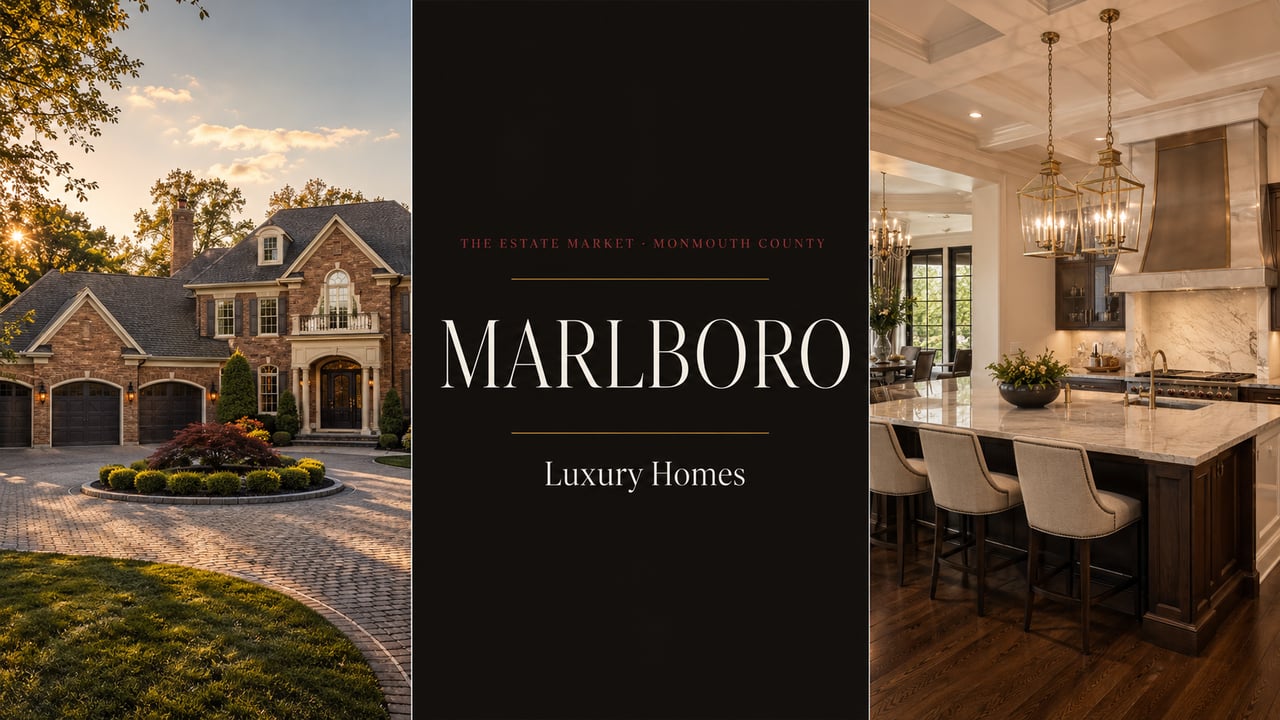
Marlboro's high end is one of the most misunderstood corners of the Monmouth County market. It isn't horse-country estate land and it doesn't pretend to be — it's four- and five-thousand-square-foot custom homes in established enclaves, feeding a top-tier school district, at a real discount to Colts Neck and Holmdel. Here's how the top of this market actually works, and who it's for.
Every luxury market sells something specific. Colts Neck sells land — ten-acre compounds, paddocks, orchards, horse country. Holmdel sells prestige and proximity. Marlboro sells the house: expansive custom colonials of four thousand square feet and up, in established enclaves like Lexington Estates and Pleasant Valley Estates, wrapped around one of the strongest K–8 districts in New Jersey — and priced meaningfully below both neighbors. That's the trade, stated plainly. You give up acreage and a certain zip-code cachet; you get more finished house, better schools per dollar, and a shorter drive to almost everything. For a New York move-up buyer, the math is stark: estate-scale living an hour from Manhattan at a number that buys considerably less in Westchester or on Long Island's North Shore. The top of this market is thin, slow-moving, and priced on craftsmanship rather than urgency — which rewards buyers who wait and sellers who prepare.
This is the dedicated guide to Marlboro's luxury tier — the segment above roughly $950,000, where the township's custom homes and estate enclaves live. For the full roster of neighborhoods and price bands, see the Marlboro neighborhoods and subdivisions guide; for township-wide numbers, the housing-market report.
The township and its estate enclaves from the air — our Above the Streets aerial tour of Marlboro.
Set expectations correctly and Marlboro's high end is easy to love. This is subdivision luxury: large custom and semi-custom colonials — commonly four thousand square feet and up, with four to five bedrooms, multiple full baths, finished basements, and three-car garages — sitting on comfortable but not vast lots inside planned enclaves. The flagship is Lexington Estates, built around 2005–2006 and so tightly held that only a couple of homes typically change hands in a year, with recent sales in the $1.3 to $1.375 million range. Around it sit Monmouth Heights, Georgetown Estates in Morganville, and the township's true estate pockets — Cannon Hill Farms, with custom homes on private cul-de-sacs, and Pleasant Valley Estates, where contemporary colonials occupy two-acre-plus parcels and floor plans stretch to five bedrooms and six baths.
What you will not generally find here is the ten-acre equestrian compound with a barn and paddocks. That product exists a few minutes away in Colts Neck, and if a working horse farm is the dream, that's the correct town — we'll tell you so. Marlboro's proposition is different and, for most families, more practical: maximum finished square footage, a genuinely excellent school district, and a location that keeps you close to Routes 9, 18, and 79 rather than down a long rural road. Luxury buyers who understand that distinction rarely leave disappointed.
Marlboro's luxury tier runs on a different clock than its family market. Where well-priced four-bedroom colonials trade in roughly three to four weeks, the high end is thin, patient, and selective. Inventory above a million is limited at any given moment, turnover in the best enclaves is genuinely low, and buyers at this level shop on craftsmanship, lot, layout, and address rather than racing a deadline. Recent activity shows real depth at the top: custom estates have traded past $2 million and as high as the $4-million-plus range, with the luxury segment averaging around $458 per square foot. The carrying cost deserves equal attention — property taxes in the premier enclaves commonly exceed $20,000 a year, so the honest affordability question is the monthly all-in number, not the purchase price alone.
The practical consequence cuts both ways. A buyer at this level should expect to wait for the right house rather than choose among six — and should be ready to act decisively when a tightly held enclave finally produces a listing. A seller can't rely on the frenzy that carries the mid-market; at the top, presentation, photography, and precise pricing do the work, because the pool of qualified buyers is small enough that each one matters.
These three townships are the inland Monmouth luxury triangle, and they compete for overlapping buyers — but they are not the same product. Colts Neck is horse country: roughly ten thousand people spread across thirty-two square miles of farms, orchards, and estates, where the luxury is the acreage, and the median sale sits near $1.4 million. Holmdel trades on prestige, wooded privacy, and its position closer to the bayshore and the corporate corridor. Marlboro is the denser, more convenient, family-forward option — and its premier homes are commonly described as comparable to Holmdel and to entry-level Colts Neck.
That comparability is the whole opportunity. A buyer choosing Marlboro at $1.2 or $1.3 million is typically getting more finished square footage and a stronger K–8 district than the same money commands in the neighboring townships — while accepting a smaller lot and less rural seclusion. Buyers who want the land and the horses should go to Colts Neck with our blessing. Buyers who want the house, the schools, and the convenience are being smart choosing Marlboro, and they tend to know it.
Source: public typical-home-value index data, 2026. Note this is a town-wide value index, not a median sale price — the two measures differ, and median sale prices run higher (Colts Neck's median sale is approximately $1.4M; Marlboro's is approximately $850K). Shown to compare relative price levels between towns, not to price an individual home. Marlboro's premier enclaves trade well above their town-wide baseline. Verify current comparables before relying.
If you're buying, the scarcity is the strategy. In an enclave that produces two sales a year, waiting for a listing to appear on a portal means you're already behind. Get your financing arranged in advance, name the specific enclaves you'd buy in, and have an agent watching those streets — including quiet, pre-market conversations with owners. Then do the unglamorous diligence properly: verify the exact school zone, pull the actual tax bill rather than an estimate, and evaluate the lot and the build quality with the same rigor you'd apply to the finishes. At this level you have negotiating room that the mid-market simply doesn't offer, so use the time.
If you're selling, a luxury home is a marketing problem, not a listing problem. The buyer pool is small, frequently comes from New York, and forms an opinion in the first ten seconds of a photograph. That means genuine preparation and staging, professional photography, cinematic video and aerial work that shows the property and the setting, and a price grounded in the handful of relevant comparables — not in what the neighbor hoped for. Mispricing at the top costs more than at any other level, because a stale luxury listing is very hard to reset. See current Marlboro homes for sale, or talk to us about what your estate would realistically bring today.
At this price point, pull the actual tax bill on the specific property before you get emotionally committed — not a portal estimate, not the township average. Premier Marlboro homes commonly carry bills north of $20,000, and on a $1.3 million purchase that's a meaningful share of your monthly cost. While you're at it, check whether the assessment looks out of step with recent comparable sales; an over-assessed estate home is both a negotiating point and, potentially, an appeal worth filing after closing. Very few buyers do this homework at the top of the market, and it's often worth thousands a year.
"When a family comes to me with a million-three and they're torn between Marlboro and Colts Neck, I ask one question: do you want the land or the house? If you want a barn and ten acres, I'll drive you to Colts Neck myself. But if what you actually want is five thousand square feet, a great school for your kids, and to be five minutes from everything — Marlboro gives you more house and a better district for the same check. There's no wrong answer, but there is a wrong assumption, and that's thinking these towns are interchangeable."
— Anthony Licciardello, Broker, The Prodigy Team
Luxury homes don't sell to whoever wanders by — they sell to a specific, often out-of-state buyer who has to be found and shown the property properly. I'm Anthony Licciardello, Broker of The Prodigy Team — a former Director of Community Affairs in the Bloomberg Administration and a member of the Staten Island Growth Management Task Force — and our entire content and marketing system exists to put New Jersey listings in front of the motivated New York families already searching for exactly this kind of move.
Our Above the Streets cinematic drone series is built for this segment — aerial storytelling that shows an estate and its setting the way a luxury buyer needs to see it, with audience performance exceeding industry benchmarks for real estate media.
Anthony Licciardello · Broker, The Prodigy Team · 718-873-7345
The luxury buyer pool is small and often out of state. We'll price it against the comparables that actually matter and market it with cinematic aerial production built for this segment.
How much do luxury homes cost in Marlboro, NJ?
Marlboro's premier tier generally runs from about $950,000 into the $1.5 million range, with custom estates trading past $2 million and recent sales recorded as high as the $4 million-plus range. The luxury segment has averaged roughly $458 per square foot. Flagship enclaves like Lexington Estates have seen recent sales around $1.3 to $1.375 million. Property taxes at this level commonly exceed $20,000 a year — verify the actual bill and current comparables for any specific home.
Where are Marlboro's luxury neighborhoods?
The flagship is Lexington Estates (custom colonials of roughly 4,000+ square feet, built around 2005–2006, tightly held). Other premier addresses include Monmouth Heights, Georgetown Estates in Morganville, Cannon Hill Farms (custom homes on private cul-de-sacs), and Pleasant Valley Estates (contemporary colonials on two-acre-plus lots). A broader family of "Estates" subdivisions fills out the upper bracket across the township.
Is Marlboro or Colts Neck better for a luxury home?
It depends on whether you want land or house. Colts Neck is horse country — large-lot estates and farms across a rural township, with a median sale price near $1.4 million. Marlboro offers subdivision luxury: large custom homes in established enclaves, a top-20% K–8 school district, and greater convenience to major routes, generally at a lower price for comparable square footage. If you want acreage, stables, and seclusion, choose Colts Neck; if you want maximum finished house and schools per dollar, Marlboro is usually the better value.
How long do luxury homes take to sell in Marlboro?
Longer than the general market. While well-priced family homes township-wide sell in roughly 22 to 27 days, the luxury tier is thin and slower-moving, with limited inventory and low turnover in the best enclaves — some produce only a couple of sales a year. Buyers should be financed and positioned in advance rather than waiting for listings to appear; sellers should invest in preparation, professional photography and video, and precise pricing, since a stale luxury listing is difficult to reset.
Moving to Marlboro — The Relocation Guide
Marlboro Neighborhoods & Subdivisions Guide
The Marlboro Housing Market — Prices & Trends
Marlboro Schools — District & Magnets Guide
Commuting from Marlboro to NYC — Buses, Trains & Park-and-Rides
55+ Living in Marlboro — Greenbriar & the Active-Adult Market
Marlboro NJ Homes for Sale
Luxury-market details per MLS-based and public real-estate data, 2025–2026, for Marlboro Township, Monmouth County, NJ. Premier tier approximately $950,000–$1.5 million typical, with custom estates trading past $2 million and recent sales recorded up to the $4 million-plus range; luxury segment average approximately $458 per square foot. Named enclaves: Lexington Estates (custom colonials ~4,000+ sq ft, built c. 2005–2006; recent sales ~$1.3M–$1.375M; typical turnover of roughly two homes per year; property taxes commonly $20,000+), Monmouth Heights, Georgetown Estates (Morganville, ~87 custom homes, early 2000s), Cannon Hill Farms, and Pleasant Valley Estates (contemporary colonials on 2-acre-plus lots). Comparison figures: town-wide typical home value indices approximately Colts Neck $1.08M, Holmdel $923K, Morganville $768K, Manalapan $688K, Freehold $517K — note these are value indices rather than median sale prices, which run higher (Colts Neck median sale ~$1.4M; Marlboro median sale ~$850K; Marlboro median days on market ~22–27). Colts Neck population 9,957 across 31.6 square miles. All figures are approximate, point-in-time, and vary by source and methodology; verify current comparables, the actual tax bill, and school-zone assignments for any specific property before relying. This post is general information, not financial, tax, or investment advice.
Prodigy Real Estate is an innovative real estate company offering high-end video production, home valuation services, purchasing, and home sales. Serving New York and New Jersey.