
Anthony Licciardello | June 2, 2026
Lavalette, NJ
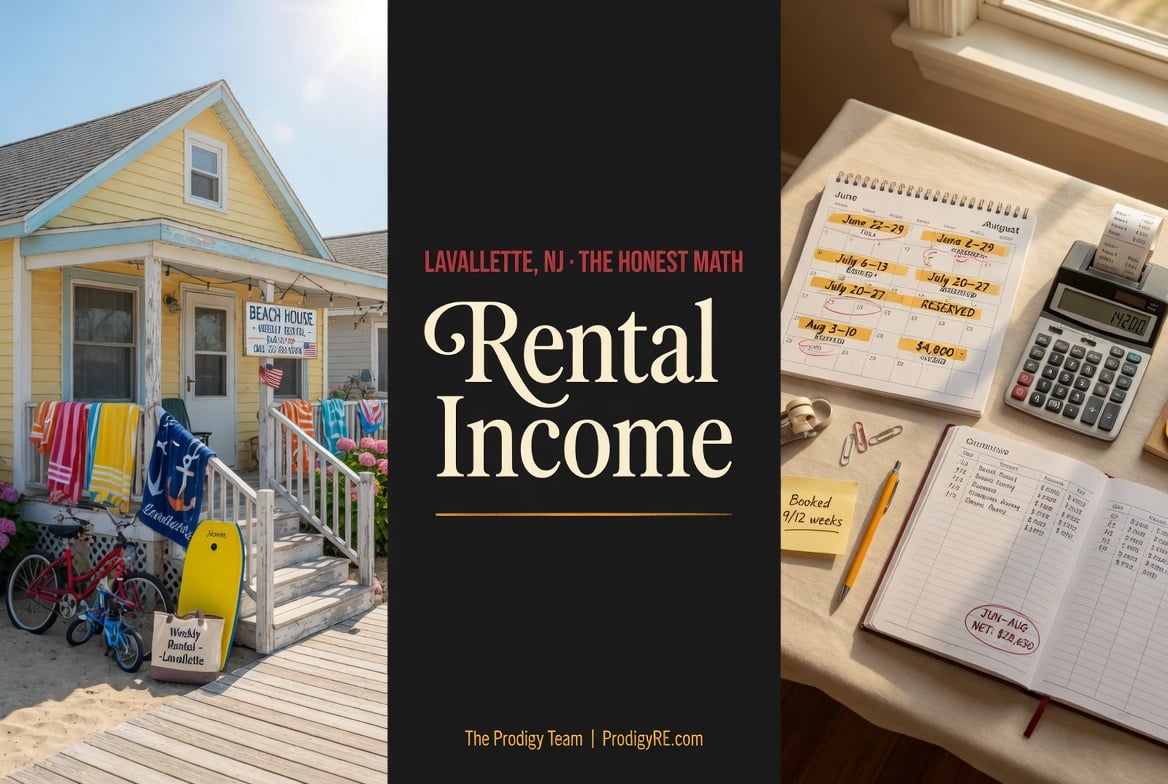
A summer rental can meaningfully offset the cost of a beach house — or quietly underdeliver against a fantasy spreadsheet. Here’s how to underwrite Lavallette rental income honestly.
Can you make money renting a Lavallette home in summer?
A well-located Lavallette home can earn meaningful summer rental income that offsets a large share of carrying costs — but it rarely turns a beach house into a pure profit center. The season is short (roughly 10–12 peak weeks), and net income is what’s left after flood and homeowners insurance, taxes, maintenance, utilities, and management. Underwrite on conservative, realistic assumptions, not the best week of the best summer.
For a large share of Lavallette buyers, the rental income isn’t a bonus — it’s part of how the purchase pencils out. Done right, summer rentals can carry a meaningful slice of the annual cost of owning a beach house. Done on optimistic assumptions, they lead buyers to overpay for a home that never produces what the back-of-the-envelope promised. The difference is entirely in the honesty of the math, and this guide is about getting that math right before you buy — not after.

The defining constraint of shore rental income is that it’s concentrated. The Jersey Shore rental season runs roughly from late June through Labor Day, with the highest rates in the peak mid-summer weeks — call it ten to twelve genuinely strong weeks, with shoulder weeks in June and September commanding less. That short window does the heavy lifting of the year’s income, which is why a single missed peak week matters far more than a quiet week in the off-season.
The traditional Lavallette rental model is weekly, often Saturday-to-Saturday, booked months ahead — many families return to the same house year after year. That loyalty is an asset: a home with established repeat renters carries a more predictable income stream than one starting cold. It also means the best weeks are the ones you, the owner, will be tempted to keep — and every prime week you block for your own use is income you’ve chosen to forgo.
The most common and most expensive mistake is mistaking gross rent for income. The headline “this house rents for X a week” is the top of a funnel with a lot of leakage before anything reaches your pocket. Here’s the full stack you subtract to get from gross seasonal rent to true net:
Illustrative categories only — not a quote. Actual figures vary widely by property; management fees in particular range roughly 10–25% of rent depending on service level. Build the model with real quotes for the specific home.
Notice that several of these costs — insurance, taxes, maintenance — you pay whether the home rents or not; rental income offsets them rather than being pure upside. The honest way to frame it for most Lavallette buyers: rental income is a powerful cost-reducer, not usually a standalone profit machine. That framing keeps you from overpaying for the house on the assumption it’ll pay for itself.
Beware the listing or seller who quotes a peak-week rate times the whole summer as “rental potential.” Real-world occupancy is never 100% of every week at peak rate — shoulder weeks rent for less, some weeks don’t book, and you’ll keep some for yourself. Discount optimistic projections hard, and ask for the home’s actual rental history if it has one.
Not all Lavallette homes rent equally. The factors that move the achievable weekly rate, roughly in order: proximity to the beach (the single biggest lever on the ocean side — renters filter for the walk to the sand), number of bedrooms and beds (more heads sleeping comfortably means a higher rate and a larger renter pool), outdoor space and amenities (decks, outdoor showers, parking, and for the bay side, a dock), and condition and presentation (an updated, well-photographed home books faster and higher).
Side of the island shapes the tenant, too. Ocean-side homes near the beach draw classic beach-vacation renters at premium rates; bay-side homes attract boating families who value dock access and can become especially loyal repeat tenants. Matching the home’s strengths to the right renter is how you maximize bookings — and it’s where professional marketing and photography earn their keep.
Two identical-on-paper homes can rent for very different numbers based on photos alone. Vacation renters book what they can see — bright, well-staged listing photos of a home a block from the beach will out-book a better house with dim phone snapshots every time. If income matters, presentation isn’t optional; it’s part of the asset.
Put it together into a buying decision with a simple, conservative process. One: estimate realistic gross seasonal rent from comparable rentals and, if available, the home’s actual booking history — not the seller’s best-case projection. Two: subtract the full expense stack above, using real quotes for flood and homeowners insurance on that specific property. Three: compare the resulting net income against your annual carrying cost to see how much of the nut the rentals actually cover.
Then stress-test it. What if you keep two prime weeks for yourself? What if one summer runs soft and bookings dip? What if insurance jumps at renewal? A purchase that only works on perfect assumptions is a fragile one; a purchase that still makes sense after you’ve haircut the income and bumped the costs is one you can own with confidence. The goal isn’t to talk yourself out of the beach house — it’s to buy it at a price the real numbers support.
Before you count on rental income, confirm the rules. Shore towns regulate rentals — registration or licensing, occupancy limits, parking, and the like — so check the Borough of Lavallette’s current requirements for short-term and seasonal rentals before assuming you can rent freely. New Jersey also applies transient-accommodation taxes to many short-term rentals, with specifics depending on how the rental is booked and managed; treat that as a real line item and a compliance step, not an afterthought.
On the income-tax side, how the property is classified — personal second home, mixed-use, or investment — affects what you can deduct and how rental income is taxed, and the rules for a home you also use personally are genuinely intricate. Loop in a tax professional before you buy, so the after-tax picture is part of the decision rather than a surprise the following April.
For the full ownership-cost picture, see the buying-a-shore-home playbook and the complete Lavallette real estate guide.
Will rental income cover my Lavallette mortgage?
Sometimes a meaningful portion, rarely the entire cost. With a short 10–12-week peak season and substantial expenses (insurance, taxes, maintenance, management), rental income usually works as a strong cost-reducer rather than fully covering a mortgage. Model it conservatively before relying on it.
What makes a Lavallette home rent for more?
Mostly proximity to the beach, then bedroom/bed count, outdoor space and amenities (decks, parking, a dock on the bay side), and condition and presentation. Bright, professional listing photos materially improve bookings and achievable rates.
What expenses come out of shore rental income?
Flood and homeowners insurance, property taxes, maintenance and repairs, management and cleaning/turnover (often roughly 10–25% of rent if professionally managed), utilities, and vacancy. Several of these you pay regardless of whether the home rents, so income offsets cost rather than being pure profit.
Are there rules or taxes on renting in Lavallette?
Yes. Shore municipalities typically regulate rentals (registration, occupancy, parking), and New Jersey applies transient-accommodation taxes to many short-term rentals. Confirm the Borough’s current rental requirements and consult a tax professional on classification and taxes before relying on rental income.
This article is informational and not financial, tax, or legal advice. Rental rates, occupancy, expenses, municipal rules, and tax treatment vary widely and change over time; all figures and categories here are illustrative, not quotes or projections. Confirm rental regulations with the Borough of Lavallette and consult qualified financial and tax professionals before making an investment decision.

Anthony Licciardello
Broker of The Prodigy Team and a licensed real estate broker in New Jersey and New York, serving Ocean County and the Jersey Shore. A former Director of Community Affairs in the Bloomberg Administration and member of the Staten Island Growth Management Task Force, Anthony helps shore investors underwrite rental income on honest numbers before they buy. 718-873-7345
Underwrite the income before you buy the house.
The Prodigy Team helps buyers model realistic Lavallette rental income against true carrying costs — and our marketing and buyer pipeline connect shore investors with the right income-producing homes.
Start the Conversation →Prodigy Real Estate is an innovative real estate company offering high-end video production, home valuation services, purchasing, and home sales. Serving New York and New Jersey.