
Anthony Licciardello | June 3, 2026
Lavalette, NJ
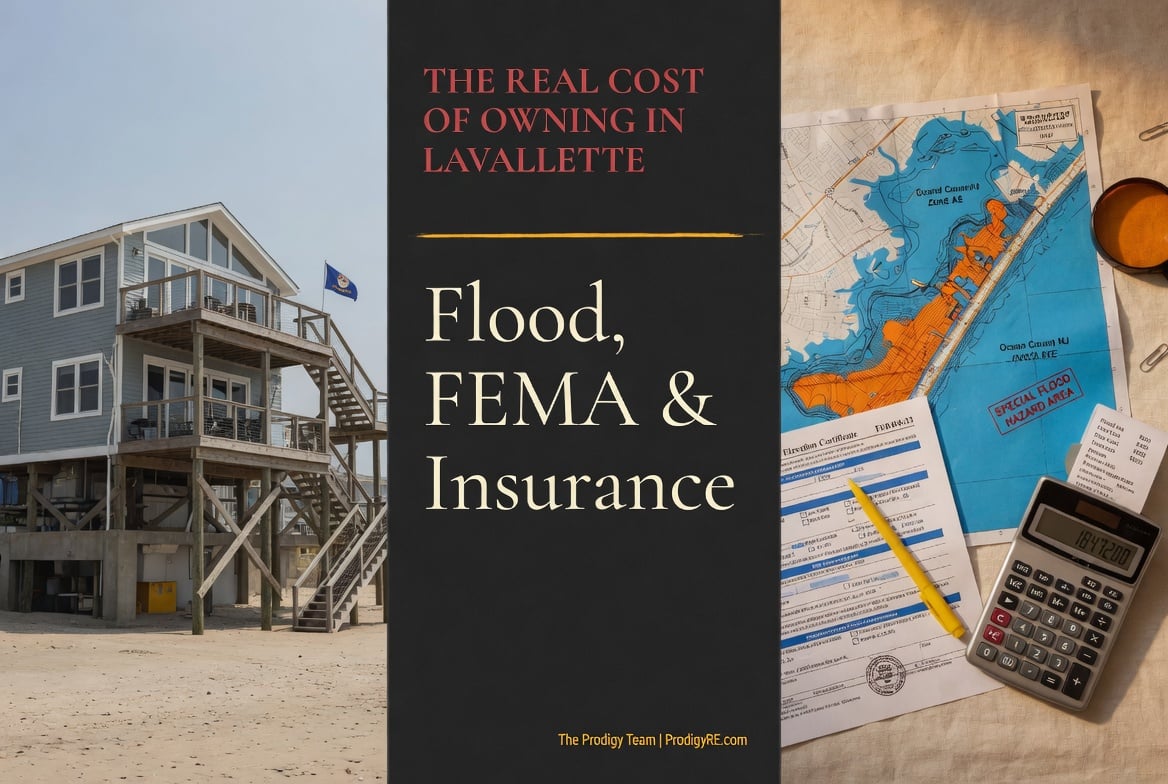
On a barrier island, flood insurance isn’t a line item — it’s a make-or-break part of the price. Here’s how flood zones, elevation, and FEMA rules actually drive what it costs to own in Lavallette.
Do you need flood insurance in Lavallette, NJ?
In practice, yes. Most of Lavallette lies in a FEMA Special Flood Hazard Area, where federally backed lenders require flood insurance. What it costs depends overwhelmingly on the home’s elevation relative to Base Flood Elevation (BFE) — under FEMA’s Risk Rating 2.0, each property is now priced on its own flood risk. Always pull the flood zone, the elevation certificate, and a current insurance quote before you buy.
The single biggest mistake inland buyers make at the shore is treating flood insurance as an afterthought — a box to check at closing. On a barrier island like Lavallette, it’s closer to a second mortgage payment, and the difference between an affordable home and an expensive one often has nothing to do with the asking price. Two houses on the same block, listed within a few thousand dollars of each other, can cost wildly different amounts to insure based on how high they sit. This guide explains why — and how to read the risk before you buy.

FEMA maps every property into a flood zone, and on Lavallette nearly all of the island sits within a Special Flood Hazard Area — the high-risk zones where flood insurance is federally mandated for mortgaged homes. The two families of zones you’ll encounter here are V/VE zones and A/AE zones.
V/VE (Velocity) zones are the most hazardous — coastal areas exposed to wave action during a storm, typically the oceanfront and immediate ocean blocks. They carry the strictest building standards and the highest insurance costs. A/AE zones cover most of the rest of the island, ocean and bay; still high-risk and still requiring insurance, but without the wave-velocity exposure of V zones. The AE designation comes with a published Base Flood Elevation — the number everything else hinges on.
A property’s flood zone is specific to that parcel — you cannot assume a home shares its neighbor’s zone or BFE. Pull the actual FEMA map designation and the elevation certificate for the exact address. The Borough’s flood plain manager and FEMA’s Region 2 coastal tools can confirm a property’s Base Flood Elevation before you write an offer.
If there is one concept to carry away from this guide, it’s this: in a flood zone, your insurance cost is driven less by the zone itself than by how high your home’s lowest floor sits relative to the Base Flood Elevation. Build or buy above BFE and you pay dramatically less; sit below it and the premiums climb fast. This is why so many Lavallette homes — especially those rebuilt after Superstorm Sandy — now stand on pilings, lifting living space above the flood line.
There’s a hard local cliff worth knowing. Lavallette participates in FEMA’s Community Rating System, which earns residents a community-wide discount on NFIP premiums. But under a long-standing FEMA policy, a building whose lowest floor sits one foot or more below Base Flood Elevation loses that CRS discount entirely — the declaration page shows a zero. A home a foot too low doesn’t just cost more to insure on its own merits; it forfeits the town’s discount on top of that.
What is Base Flood Elevation and why does it matter?
Base Flood Elevation (BFE) is the height floodwaters are expected to reach in a base (1%-annual-chance) flood. Your flood insurance cost depends heavily on how your home’s lowest floor compares to BFE — above it is far cheaper; a foot or more below it can even forfeit Lavallette’s Community Rating System discount. An elevation certificate documents exactly where your home sits.
As of FEMA’s Risk Rating 2.0 — the pricing overhaul fully in effect since 2022 — flood premiums are calculated on each property’s individual flood risk rather than a one-size-fits-all zone rate. The factors that move your number include the home’s elevation relative to BFE, its distance from the water, the flood types it’s exposed to, and the cost to rebuild it. Two practical consequences follow.
First, a second home is priced differently from a primary residence, and increases on certain property types can run higher year to year under the federal rules — relevant since most Lavallette homes are second homes. Second, mitigation pays: elevating the structure, elevating machinery and equipment above the lowest floor, and adding flood vents below BFE can all lower the premium. The CRS community discount (which ranges from 5% to 45% depending on a town’s class, applied in 5% increments) layers on top — provided the home isn’t sitting below BFE and forfeiting it.
I’ve seen two listings on the same street where the insurance gap rewrote the whole comparison — the “cheaper” older home sat low and cost a multiple of the elevated newer one to insure, erasing the price difference and then some. The single most useful thing a shore buyer can do is get a real flood quote on a specific home before falling for it. It’s a phone call that can save tens of thousands over the years you own.
This rule catches buyers planning to renovate an older, lower home. Under the NFIP, if the cost of reconstruction, rehabilitation, an addition, or other improvements equals or exceeds 50% of the building’s market value, the building must be brought up to current-construction standards — which on this island means elevating it to or above the current BFE. The same requirement applies to any home declared substantially damaged, the mechanism that forced so much elevation after Sandy.
The practical reading: if you buy a low, older home intending a major renovation, budget for the strong possibility that you’ll have to elevate the entire structure — a significant cost that can change the math of the whole purchase. It’s also why so much of Lavallette’s post-Sandy stock is now newly built on pilings: rebuilding to code and lifting above the flood line was, for many owners, the path the rules required.
A companion piece covers elevation, rebuilding, and new construction on the island in depth.
Before you commit to any Lavallette home, get these in hand:
The flood zone and FEMA map designation for the exact parcel — V/VE vs A/AE matters. The elevation certificate, showing the lowest floor relative to BFE; if one doesn’t exist, factor in getting one. A current flood insurance quote for that specific property, not a town average — this is the number that belongs in your monthly budget.
Then, if you intend to renovate: the home’s market value vs. your planned improvement budget, to test the 50% rule, and a conversation with the Borough’s construction office about current elevation requirements. None of this is difficult to obtain — and skipping it is exactly how a dream beach house becomes an annual financial surprise.
For how flood risk differs by side of the island, see the ocean-vs-bay guide; for the full market picture, the complete Lavallette real estate guide.
Is flood insurance required in Lavallette?
For mortgaged homes in a FEMA Special Flood Hazard Area — which covers most of Lavallette — federally backed lenders require flood insurance. Even where not strictly required, on a barrier island it’s strongly advisable. Confirm the specific property’s zone before assuming either way.
What makes flood insurance cheaper or more expensive here?
Mainly elevation relative to Base Flood Elevation, plus distance from water, flood type, and rebuilding cost under Risk Rating 2.0. Elevated homes pay far less; homes sitting below BFE pay more and can lose Lavallette’s Community Rating System discount. Mitigation like elevation and flood vents lowers premiums.
What’s the difference between a V zone and an A zone?
V/VE zones are coastal high-hazard areas exposed to wave action — typically the oceanfront — with the strictest building rules and highest premiums. A/AE zones are high-risk but without wave velocity, covering most of the island. AE zones have a published Base Flood Elevation.
If I renovate an older Lavallette home, will I have to elevate it?
Possibly. If improvements reach or exceed 50% of the building’s market value — or the home is deemed substantially damaged — NFIP rules require bringing it up to current standards, which on this island generally means elevating to or above Base Flood Elevation. Budget for that possibility before buying a low, older home to renovate.
This article is informational and not insurance, legal, or engineering advice. Flood zones, Base Flood Elevations, FEMA rules, and CRS discounts are property-specific and change over time. Confirm any home’s flood zone and elevation certificate with FEMA and the Borough of Lavallette flood plain manager, and obtain a current quote from a licensed insurance professional before relying on these figures.

Anthony Licciardello
Broker of The Prodigy Team and a licensed real estate broker in New Jersey and New York, serving Ocean County and the Jersey Shore. A former Director of Community Affairs in the Bloomberg Administration and member of the Staten Island Growth Management Task Force, Anthony brings a risk-aware, data-first approach to the true cost of owning a shore home. 718-873-7345
Price the flood line in before you fall for the view.
The Prodigy Team reads flood zone, elevation, and insurance into every Lavallette valuation — and our buyer pipeline helps shore buyers budget for the real cost of ownership, not just the asking price.
Get Your Shore Home Valuation →Prodigy Real Estate is an innovative real estate company offering high-end video production, home valuation services, purchasing, and home sales. Serving New York and New Jersey.