
Anthony Licciardello | June 10, 2026
Hoboken, NJ
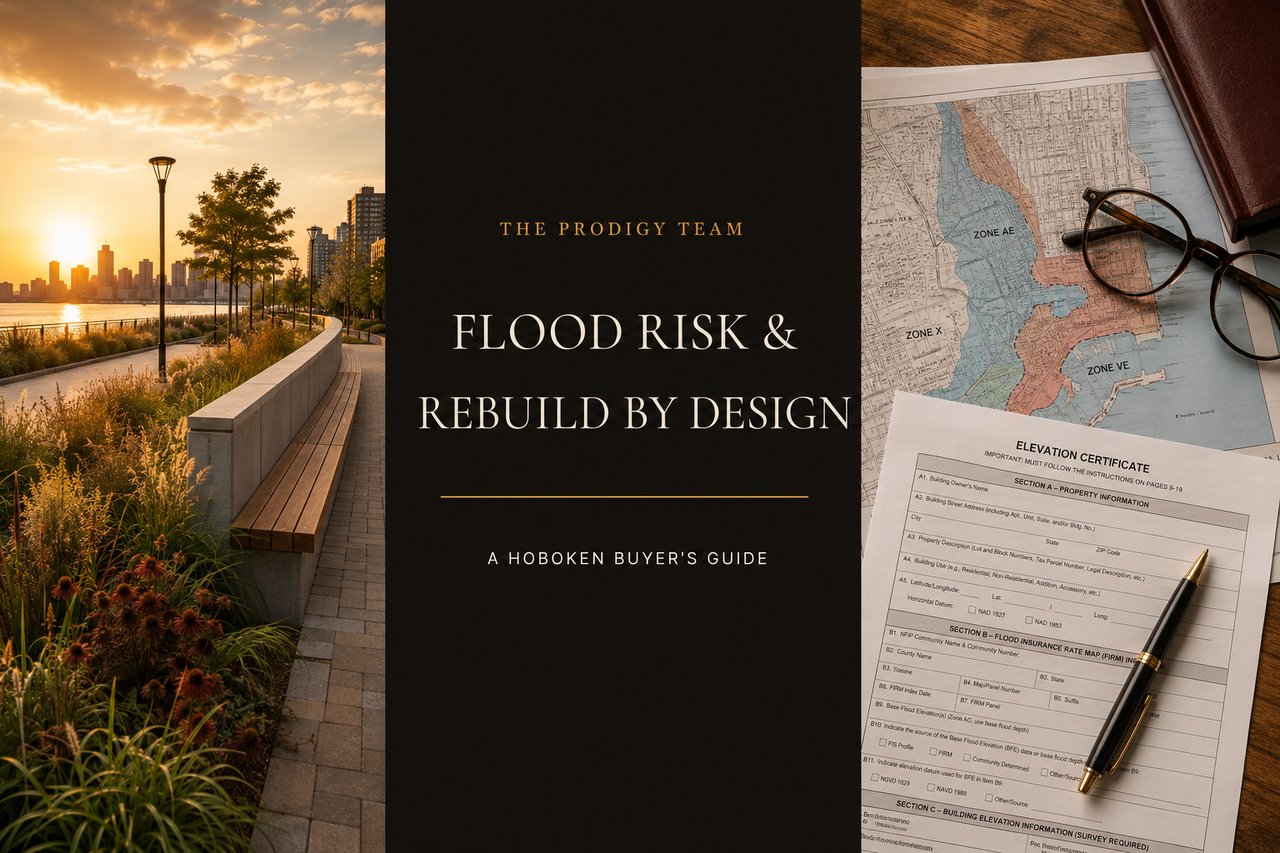
No single factor will reshape Hoboken real estate over the next few years more than flood protection. Roughly two-thirds of the Mile Square City sits in the FEMA 100-year flood zone, and Superstorm Sandy famously drowned the city in 2012. But a $230 million flood-protection system is now nearing completion that, by the City's own projection, would remove about 80% of Hoboken from the FEMA-designated flood plain and significantly lower flood-insurance costs for residents. For a buyer, that means a building's flood status — and where it sits relative to the new protection — can swing the true cost of ownership by thousands of dollars a year. This is the guide to understanding it.
This guide is part of our complete coverage of the city. For the full picture, start at our complete guide to buying and selling in Hoboken.
Hoboken's flooding is a matter of geography. It is a low-elevation, intensely developed city — roughly 94% of its surface is paved or built over — sitting right on the Hudson, which leaves it exposed to a dual threat: storm surge pushing in from the river, and heavy rainfall that overwhelms the drainage system, sometimes at the same time. During Sandy, surge breached the shoreline at two points, Hoboken Cove to the north and the Long Slip Canal to the south, and more than 500 million gallons of water poured into the city. Today the most common FEMA flood-zone designations in Hoboken are AE, AO, and X, and which one applies to a specific address has a direct effect on insurance requirements and cost. Low-lying southern and western blocks have historically borne the brunt.
From the Broker
“Flood zone is not a city-wide answer in Hoboken — it's an address-by-address one, and it's about to change for a lot of buildings. The buyers who win here are the ones who check the specific zone, the elevation, and the insurance bill before they fall for a place, not after.”
Anthony Licciardello, Broker, The Prodigy Team
Out of the federal Rebuild by Design competition that followed Sandy came the Rebuild by Design Hudson River project — a $230 million flood-protection system funded by the U.S. Department of Housing and Urban Development for Hoboken, Weehawken, and Jersey City, with additional state and federal money since. Its strategy has four parts: Resist storm surge with flood walls and deployable gates that connect existing high ground at the city's northern and southern breach points; and Delay, Store, and Discharge rainfall through green infrastructure, stormwater parks, and pumps led by the City. The Resist structures are being woven into the streetscape as seating, planters, public art, and parks — at Harborside Park, a sliding floodgate sits hidden in plain sight until a storm calls for it. Construction has continued through 2026 across southern and central Hoboken. When complete, the City projects the system will remove roughly 80% of Hoboken from the FEMA flood plain.
Here is where it gets practical. Most flood coverage comes through FEMA's National Flood Insurance Program, and if a home sits in a Special Flood Hazard Area (the A and V zones) and carries a federally backed mortgage, flood insurance is generally mandatory. Under FEMA's current Risk Rating 2.0 methodology, premiums are priced on a property's specific characteristics — elevation, distance to water, replacement cost — not the zone alone. A private flood-insurance market also exists as an alternative to the NFIP.
The Rebuild by Design project is projected to lower flood-insurance costs for much of the city — but the timing and mechanics matter, and it's important not to assume an instant windfall. Moving properties out of the mapped flood plain depends on FEMA reviewing and accrediting the completed protection system and then issuing revised flood maps, a process that follows construction rather than coinciding with it. Even then, property-specific pricing under Risk Rating 2.0 means two homes in the same area can pay very differently. The honest takeaway: the direction is strongly positive, the magnitude is meaningful, but the exact effect on any one building's premium should be confirmed, not assumed.
This is general information, not insurance, legal, or financial advice. Flood-zone designations, FEMA map revisions, and insurance pricing are determined by FEMA, insurers, and other authorities and can change; confirm a specific property's flood zone with FEMA and current premiums with a licensed insurance professional.
Before making an offer on any Hoboken home, run down the flood picture for that specific property:
Flood cost is also tied to the building behind the unit, so pair this with our guide to buying a condo or co-op in Hoboken, and remember that flood exposure runs highest on the lower-lying blocks — including parts of Downtown near the Terminal and the historically lower western reaches covered in the Midtown and West Side guide.

Worried about flood risk and insurance? Get the real numbers first.
Flood status is one of the most misunderstood parts of buying in Hoboken — and one of the most consequential for cost. The Prodigy Team helps buyers, including the many New Yorkers and Staten Islanders crossing the Hudson, get the actual flood zone, insurance figures, and Rebuild by Design context for a specific building before they commit — and helps sellers tell the right story when their block is newly protected.
Anthony Licciardello, Broker, The Prodigy Team · 718-873-7345
See What Your Hoboken Home Is Worth
Historically, yes — roughly two-thirds of Hoboken lies in the FEMA 100-year flood zone, and Superstorm Sandy inundated the city in 2012. However, the Rebuild by Design Hudson River flood-protection project is projected to remove about 80% of the city from the FEMA flood plain once complete, materially reducing the risk for protected areas.
It is a $230 million, HUD-funded flood-protection system for Hoboken, Weehawken, and Jersey City that uses a Resist, Delay, Store, and Discharge strategy — flood walls and deployable gates plus green infrastructure and stormwater parks. The City projects it will remove roughly 80% of Hoboken from the FEMA flood plain when complete.
The project is projected to reduce flood-insurance costs significantly for much of the city, but reductions are not automatic. They depend on FEMA accrediting the completed system and issuing revised flood maps, and premiums under Risk Rating 2.0 are priced by property-specific factors. Confirm any specific building's outlook with a licensed insurance professional.
Check the address's FEMA flood zone, whether an elevation certificate exists, the building's flood and claim history, the current insurance premium in writing, the property's position relative to the new protection, and — for condos — whether the master policy includes flood coverage and its deductible.
Prodigy Real Estate is an innovative real estate company offering high-end video production, home valuation services, purchasing, and home sales. Serving New York and New Jersey.